 BURST
BURST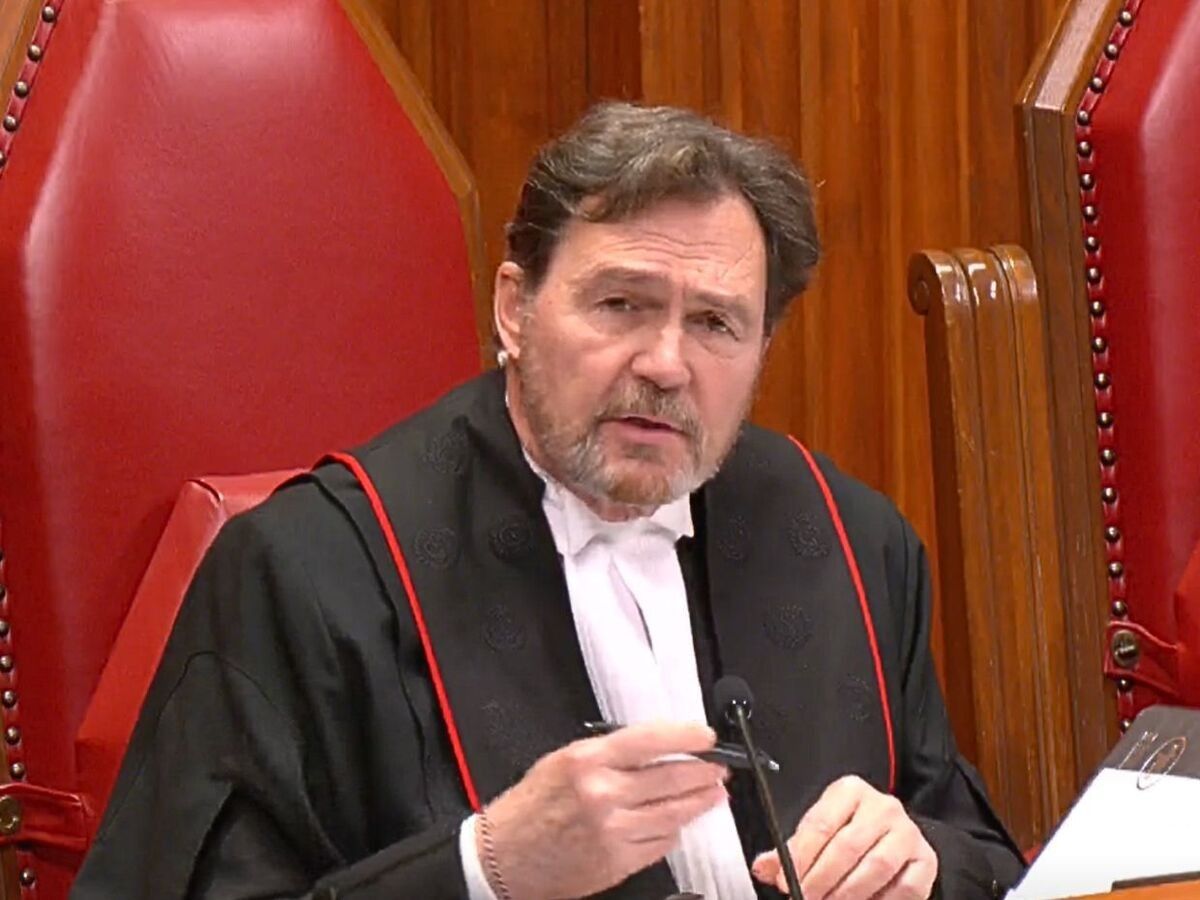
OTTAWA — Chief Justice Richard Wagner denied a request to recuse himself from the Emergencies Act case Wednesday, saying his 2022 comments about the Freedom Convoy protests have nothing to do with the issues on appeal.
In a letter to parties on Wednesday, Supreme Court of Canada registrar Chantal Carbonneau said Wagner believed there was no legal reason for him to step aside from the case, which the top court is currently considering if it should hear.
The decision is in response to a request in March from Canadian Frontline Nurses (CFN) and one of its members, Kristen Nagle, arguing that past comments by the chief justice regarding the 2022 Freedom Convoy protests “could lead to an apprehension of bias.”
“I am writing to advise that Chief Justice Wagner has considered the certificates and letter, and has concluded that there is no actual or reasonable apprehension of bias that would require his recusal under the applicable legal test,” Carbonneau responded to parties.
“In this respect, Chief Justice Wagner has advised that he did not, at any time, either directly or indirectly, comment on the Emergencies Act, RSC 1985, c 22 (4th Supp) or matters at issue in the proceedings,” she added.
In March, the federal government filed its application for leave to appeal to the top court in the hopes of overturning two earlier decisions that ruled the use of the exceptional powers in the act was unjustified as a way to stop the Freedom Convoy protests.
Shortly after, the CFN filed its request for Wagner to consider recusing himself from the case. The CFN and Nagel are involved in a separate but related application for leave to appeal to the Court, and Wagner’s decision on recusal stands for both cases related to the invocation of the Emergencies Act.
At issue for the CFN were two sets of 2022 comments in which Wagner called the Freedom Convoy protest the “start of anarchy” and said participants took Ottawa residents “hostage,” according to submissions by CFN and Nagle.
In an April 2022 interview with Montreal-based newspaper Le Devoir , Wagner said in French that some participants in the Freedom Convoy protests were “remote-controlled” people looking to short-circuit the political system, something that “does not fill me with good feelings.”
“What we saw recently on Wellington Street, here, is the budding start of anarchy where some people decided to take other citizens hostage, to take the law into their own hands, to disregard the system … I find that worrying,” he said in French.
Canada’s top judge also argued that the occupation of downtown Ottawa was fuelled in part by a “certain ignorance” and a “bad understanding” of Canadian law, the newspaper reported.
Then in a press conference in June 2022, the chief justice described the impact of the Freedom Convoy’s blockades on many Ottawa business and individuals — particularly “the most vulnerable” — as “deplorable.”
Those comments led CFN and Nagle to write the court arguing it would be “inappropriate” for Wagner to participate in any appeal process involving the government’s use of the act during 2022 Freedom Convoy blockades.
“The comments referenced above could reasonably be perceived as expressing negative bias against the protesters and may undermine public confidence in judicial impartiality,” reads a March 23 letter.
“Accordingly, it is respectfully submitted that it would be inappropriate for Justice Wagner to take part in the adjudication of the proceedings related to this case.”
In refusing to recuse himself from the case, Wagner also denied an earlier request by CFN and Nagle to allow all parties to the Emergencies Act appeal to make submissions on if he should sit on the panel of nine judges or not.
Alexander Boissonneau-Lehner, who represents the CFN and Nagel, told National Post it would be inappropriate to comment on Wagner’s decision while the case is in front of the court.
“We had hoped for a process from the court inviting submissions not only from us but also from other parties,” he noted.
Wagner’s decision contrasts with that of his colleague Justice Mahmud Jamal in 2024, who allowed parties to make submissions on if he should sit on the appeal of Quebec’s controversial secularism bill, also known as Bill 21.
Though he initially declined to recuse himself, Jamal ultimately stepped aside from the case after hearing submissions. He told parties at the time there was “no legal basis for his recusal” but was doing to “avoid his participation becoming a distraction.”
Wagner’s comments on the Freedom Convoy have tailed him for years, with a group of Freedom Convoy supporters filing a complaint to Canadian Judicial Council (CJC) — on which Wagner presides — in May 2022 also arguing that the interview in Le Devoir raised concerns about bias.
The complaint was dismissed two months later, partly due to the fact that a case involving the invocation of the Emergencies Act was not in front of the Supreme Court at the time, making the issue hypothetical.
“A subjective appreciation of impartiality on a hypothetical matter that is rooted in unsupported claims related to comments attributed in a news article does not meet the threshold of the reasonable apprehension of bias test,” CJC acting Executive Director Jacqueline Corado wrote at the time.
National Post
cnardi@postmedia.com
Our website is the place for the latest breaking news, exclusive scoops, longreads and provocative commentary. Please bookmark nationalpost.com and sign up for our politics newsletter, First Reading, here.