 BURST
BURST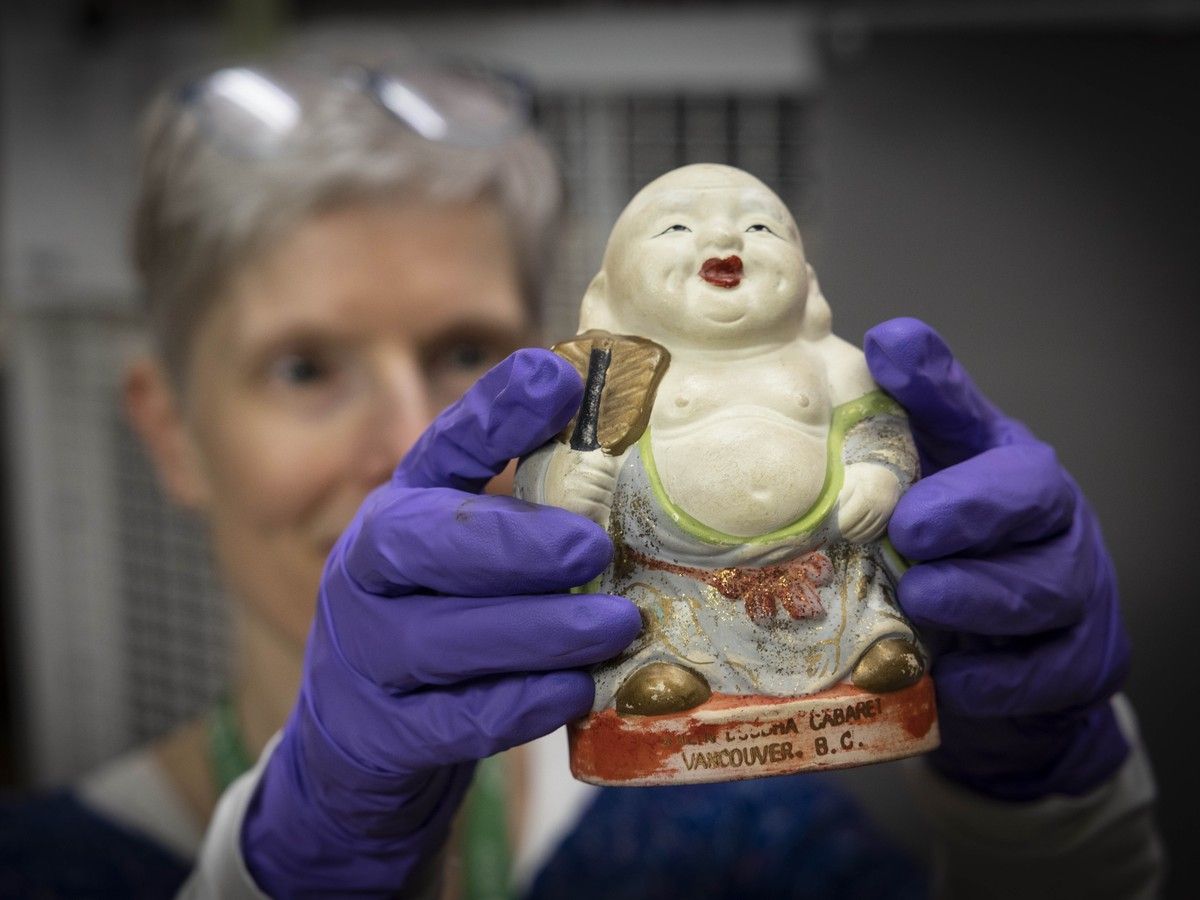
The Smilin’ Buddha Cabaret has been closed for decades, but its legend lives on. In the 1960s, it was a rhythm and blues hotspot where a teenage Jimi Hendrix supposedly played. In the 1970s and ‘80s it was Vancouver’s premier punk rock venue.
Even people who never went inside knew its elaborate neon sign, an orange neon buddha with a bulging belly that bursts out of a green neon robe. The jolly figure reclines on blue neon that reads Smilin’ Buddha and red neon that reads Cabaret.
It was so iconic that rockers 54-40 bought it and took it on tour. The band then donated it to the Museum of Vancouver, where it is the star of the museum’s extensive collection of neon signs.

Now the museum has a companion piece for the Buddha neon — a Smilin’ Buddha piggy bank.
The ceramic piece features a tubby buddha with a fan atop a red plinth that has the club’s name. On the back is the club’s address, 109 East Hastings, and the invitation to “dine and dance.”
That it still exists defies belief. It was probably made as a cheap souvenir after Albert Kwan opened the club in 1952 as a venue where you could eat Chinese food and then dance to the Smilin’ Buddha Orchestra.
KC Stogran bought the piggy bank as a child around 1973 at a swap meet at the Delta Drive-In in Richmond. He didn’t know what the Smilin’ Buddha was, he just liked the piggy bank.
“I paid about 50 cents for it,” he recalls. “I collected Chinese memorabilia.”
The Buddha became infamous in the punk era — Strogan’s high school band Flexhauser (“there’s two little dots over the U”) almost played there. When he recently decided to downsize, he emailed Wendy Nichols at the museum to see if it wanted it.
Why yes, they did. But there was a hitch: Stogran lives in Lakefield, Ont., near Peterborough. He was coming to Vancouver to scatter his brother’s ashes, so he brought it west and Nichols went to his hotel to pick up the artifact.
This week, the Smilin’ Buddha piggy bank was being catalogued alongside several new donations to the museum’s collection of approximately 80,000 items. The collection includes a bit of everything, from carvings by the great Haida artist Charles Edenshaw to ephemera such as a tiny cap for the 1939 Royal Visit.

Nichols is the curator of collections at the museum, which is beside the H.R. MacMillan Space Centre at 1100 Chestnut St. in Vanier Park.
“I get calls or emails every single day (about possible donations),” said Nichols. “The best part of my job is seeing what turns up.”
There are a pair of recent additions to the neon collection, including a “Ladies” sign for the Royal Hotel on Granville Street that dates to an era when men and women had to enter a beer parlour by separate entrances. A neon crown hovers above Ladies.
It was donated by Ian Thom, a retired curator at the Vancouver Art Gallery. Thom also donated a neon sign for Hazelwood ice cream that is shaped like an ice cream carton, with ice cream coming out the top.
The most colourful new addition, though, is a “B.C. tartan” coat that belonged to the late Bruce Eriksen, the fiery anti-poverty activist who co-founded the Downtown Eastside Residents Association and was a longtime Vancouver city councillor.
Eriksen was on the board of the Pacific National Exhibition, which gave the tartan coats to its directors. It was donated by his son Leif, and came covered in PNE buttons.
Some recent donations speak to controversial events.
Canada banned immigration from China between 1923 and 1947, and made Chinese-Canadians who were already here register with the Canadian Immigration Service’s Department of Immigration and Colonization.
The museum now has the registration card for a young boy named Barry Chin. It was issued June 20, 1924, and signed by the “Controller of Chinese Immigration.”
The recent donations also include several postcards sent by Japanese-Canadians who were interned in camps during the Second World War.

The most unusual item is a “bracket fungus” from a fir tree from the Sieburth family, which is covered in signatures in the 1930s and ’40s.
“The story goes that John (Sieburth) needed to use the washroom,” said Nichols. “He went off behind a tree, found this (fungus), and his father removed it from the tree. Then the family used it as a guest book, all their friends would sign it. There are signatures from Chief Khatsahlano, Mary Lipsett and Phillip Timms.”
Kitsilano is named after Chief Khatsahlano. Lipsett and her husband Edward were prominent collectors of Indigenous art who once had a museum of native art and artifacts at Hastings Park. Timms was the top photographer in early Vancouver.
It’s a unique slice of Vancouver history, and now it has found the perfect home at the Museum of Vancouver.


