 BURST
BURST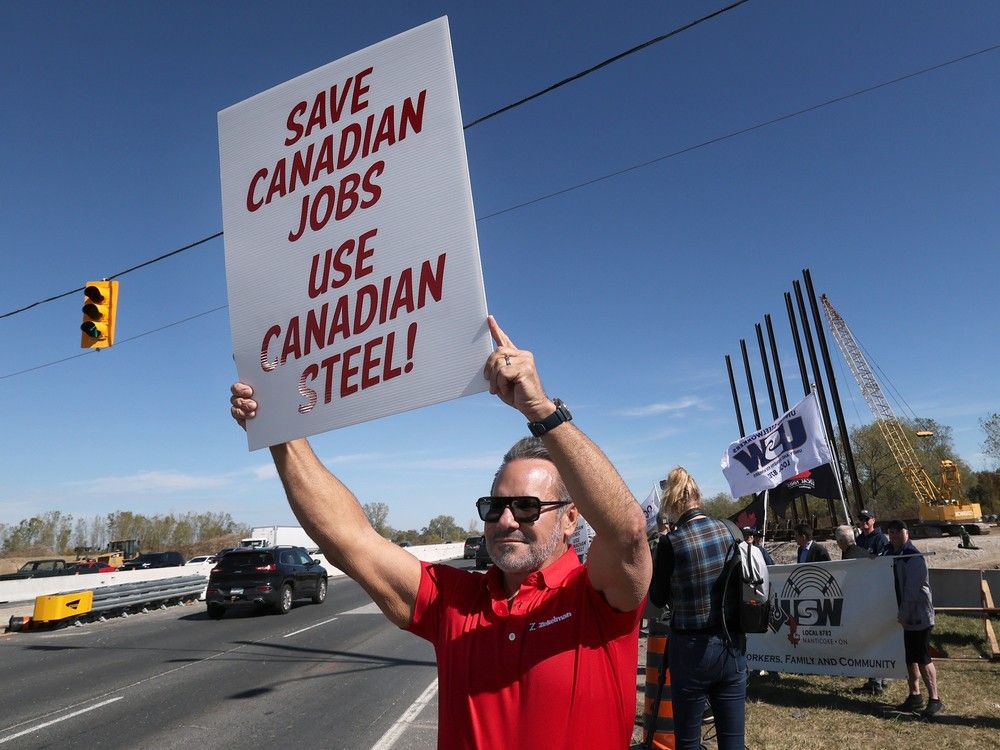
Government “Buy Canadian” policies favouring domestically produced material for public infrastructure would put B.C. projects in a bind when it comes to steel due to the added cost and lack of availability for key products, according to industry insiders.
Canadian steel, aluminum and wood products are at the centre of Canada’s tariff war with the U.S., and Prime Minister Mark Carney’s recent budget includes efforts to prioritize domestically produced materials for federally supported procurement.
On the West Coast, however, it can be more expensive for construction companies to ship Canadian steel from Central Canada than it is to import material by sea, which puts added cost pressure on public projects already subject to soaring budgets, according to economist Jock Finlayson.
Buying domestic materials “is something we want to be considering,” but when it comes to steel, “to the extent we put tariffs on steel imports to protect a handful of steel mills in Ontario, in my view, we’re shooting ourselves in the foot,” said Finlayson, the chief economist for the Independent Contractors and Business Association.
“We effectively don’t manufacture steel in this region,” he added. “So we are totally dependent on bringing it in from other markets, whether that’s Ontario, whether it’s offshore, whether it’s the United States.”
To Windsor-based steel tycoon Barry Zekelman, that view comes “at the expense of Canadian workers and Canadian tax dollars,” he said in a news release.
His company has launched a “name and shame” campaign to shine a light on government-supported construction projects using imported steel, including three in B.C.
Zekelman, CEO of Zekelman Industries, is upfront about the effort being a “snitch line.” A form on his company’s Canadian website calls on people to report on Canadian, government-supported construction projects using foreign steel, promising $1,000 rewards in exchange for credible reports.
Zekelman told the Windsor Star that he was part of a behind-the-scenes lobbying effort to push Carney on his “Buy Canadian” policy, but moved to this more public offensive to shame governments into doing “the right thing for our country.”
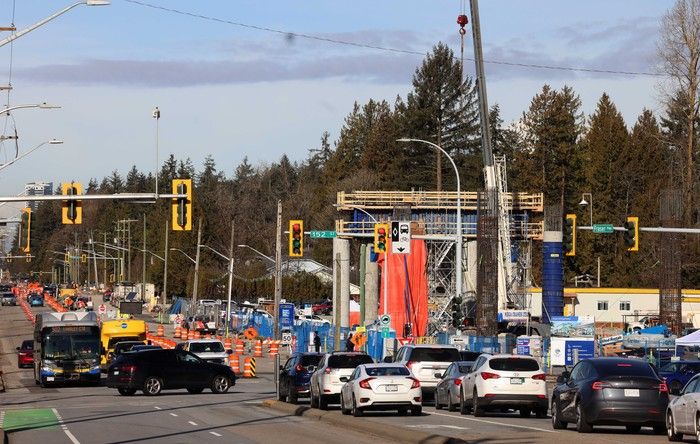
On Monday, Zekelman Industries said it had paid out $10,000 in rewards after just two weeks, which singled out the $137.5 million PNE Amphitheatre project being built for the City of Vancouver, the province’s $1.64 billion Pattullo Bridge replacement, and the $6 billion Surrey-to-Langley SkyTrain extension.
The City of Vancouver has adopted a motion that includes a “Buy Local” imperative and city staff are continuing to review measures the municipality can take in response to tariffs, according to Alexander Ralph, Vancouver’s chief procurement officer.
However, with respect to the PNE Amphitheatre, Ralph said procurement was up to their prime contractor, EllisDon, which tendered and awarded the subcontract for structural steel in 2024. That predated the Canada-U. S. tariff dispute.
“The city’s procurement resulted in an agreement with EllisDon to construct the amphitheatre, including the supply of all labour and materials,” Ralph said in a written statement in response to Postmedia questions.
“In terms of the procurement of materials, the city does not have input in EllisDon’s process except for holding EllisDon accountable to the city’s supplier code of conduct and ethical procurement policy, as well as the expectation of best value from (the company’s) material or subtrade procurements,” Ralph said.
Officials from the provincial ministry of transportation, which is responsible for the Transportation Investment Corp. that is overseeing both the Pattullo Bridge replacement and SkyTrain extension, did not respond to Postmedia questions by deadline.
However, the CEO of a major supplier of concrete reinforcing steel for the Pattullo replacement project called Zekelman’s campaign “misguided,” considering the unavailability of Canadian-made material on the West Coast.
“I don’t think he has the knowledge when it comes to the reinforcing steel industry,” said Ron McNeil, CEO of Surrey-headquartered LMS Reinforcing Steel Group.
McNeil said reinforcing steel, the rebar used to give structure to concrete construction, is difficult to source at competitive prices from Central Canada mills that make it, and supplies are inconsistent.
On top of that, McNeil said it costs about $200 per tonne to ship Canadian steel by rail, versus a quarter of that to bring it in from Asia by sea.
“The cheapest highway we have is the Pacific Ocean,” McNeil said.
LMS is currently sourcing reinforcing steel from eastern Europe, South America and some Asian markets, although not heavily tariffed China.
And in McNeil’s view, a “Buy Canadian” requirement for his part of the industry “would be an absolute failure, both on price increases and access to steel.”
Even on other structural steel, Canada needs to do more to build up its manufacturing capacity to make “Buy Canadian” more viable, according to Chris Atchison, CEO of the B.C. Construction Association.
“Domestic output does not come anywhere close to covering the full spectrum of construction-grade products,” Atchison said. “Key items like wide-flange beams, structural sections and some fabricated components are not produced sufficiently (in Canada).”