 BURST
Free soloing has been called many things: foolhardy, deadly, a life wish, a misnomer, an art form, a dangerous game. But for all its history of taking lives, it’s rarely been the cause of saving one. In a thoughtful essay about free soloing published in January, longtime Colorado climber Jim Erickson urged free soloists to channel their courage toward search and rescue operations. “Every single free solo climber possesses the freedom to choose their danger,” he wrote. “The true heroes in life selflessly risk, and sometimes relinquish, their own lives to help other human beings.”
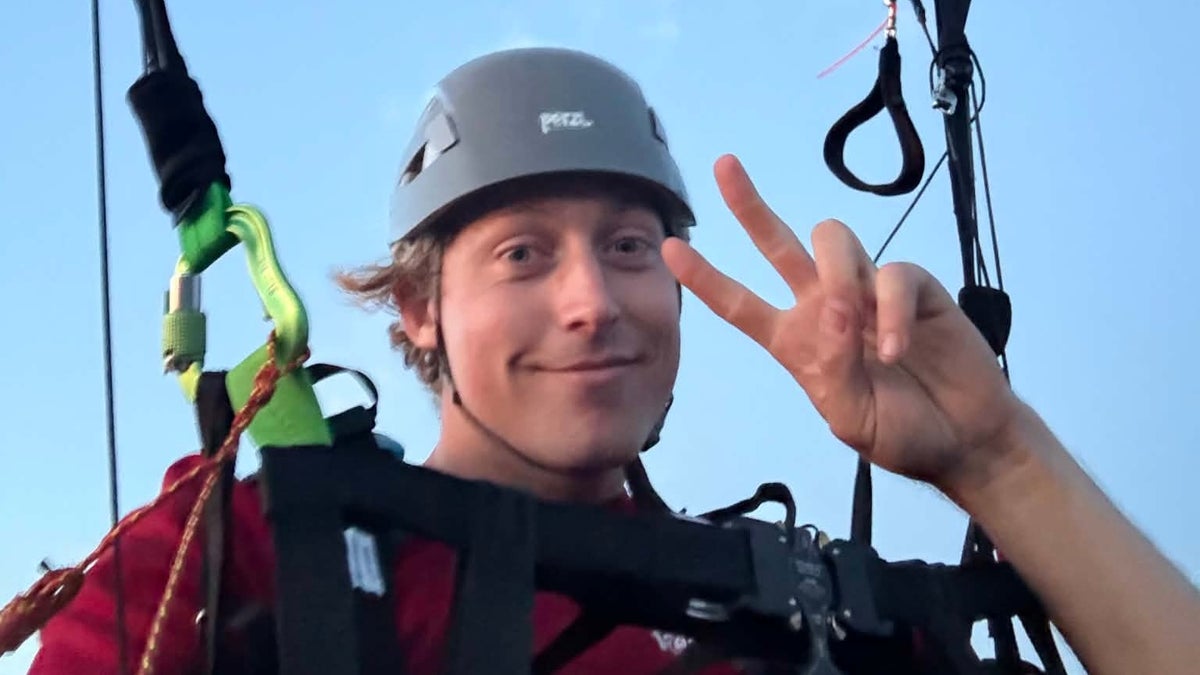
Earlier this year, one climber did exactly that. On February 6, a 75-year-old hang glider pilot named Steve Parson crashed into a cliff near Mount Prevost, a popular take-off spot on Vancouver Island in British Columbia. Minutes later, Matthew Robert Clark, a 24-year-old climber and electrician based on the Island, landed his paraglider nearby. When Clark heard about the crash on his radio, he drove up to the cliff, onsight free soloed a 50-foot chimney to reach Parson, and cut the trapped hang glider pilot out of his harness. He remained with Parson, treating his injuries, until rescuers arrived three hours later to hoist Parson into a helicopter. His climbing abilities and quick thinking likely saved Parson from three hours of additional suspension trauma.
Two weeks ago, Clark was announced as one of the 16 recipients of the Carnegie Medal, the highest honor in the U.S. and Canada for civilian heroism. Represented in a bronze medallion, the Carnegie Medal is awarded “to civilians who risk death or serious physical injury to an extraordinary degree saving or attempting to save the lives of others,” according to the Carnegie Hero Fund Commission’s website.
I spoke with Clark to revisit the events of February 6, learn more about his climbing and paragliding background, and get his thoughts on receiving the Carnegie Medal.
How a free soloist became a rescuer
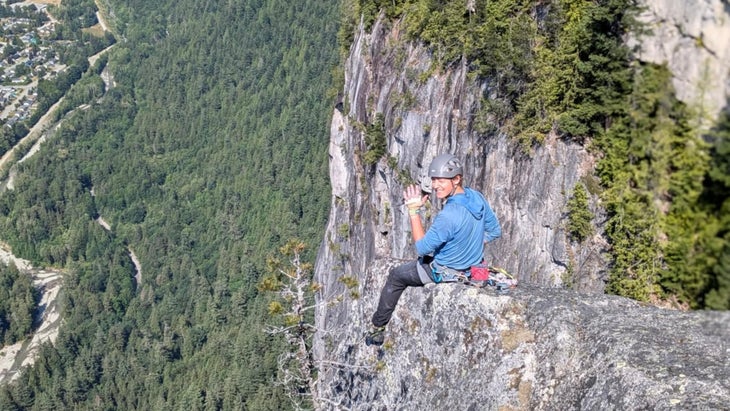
Clark, who just turned 25 in early September, has been a climber for five years, but is on “a bit of a hiatus” from climbing ever since he discovered paragliding, which has now become his main sport. He’s also dabbled in free soloing; in 2024, he spent a summer in Squamish and did some soloing around the Smoke Bluffs, one of Squamish’s most accessible crags. But he was never trying to push his free soloing grade to the limit.
“[It was] always really easy stuff, maybe 5.9 at the most,” said Clark. “Just stuff I feel really comfortable and secure on.”
On the morning of February 6, Clark drove his car out to a large farmer’s field below Mount Prevost (2,585ft), which sits just 10 miles west of the U.S.-Canada border. Instead of driving up to the landing spot, he hiked up the mountain alone for an hour and a half, carrying his 30-pound paragliding kit—something he does frequently when he feels like he needs some exercise. At the launch spot, just below the summit, about eight other people were preparing to take off on their paragliders, plus Steve Parson on his hang glider. Parson launched a few minutes before Clark.
Just after Clark landed, he heard on his radio that Parson had crashed in the cliffs nearby. “I actually didn’t know how to get there,” Clark said, “but the people I was with did. They drove up to the general area.”
Clark and his companions hiked 10 minutes up to the cliffs and spotted Parson, who was suspended in his harness about 50 feet above them, on a sloped summit above the cliff.
“There wasn’t anything simple that I could just hike up,” said Clark. He spotted a chimney that he said “looked pretty decent,” and after considering his options, opted to free solo up to get to Parson.
“There were some good hand jams here and there,” he said. “It was mossy from one side, and it was really nice conglomerate rock on the other side with some good pockets. I put my back on the mossy side and worked my way up there. It was maybe two to three feet wide, so it wasn’t particularly difficult.” He described exiting the chimney as the sketchiest part. “There weren’t really a lot of holds, just some bushes, so I grabbed onto those and carefully pulled myself up.”
After about five minutes of climbing, Clark reached a semi-conscious Parson, who was complaining about pain in his legs. Clark couldn’t find the buckles on Parson’s harness, nor a knife. Luckily, a Royal Canadian Mounted Police officer had followed Clark to the base of the cliff. The officer threw a knife up so Clark could cut Parson free. Then he moved Parson to a flat spot. A few years ago, Clark had completed a Wilderness First Aid course, and he used this knowledge to bandage a gash on Parson’s knee. “I was just trying to get him comfortable and warm and was checking his vitals,” Clark said.
It took another hour for search and rescue to show up on foot, but they were not able to reach Parson and Clark. “They tried to get to me,” said Clark. “They didn’t want to climb up to me, and they tried to rappel down from the top, but their ropes weren’t long enough, I guess.” Two hours later—three hours after the crash—a helicopter team finally reached the duo. They extracted Parson using a long line, left one search and rescue member with Clark, and returned later with the helicopter to collect Clark, too.
What happened next
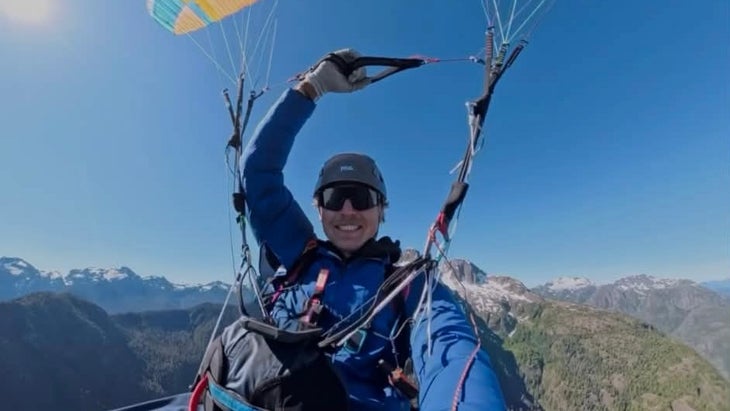
Since the February accident, Clark has stayed in contact with Parson. Last week, in fact, Parson drove Clark out to Mount Prevost and watched the younger climber as he launched his paraglider. “He’s doing really well,” said Clark.
Receiving the Carnegie Medal was a surprise for Clark and his family. “I’m definitely really honored and grateful for the recognition,” he said. “I don’t think I needed it. It’s definitely very nice.”
Although he witnessed the aftermath of Parson’s accident, Clark says it hasn’t made him more nervous to fly. “I know that every time I fly, something can go wrong, so I just have to make sure I’m always safe and doing my best and be ready for things to go wrong,” he said. “I love it so much that it doesn’t deter me from it.”
The climber did, however, walk away with the realization that he needed to update his first aid training. Despite this, he says that he was “really happy I could help [Parson].”
Today, Clark still works as an electrician in Vancouver Island and paraglides in his free time. His fellow Carnegie Medal recipients include Selwyn M. Taylor and Daniel A. Lyle, who charged into a toxic coal mine to rescue trapped workers after an explosion, Lenny Skutnik, who saved a drowning passenger from a plane crash in 1982, and DeWayne “Tiny” Lund, who pulled a driver from a burning race car in 1963.
The full list of 2026 Carnegie Medal recipients can be found here.
The post Climber Awarded Carnegie Medal After Free Soloing a Cliff to Rescue a Crashed Hang Glider Pilot appeared first on Climbing.