 BURST
BURST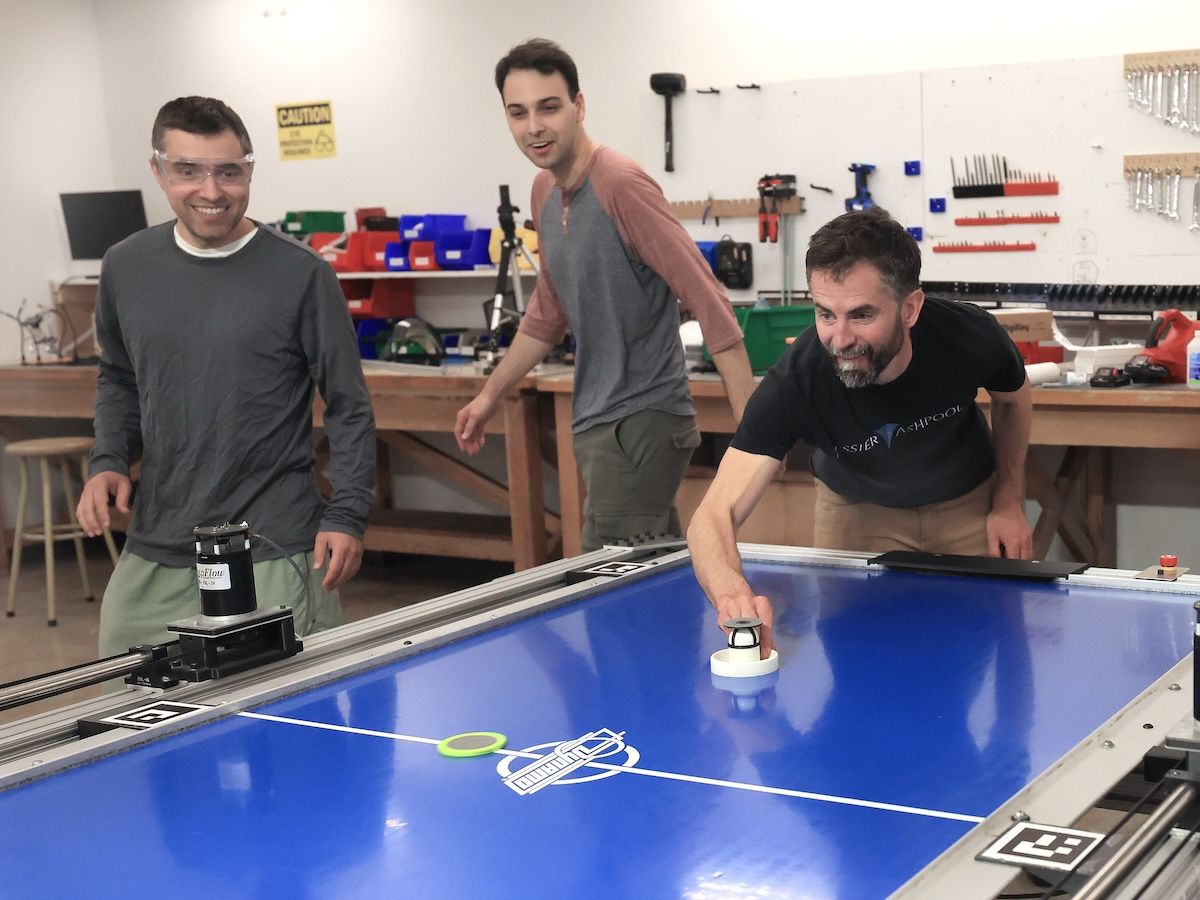
An AI-driven air hockey robot created by UBC engineers that has defeated all challengers so far has a high-noon showdown on Wednesday with a human 10-time world champion.
Tim Weissman, known as the “Kasparov of air hockey” for his strategic play, saw a YouTube video posted by UBC student Hudson Nock, one of the members of the UBC engineering physics project lab team that helped develop the machine, and left a comment. That comment led to a Zoom meeting, then an invitation for Weissman to fly up from Houston, Tex., along with his son Jacob — also a former world champ.
Back in 1997, Garry Kasparov took on Deep Blue, a chess grandmaster matching wits with an IBM computer capable of calculating 200 million chess positions per second.
Kasparov, considered the greatest chess player of all time, had already beaten the machine once in a six-game series. But a year later, the computer emerged triumphant in the rematch, handing Kasparov his first-ever loss.
It was both symbolically and technologically significant, showing machine intelligence was catching up to humans.
Now the Kasparov vs. machine clash has returned on a different plane — air hockey.
There have been many air hockey robots over the years, some as far back as the 1990s. But what the UBC crew says sets theirs apart is the method of its training and its ability to learn.
“What’s unique about this (air hockey robot) is that it is AI-enabled, or controlled by AI,” said Dylan Gunn, the director of the lab.
“Up until seven or eight years ago, robots were really just what you would call classical programming. Lots of, ‘If this happens, then do that,’ and you’re writing that in the code. The problem is, robots are now so complicated that that just doesn’t scale anymore.
“That’s where we started doing AI, and it means you can’t program it explicitly. You just have to set up what was a simulation, that AI can play thousands of games in simulation and learn the sport for itself.”
But it has to learn air hockey, and can’t be told what air hockey is. It has to learn on its own.
Weissman said it was the first robot he had seen that he thought had an actual chance of beating a competitive human.
“What struck me was how it was playing defence,” said Weissman. “I’d never seen defence played this well, and the positions that it was going to were really strong. I started thinking, ‘Wow, there’s something’s different with this one. This is really cool. It’s different.’
“I am genuinely curious. Can we can we still beat robots in air hockey? … In a weird way, I’m rooting for the robot just because it would be a more compelling story.”
The capstone project started in 2018 and has seen 25 students across seven teams working on it, developing evolving iterations through the years.
In addition to virtual learning, the system they created includes an electro-mechanical system that drives the physical components, the software to run it, and a camera vision system capturing the table state. The computer tracks the location of the puck and the opponent mallet, and reacts accordingly.
In the fall of 2025, the last group realized it was performing so well — they hadn’t scored on it in months — it needed higher-level competition.
“We started to see it exhibit human-level play,” Gunn said. “Rather than just trying to connect with the puck, it started doing things like dribbling the puck, bouncing it off the sidewalls, and doing bank shots and stuff. That was without us giving it explicit rewards to learn that. We were rewarding it for scoring on goal and not getting scored upon. But it learned those kind of human-level behaviours.”
In baseball, a batter has around 400 milliseconds to decide whether to swing, at what level and force at a pitch. In air hockey, it’s around 200 milliseconds. The robot can react in as little as 20 milliseconds, according to Nock.
“The reaction time is very, very fast, but that does get to an interesting question: What does a fair competition between a robot and a human look like?” Gunn said. “We could just build a robot that’s insanely fast. It can see faster than a human can. It can move faster than a human can. But that wouldn’t really be satisfying to be a human.
“We would rather have it win because it’s just better at air hockey.”

When Kasparov lost to Deep Blue in 1997, it was because the computer played an unorthodox and unexpected move, flummoxing the world champ and compounding the weak position he had put himself in from the start. Weissman is excited to see if this can translate to an AI air hockey machine.
Weissman, credited with inventing the hypnotizing “circle drift” move , knows his usual tricks won’t work against a computer. Nor will he have any body language or motions from the machine to key off of. Will his real-life experience pay off? Simulations have a hard time re-creating things such as inconsistent air flow, or imperfections in the playing surface or walls.
“That’s the wild thing. This robot learned in simulation, it learned in a fake world,” said Weismann, a clinical psychologist by trade.
“I’m not going to be able to fake it out,” he said, explaining he is confident that his shots will be too powerful for the AI to react in time.
“It’s going to know the trajectory of that shot pretty quickly. But can it move in position quick enough to block it? … Is it is going to depend on how accurate those calculations are, and how precise they are, because I can get my mallet pretty darn close to the puck before I actually accelerate and explode into it.
“I think that we’re going to destroy it. So it’s going to be fascinating to see if that actually is the case.”