 BURST
BURST
A B.C.-trained nurse, who has spent decades in the U.S. but has returned to care for her terminally ill mother, says she’s been struck by the level of understaffing among nurses and worries that the added responsibilities placed on them has led to a decline in patient care.
Carmen Toneatto has been a nurse for 40 years and has lived in the U.S. since 1992, currently in Atlanta. She has spent the last few months caring for her 86-year-old mother, Loretta, who is in hospice in Delta after complications from a routine procedure in February at Surrey Memorial.
Toneatto says that what she’s experienced at both Delta Hospital and Surrey Memorial are nurses who are overworked, understaffed, and not in a position to focus on patients.
“If a nurse is working a 12-hour shift, the team includes a unit clerk who is scheduled from 7 a.m. to 3 p.m. The unit clerk’s duties include processing all the orders, answering the phone and directing traffic. Then at 3 p.m. they go home, so for the remainder of the 24 hours, the nurses are covering those tasks and that’s a lot of extra work, plus having to do their own job,” said Toneatto.
“When the nurses feel like they’re on their own, without support, that shows up in the care that the patients are getting. If they don’t feel comfortable and they do not have the resources of support staff including health-care aides, unit clerks and experienced nurses to help resolve patient issues, care given to patients is not as good as it could be.”
Toneatto said it appears that, because of the extra tasks, nurses have been forced to become task-oriented rather than patient-oriented and that is different than when she was working at Vancouver General Hospital in the 1980s and early 1990s. In those days, she said nurses were very collaborative and able to focus on delivering the best care.
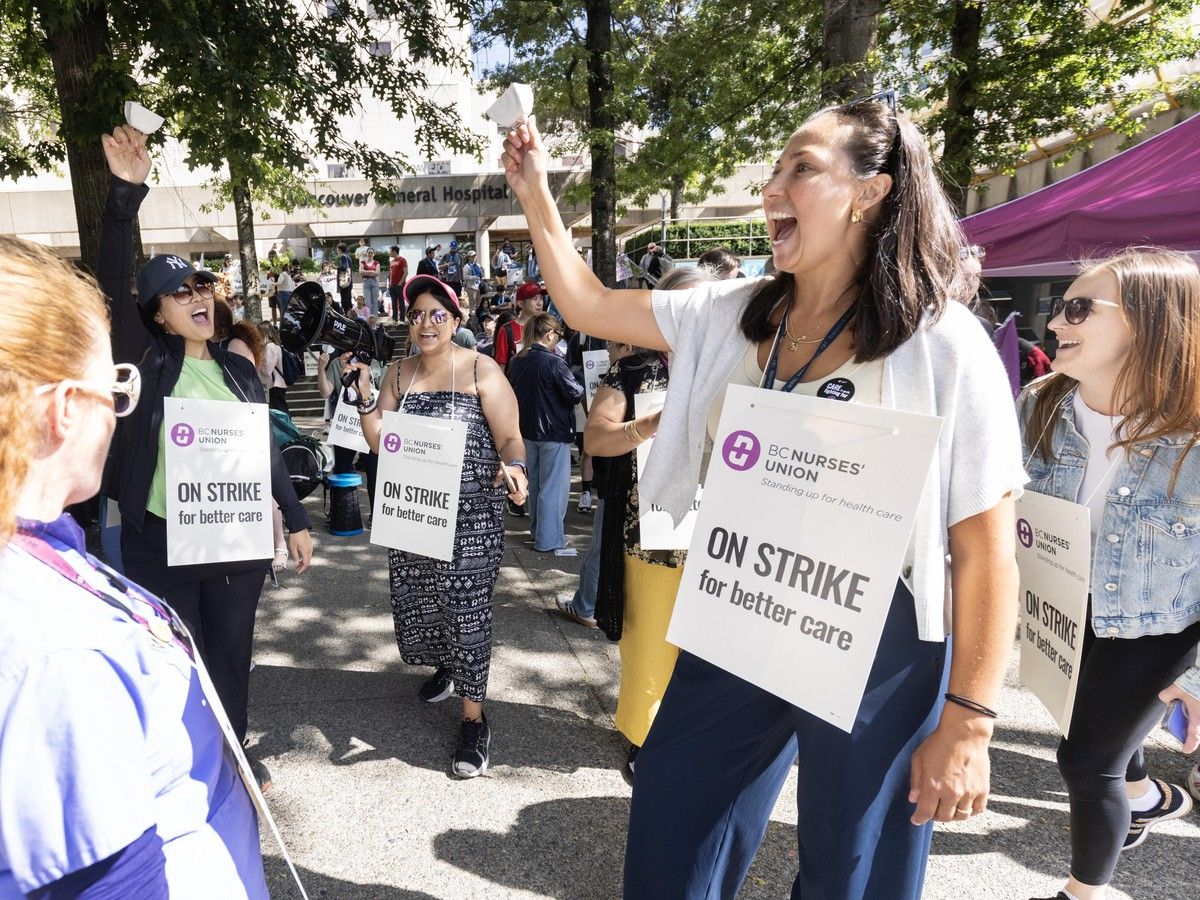
B.C. Nurses’ Union president Adriane Gear said the reality is that essential care is missed every day in B.C. because of the 4,500-6,000 nursing vacancies in the province. She said that is one of the reasons the union is on strike, as patients aren’t being cared for properly because of the deteriorating working conditions for health-care workers.
“It’s not like nurses are working short-staffed once in a while and have to pull together and sort of get through a shift. This is the context of how we practise nursing, and so I think it is shocking that missed care is not more evident in the system and in outcomes,” said Gear.
B.C. Health Minister Josie Osborne also said in a statement that progress has been made at the negotiating table with nurses on a new collective agreement but there is still a ways to go.
She said the government is doing what it can to beef-up the nursing ranks.
“Nurses’ priorities are our priorities too — hiring more nurses, implementing minimum nurse-to-patient ratios to strengthen patient care and support quality environments for nurses, and protection from workplace violence. While we’ve made progress together on these priorities, there’s no question there’s more to do,” Osborne said.
The shift in how the system operates has shown up in the care her mother has received, says Toneatto, with health-care workers at Delta Hospital not appearing to know what to do with her after she was sent back with a punctured esophagus following a procedure to remove stones from her bile duct.
Loretta was brought to Delta Hospital on Feb. 16 suffering from shortness of breath and coughing. Initially diagnosed with a urinary tract infection and possible pneumonia, Loretta was diagnosed with stones in her bile duct following an ultrasound.
Scheduled for a procedure to remove the stones on Feb. 23 at Surrey Memorial Hospital, the doctor who performed the surgery ended up puncturing Loretta’s esophagus, alleged Toneatto. Instead of sending her to critical care at the hospital, Carmen says the doctor sent her mother back to Delta Hospital.
There, she said the nurses didn’t seem to know what to do with Loretta or how bad of a condition she was in, despite her heart rate being extremely high, her oxygen levels being low, and the fact she was coughing up blood.
On FaceTime with her sister for her mom’s arrival, Toneatto said she had to give her sister instructions for the nurses.
Flying in a couple days later, Carmen said she had to threaten to call the media before her mom was transferred to Surrey Memorial’s critical care wing, as Delta Hospital didn’t have the services required.
There Loretta stayed until April 10 when she was discharged. Complications sent her into hospice on April 29 after a few weeks of home health.
In a short emailed statement, Fraser Health said “that the person’s family recently reached out to our patient care quality office, and they are working to support the family.”
B.C. Conservative health critic Anna Kindy, who was in the health-care field for over 30 years before becoming a politician, said nurses aren’t just having to deal with staffing issues and added responsibilities but also violence in hospitals. She said all of this adds up to nurses quitting and exacerbating the staffing issues.
“The government’s not taking this violence issue seriously. We should start with the basis of zero violence in the hospital,” said Kindy.
“If you’re looking at attrition rates, we’re recruiting and we’re training nurses, but we’re having a lot of nurses quitting their role in hospital, going elsewhere, and so that’s why it’s difficult to sometimes fill the shifts.”