 BURST
About our reporting: Associate editor Sam MacIlwaine pulls from a prior interview with Elias Iagnemma, a Testpiece Climbing podcast episode, Adam Ondra’s public posts, several YouTube videos, and records from Climbing’s digital archives to explain the history of Ondra’s downgrades and why the world’s first V18 was no exception.
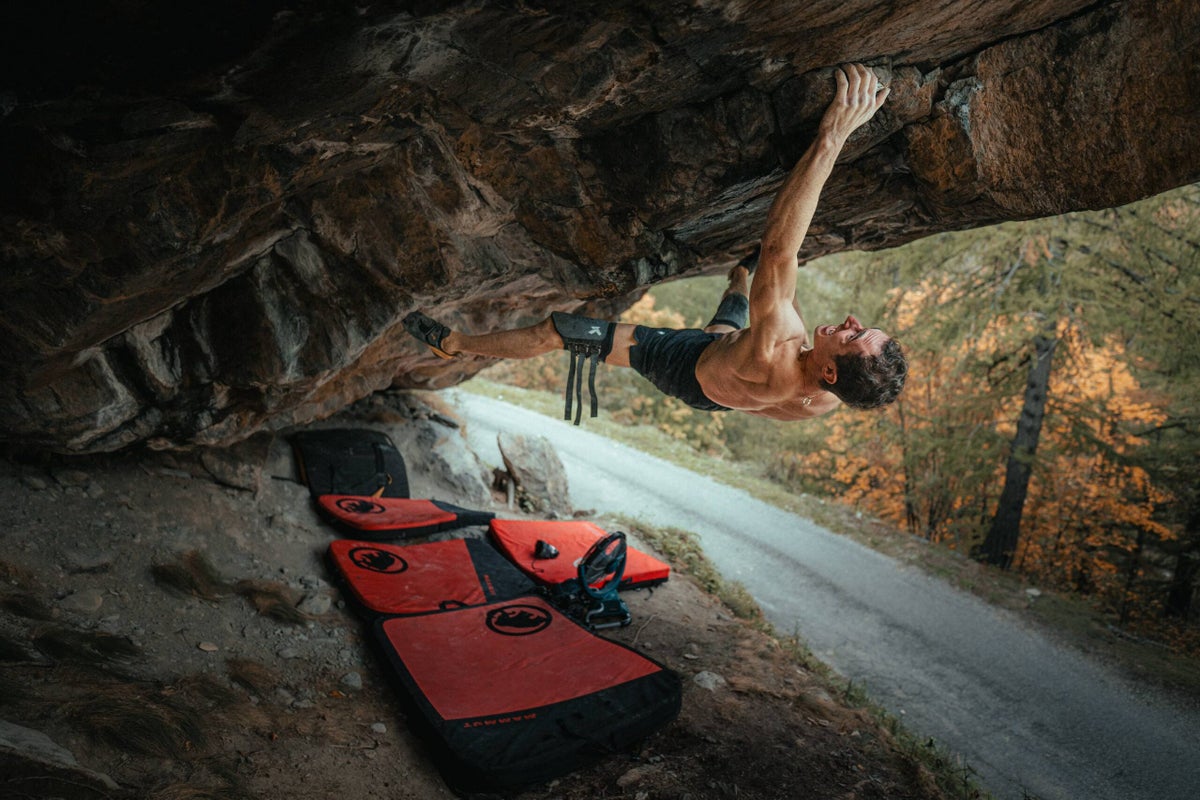
On Sunday, October 18, Czech climber Adam Ondra announced that he made the second ascent of Exodia, the world’s first proposed V18, in Piemonte, Italy. The 33-year-old Olympian, who is arguably the most accomplished rock climber of all time, downgraded the boulder from V18 to V17. His downgrade ended nearly a year of speculation over whether the first-ever proposed V18 would hold up in future repeats.
“It’s very much my style,” Ondra wrote in an Instagram post caption, adding that the climbing was “extremely cool and very fun to project.” He took four days in total to send it, noting that he was in “possibly my best ever” shape for climbing it.
Exodia marks Ondra’s second V17, after Soudain Seul in Fontainebleau, France. However, he remarked that it “felt harder than Soudain Seul,” making Exodia his most difficult bouldering send to date. Read on for a history of Ondra’s biggest downgrades.
A brief history of Exodia
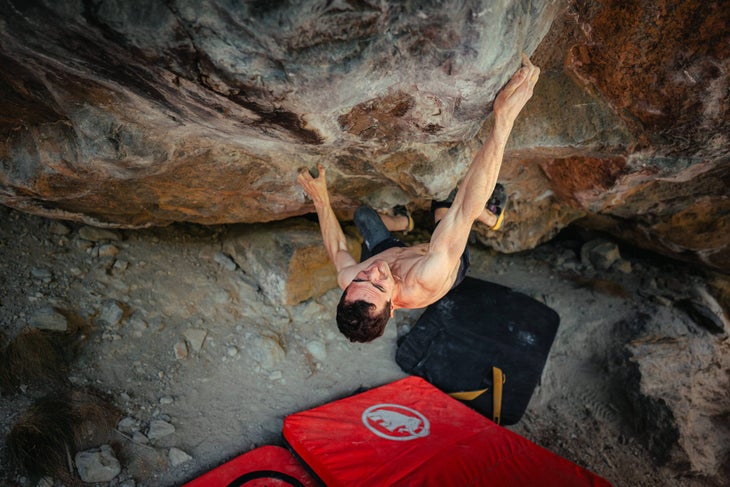
Last November, Italian climber Elias Iagnemma shocked the climbing world when he finally sent his 211-session, four-year project, Exodia. He then proposed it as the world’s first V18. Prior to Exodia, Iagnemma had sent Burden of Dreams, the world’s first V17 and a benchmark for the grade, in 25 sessions. He also put up his own first ascent, The Big Slamm, in 35 sessions, proposing V17; however, it has not been repeated. Exodia took him six times as long as either boulder. After his send, he told Climbing that it was “the hardest thing I’ve ever done in my life.”
In broad terms, Iagnemma described Exodia in two parts, a V14 and a V16, with an inverted kneebar rest between them. It contains approximately 25 hand moves across a blocky overhang traverse. Iagnemma compares the boulder visually to “the face” of the Exodia Yu-Gi-Oh card, which inspired the problem’s name.
Since November, several elite boulderers, including Soudain Seul third ascensionist Camille Coudert, have traveled to Piemonte to try Exodia, according to a Testpiece Climbing podcast episode interviewing Iagnemma. But it wasn’t until Ondra showed up, fresh from a spree of V14 and V15 first ascents in Italy, France, and the Czech Republic, that Exodia saw a second ascent.
Ondra’s assessment of Exodia
When Ondra visited the boulder in September, Iagnemma showed up and offered all his beta. “Adam thinks the first part is 8B+/V14 hard,” the Italian said on the September 28 podcast episode. “For me it’s just 8B+. But for the second part, Adam doesn’t think it’s 8C+/V16.”
In Iagnemma’s send video, he jumps to a pinch and cuts feet shortly after exiting the kneebar. But for this move, he claimed, Ondra did not need to cut feet. “When I jump to the pinch, Adam’s still with the toe hook to the pinch, and maybe this way, it’s a bit easier than 8C+,” Iagnemma said. “I’m a little bit smaller and I lose my feet.”
Ondra confirmed this advantage in his send announcement. “The second part is even more my style,” he wrote. “I can reach one hold from one toe hook without cut[ting] loose.”
Iagnemma responded to the announcement with congratulations. “You’re not only the strongest climber in the world, but an amazing person as well,” he wrote publicly in Ondra’s comments. “I hope we get to climb together someday.”
Inside the downgrading machine
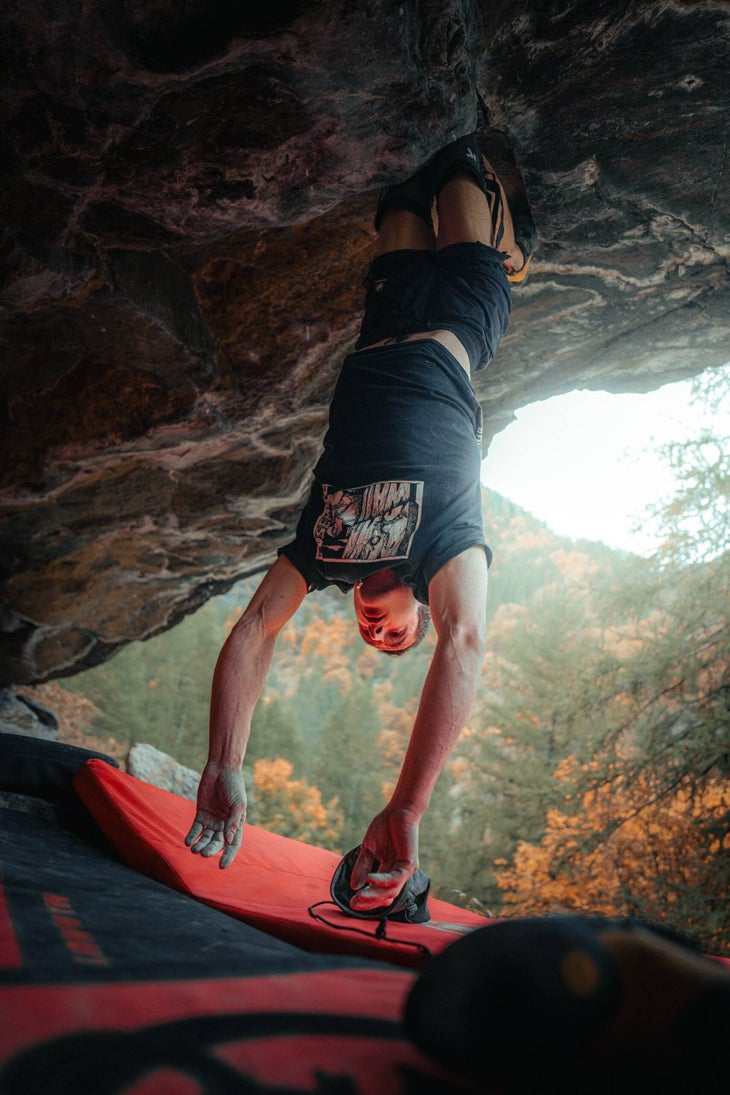
With Exodia, Iagnemma joins a long list of elite climbers to have experienced an Ondra downgrade of their first ascent, including Stefano Ghisolfi, Jonathan Siegrist, Magnus Midtbø, Will Bosi, Dave Graham, and Aidan Roberts.
In 2003, Spanish climber Barnabé Fernández claimed the first ascent of the 270-foot Chilam Balam in Málaga, Spain, calling it the world’s first 5.15c. However, he did not provide proof of his ascent, and the 5.15c grade was called into question by Alexander Huber and many others. Eight years later, Ondra swept in, made the first confirmed ascent, and downgraded it to 5.15b, a grade that had been already established by then.
One of Ondra’s most memorable downgrading sprees occurred back in 2012, during his first visit to the U.S., when he quickly disposed of three of the hardest routes in the Red River Gorge. He onsighted both Jonathan Siegrist’s Pure Imagination and Adam Taylor’s The Golden Ticket on the same day, then downgraded both from 5.14d to 5.14c. A few days later, he flashed Taylor’s harder route, Southern Smoke Direct, and downgraded it from 5.15a to 5.14d. “Adam Ondra pretty much wrecked the Red,” wrote routesetter Aubrey Wingo in a blog post about the sending spree.
One of the reasons that Ondra is known for downgrades is his geo-agnostic philosophy on grading, which adheres to a universal scale instead of bending to the subjectivity of local standards. “What is a grading system worth if we are not even trying to make it objective?” he told this magazine after his Red River Gorge massacre. “We’re just lying to ourselves to get the highest number possible. I am always trying to compare my ascents with other benchmarks of that grade, so climbing said grade feels the same in the Red, the Alps, Norway, or Spain. It seems to me that grades were really stiff in the 1980s and `90s, but then, strangely enough, inflation occurred.” He also noted, “I wouldn’t call it downgrading—I would call it a personal suggestion or opinion.”
But while Ondra considers his downgrades “opinions,” nearly all of his suggestions tend to stick. Others have acknowledged that Ondra’s ascent of their route is what defines the grade. In 2025, Magnus Midtbø jokingly pointed out that Ondra’s 2012 downgrade of his boulder Blood Redemption from V15 to V14 came one day after day after Midtbø beat Ondra in a competition in Norway. “I almost had a V15 under my belt until Adam Ondra ruined it,” Midtbø mock-complains in a YouTube video. However, later in the video, he admits that V14 is “probably a more accurate grade.”
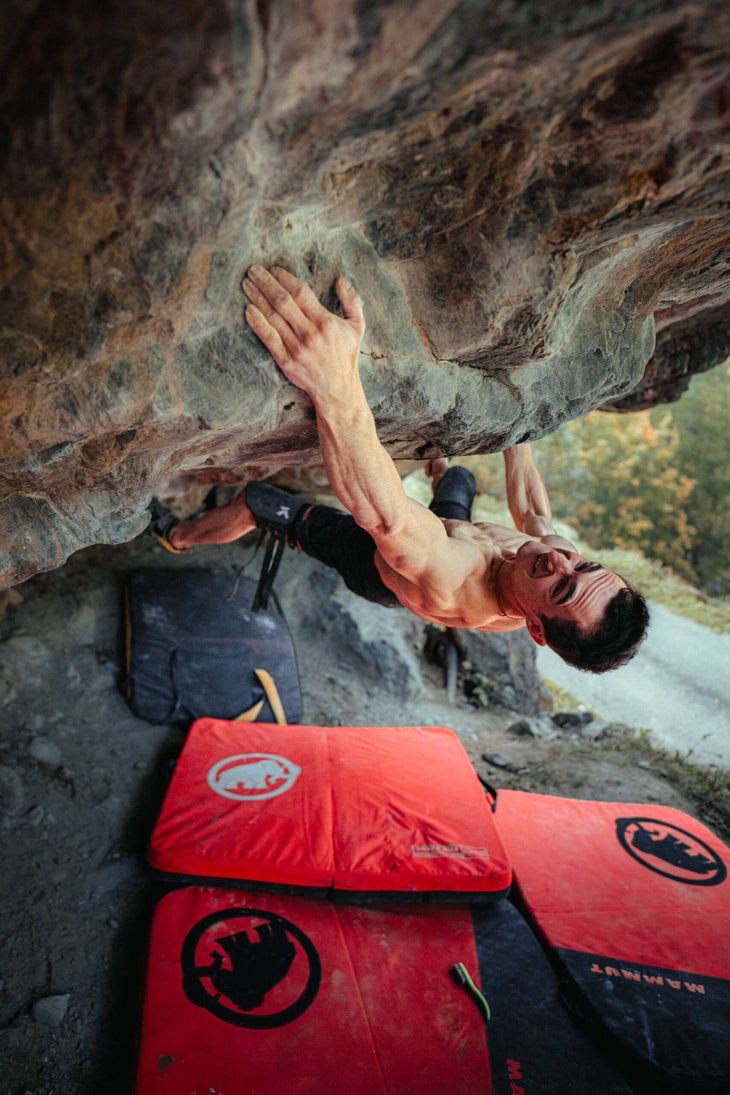
Ondra has acknowledged his power over the community, too. In recent years, he’s become more careful to stress that his downgrades are not personally motivated. In 2021, he downgraded Stefano Ghisolfi’s Erebor, then considered the hardest route in Italy, from 5.15b/c to 5.15b, right after Laura Rogora redpointed it and became the first woman to climb 5.15b/c. “The fact that Laura did Erebor is one of the most impressive achievements in climbing ever,” Ondra wrote in an Instagram post caption, “but my suggestion is just my honest opinion and not a way to put down her achievement.”
At this point, when Ondra comes to town, it’s normal for any first ascensionist to prepare for the re-evaluation of their life’s biggest accomplishment. In 2017, when Ondra tried Steve McClure’s Rainman (5.15b), the hardest sport climb in the U.K., McClure himself showed up to watch. A video published by the British Mountaineering Council shows him visibly nervous. Rainman was McClure’s seven-year obsession; it took him 127 sessions to finally get it done. But Ondra didn’t send that day. “You can be relaxed,” Ondra told McClure, laughing, after he fell from high up on McClure’s route. The 47-year-old grinned in obvious relief. Today, Rainman remains 5.15b.
Given Ondra’s unique reputation as possibly the best climber in the world, British climbers Tom Randall and Pete Whittaker have jokingly invented a new grading scale based on Ondra’s ability level. “The O-grading system starts at 0, so if Adam flashes anything, it’s just O-zero,” said Randall in a 2023 YouTube video of Ondra visiting his famous Cellar in Sheffield. “O1 will be, it will take him one session. That could be the second go, or it could be the 25th go of the session. It’s always O1. O2 is two sessions; O3 is three sessions, and so on.”
Ondra joined in the joke in 2024. On April Fool’s Day, he posted the O-grades for a few of his biggest accomplishments, adding the plus and minus effects to note effort and to narrow the scale. Silence (5.15d) and La Dura Dura (5.15c), two of his most groundbreaking redpoints, were labeled O60 and O42+ respectively.
But at this point, the O-grade system is probably worth taking seriously, if only to get inside Ondra’s head and anticipate a future downgrade. Like any other climber, Ondra relies on his past experiences on various routes and boulders to determine the grade for his current one. Yet unlike most other climbers, his opinion carries significant implications for us all. One may wonder whether Rainman survived a downgrade simply because in 2017, Ondra hadn’t yet flashed 5.15a, the benchmark for O-zero; therefore it had to be at least O1, which was (and is still) 5.15b.
By contrast, Exodia took Ondra four sessions, which means it’s O4—slightly lower on the O-grade scale than Ondra’s only other V17, Soudain Seul (O5). In that line of logic, the downgrade suddenly makes perfect sense.
The post Adam Ondra Just Downgraded the World’s First Proposed V18. We Should Have Seen This Coming. appeared first on Climbing.