 BURST
BURST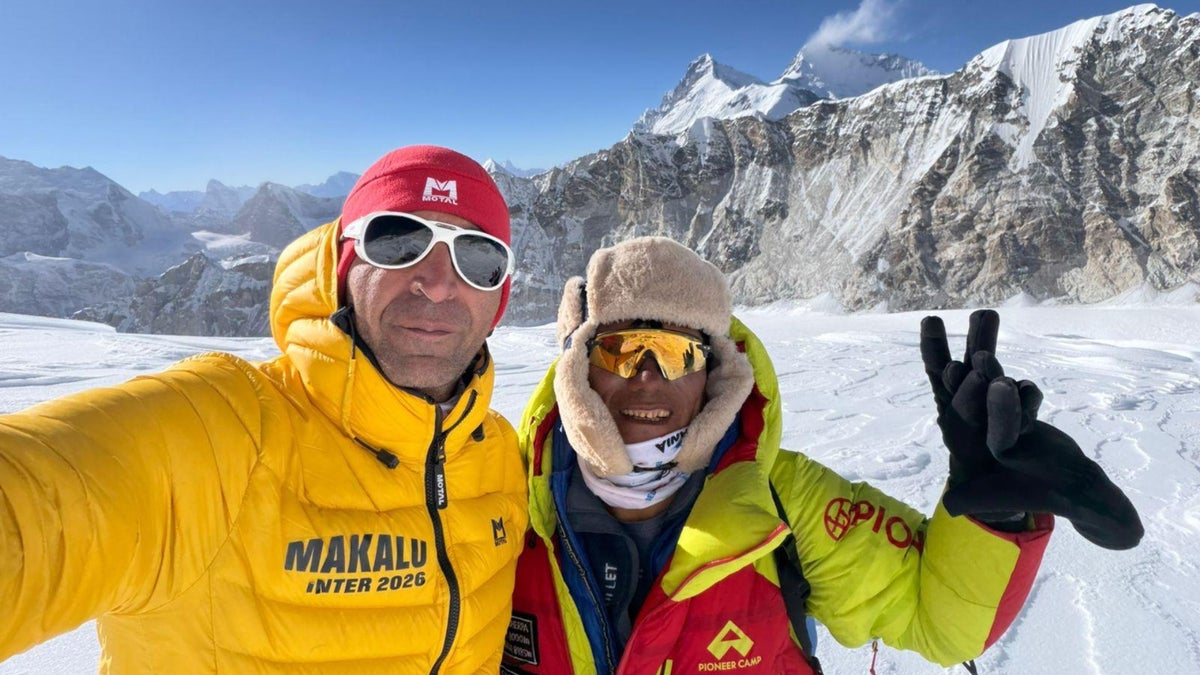
On Thursday, January 15, three Sherpas and a guided client summited Makalu (8,485m/27,838ft), the world’s fifth-highest peak. It was only the second winter ascent of the mountain, and the first that was commercially guided.
A safe descent seemed almost certain. They’d summited at 10:27 a.m., with plenty of time to get back to camp before dark, and although high winds and cold temperatures were slated to arrive the following day, for now the air was calm.
For the client, 42-year-old Iranian Abolfazl Gozali, it was the second attempt at a winter ascent of Makalu, after an effort last year was stymied by 50mph winds at 7,800 meters (25,590ft).
Gozali, who had already summited the other 8,000ers Manaslu and Lhotse, was accompanied by three Sherpas working for outfitter Makalu Adventure: Lakpa Rinji, Phurba Ongel, and Sanu—Ongel’s older brother and the team’s leader. A second client, Piyali Basak of India, had fallen ill and turned back at Camp III (7,250m/23,786ft).
The four-person group was a strong, experienced team. Sanu is one of the most accomplished high-altitude climbers alive. He is currently the only person in history to have summited all 14 8,000-meter peaks twice, and has summited many of them three times. Phurba Ongel had reportedly summited Everest (8,848/29,031ft) at least 19 times. He and Sanu had guided Gozali on last year’s winter attempt.
The ascent proceeded normally up to Camp IV (7,400m/24,278ft), the last camp before the summit. Sanu and his team, however, knew that their weather window was tight, so to save time, they decided to climb the last section alpine style, without fixing lines to the summit.
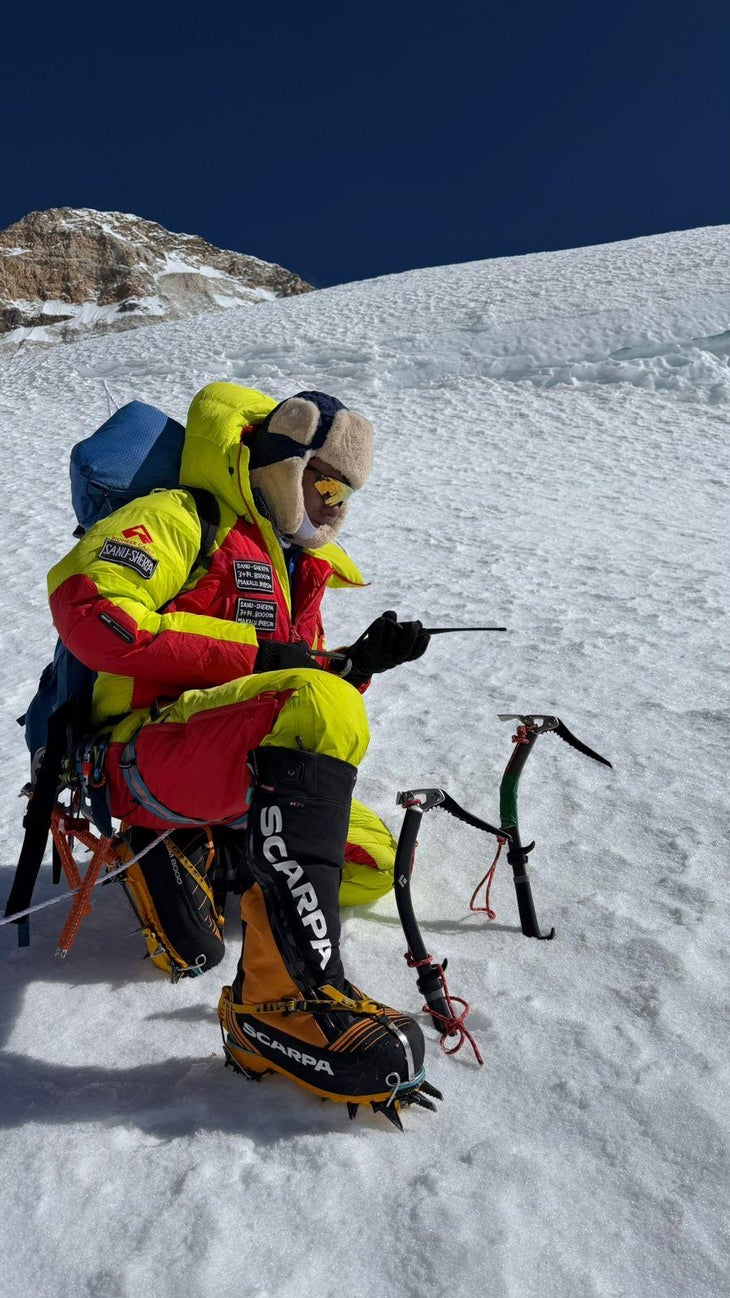
The men succeeded, and it was no small thing. Makalu has received countless springtime summits since its first ascent in 1955, but it took more than 50 years for it to be climbed in winter, by Simone Moro and Denis Urubko in 2009. (Unlike Gozali, Moro and Urubko did not use bottled oxygen during their ascent.)
Makalu Adventure’s founder and owner, Mohan Lamsal, said that after their successful summit, the four climbers had safely descended the most technical section of the route, the French Couloir, and were now on low-angle terrain at an elevation of around 7,500 meters (24,606ft).
The men were using the peak’s standard route, which at this point follows a wide glacial plateau along the northern side of the northwest ridge. They were quite close to Camp IV, Lamsal said, with Lakpa Rinji hiking first and Phurba Ongel following close behind. “About three minutes behind them was Gozali, roped to Sanu Sherpa,” Lamsal said.
“They were trekking nicely. They were already planning to celebrate and dance in base camp,” Lamsal said. “When they returned to Kathmandu, we were going to have a big party for them with Makalu Adventure.”
The celebration never happened. Lakpa Rinji, in front, heard a strange sound behind him. He turned to see Phurba Ongel had slipped, and was sliding down a steep slope to the right of their descent route. As Lakpa Rinji watched, horrified, Ongel slid some 650 feet down the mountain and out of sight below.
Sanu and Gozali reached Lakpa Rinji a few minutes later to find the Sherpa crying, explaining that Phurba Ongel was gone. Sanu immediately decided to rappel down after his brother. “Sanu said to the client, ‘Sir, you wait here,’” Lamsal said.
Gozali, Lamsal claimed, didn’t want to wait, and decided to descend on his own. Sanu relented. “You slowly walk down if you like,” he said. “We’ll see you on the way. We’re going to help Phurba Ongel.’”
Although Phurba Ongel had slid hundreds of feet, Sanu hoped his brother might still be alive somewhere below. Perhaps he’d managed to arrest, become stuck in a small crevasse, or collided with rock or another obstacle that had stopped his slide. He and Lakpa Rinji both carried 100-meter ropes that they’d planned to fix to the summit, so they rigged them and rappelled together down the icy slope after Phurba Ongel. Meanwhile, Gozali continued down the wide, low-angle plateau that led past their fourth camp down to Camp III.
After searching for a little over half an hour, Sanu and Lakpa Rinji found Ongel, but the 44-year-old was already dead. By now, Lakpa Rinji and Sanu Sherpa were physically and emotionally exhausted.
The two Sherpas felt that, on their own, a body recovery would be too time consuming. It was already early afternoon, and they’d left Gozali, their client, on his own. “They decided that at this point in time, it was not possible to bring him home, and they needed to go back to the client,” Lamsal said.
The two Sherpas jugged back up onto the route, gathered their ropes, and began descending to catch up with Gozali.
At 4:30 p.m., they could see the Iranian ahead of them. The sun was setting, but Gozali appeared to be very close to Camp III, where another team member was waiting for him. “Sanu Sherpa saw him very, very clearly,” said Lamsal. “He was standing on a small, flat hill.”
They were too far apart to shout to Gozali, but he was standing still, not moving, almost like he was waiting for them.
Sanu and Lakpa Rinji continued hiking down, hurrying toward the spot where they’d seen Gozali, but by the time they reached that point, their client was gone. This wasn’t exactly surprising. It made sense that he would have gone down to Camp III to wait on them. The two Sherpas headed there, where they met another team member, Ngima Tashi Sherpa, who had stayed behind during the summit push and was stationed at Camp III to prepare hot food and drinks for the rest of the team.
“They asked Tashi, ‘Where is the Iranian!?’” Lamsal said.
Ngima Tashi was confused. He’d seen no sign of Gozali.
By now, darkness had fallen. The three Sherpas conferred, and decided that because Gozali was so close to Camp III when they’d seen him last, he must have passed the camp without stopping and continued on past the down to Camp II (6,600m/21,653ft).
“All three of our Sherpas—Lakpa Rinji, Sanu, and Tashi—then went down to Camp II,” Lamsal said. At this point it was extremely cold and very late, close to 1:00 a.m. The Sherpas searched all four of the tents they’d left in Camp II, but could not find any sign of their companion.
By now the men knew that something had gone seriously wrong. They contacted Makalu Base Camp (17,224ft) via radio, and the base camp staff confirmed that Gozali had never made it there, either.
Desperate, the Sherpas searched through the darkness and into the next morning, scouring the terrain between Base Camp, Camp I (6,100m/20,013ft), and Camp II. They’d been awake for nearly 36 hours.
Lamsal received a distress message from his team at 3:00 p.m. on Friday, explaining that Phurba Ongel had fallen and Gozali was missing. Winds were high that day, so no helicopter could be dispatched, but by early Saturday morning, a chopper was on its way to high camp with a team of rescuers. They searched the area below Camp II that evening, and the following day, Sunday, they reached Camp III. “They could not find any sign of him,” Lamsal said.
Monday the 19th brought high winds, upwards of 40 mph, so the rescue team were forced to return to base camp. On Tuesday, the wind relented to around 30 mph, but visibility remained poor. When I spoke with Lamsal that evening, five days after Gozali went missing, he was perplexed by the whole debacle.
“Sanu saw [Gozali] very clearly above Camp III, on this small hill,” Lamsal said. “From there, there is no point where he could have slipped and fallen far. It is not steep. He could arrest.” At that point, he refused to suggest that Gozali was dead, although the Iranian had by this point spent multiple nights out above 7,000 meters in winter conditions. “I cannot say anything,” he said. “Sanu Sherpa is a very experienced climber, and he is still searching.”
Over the next few days, high winds battered the peak, and temperatures plummeted. Lakpa Rinji was eventually hospitalized with frostbite on eight of his fingers, but Sanu Sherpa and others spent nearly a week climbing up and down the mountain, hoping to find some trace of their missing client. As of Thursday morning, the efforts to recover Ongel’s body and find Gozali have been called off.
Why did Phurba Ongel fall? What happened to Abolfazl Gozali?
There appear to be two judgement errors in this incident, one which resulted in Phurba Ongel’s death, the second led to Gozali becoming lost, a tragedy which at this point seems likely to have caused his death, too.
My first question for Lamsal was: “Why were the men climbing above Camp IV unroped?”
“I raised the same question when I spoke to them,” he admitted, somewhat sheepishly. “It is not common practice, but they needed to move fast. They knew windy conditions would be very bad the next day, and if they had fixed the ropes to the summit, they would have missed their weather window.”
Deciding not to fix ropes is one thing, but this doesn’t explain why Phurba Ongel and Lakpa Rinji weren’t at least roped together, in typical glacier-travel fashion—as Sanu Sherpa and Gozali had been. If the two had been roped up, Lakpa Rinji could have potentially arrested Ongel’s fall.
Lamsal didn’t have an answer, other than to say that the men were moving on low-angle terrain where they did not believe a high-consequence fall was possible.
Speaking to Everest Chronicle, Sanu Sherpa suggested the same. “The terrain there is largely flat and considered one of the easiest sections,” he said. (This early report does contain a few inaccuracies, including that Phurba Ongel fell 700m/2,200ft, which Lamsal said was incorrect, and that the two groups were traveling only ‘a few meters’ apart, as opposed to ‘three minutes.’)
The second fatal decision was for both Sanu and Lakpa Rinji to leave their client. It’s understandable (the fallen Sherpa was Sanu’s little brother), but in hindsight, it was clearly a choice that turned one death into two. “Since Phurba Ongel was about 200 meters [650 ft] down, and they thought one person could not bring him up that far on their own,” Lamsal told me. “That is why they decided to leave Gozali.”
For the 51-year-old Sanu Sherpa, the Makalu winter ascent is a tragedy on many levels. Not only is this the veteran guide’s first time losing a client in more than 40 8,000-meter expeditions, but he lost his little brother, too.
It is likely that both bodies will remain on the mountain until the spring.
The post First a Guide Died on Makalu. Then His Client Vanished, Too. appeared first on Climbing.