 BURST
About our reporting: For this story, we interviewed the executive director of the nonprofit Joe’s Valley Climbing and Community and a board member of the Emery County Trails Committee, as well as solicited comments from a Bureau of Land Management (BLM) representative involved in the project.
What climbers should know: After a coal mine reopened in Joe’s Valley in central Utah, a local climbers’ coalition partnered with land managers and the mining company to address safety risks through new climber parking lots and trails, offering a case study for other climbing areas facing mining claims.
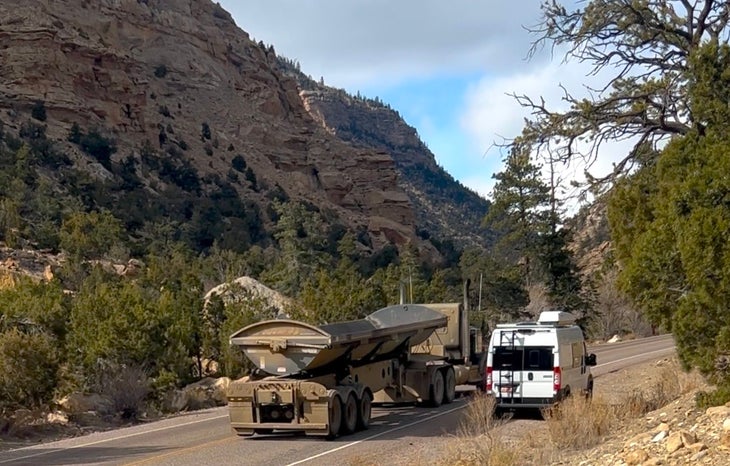
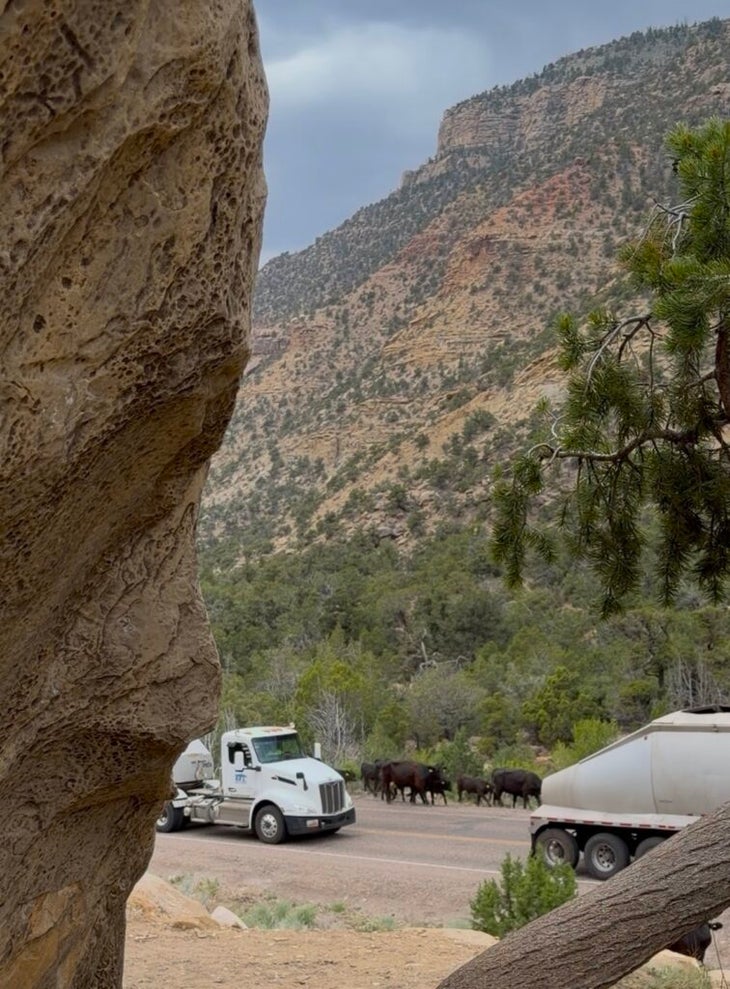
Over 25 years after the last coal mine in Joe’s Valley closed down, coal is once again coming out of the ground. For the thousands of boulderers who visit the hundreds of sandstone boulders here in central Utah every year, that means big trucks rumbling past the many roadside blocs every three or four minutes. Not only do those large trucks cause a ruckus, but they also pose a safety risk to the right-off-the-road parking found throughout Joe’s Valley. Climbers unloading crashpads from their vehicles—often with kids and dogs in tow—was an accident waiting to happen, says Julie Janus, the executive director of the nonprofit Joe’s Valley Climbing and Community.
“How can we all work together to get something that works for the community as a whole?” Janus says of how she approached the situation. “It’s not climbers versus coal. It’s not us versus them. We’re trying to bring climbers and the local community together.”
For those who have watched the 2019 Reel Rock documentary United States of Joe’s, this question is a familiar one, but it has become increasingly relevant to climbers in Utah and beyond. Since February, global demand for coal has risen due to the war in Iran, and the Trump administration has sought to eliminate barriers to mineral production, even at the cost of opening up valuable public lands to extraction. Just last week, we saw the first mining claims filed across acres previously protected as Bears Ears National Monument, which Trump downsized significantly in July. And as the feds close the comment period in early October on the rescission of the Roadless Rule, the possibility that new roads will be sanctioned across national forests could pique the interest of extractive industries scoping out previously inaccessible areas.
So what can this small rural community with globally renowned boulders teach climbing communities across the country?
Land of coal and climbing
One difference in the case of Utah’s Joe’s Valley from some other climbing areas staring down mining interests is that the concept of a coal mine here is nothing new—nor is it avoidable. “Mines have been here for a long time,” Janus tells Climbing, “back from the early days when pioneers were settling and looking for different industries.” Many of the roads climbers use to access the 1,100-some boulder problems across Joe’s Valley were built by mining companies. Mining is also a significant part of the local economy.
“Climbing and mining have been intertwined here for decades,” says Janus, who relocated to the area about six years ago, when she quit her corporate job to move into her van.
Steven Jeffery, a climber of 40-some years, the co-founder of Joe’s Valley Fest, and a board member with the local Emery County Trails Committee, also believes climbers ought to acknowledge the land users who came before them, from Indigenous people and pioneers to miners. “What’s really important is paying homage and respect to what happened in that area before you even showed up,” Jeffery says.
So three years ago, when climbers started hearing murmurs that the mine was reopening, it wasn’t exactly a shocker. Formerly called the Trail Mountain Mine, the new mine, dubbed Fossil Rock, would meet increased demand for coal. Soon after talk of a coal comeback started, the mine began clearing out the existing site, which overlaps with the bouldering. This past year, Fossil Rock has become officially active, with trucks running up and down UT-29, the road through Joe’s, every few minutes.
How Joe’s Valley climbers adapted to the mine
We often read about climbers pushing back on a mine opening as the first course of action. But with much of the bouldering accessed via old mining roads and overlapping with mining land, that wasn’t an option for local boulderers here.
Instead, the Joe’s Valley Coalition—a grassroots group under the larger nonprofit—began working toward a way to mitigate safety risks and traffic caused by Fossil Rock reopening.
“As soon as we started seeing the rumblings that the mine might reopen, we tried to be proactive and engage with the local community,” Janus says. “What can we do to get ahead of this?”
The Coalition identified the roadside pullout parking that climbers used as the biggest risk with the mine reopening and the truck traffic it would create. So they started looking for funds to pay for a new parking lot, and the expansion of another.
Another reality of the mine resuming operations? The noise and air pollution associated with coal trucks lapping the road through Joe’s. This is especially problematic in the Right Fork sector, also known as Cottonwood Canyon, which boasts the lion’s share of problems in the area and many roadside boulders. New trails that make it easier to access boulder problems in other sectors and further down in the canyon would allow climbers to escape the roar of coal trucks, as well as spread out climber traffic and reduce canyon congestion, according to Janus.
To pay for it all, Joe’s Valley Climbing and Community obtained two grants: $45,000 in federal recreational trails dollars, as well as $10,000 through their local Emery County Trails Committee. The county and BLM agreed to donate much of the labor involving heavy machinery as well.
“Joe’s Valley is a great example of what responsible multiple-use management can look like when we work together,” says Jaydon Mead, who serves as the outdoor recreation planner at a BLM field office in the nearby Utah city of Price. He was so pleased with the collaboration that he was inspired to create an AI-generated country music song celebrating the project.
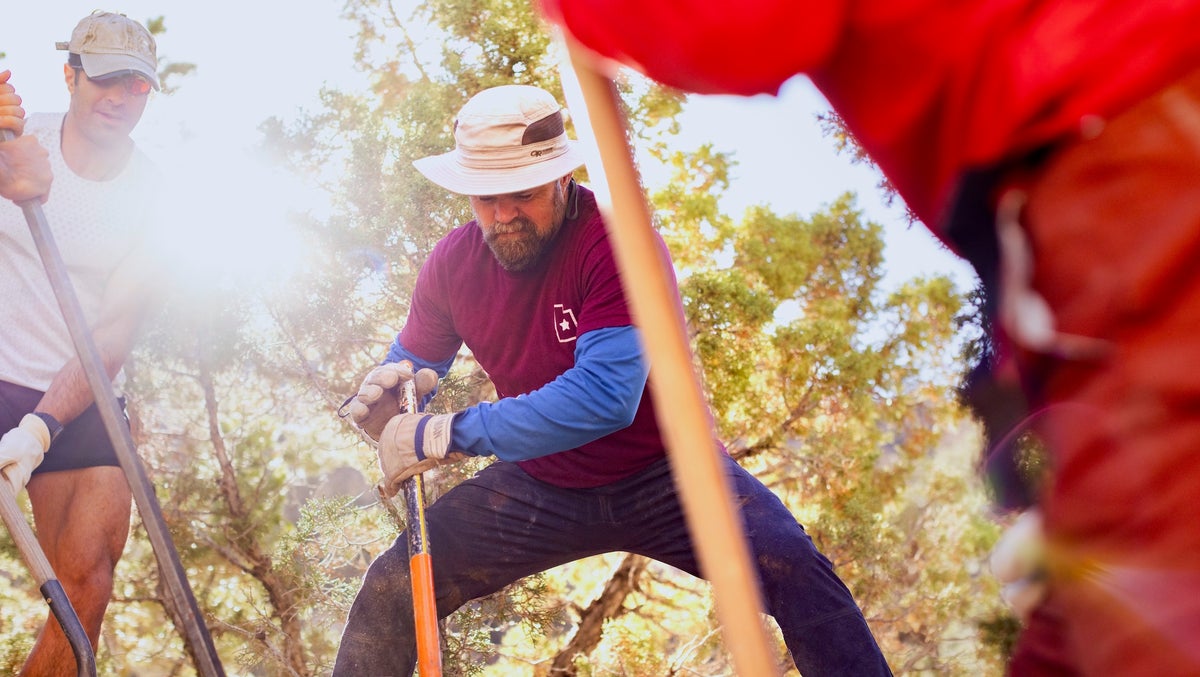
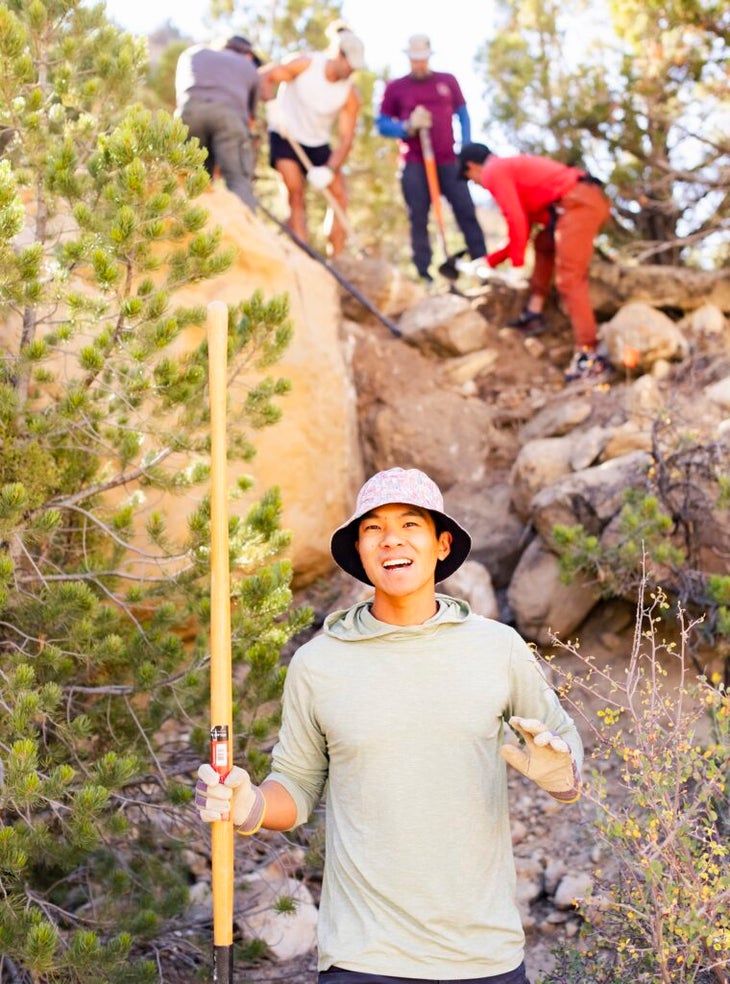
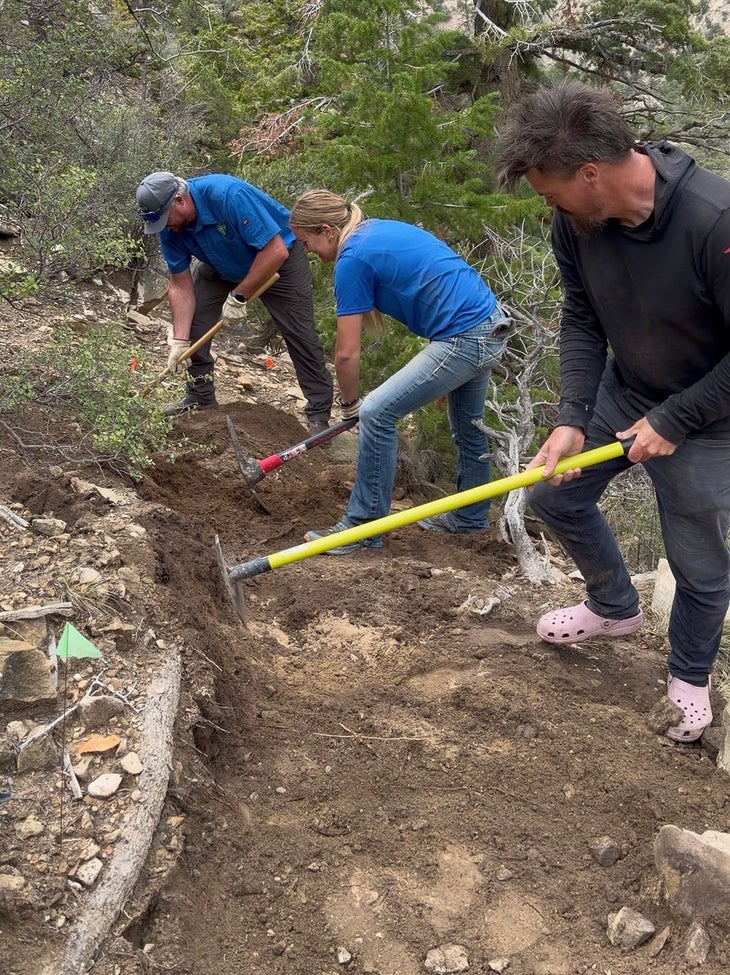
While the BLM helped with the trail access work, climbers have also stepped up to support the construction of 1.2 miles of new approach trails, as well as 1.5 miles of trail maintenance. Last year, Janus estimates that between 30 and 40 volunteers busted out the garden hoes, Pulaskis, and shovels during the annual Joe’s Valley Fest to help. Using the grant funds, the nonprofit also hired a private company, Alpine Forestry, to support trailbuilding this year.
What climbing communities can learn from Joe’s Valley
In times of record-high political division, a story where everyone more or less gets along is rare. Both Janus and Jeffery say that the key to proactively navigating competing land interests is focusing on solutions, rather than problems.
The Coalition quickly moved to build partnerships with all the stakeholders—the county, the BLM, the Forest Service, and the mining company. Once they started the conversation, they stayed open to adjusting the solutions they were proposing (i.e., parking lots and trails), to ensure that they worked for the whole community, not just the climbing community.
“We’re trying to bring locals and climbers together,” Janus explains. “It’s part of our mission.” Even if she doesn’t agree with the local government or a mining company rep, she can still try to understand where they’re coming from. “I try to see it from other people’s point of view,” she says, acknowledging that for many local residents of the gateway towns of Castle Dale and Orangeville, mining is their livelihood.
Jeffery thinks that the current situation in Joe’s shows what happens when climbers actually take the time to explain what they do to other land users. “Climbers have always been out in the woods sneaking around, but it’s a whole different world now with so many climbers,” Jeffery explains. “You can’t just hide in the woods anymore.” He says it’s never been more important to own up to our increasing impacts as climbers and befriend land managers—and even mining companies.
Of course, no two mining projects are alike, and the pre-existing Fossil Rock Mine differs significantly from some proposed mining operations, like the Resolution Copper project in Oak Flat, Arizona, which climbers and Indigenous leaders have been fighting in court. While the proposed Resolution Copper mine is foreign-owned and set to destroy a significant portion of the land, Fossil Rock supports an existing community, poses minimal impact to access, and is a subsidiary of a Utah-based coal producer.
“I would love these coal trucks to get out of my climbing area,” Jeffery says. But he acknowledges the fact that he ultimately depends on the energy that coal generates, too. “When a mine shows up, open up your vision scope to the full potential of everyone who needs to benefit in the area,” he adds, “If we don’t, it’s just fighting again and fighting gets us nowhere.”
Mead, the BLM rep involved in the project, echoes that appreciation for collaboration. “The new parking area and trail improvements are a great example of what can happen when land managers and user groups work together,” says Mead. “We appreciate the Coalition and all of the climbers who care about this place and help us keep Joe’s Valley a special place for people to enjoy for generations to come.”
What’s next for Joe’s
So far, Joe’s Valley Climbing and Community has only had to close access to one boulder due to its proximity to the mining operation: Thor’s Hammer (V7). Janus remains hopeful that the reopened mine won’t impact access to any of the other problems at Joe’s.
“We proactively closed off a boulder that is on mine property and rerouted a trail to another zone that crossed mine property,” Janus explains of Thor’s. “So far this has stopped any other access issues to boulders. But there is perhaps potential loss of access to others, hence part of the reason to mitigate approach trails.”
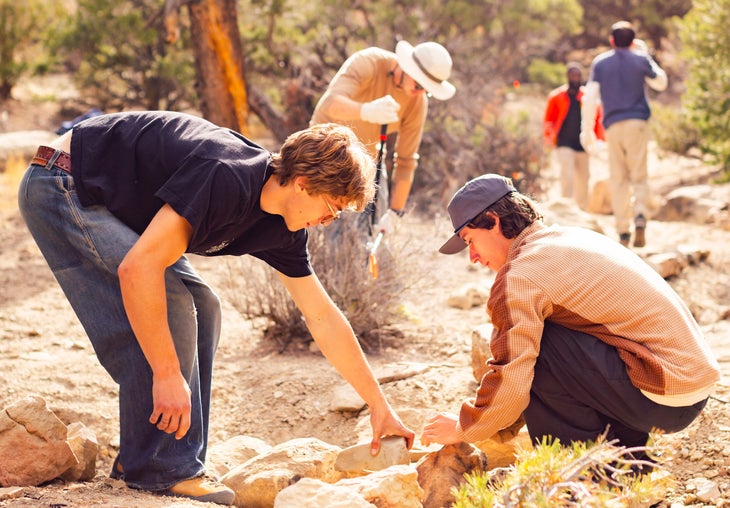
Next weekend, Joe’s Valley Fest will host climbers and locals for night bouldering sessions, local and artisan climbing clinics, and even a rodeo. During the fest, on October 4, the nonprofit is hosting a Stewardship Day, which often sees as many as 60 climbers participate. The goal? Keep the Joe’s dream alive through trail work and community.
The post When a Coal Mine Reopened at This Global Bouldering Destination, Local Climbers Got Out Their Shovels appeared first on Climbing.