 BURST
BURST
Terrence Loyer is dying. He just wants one more thing before he goes: A camping trip with his grandson.
In October of last year, the cancer-stricken 74-year-old was on a bus in Delta when he saw through the window an old camper van sitting in a yard — the kind he remembered from his youth, beige with brown stripes, a pop-up roof and horizon-wide front window.
That’s when the camping trip idea grabbed hold. Spur of the moment. He pictured himself and his 17-year-old grandson on the road like something out of a movie. Obi-Wan Kenobi and Luke Skywalker. Bruce Wayne and Alfred. Doc Brown and Marty McFly.
Loyer got off the bus, unfolded his walker and backtracked to the house.
“It looked like it had been sitting there for years. When vehicles have been left out, sometimes you can get them pretty cheap,” he said.
Loyer is on a minimal pension. He doesn’t have much to live on, or much time left. His advanced prostate cancer has spread to the hip, leg and spine. He’s on chemo and painkillers and would be homeless if not for the room at St. Paul’s Hospital Catholic Men’s Charities where he is waiting out his last few months.
“I’m quite happy here, I’m not in a lot of pain,” he said. “They say I’ve got two to three months to live.”
He has two adult sons who live in Red Deer, Alta., a 17-year-old grandson and a three-year-old granddaughter. Life and distance have troubled the relationships over the years.
“I wanted to visit,” he said.
The van called to him like a beacon. Maybe this was his ride.
He knocked on the door.
A man answered and agreed to show him the van.
“He started it up, it ran good, it had low kilometres,” said Loyer. “I was quite impressed. He said he only used it on weekends.”
Not only that, the man had several cars in his yard. Like Loyer, before he got sick, this was someone who tinkered with old cars, fixed them up and sold them. He felt he could trust him.
According to Loyer, the man agreed to sell it to him for $1,500. Loyer said he could go to the bank for the cash, but couldn’t get all the money at once.

“I gave him $500 and he wrote out paper to me saying the rest was to be paid by the end of December,” said Loyer.
The total to be paid on the note says $1,500, but doesn’t acknowledge that $500 had been paid. That’s when things got weird, said Loyer.
“He wanted to write another receipt for $3,500. He told me he didn’t want his son to think he sold it for such a low price.”
Loyer agreed, and on the I-owe-you note for $3,500, the van owner noted that $500 had been received. That made Loyer feel better.
The two remained in phone contact. On Dec. 15, Loyer showed up with $1,000 in cash for the balance.
“He wouldn’t accept cash, he wanted a money order,” said Loyer.
And he wanted it sent by mail. Loyer went to the post office and purchased a money order for $999.99, the maximum allowed. He enclosed a nickel to make up the difference, and sent the van owner the money order by registered letter.
When Loyer saw the registered letter had been delivered, he went to the house to pick up the van: “He answered the door and said, ‘No, you can’t have it.’ ”
Loyer alleges the man now wanted $5,000 for the van, and wouldn’t return the $1,500 Loyer had already paid.
“That’s when I realized I had been so stupid,” said Loyer. “I had signed the two bills saying $1,500 and $3,500.”
Loyer said he tried to recoup some of the money by offering to let the man keep the $500 deposit, but claims the man refused.
“He slammed the door in my face,” said Loyer.
Loyer reported it to the Delta police, who paid the van owner a visit. The constable later told Loyer that it was a civil dispute, and he would have to go to small claims court.
“I got ripped off. I was stupid,” said Loyer. “I’m on a lot of meds, I wasn’t thinking clearly. He lived in a house. I thought I could trust him.”
Postmedia News reached out to the van owner, who simply said “no” when asked if he would discuss the matter.
Whether it was a scam, fraud or just a case of two elderly men not thinking straight, one is richer, and one poorer.
Loyer wasn’t stupid. Like many people, he was acting on emotion and was vulnerable due to age and infirmity.
According to the Canadian Financial Crime Academy , scammers exploit victims by playing on emotions, exploiting cognitive biases and leveraging the instinct to trust. Loyer’s brain, amped up on emotion, bypassed critical thinking and inherent biases took over: optimism bias (I’m a good person, therefore everyone is good); authority bias (he lives in a house, he must be trustworthy); and confirmation bias (I believe we agreed on a price and that is enough).
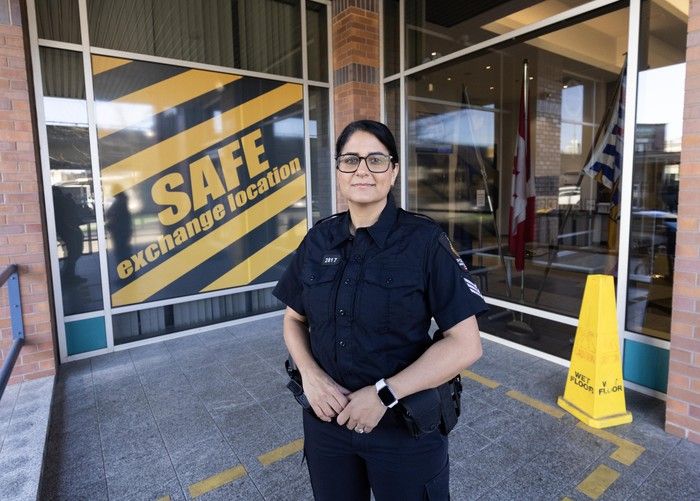
Sgt. Rita Raj, one of the founders of the VPD’s scam prevention for seniors program , said it’s an unfortunate situation, but when a verbal or written contract is in place, the matter would be civil, not criminal. Still, people like Loyer fit the bill for those most vulnerable to frauds and scams.
He was older, alone, possibly lonely, and on medication.
“They prey on that vulnerability,” said Raj.
The VPD’s free scam prevention seminars started in 2023 as “just a little idea,” said Raj. Demand has skyrocketed, and the Vancouver Police Foundation has hosted over 27 sessions in multiple languages throughout the Lower Mainland.
Seniors are particularly vulnerable.
“They’re lonely, spend a little more time talking to people on the phone, and if they do get scammed they feel even more isolated,” said Raj.
They’re less likely to report scams due to embarrassment and shame. They worry about having their freedom revoked, having their families take bank cards or laptops away, or bring up the dreaded word ‘dementia’.
Seniors with savings, pensions, home equity and strong credit are attractive targets. Many fall victim despite being highly educated and financially savvy, said Raj, in part because they’re socialized to respect authority.
“One of the top scams are bank card scams where a scammer calls impersonating the bank, saying your bank card has been compromised. In order to rectify the situation they say they need to come to your house and get your PIN number. Then they go straight to the bank and clean out your account,” said Raj.
If someone is coming over to your house, and the scam is in progress, call 911, said Raj. Police will attend.
Scams also occur when people make purchases from strangers or through Facebook Marketplace, Craigslist or social media. If it’s too good to be true, or you have to shell out money (you’ve won $10,000, or a free cruise, but you have to pay $500 first), it’s a scam.
Currently, many scams spoof police department phone numbers with calls and text messages demanding payment for a parking or speeding ticket.
“The police don’t collect fines,” said Raj. “Another one is the grandchild bail scam. Someone calls saying they are police, customs, jail and impersonate your loved one’s voice through AI: to a senior it’s grandkids in trouble and grandparents have lost thousands and thousands of dollars to these.”
Seniors who are lonely and looking for companionship through social media platforms are particularly vulnerable to the romance fraud, known as “pig-butchering” scams, where an online paramour fattens up their ego with compliments and love-bombing.
“This is where a lot of the embarrassment comes in,” said Raj.
She recently helped a senior whose family doctor called on their behalf, worried after the man confided he had been spending all his money buying gift cards for an online girlfriend he had never met, and now couldn’t pay his rent.
Red flags to watch out for include phone calls from anyone claiming to be the police, the CRA or the bank.
“Hang up and call us, call your bank, call the CRA,” said Raj. “Watch for spelling and grammar mistakes, links and attachments in emails, and there is never a reason to provide pin numbers, passwords, one-time codes or allow remote access into your software.”
Never deal with anyone requesting crypto, gift cards, prepaid cards or wire transfers.
Most police departments, including the VPD at 2120 Cambie St., have designated safe areas to meet the seller and complete the transaction.
“Ours is right in front of the entrance, in full view of all the cameras,” said Raj.
As for Terry Loyer, he’s out $1,500, and unsure of how to pursue a civil claim.
“I’ll probably be dead by the time it gets to court,” he said.
To register for one of the VPD scam prevention seminars go to vancouverpolicefoundation.org/scamprevention/