 BURST
BURST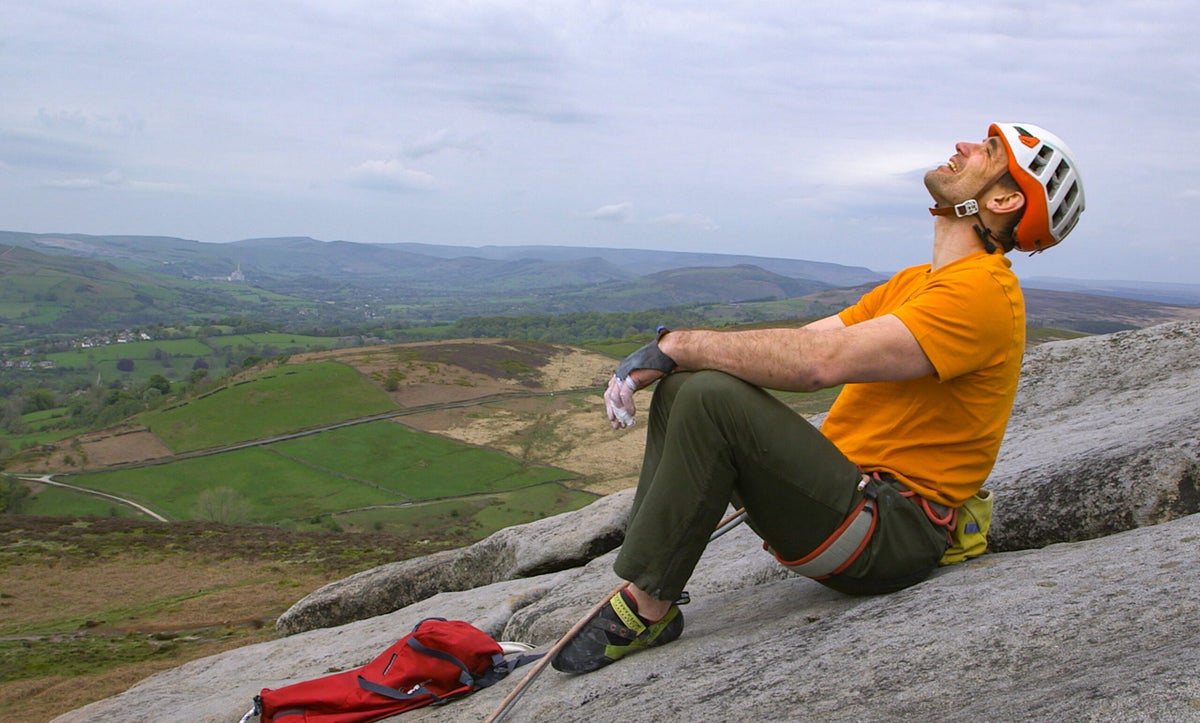
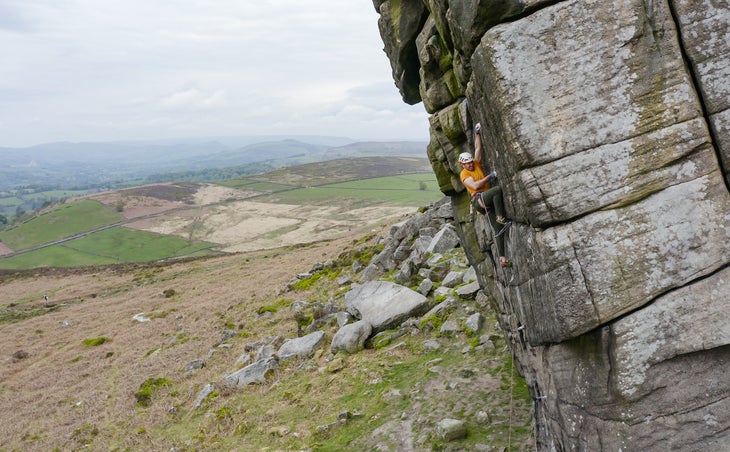
On April 23, British climber Jesse Dufton was coming close to sending his spring project, a trad route called Bat Out of Hell in the Peak District of the United Kingdom. It was Dufton’s thirteenth lead attempt, and he was a little over halfway up the line, entering the crux.
He fixed his feet into a horizontal seam. Then he crouched down off a right sidepull and a poor left crimp on what he describes as a “rounded ball thing.” He prepared to fire up into a massive left dyno, slapping high for a sloping, horizontal seam.
The catch? Dufton had absolutely no idea where his hand was about to land, because he’s completely blind.
Mostly onsight, always nonsight
Forty-year-old Dufton was born with rod-cone dystrophy. This rare genetic eye disorder causes gradual vision loss. He’s been functionally blind since his early twenties. Today, he can tell if it’s daytime or nighttime, but that’s it.
But Dufton, who led his first gear route at the age of 11, never let his vision loss keep him off the wall. To date, he has onsighted (or, as he calls it, “nonsighted”) more than 2,000 traditional routes around the United Kingdom. His wife, Molly, is almost always on belay, verbally guiding him up the rock.
Dufton’s projecting, however, is much less ambitious. He’s projected a grand total of three routes in his entire career. “My ratio is a bit skewed,” he joked.
This is partly because of the stiff UK gritstone ethics he was raised on. But it’s also because he finds trying new lines infinitely more enjoyable than rehearsing routes. “Onsighting is more rewarding, because you’re forced to solve the puzzle on the fly,” he said. “Nothing else quite ticks that box for me.”
To date, Dufton’s hardest sport route is Namaste (5.11d) in Zion National Park’s Kolob Canyon. His hardest trad send is Howling Gale (E3 6a) in Pembrokeshire, Wales, which would translate to the 5.11 range. Bat Out of Hell, at Higgar Tor in the UK’s Peak District, is harder than both. It’s also the first route that Dufton has ever headpointed—worked on toprope before trying on lead. Dufton put only two sessions into the 65-foot gritstone line on toprope before deciding to work it on gear, simply because the route is quite steep, and it’s hard to get back on the wall if you swing out.
The route is graded E5 6a in the United Kingdom’s combined scale, which denotes both physical difficulty and danger. The first metric, the E-grade of E5, describes the overall commitment of a route. This grade incorporates technical difficulty, but also exposure, rock quality, and gear placements. The second metric (6a) denotes the hardest physical move on a route, regardless of how many or where they are.
A direct translation is impossible, but E5 6a equates roughly to 5.11+ or 5.12- in the Yosemite Decimal System. Dufton said the route is on the safer end of E5, but it’s steep and pumpy. The only gear placement after the crux sequence is marginal—a cam in a flared, shallow crack—so a groundfall is possible. In terms of raw difficulty, he said the climb doesn’t feel near-limit for him, but it has four dynamic moves, so rehearsing it was a necessity.
“I’d never go for a dynamic move onsight,” he said. “If you can’t see your target, your odds of catching it aren’t great. So with Bat Out of Hell … the accuracy of making the dynamic moves was the hard bit. It wasn’t a question of how hard I could pull or how long my arms would last for.”
When I first met Dufton in 2023, he’d told me dynoing was out of the question for a blind climber like him. But with Bat Out of Hell, and the help of a toprope to rehearse the moves, that’s changed.
So, how does a blind climber dyno?
Dufton says it’s all about proprioception. This term describes the human body’s ability to sense its own position, movement, and orientation. “You have to understand the three-dimensional positioning of your body in space, and then imagine where the holds are in relation to it,” Dufton explained.
Even though Dufton can’t see, he feels his dynos are more accurate if he pretends to see, pointing his head in the direction of where he thinks the hold is. “I can usually do the movement if I point my head in another direction, but my accuracy almost always goes down,” he said. “So I look to where I think the hold is, and imagine that I can see it before I move.”
Beyond visualization, to land the dyno, Dufton must stay mentally attuned to how his body feels. Most of the preparation for throwing for a big move, he told me, consists of recalling muscle memory. He conjures up past successful attempts, trying to replicate that feeling.
“You visualize a little bit, but mostly you’re thinking about the feeling of all the different body positions,” he said. “You’re trying to remember your previous attempts, and how you set up, remembering how much you needed to pull on each of your biceps or push off each of your legs, trying to remember if your feet feel the same as they did the last time.”
It’s a strange sensory puzzle. “I honestly don’t know if there’s the vocabulary to describe this kind of feeling,” Dufton said.
Sometimes, he also tries something that might surprise climbers without any visual impairment: He closes his eyes. “I generally don’t have my eyes closed when I climb, because it takes concentration to keep them closed,” Dufton said. “But when I was doing the first series of moves on Bat Out of Hell, I often did them with my eyes shut, because it actually helped me concentrate. It helped me get in the right mental state to remember all the little micro-adjustments that I needed to do.”
The Bat Out of Hell beta
The first of Bat Out of Hell’s four dynos awaits at the start of the route. “You have a sidepull with your right hand and your left in a crack,” Dufton explained. “Your left foot’s outside edge is on a big shelf, and you have to pull in and slap your left hand up high to a ledge.”
The move is high-consequence. “You don’t want to mess up, because underneath there’s a load of sharp, jaggedy boulders that you’d be falling back onto,” Dufton said. “It wouldn’t be pretty.”
From there, the climber jams up higher. You plug a couple of pieces of gear, before laybacking up a large flake, roughly 10 to 15 degrees overhung. “The holds are big, but it’s modestly steep,” Dufton said.
After that comes the first of two horizontal seams. For a sighted climber, this seam is a bomber spot to place gear. For Dufton, it’s a bit trickier. “There’s some really good gear on the right, but it’s quite hard to place, because there’s a little slot, which is only just wider than the head of the cam. You’ve got to be very accurate,” he explained.
The dynamic sequence beyond this seam is the crux for Dufton. “You reach up above your head to get a side pull, but it’s kind of undercut, because at this point, you’re underneath it,” he explained. “Then you build your feet up, pull pretty hard on this sidepull as you get feet into that horizontal break where your gear is. Then you grab an intermediate, a poor, rounded ball thing, with your left hand, sink down and get ready to slap for that horizontal break.”
The way Dufton describes preparing to make a dyno like this, without any vision, is evocative of the metronome mechanics found in many video games, where one has to calculate the exact amount of force to land a shot. It’s something of a dice roll. “If you put too much power in, you’ll miss the break because you go too high,” he said. “But if you’re too tired, or put too little power in, you might miss the break because you don’t go high enough.”
The move is also sketchy because of the threat of inadvertently snaking a foot behind the rope as you throw. “On my second lead attempt, I slapped for the break, missed, and got my foot tangled behind the rope, in one of the pieces of gear, as I fell,” Dufton said.
He flipped upside down during his fall, and smashed his head into the rock. “It was quite nasty,” he remarked. “Luckily, my right buttcheek took most of the impact, but it was a good advertisement for wearing a helmet.”
Throwing into darkness
Back on Jesse Dufton’s thirteenth attempt on Bat Out of Hell, he crouched, preparing to launch into the move. He locked into the muscle memory he’d built over previous attempts. Dialing in his power calculation, he aimed his head up at a hold he couldn’t see and threw.
His left hand found the sloping seam. From there, he brought his right hand up to match it in another big throw. “That sloper isn’t very good, you can’t go up off it static, and you’re quite spread out, with both feet in the lower break, both hands in the upper break,” he recalled.
Even after landing both hands in this shallow, slopey seam, the route doesn’t let up. The only gear in the higher seam, a gold DMM (#4), is marginal. “The break that you’re placing the cam into is really quite flared and shallow, so you can’t get it as deep as you’d like,” Dufton said. He noted that many climbers don’t place it, but then risk a groundfall in the final sequence.
“There’s a little three-finger ripple that you can hold, but you haven’t got any decent feet,” Dufton said, “so you put your feet on the sidepull, but you can’t really push down, you’ve got to push sideways.”
From there, he made another dynamic throw up to a ledge, trusting his gold DMM. Beyond that, he fired a few insecure jams and a few more easy moves to the top.
When Dufton successfully pulled over the lip, he’d secured not only the hardest send of his career, but perhaps his most mechanically complex. He told me the climb opened his mind to the possibilities of headpointing and projecting. Perhaps Bat Out of Hell will unlock new, harder climbs that he never would have been able to do without the ability to practice a route.
But for now, he wants to ditch the rehearsals. “Honestly, I really just want to go do some onsighting,” he said.
The post British Climber Jesse Dufton Pushes His Trad Limits, Sight Unseen appeared first on Climbing.