 BURST
BURST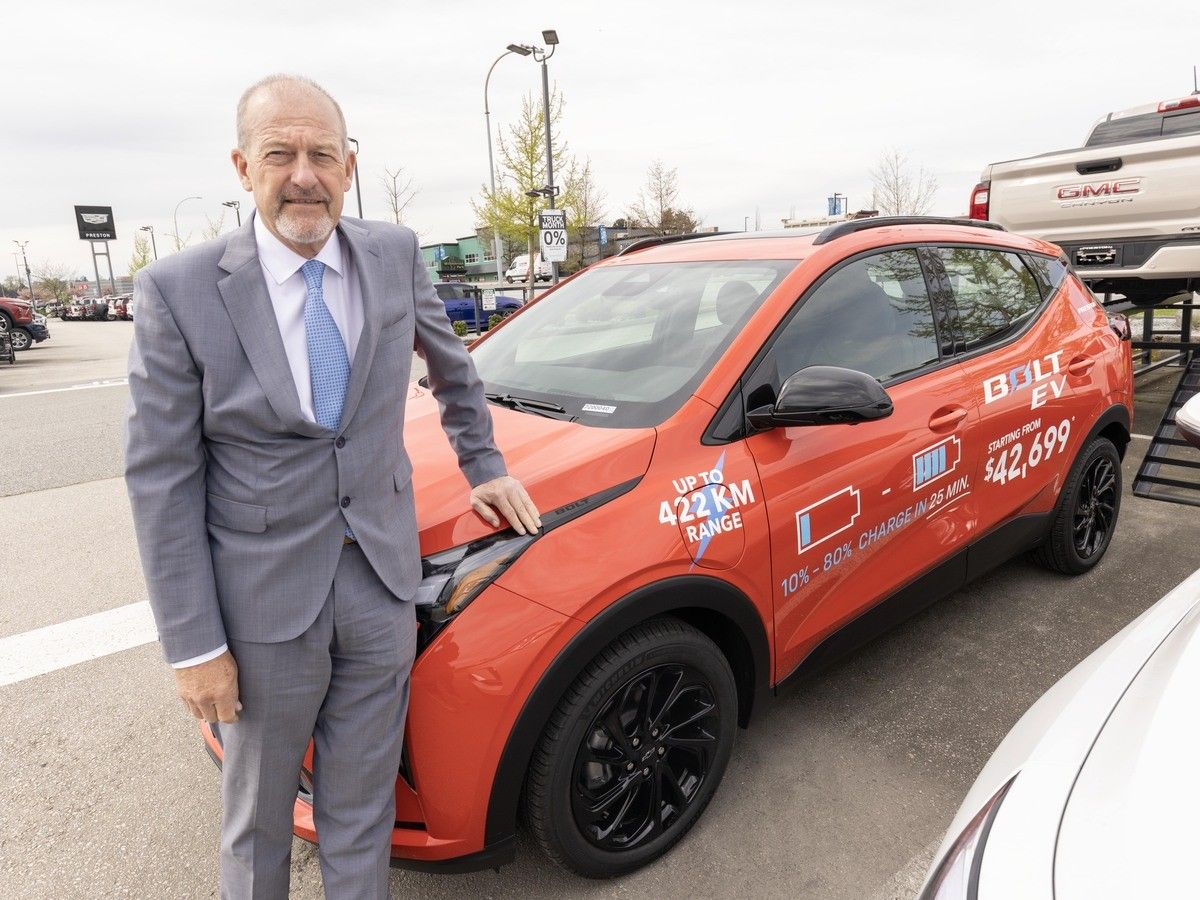
Peter Heppner, the boss at Preston GM in Langley, said his car dealership didn’t really see a dip in zero-emission vehicle sales after governments hit pause on rebates. But with gas still in the range of $2 a litre, he is seeing a surge now.
Last month, for the first time in Heppner’s career, his dealership sold more EVs than non-EVs, he said.
Heppner said disclosing the number would tip competitive information, but noted that Preston is one of the region’s larger dealerships and EVs have become “a very material portion of our business nowadays.”
“Nobody wants to pay for gas,” Heppner said. “It’s interesting. It doesn’t matter how expensive the vehicle is that we sell, and we have some that are way up there nowadays, but nobody wants to pay for gas.”
The rebound in zero-emission vehicle sales, both EVs and plug-in hybrids, is being experienced by B.C. dealerships across the province as consumers struggle with high gas prices and react to the reinstatement of federal rebates, according to the New Car Dealers Association.
The association tracks numbers through Statistics Canada, which found that in February, B.C. dealerships racked up a 36 per cent increase in zero-emission sales, to 2,614 new vehicles. That accounts for almost 19 per cent of all vehicle transactions.
The number falls below the province’s CleanBC program targets for zero-emission adoption, but it marks a reversal of a sales slide that followed the suspension of federal and provincial rebate programs that saw zero-emission transactions fall to just 13.7 per cent of total sales in January.
New Car Dealers Association CEO Blair Qualey said the reappearance of rebates is a big part of the shift.
The federal government in February reintroduced rebates that it paused at the beginning of 2025 under a new electric-vehicle affordability program, which offers incentives of up to $5,000 for the purchase fully battery-electric vehicles and $2,500 for plug-in hybrids.
B.C. hasn’t brought back its incentive program, but nationally, Statistics Canada recorded a surge in sales.
In February, sales nationally added up to 12,626 new zero-emission vehicles. Taken within all 124,004 new cars sold, they accounted for 10 per cent of sales. Across Canada, that is a 47 per cent increase from the same month a year ago.
“What we are seeing is a direct response to both economic conditions and policy decisions,” Qualey said.
Consumers, however, aren’t just responding to those direct incentives. They are also taking greater comfort in factors such as government investments in public charging infrastructure, according to the marketplace site AutoTrader.
AutoTrader, in the 2026 edition of its electric vehicle insights survey, had a rebound in sentiment towards EVs from non-EV-owning respondents.
“We’ve been doing this survey since 2022,” said AutoTrader executive Baris Akyurek. “And the percentage of those who were interested in buying an EV at the time was 68 per cent.”
However, that number slid to 56 per cent in 2023, 46 per cent in 2024, and 42 per cent in 2025.
But this year, it went back up to 49 per cent.
“So, there’s quite a bit of an uptick,” said Akyurek, vice-president of insights and intelligence.
There are various reasons behind this, he said, including the return of federal rebates and infrastructure spending.
Akyurek added that high gas prices can’t be underestimated in the equation either. Aside from the survey, AutoTrader tracked a 33 per cent surge in searches for EV listings in March, which corresponded with a rise in gas prices of almost the same magnitude due to war in the Middle East.
At Westwood Honda in Port Moody, general manager Rysam MacIver knows that whenever gas prices spike, his dealership will see an increase in customers looking for EVs.
“With the recent gas price spike due to the political climate, we’ve seen a lot of people who were curious become very interested and made the switch,” MacIver said.
Most of MacIver’s EV inventory is used vehicles and in March those transactions made up 26 per cent of their sales.
“In April, it seems that trend is continuing,” he added.
However, beyond EVs, MacIver said Honda’s wide range of hybrid vehicles, including Civic, Accord and CR-V models, have become the most popular on their lot. In March alone, he said they sold 59 hybrids — 66 per cent of overall sales.
“Beyond gas prices, a lot of people commuting have benefited from the ability to use the HOV when owning an EV,” MacIver said. “So it’s saving tons of time commuting in our ever changing traffic landscape.”