 BURST
A few months ago, Paramount owner David Ellison succeeded in forcing California and Democratic states attorneys general to drop their antitrust suit against his acquisition of Warner Brothers. He used a variety of tactics, including a threat to move the studios out of the state, and ultimately bluffed the elected officials into folding. BIG predicted at the time that Ellison’s threatened capital strike, along with political coercion, was a preview of what is to come if voters choose Democrats as a Congressional majority.
And sure enough, that’s what one of Ellison’s close allies - Elon Musk - just did. Earlier this week, following reports that Musk had throttled Ukraine’s access to his Starlink satellite network, Politico ran a story that several Dem members of Congress are gearing up to hold oversight hearings if the midterms go their way in a couple of weeks.
Musk responded by explicitly threatening any Democrat or institution seeking to scrutinize him, his portfolio of companies, or his time at DOGE. Here’s what he said:
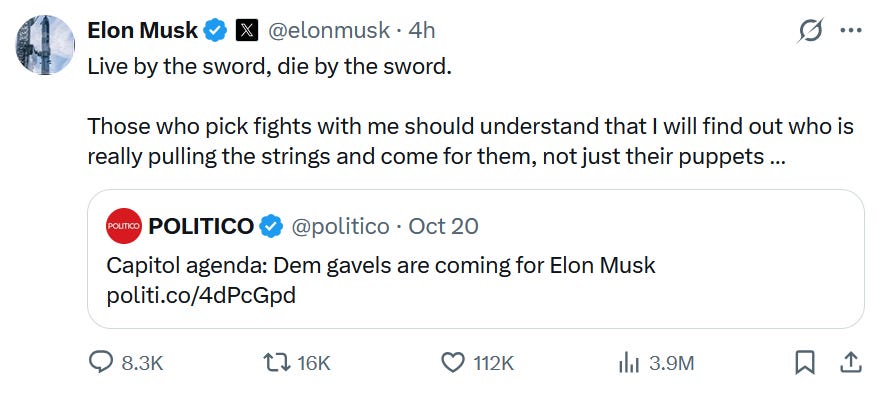
It’s a remarkable statement, and it speaks to a fundamental view held by Musk and his allies that the votes of ordinary people simply should not count. He and a small circle make the key decisions in our society.
Musk tweets so much that it’s hard to keep track of his views, but he is also explicit about that point too:
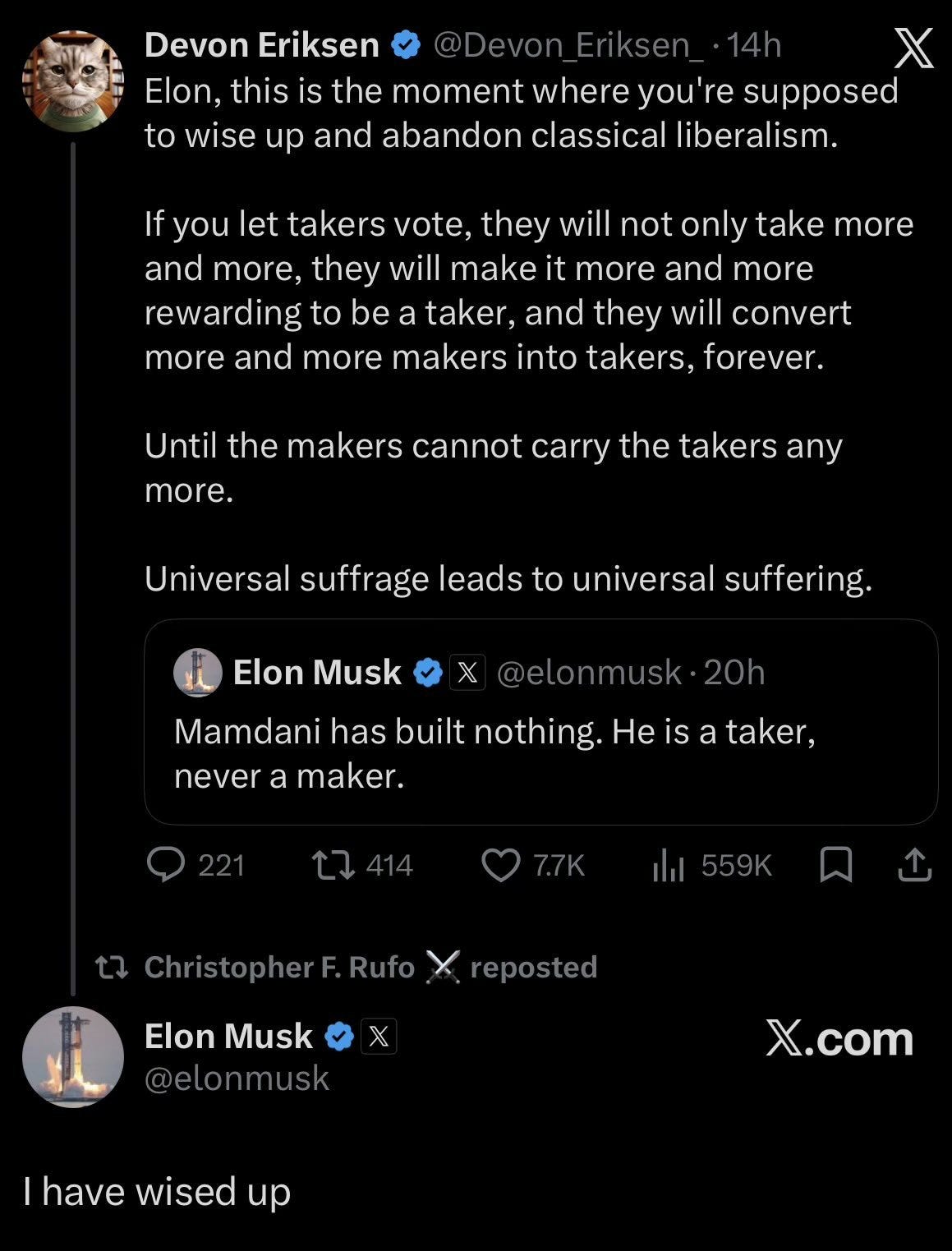
Musk’s political threats are not really the story. The story is that he actually has the leverage to make them real, through a network of political influence and, more importantly, control over key social infrastructure. As with Ellison’s ability to harm California, Musk can actually threaten the Pentagon, foreign countries, and the U.S. government itself. And he does.
The story is that, depending on the outcome of the midterms, which we’ll know a lot more about in 11 days, we’re entering a new phase of a battle between democratic systems and oligarchical ones that will test the limits of Musk’s extraordinary power and the temerity of Democrats to actually do something about it.
The Fool on the Hill
Let’s start by reckoning with Musk’s power, which spans all sorts of infrastructure, campaign finance, and media. As to his control over critical infrastructure, the most salient revelation, and the catalyst for renewed political controversy, is Musk’s apparent role in throttling Ukraine’s access to military-grade satellite service through Starlink, a satellite-based internet network operated by Musk’s aerospace company, SpaceX. Ukraine took significant damage and was unable to orchestrate its offensive strategy against Russia as a result of the cut-off.
How does this system organize the fate of wars? Starlink is adjacent to Starshield, a SpaceX service that provides secure communications for governments. It’s a critical piece of national security infrastructure. And that goes beyond providing internet access to war-torn battlefields.
By some accounts, Starlink operates roughly 75% of all active maneuverable satellites. It provides internet service designed to connect homes, businesses, vehicles, ships, aircraft, and more, including in remote locations that are poorly served by existing broadband or fiber-optic cables.
And it’s increasingly important commercially. Just yesterday, United CEO Scott Kirby cited the airline’s partnership with Starlink for boosting its market share. (To believe this, you have to believe there’s actually enough competition between airlines for Starlink to make a difference, and I have my doubts, but it’s clearly a useful service.)
SpaceX has private shareholders, but it is a government sanctioned firm whose growth over the past two decades is fundamentally owed to public funds, some $48 billion in contracts, loans, subsidies and tax credits, as well as access to key public space infrastructure. SpaceX started receiving DARPA money in 2003, a year after SpaceX was formed, and has been a go-to private contractor for every administration since. In other words, Musk’s control over essential infrastructure, and his ability to wield it privately despite procurement terms superficially nodding to safeguards, is a bipartisan creation of the federal government.
There is some debate over the extent to which Musk wields that power unilaterally or in collaboration with government officials — it’s far closer to a public-private partnership than a purely private entity — and a 2023 expose by Ronan Farrow reveals how that collaboration looks more like dependence across swaths of the federal government:
Current and former officials from NASA, the Department of Defense, the Department of Transportation, the Federal Aviation Administration, and the Occupational Safety and Health Administration told me that Musk’s influence had become inescapable in their work, and several of them said that they now treat him like a sort of unelected official. One Pentagon spokesman said that he was keeping Musk apprised of [Farrow’s] inquiries about his role in Ukraine and would grant an interview with an official about the matter only with Musk’s permission. “We’ll talk to you if Elon wants us to,” he told [Farrow]. In a podcast interview last year, Musk was asked whether he has more influence than the American government. He replied immediately, “In some ways.”
Not unlike other historical and contemporary barons of distribution networks, from Cornelius Vanderbilt to Jay Gould to Andrew Mellon to Jeff Bezos, Musk’s control over infrastructure provides him with leverage over public institutions. His quasi-unilateral intervention in the Ukraine-Russia conflict is one example. And the way that power works is by threatening to pull the deployment of that infrastructure, or discriminate between who can access it, which has commercial and geopolitical implications. It’s the power of a capital strike, not unlike Meta’s renewed threat, just yesterday, to cut off service to the State of New Mexico in response to a jury verdict finding them liable for over 43 million violations of the state’s unfair practices law. Or take (Amazon) your (Google) pick (Uber/Lyft), really, because capital strikes are as American as unbridled monopoly power.
Musk’s threat is also to use his wealth, so much of which is traceable to benefits conferred by the government, to distort our democratic elections. Bloomberg’s Billionaires Index estimates that SpaceX is the source of over 75% of Musk’s overall net worth, which hovers around $1 trillion. And Musk’s election spending is a business investment for which he expects a return. As of mid-October, nearly 50 megadonors had spent close to $2.4 billion on the midterm elections, and Musk’s $369 million in campaign contributions dwarfs everyone else. At least $176.8 million has gone solely to support Texas AG Ken Paxton’s bid for the Senate and to oppose Democrat candidate James Talarico.
Musk is far from the first, or only, oligarch to wield other instruments of persuasion, including the media. His purchase of Twitter/X evokes Henry Ford’s 1919 purchase of the Dearborn Independent, then the second most widely distributed newspaper behind the New York Times, in the wake of his Senate campaign loss. And just as Henry Ford used his newspaper to grind various political axes, with a heavy dose of overt antisemitism, Musk’s takeover of Twitter has amplified partisan conservative voices and driven social wedge issues to divert attention from a more unifying politics.
Add to Musk’s efforts to control the public commons his lawsuit against Media Matters, alleging that the watchdog group interfered with Twitter/X contracts and economic advantage when it published a report showing advertisements appearing next to pro-Nazi content. Understandably, many advertisers pulled their spending from Musk’s platform. Here, Musk’s effort to censor his opponents is also a threat to bury any other opponent in litigation costs. And it’s yet another data point in Musk’s leverage over the federal government, reflected in the Trump administration’s transparent weaponization of antitrust. The FTC’s own, subsequent investigation into Media Matters is hard to see as anything but the abuse of public resources at Musk’s behest.
Ladies and Gentlemen, the Democrats!
But of course, Musk and the billionaires are one part of the equation. The other is voters, who are choosing to move away from DOGE and the Trump era by voting for the ostensible opposition party. And what are some of those Democrats likely to do? That’s less clear.
One response is to campaign on the blatant corruption eroding our democracy, as Talarico is doing. Multiple studies have observed that ad saturation driven by massive campaign spending can have marginal returns on voter persuasion and eventually lead to voter suppression. And on some level, voters react to the source of funds. A recent Data for Progress poll showed that 75% of likely voters were less likely to vote for candidates who receive support from the AI industry. Musk is polarizing, at best, and has a net-negative favorability rating even in Texas.
A different response, one we saw with the Skydance merger, is to cower and fold before the superrich. For example, even though support for AI - another area of Musk investment - has become a third rail in politics, some Democrats are backing away from talking about it at all:
Senior Democrats and candidates are worried that if they go too hard in criticizing AI, industry-affiliated super PACs could drop millions more dollars against them, according to interviews with more than a dozen Democratic lawmakers and strategists. They are especially worried about a slate of competitive races, including Reps. Don Davis in North Carolina, Marcy Kaptur in Ohio, Henry Cuellar in Texas and a handful of South Texas and Pennsylvania races, getting hit with even more spending on topics like AI.
I have experience in politics and in running large legislative campaigns, so here I’ll offer advice. Be direct and aggressive against men like Musk. Politicians don’t need to chase every polarizing issue, but the inability to put forward an honest and moral position on a defining economic and social question kneecaps the ability to harness broader political support.
And we can see that because Republicans increasingly want Musk’s money, but don’t want him near their campaigns. Musk’s donations are funneled through political action committees like the Senate Leadership Committee, America First, and Lone Star Liberty, none of which bear his name. And while Republicans have been far less critical overall of Musk’s political interloping, several spoke out against his DOGE cuts, and Rep. Mike Turner of Ohio has joined calls for an oversight hearing on Musk’s weaponization of Starlink in Ukraine. Republicans are constrained by Musk’s giving to form a more coherent political message. Democrats shouldn’t be.
The Government Gave, and the Government Can Take Away
Here’s my prediction. I don’t think Dems will back down from their calls for oversight hearings regarding Musk’s conduct. And I suspect some Republicans will join, particularly if Dems overperform in the midterms. The fact about people like Elon Musk is that their power is also their weakness. Campaign consultants can hardly beg for a more perfect foil than someone whose most identifiable consumer product, the Cybertruck, is a politically charged purchase and a visual manifestation of ego.
But it would be naive, if not damaging, to think that oversight hearings are adequate on their own. Oversight hearings easily drift into theatrical content farms, and viral social media clips, on their own, risk reinforcing a growing perception that too many Democrats are more adept at pretending to care than doing anything meaningful to generate durable outcomes.
More importantly, the question isn’t whether there should be oversight, but the point of that oversight. It’s critical to neutralize Musk’s ability to threaten nation-states and our own government, and if that means building the case for breaking apart his empire or imposing new rules, that must be baked into the hearings from the beginning. A free society cannot be bullied by threats of capital strikes, particularly as to essential infrastructure, and the ability to channel capital must be done through democratic means.
What would real oversight of oligarchs look like? Well, it would mean seeking intel about corrupt slush funds for the White House ballroom or Trump’s presidential library, about the purchase of equity stakes in companies like Anduril just before receiving nearly $1.8 billion in government contracts, about leading a $300 million investment in Polymarket while it receives conspicuously favorable regulatory treatment, or about $2.6 billion in stock trades immediately prior to the Iran war. It would also mean simultaneously governing, by moving legislation to close the McDonnell “official acts” loophole, to ban profiting off of public service, and to ban Congressional stock trading. When the next President takes office, Congress should abandon the filibuster to do these things. The path to durable governance is through tearing down parliamentary barriers to governing.
Moreover, oversight hearings cannot stop at the low hanging fruit. Democrats must create a drumbeat for oversight of corporate bad actors. It’s a target-rich market: JetBlue and Instacart on surveillance pricing, Live Nation inducing a corrupt settlement with the Justice Department amid their losing antitrust trial, Skydance on its relationship to sovereign wealth funds, Jeff Bezos and Amazon on their ongoing monopolization of e-commerce, HPE-Juniper on the circumstances of their corrupt merger settlement, the Big Three PBMs, the Big Four Meatpackers, KKR and Black Bear on private equity crippling youth sports, Nvidia, OpenAI and Anthropic on the efforts to hide the private financial risk of the AI bubble in a systemically vulnerable network of private credit, insurance, pension funds and banks. And on and on.
And Elon Musk. The richest welfare recipient in the world. As to Musk, the most obvious thing to do is not a matter of partisan convenience, but of strategic necessity: nationalize SpaceX. It’s something Matt has written about for BIG previously. SpaceX should be treated like a public utility. It’s a private company in form, but hardly so in terms of the government funding that has been central to its growth.
Will Democrats actually accomplish real oversight? I don’t know. But I can say that squandering power breeds resentment, and fear of reprisal is an abdication of the duty to govern.
Fundamentally, Musk’s threat, “Live by the sword, die by the sword,” is a cautionary admonition against violence, taken from scripture, Matthew 26:52. Perhaps the best response draws from another scripture, Job 1:21, “The Lord gave, and the Lord hath taken away.”
Thanks for reading! My name is Lee Hepner, I’m a guest-writer for BIG while Matt is out on paternity leave. Your tips make this newsletter what it is, so please send tips on weird monopolies, stories I’ve missed, or other thoughts. And if you liked this issue of BIG, you can sign up here for more issues, a newsletter on how to restore fair commerce, innovation, and democracy. Consider becoming a paying subscriber to support this work, or if you are a paying subscriber, giving a gift subscription to a friend, colleague, or family member.
cheers,
Lee Hepner