 BURST
BURSTIn September 1999, American climbers Alex Lowe, Conrad Anker, and David Bridges were on an expedition to Shishapangma (8,027 m), a Himalayan peak and the 14th-highest mountain in the world. The team was part of the 1999 American Shishapangma Ski Expedition, which aimed to document big-mountain skiing.
Lowe and Anker were slated to attempt a ski descent from the summit, a feat that would have made them the first Americans to ski an 8,000-metre mountain. Bridges, a two-time U.S. national paragliding champion, was part of a three-man film crew documenting the expedition for an NBC production sponsored by The North Face.
Lowe had long pursued the goal of skiing from an 8,000-metre summit, but emphasized that conditions and terrain mattered as much as altitude. He described Shishapangma as offering the most direct and aesthetically appealing ski line among the world’s highest peaks, with a continuous descent down the mountain’s Southwest Face.
“Our goal in 1999 was to ski the central couloir on the mountain,” Anker said in a newly released mini-documentary about Shishapangma. “The first time we saw the mountain was, um, OMG, what did we get ourselves into?”
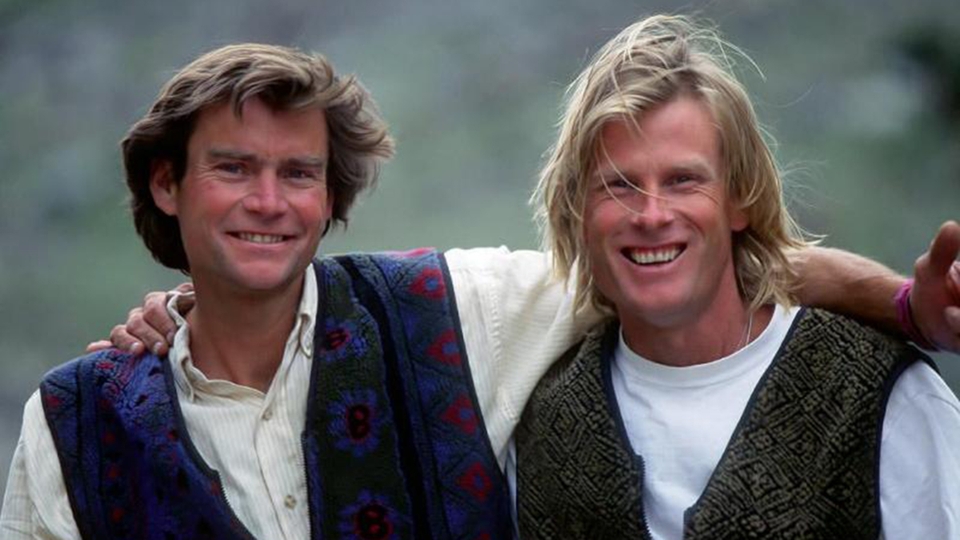
On Oct. 5, the expedition split into two teams to search for viable routes up the mountain. “It was an acclimation day, quote, rest day,” said Anker. “David and Alex and I walked up this lobe of glacier, and at one point we looked up and an avalanche started, and fight-or-flight, death is happening.”
Lowe, Anker, and Bridges were travelling together across a flat glacier when a massive serac broke loose high above them. “I had contoured and went a direction like this,” said Anker. “Alex and David had gone downhill and got picked up and thrown, like some 30 metres, pummeled, cracked ribs, concussion.”
The collapse triggered a wide avalanche that swept across the glacier, engulfing all three men. “I stood up and I was enveloped in this huge, massive cloud of very fine snow particles,” said Anker. “And as that cloud settled down and the sun came out, it was like they were gone. They disappeared.”
The avalanche, estimated to be 500 feet wide, struck with devastating force. Anker was thrown roughly 100 feet by the wind blast and sustained serious injuries, including a head laceration, two broken ribs, and a dislocated shoulder. Despite his injuries, he managed to free himself from the snow and initiate a rescue effort.
Anker, along with other team members, spent nearly 20 hours searching the debris field, which in places was several metres deep. The effort was ultimately unsuccessful. The bodies of Lowe and Bridges were not located at the time, and the mountain claimed both men.
“And being the only one who walked away, to me there was a weight to it,” Anker said. “The PTSD layered on top of the survivor’s guilt, which I did not really understand until later. We have a great time up there and we celebrate what mountains are, until they go wrong. And when they go wrong, they go really wrong. Then you question why we are pursuing this sport and what the sense of it is.”
Nearly 17 years later, on April 27, 2016, Ueli Steck and David Göttler discovered the remains of Lowe and Bridges emerging from the glacier. The finding brought long-delayed closure to one of the most tragic losses in American high-altitude mountaineering history.
Shishapangma
The post Conrad Anker Talks Deadly Avalanche in 1999 on Shishapangma appeared first on Gripped Magazine.