 BURST
BURST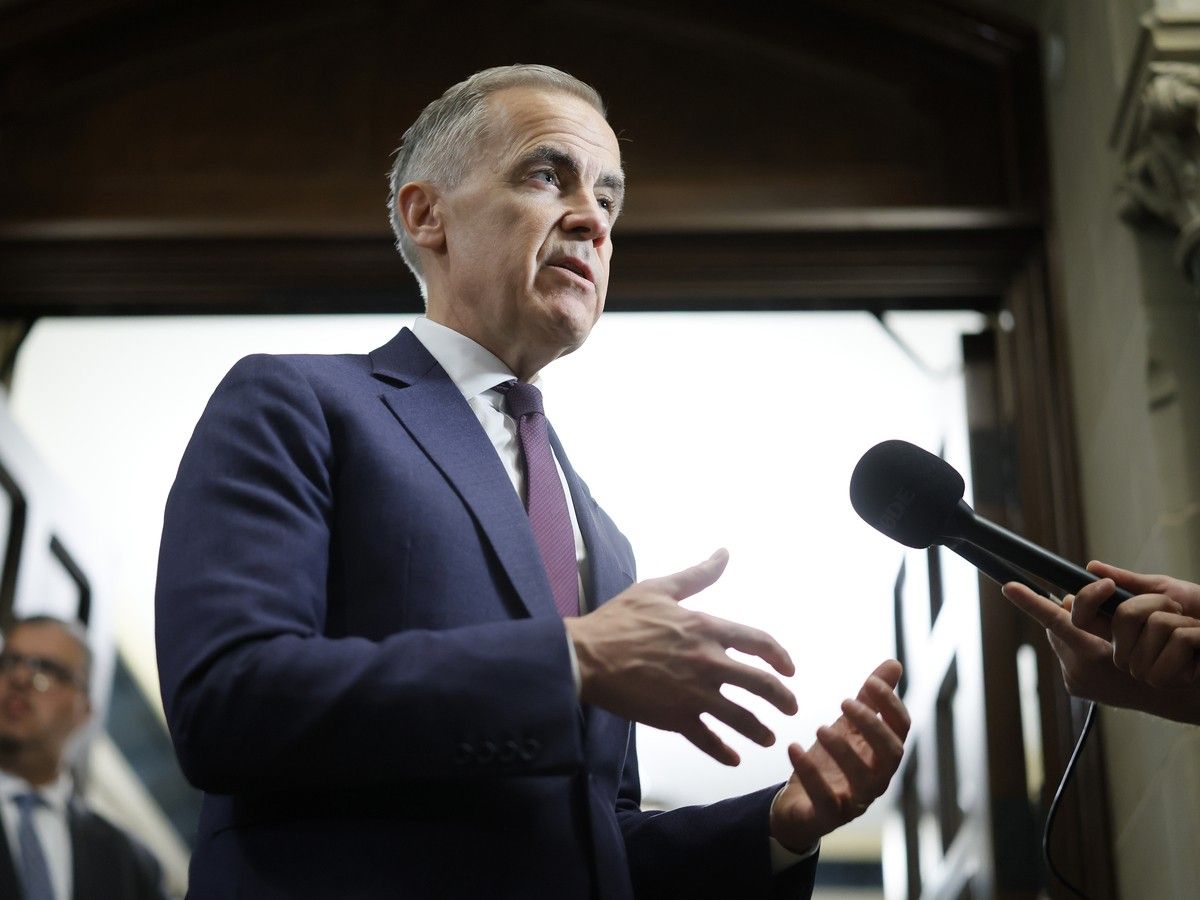
OTTAWA — Prime Minister Mark Carney said the Trump administration’s latest threat of tariffs following an investigation into forced labour supply chains is “not a surprise” and that Canada supports the overall objective of ending the practice of forced labour.
Speaking on Wednesday, Carney also hinted his government will soon be proposing more stringent measures to better halt the importation of these slave-made goods into Canada.
“Canada has a very strong legislative regime against forced labour in supply chains,” he said. “We don’t want any element of forced labour coming in goods and services, and we want to use our influence to eliminate this practice of forced labour and child labour.”
Carney said his government has been looking at ways to “reinforce” its regime to better stop imports of forced labour and said the intention is to table those legislative measures in the House of Commons before the end of the session on June 19.
The United States Trade Representative (USTR) released a report late Tuesday which said that Canada, Mexico, the European Union and other countries have “failed to effectively enforce a prohibition on the importation of goods produced with forced labour.”
The USTR is invoking section 301 of the Trade Act of 1974, which is designed to address unfair foreign acts, policies or practices affecting U.S. commerce.
As a result, the Trump administration proposes those countries, which include Canada, be hit with 10 per cent additional tariffs. Dozens of other countries which have partial or no bans on forced labour imports could be hit with a higher duty of 12.5 per cent.
“The failure of our most important trading partners to address the importation of goods made with forced labour is unacceptable,” said U.S. Trade Representative Ambassador Jamieson Greer in a statement.
“This creates a dynamic where American workers are forced to compete globally on an unlevel playing field,” he added.
Dominic LeBlanc, the minister responsible for Canada-U.S. Trade, met with Greer in Washington D.C. on Tuesday to relay Canada’s position on the issue.
“I would say that the conversation today helped the Americans understand our shared commitment to issues like… the question around forced labour and the fight against forced labour,” LeBlanc told reporters at the outset of the meeting.
“It won’t surprise you that we share the concern of the Americans and other economic partners that we need to do everything we can together to face this challenge,” he said.
LeBlanc, however, would not speculate on whether Canada would retaliate if these new tariffs went ahead.
“We’re not going to answer hypothetical questions about a potential response to a measure that we haven’t seen,” he said.
In 2020, Canada implemented an import prohibition on goods produced wholly or in part by forced labour through an amendment to its Customs Tariff, in compliance with the Canada-United States-Mexico Agreement (CUSMA) which had just replaced NAFTA.
Other legislative efforts further improved transparency. In 2023, former Liberal MP John McKay passed a private member’s bill that requires companies to report any possible forced or child labour in their supply chains and in their annual financial statements.
The USTR report claims that in the past nearly six years, “the number of enforcement actions Canada has taken to prevent the entry of forced labor goods is minimal.”
“The little information that is available regarding enforcement statistics suggests that, between 2020 and 2026, Canadian authorities intercepted just 50 shipments for suspicion of forced labour, with only two shipments ultimately prohibited entry,” it reads.
The report also takes aim at the Canada Border Services Agency (CBSA), the agency responsible for enforcing the prohibition on forced labour imports, as it “does not appear to publish official statistics or other information regarding its enforcement efforts.” CBSA was not immediately available to respond to those claims.
Finally, the report takes aim at Canada being a possible “dumping ground” for exports of forced labour which may have been denied entry into the United States.
On his way to his weekly caucus meeting, Carney stopped to tell reporters that, “with respect to these 301 tariffs, this is not a surprise, it’s something that the U.S. has been planning for a few months.” The USTR initiated the investigation back in March.
He also noted that the consultations on the new proposed tariffs will be happening for about 30 days, and that Canada will still benefit from its carve-out with CUSMA.
“So, that puts us in a position where, again, we would still have the best trade deal of any of the U.S. trade counterparts,” he said.
It is not the first time that American legislators have complained that Canada has not been doing enough on the file of forced labour imports.
In 2024, a group of U.S. senators, which included now U.S. Secretary of State Marco Rubio, called on the U.S., Canada and Mexico to take more action so that slave-made goods, especially by Uyghurs in China’s Xinjiang region, don’t end up on North American shelves.
National Post
calevesque@postmedia.com
Our website is the place for the latest breaking news, exclusive scoops, longreads and provocative commentary. Please bookmark nationalpost.com and sign up for our newsletters here.