 BURST
BURSTToday, Attorney General Pam Bondi fired antitrust chief Gail Slater, who was considered a hawkish enforcer skeptical of big tech. Bondi and her deputy, Todd Blanche, had come to dislike and distrust Slater, for a variety of reasons. She had ruffled feathers of corporate allies, been slow to achieve much, and had played her internal politics poorly.
But there’s another reason she was ousted. Corruption. For months now, Bondi and Blanche have been overruling Slater’s decisions, both big and small, often at the behest of a corporate lobbyist and MAGA influencer named Mike Davis, one of whose clients is Ticketmaster/Live Nation.
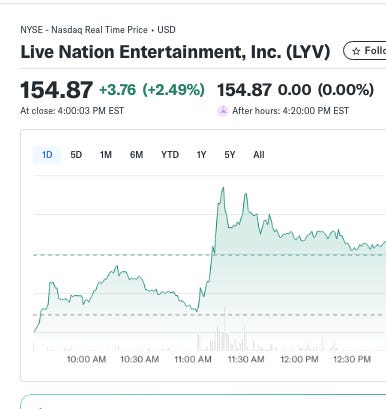
And indeed, Live Nation’s stock jumped on the news, on the expectation that the antitrust case seeking to break up the company, slated for trial next month, may be settled or dropped.
It’s been an ugly fall from grace for Slater, who worked as an advisor to J.D. Vance in the Senate and was considered a flag-bearer for the populists on the right. It’s also instructive, because it reflects the final victory of corporate power and the Epstein class within the Trump coalition.
We’ll start with the Slater’s appointment to the job. She came in with great promise, appointed and confirmed in March of 2025, which is very early for an antitrust chief. 78 Senators voted for her, an unusually strong bipartisan endorsement for a Trump appointee. And Trump liked her personally. “Big Tech has run wild for years,” Trump said in announcing the pick, “stifling competition in our most innovative sector and, as we all know, using its market power to crack down on the rights of so many Americans, as well as those of Little Tech!”
Slater had a business coalition behind her, some sympathy from progressives, the trust of the Senate, and the President and Vice President. And she was at first walking tall, snapping necks and cashing checks. She inherited the Google adtech case after the arguments were done, and the Judge ruled for the government. Her Division recommended to courts that they be skeptical of of the use of algorithms to collude on price.
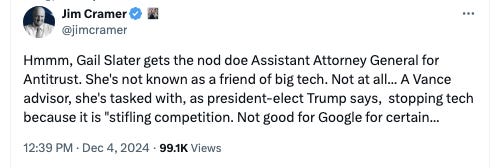
And Wall Street noticed. Here’s Jim Cramer, expressing fear after she was nominated.
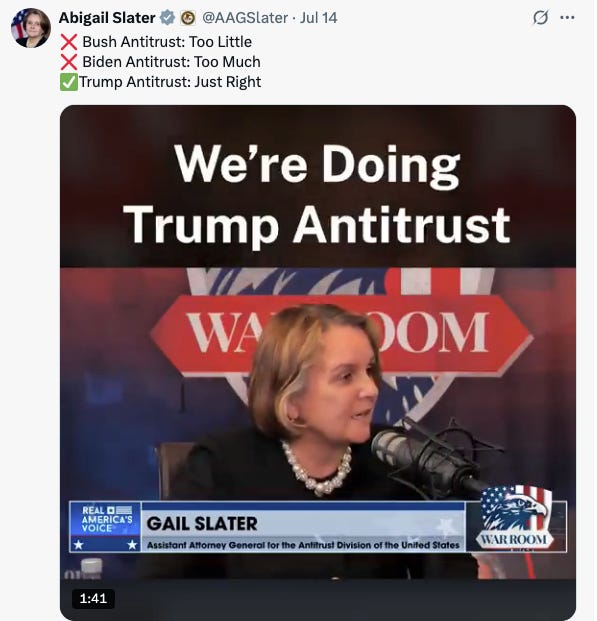
But there was a certain arrogance to Slater, and her counterpart at the Federal Trade Commission, Andrew Ferguson. Despite having accomplished nothing, they imagined themselves to be the fighters that their predecessors, Lina Khan and Jonathan Kanter, actually were. It’s unusual to bash the enforcers who came before; Slater and Ferguson did it all the time. Here’s a standard tweet, though there were many of these.
In April, Slater faced her first big test, over whether to allow a multi-billion dollar Discover/Capital One merger that would enable the combined firm to dominate low end credit cards. Staff thought there was a reasonable case to challenge it, but Slater overruled them to put the deal through. Another gruesome moment was when she allowed KKR to buy out a series of nursing homes, allowing UnitedHealth Group to buy home health and hospice care provider Amedisys.
That was just bad policy, then the corruption started. In July, Davis, as well as a different lobbyist close to Trump, Arthur Schwartz, sought to have the Division approve a $14 billion merger between Hewlett Packard and Juniper it had first sought to block. Slater said no. So the lobbyists went to Bondi’s office, and Slater was overruled. Another merger challenge, between American Express Global Business Travel and CWT Holdings, was also dropped, with Davis rumored to be involved as well.
Something similar happened more recently with a merger between real estate firm Compass and Anywhere Real Estate, where Davis represented Compass and got Slater overruled once again. At that point, Davis tried to have Slater fired, but JD Vance intervened on her behalf, keeping her job but allowing the firing of her subordinates.
In November, Slater settled with alleged rent-fixing software firm RealPage. And it’s clear she was feeling deeply stressed; I criticized the settlement, and she randomly responded on Twitter by calling me a “eunuch.” While the corruption was bad, it was done in parallel with Slater’s inability to actually get any results. Under her tenure, the Antitrust Division didn’t file a single new civil monopolization or merger case. The drumbeat of troubles continued last week, when Slater tweeted that her chief of staff was leaving, and then reversed herself publicly. The rumor is Bondi forced Slater to retain her employee, just to humiliate her.
Basically, all of Slater’s loyal deputies were fired, her chief of staff was a disloyal plant, she had lost all her allies, and Vance got tired of her causing friction with Bondi. So she lost her job. It’s an ugly set of twists and turns, but it goes beyond just a personnel matter. A lot of people invested a lot of energy into Slater, she carried a movement with her. So it’s not overstating the matter to suggest the populist right has been utterly vanquished. The Trump approach to political economy is overtly based on using the threat of legal action to extract lobbying payouts or other political concessions, with no resistance to this method of governance anywhere on the right.
This sordid situation leads to a bigger question. Why did the populist right fail? It’s not because the courts didn’t let their cases go forward, or for some other logistical reason, but because they couldn’t actually wield power with their own ideas. And I want to explain why I think that is.
Let’s start with why the Brandeis populist movement did have some significant achievements, and is continuing to build power. Starting as a rebellion against the Geithner wing of the Democrats during the financial crisis, anti-monopolists on the left built their intellectual foundations through journalism. They spoke with business people and workers about what was wrong with American society. And what they found, in everything from candy to chicken to airlines, was that a consolidation of private power was fostering a host of severe social harms and the rise of a dangerous form of authoritarian governance.
Long before anyone talked about the Epstein class, the Brandeisians fingered Larry Summers and economists writ large, as well as billionaires like Jeff Bezos, as the intellectual and political center of rot. They asserted that a series of policy choices under Bush and Obama, going all the way back to Robert Bork and Ronald Reagan, created an oligarchy. This set of writers and thinkers, as well as a group of politicians hardened by years of bitter conflicts with bankers and feckless Democrats, was ready when Biden took power.
So Lina Khan and Jonathan Kanter executed on this clear vision, despite significant obstacles. Big business, the antitrust bar, and law school professors were nasty to the Antitrust division and FTC, with the Wall Street Journal editorial page publishing a hit piece on Khan twice a month her entire tenure. The Republicans in Congress engaged in nonstop legal warfare, with oversight hearings and letters and threats of subpoenas. Key Department of Justice figures like Lisa Monaco were hostile, as was much of the government. At one point, a senior official from the USDA sugar division testified against the Antitrust Division’s challenge of a sugar merger, despite Biden’s explicit orders for the government to foster competition.
But Khan and Kanter didn’t buckle, bringing monopolization or antitrust suits against Google, Apple, Amazon, Meta, Microsoft, Kroger, KKR, UnitedHealth, CVS, Ticketmaster, et al. They went after price-fixing among corporate landlords and meatpackers, and radically tamped down a merger wave, engendering constant bitterness among Wall Street Democrats and the entire Epstein class, men like Paul Weiss’s Brad Karp. Tactically, they won in some ways, and lost in others, but what they did was popular and inspiring. A new generation of politicians, led by New York City Mayor Zohran Mamdani, embraced their agenda. And more legislative attempts to break up big business suggests the broader argument has been accepted.
The populists on the right looked similar on the surface to the Brandeisians. After seeing Trump wreck the GOP establishment in 2016, a network of younger conservatives began trying to organize a policy regime to replace the libertarian establishment of D.C. think tanks. Over the course of the first Trump term, this group began calling themselves the ‘realignment right.’ They drew upon traditional conservative skepticism of the media and academia, and made the case that big tech firms were part of a progressive governance agenda. But resistance from the establishment was fierce. Covid, and then Trump’s deplatforming after January 6th, gave them a way to explain the perils of monopoly to normal conservatives, in ways those people were more likely to accept
On the surface, this group agreed with the Brandeisians that the problem confronting Americans was corporate concentration. But they also made a different claim to manage their coalition politics. The core ideological problem in America, according to many of the realignment right, was not just too much concentrated corporate power, but too much of it held by progressives.
At first, this realignment framework was devastatingly effective. Clearly, for instance, Amazon Web Services kicking Parler off their cloud showed market power could threaten conservatives, and the government needed to act to protect them from censorship. Libertarian-minded Republicans were ill-equipped to respond, as they just didn’t believe the government should do anything to interfere with corporations. By 2021, Justice Clarence Thomas was regularly attacking Google. Their strategy was to back Trump, who accepted their broad argument, and hope he would allow them to execute on policy.
But in 2022, establishment figures like Rep. Jim Jordan had figured out a vulnerability. They could simply say “yeah we agree there’s too much concentrated power in the hands of the left, let’s make sure this power is in the hands of the right.” Conservative populists had no answer, because they never clearly articulated whether the problem was corporate monopolies or progressives wielding corporate power.
One clear red flag was that Lina Khan became a bogeyman for conservatives, and the populists on the right had to go along publicly badmouthing her even though privately most of them were acknowledging she was pursuing things they liked. There were some exceptions, like Josh Hawley and Matt Gaetz. But for the most part, the realignment right had built their movement on a rickety foundation.
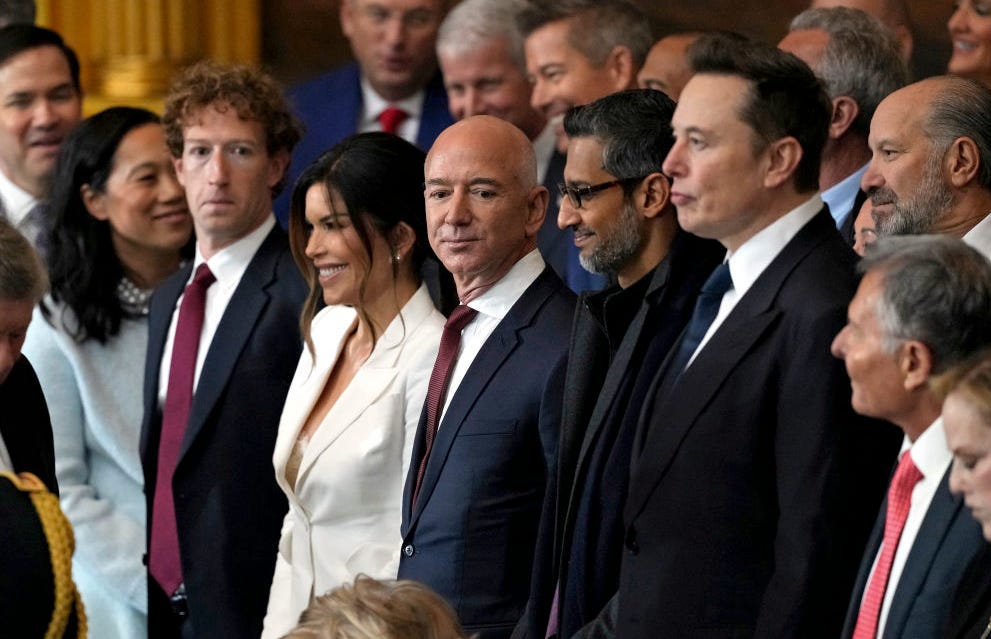
Unfortunately, while Trump would sometimes use anti-corporate rhetoric, and he isn’t a libertarian, he is not an anti-monopolist. He wants more powerful monopolies, so long as they are loyal to him and to conservatives. So that’s what happened. Elon Musk bought Twitter, Jeff Bezos and Mark Zuckerberg flipped to become Trump-friendly, and donations for the East Ballroom poured in. And indeed, the right populists solved a problem - no longer is America controlled by a set of monopolists who pretend to be progressives. It’s just not the one they imagined themselves addressing.
There are some useful parts of the antitrust world that have been preserved because of Slater and Ferguson, but in general, their approach is a failure. Slater conceded on merger policy to try to save her job, and got fired anyway. Ferguson has been reduced to hectoring Tim Cook over whether enough conservatives appear in Apple News, in the desperate hopes he’ll get appointed to become an appeals court judge. The staff exits are so severe that there is effectively no capacity to do investigations into housing, meatpacking, or anything else Trump wants to address.
I watch CNBC every morning, and the Biden enforcers were a constant topic of conversation. Today, no one on Wall Street notices the antitrust leaders anymore. They are a high-drama low-impact group.
And what about the lobbyists? I’m guessing it won’t end well for them. Many conservatives are furious about the open auction of policy by men like Davis, because it makes a mockery of their pretense to integrity. They also all know they are about to get pasted in the next election.
And then there’s the change within the Democratic Party. In Trump term one, the “resist liberals” focused on baroque and weird aspects of the administration, like Russiagate. But this time, Democrats are not just noticing that Trump is corrupt, but see that these companies are enabling or are part of the corruption. And you are seeing new leaders like Ruben Gallego and others say, when we govern we will also come after you. It’s different from term one where everything started and ended with Trump.
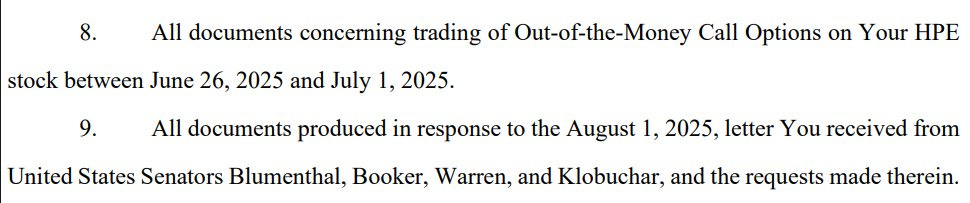
On a more interesting note, because of the weirdness of antitrust law, there’s a judge, Casey Pitts, overseeing the Hewlett Packard settlement, and he has wide discretion to get information on the case. And Democratic state attorneys general are going to depose Davis, Schwartz, (and Will Levi of Sidley Austin) over what happened. And there’s planty of dirt; the stocks of both companies went haywire before the settlement was announced, indicating insider trading, so the state law enforcers have asked for information involving that.
I had hoped for more from the populist right. Had Trump pursued policies to take on concentrated corporate power, the working class would have benefitted. My own political party would have likely been relegated to a minority status, but I am an American before I am a Democrat. Unfortunately, that didn’t happen.
I’ve seen this kind of failed movement before. Politics involves compromise, but there’s a difference between cutting deals and working within a coalition to achieve something, and being willing to operate on an intellectually dishonest foundation in the hopes of lying your way to a better society. That usually doesn’t work out. When the conservatives have to rebuild the smoking rubble of their politics, I hope they recognize that.
There is always a chance to learn. Slater was a coward in office, and did not speak out when her subordinates were fired and when she saw rampant corruption. But her deputy, Roger Alford, did testify publicly about it, in an attempt to save the conservative populist approach. Slater can follow his lead.
And as the country starts to turn to Democrats, for no other reason than it’s the only alternative, we must figure out how to rebuild the Department of Justice and its anti-corruption section. Being opposed to an existing corrupt regime, while not particularly focusing on what led to the rampant corruption, is a dead end. That’s bracing truth for them as well.
Thanks for reading! Your tips make this newsletter what it is, so please send me tips on weird monopolies, stories I’ve missed, or other thoughts. And if you liked this issue of BIG, you can sign up here for more issues, a newsletter on how to restore fair commerce, innovation, and democracy. Consider becoming a paying subscriber to support this work, or if you are a paying subscriber, giving a gift subscription to a friend, colleague, or family member. If you really liked it, read my book, Goliath: The 100-Year War Between Monopoly Power and Democracy.
cheers,
Matt Stoller