 BURST
BURST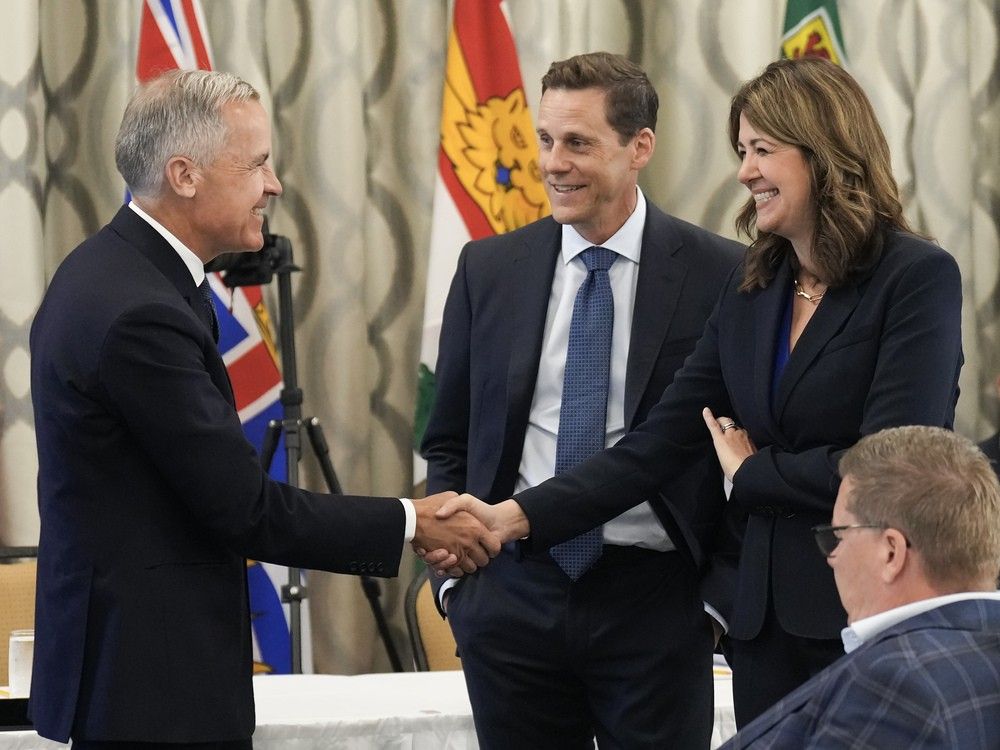
OTTAWA — Prime Minister Mark Carney has agreed to suspend clean electricity regulations in Alberta and will consider making an “adjustment” to the federal oil tanker ban off British Columbia’s coast to pave the way for construction of a new oil pipeline.
The concessions from the federal government will come in exchange for Alberta strengthening its industrial carbon price.
The commitments are outlined in a memorandum of understanding signed today in Calgary by Carney and Smith, outlining the terms of how both jurisdictions will work together on energy.
The document signing has been touted as an important step by both Alberta and Carney’s government to help transform Canada into an “global energy superpower,” as the prime minister promised during the spring federal election campaign. The deal also outlines how both Alberta and Canada “remain committed” to achieving net-zero emissions by 2025.
To do so, the deal spells out a series of projects both jurisdictions agree to collaborate on, including “construction of one or more private sector constructed and financed pipelines,” that would carry “one million barrels a day of low-emission Alberta bitumen” to Asian markets.
It clarifies that the new pipeline project would be in addition to the expansion of the Trans Mountain pipeline.
The deal also links a new bitumen pipeline from Alberta to the advancement of a massive carbon capture and storage project in the province, a project Carney and Smith commit to negotiating a trilateral agreement on with the oilsands partner behind the proposal.
In terms of commitments, Smith signed on to work with Ottawa on negotiating a new industrial carbon pricing agreement before April 1, 2026, which would then formalize the suspension of the clean electricity regulations.
The deal spells out that Ottawa would immediately suspend the regulations in exchange for Alberta hiking its industrial carbon price, which it froze earlier this year.
The document also commits Alberta and Ottawa to negotiate on a new methane equivalency agreement before April 2026, which would set a target of reducing methane emissions by 75 per cent below 2014 levels by 2035.
When it comes to the pipeline proposal, which was Smith’s top priority entering into the negotiations, the new deal spells out that her United Conservative Party government would submit a proposal to the federal major projects office by July 1.
Carney committed his government to declaring that the pipeline proposal was a nation-building project, and if ultimately approved under a special cabinet designation, his government “would enable the export of bitumen from a strategic deep-water port to Asian markets, including if necessary through an appropriate adjustment to the Oil Tanker Moratorium Act.
More to come …
National Post
Our website is the place for the latest breaking news, exclusive scoops, longreads and provocative commentary. Please bookmark nationalpost.com and sign up for our politics newsletter, First Reading, here.