 BURST
BURST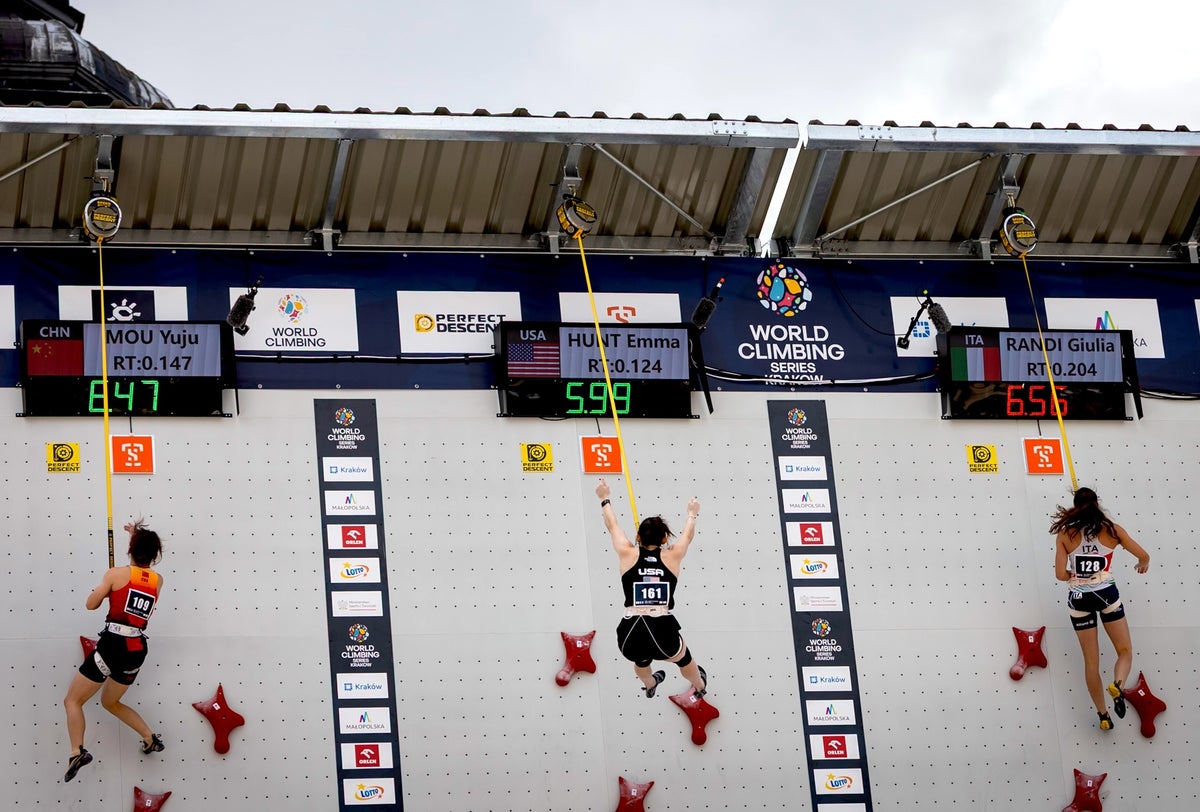
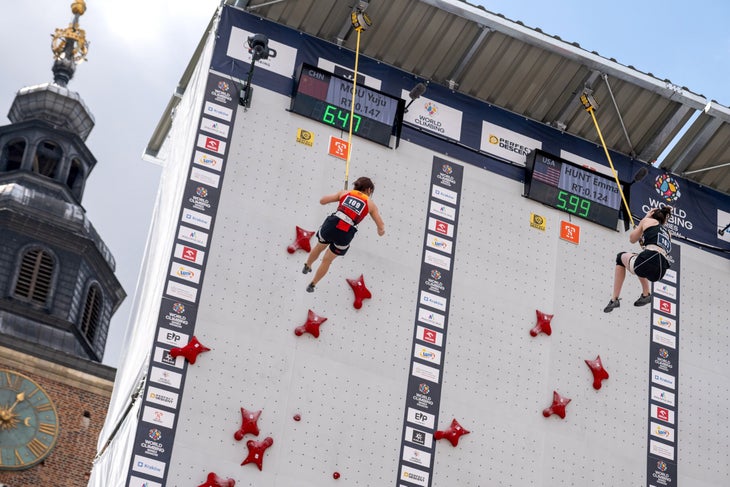
On July 4, Emma Hunt officially became the fastest female speed climber in the world with a 5.99-second run in Kraków, Poland. This broke the previous record of 6.03 seconds set by Polish climber Alesandra “Ola” Mirosław—who recently announced she would be retiring at the end of the year—last September. And it broke Hunt’s own previous personal best time of 6.30 seconds.
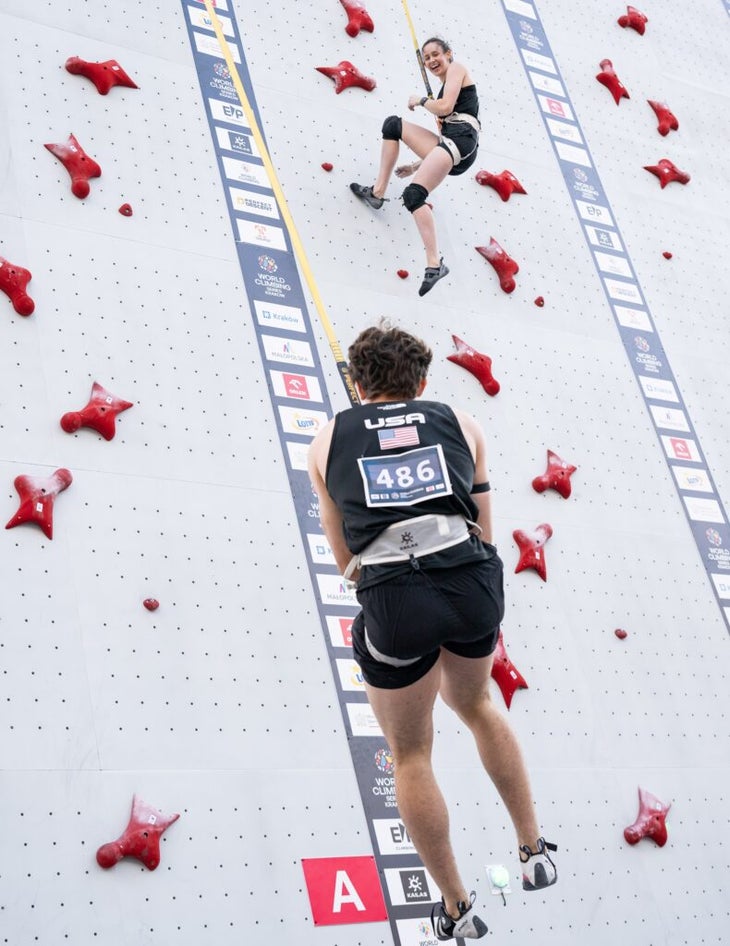
Hunt’s historic run was part of a World Climbing Series Speed Mixed Relay event that also set a world record for fastest male-female team run. The Speed Mixed Relay is a new format for competitive speed climbing that made its debut in Kraków. Hunt and teammate Samuel Watson achieved a combined total time of 10.89 seconds, becoming first to break 11 seconds in the event. The team took Gold for USA Climbing on the country’s 250th birthday.
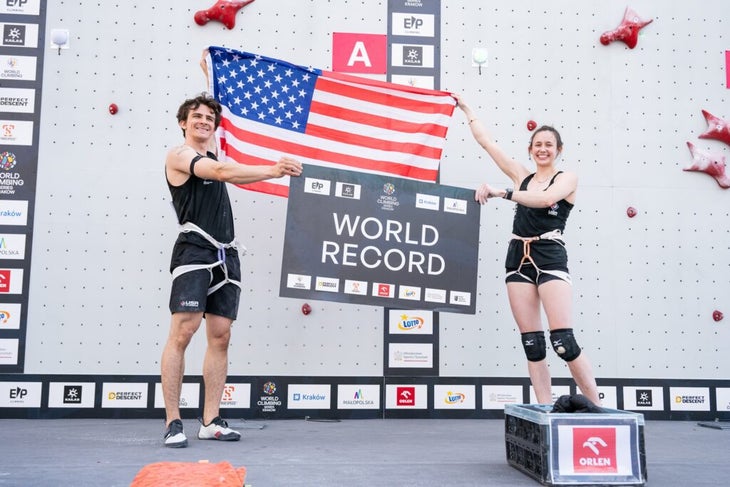
For his part, Watson also climbed a personal best of 4.60 seconds, which is now also the top Pan-American time. The current world record in men’s speed climbing is held by Chinese climber Zhao Yicheng, who clocked 4.54 seconds on May 10 of this year.
But the biggest headline out of Kraków was undeniably 23-year-old Hunt’s record-breaking run. Hunt started climbing as a kid when she first tied in at a climbing wall at a mall near her home of Woodstock, Georgia. She has been active on the international speed circuit since 2019.
A week after she made history, we caught up with Hunt from Salt Lake City, Utah, where she’s training this summer. She explained how she got into speed climbing, one factor that might have led to her record, and her best advice for any climber who wants to move a little faster on the wall.
Our conversation with Emma Hunt
This interview has been lightly edited for concision and clarity.
Maya Silver: Were you surprised when you topped out at 5:99? How did you feel?
Emma Hunt: I was definitely shocked. The fastest I’ve run in training is 6.17, so not really anywhere close. To be honest, I wasn’t really feeling it that day. I was kind of sore when I was warming up. So I was very shocked in the moment and just so ecstatic. I couldn’t believe the goal was over.
Silver: Tell me about the day of the climb. Did you do anything differently that day?
Hunt: There wasn’t anything too out of the ordinary for my standard comp routine. It was the morning final, so it was pretty much just wake up, get ready, go to the wall. The venue warm-up is really only a speed start section. So it was a little more of a speed-specific warm-up than some of the other comps.
Silver: Was there anything else different about that run on July 4 that you think led to your success? Was it something about the crowd or the venue?
Hunt: I don’t know if I can pinpoint something exactly that led to this success, but the crowd at Kraków was incredible. They just stick a speed wall in the middle of the old town square. All these people that don’t know anything about speed climbing and are just tourists can go watch. At all these restaurants with outside seating, people can sit and watch this comp. [Poland] has a huge speed following because of Ola Mirosław, the Olympic Gold medalist. So it’s an incredible crowd and they love speed. When you’re on the wall, you can hear the cheering in the back of your head. When I was getting to the top, it was getting louder. That probably pushed me up a little more.
Silver: Have you changed anything in terms of your training or nutrition in the past year that you think made a difference?
Hunt: I’ve been doing a lot of things differently. I didn’t have quite the ideal off season I wanted. A lot of my training got messed up and moved around. And I had some little mental challenges. So I’ve been trying a lot of new things to see what works. Nutrition’s pretty standard. I’m unfortunately gluten- and lactose-intolerant. So not ideal, but it does make nutrition a little easier—a lot of chicken, rice, fruits, vegetables. Timing is really important—just being fueled for sessions, after sessions.
Silver: Your parents came out to support you in Poland. Do they go with you to all your comps?
Hunt: My family’s in Georgia, but they come to the comps that they can and my mom goes to most of them, which is super helpful. They all climb, so they all get it and they’ve been in the whole series with me.
Silver: Did they climb before you started climbing or were you the impetus for them to get into it?
Hunt: My dad got my whole family into climbing. He tried a portable mall wall when I was five years old, loved it, and just started taking our whole immediate family to the gym. We’ve been climbers ever since.
Silver: Outside of your speed climbing, what kind of climbing do you do with your family?
Hunt: We’re a big bouldering family, so we usually go outdoor bouldering in the South to Stone Fort [in Tennessee] and Horse Pens [in Alabama]. Then you have Rocktown [in Georgia] and Pep Boys and the Middle Creek area [in Tennessee]. I’m trying to get back into comp bouldering a little more. But kind of all of it—I love outdoor lead, too.
Silver: How did you end up getting into the niche of speed climbing, after growing up bouldering?
Hunt: I started comp climbing when I was eight and did only bouldering. When I was 10, I started doing the toprope lead. Then, when I was 12 or 13, I moved to a different team and they had speed climbing. I was always drawn to the wall, and then I got to try it and I was hooked. I wasn’t good or fast at all, but I was like, “This is amazing.”
Silver: How did Mirosław react when you broke her record?
Hunt: I’ve known her for so long now and she’s just always been so supportive and encouraging. It can’t be easy, having someone break your record. But she’s been so gracious about it. She came up and congratulated me during the round, which is really nice, especially because a lot of athletes are really focused on themselves. But she took the time to come congratulate me. She’s the best representation for speed climbing athletes and I’m really gonna miss her not being at the World Cups.
Silver: How tall are you? And how does your height play into your technique with speed climbing?
Hunt: I’m 5’8” or 5’9”—I don’t actually know which one. But I have a +4 ape index, so that definitely helps with the beta I can choose. I do more of a men’s beta than a lot of the other women because I am on the taller end of the women. But I don’t think it’s a disadvantage or an advantage to be tall or short.
Silver: What does the men’s beta—or the taller person beta—look like in speed climbing?
Hunt: The shorter women can fit into these smaller boxes and get their feet higher and faster and be a little more explosive. They do shorter moves faster and I do bigger moves faster. So it’s just a trade off. I’m also definitely more legs than arms. So I do the Tomoa start, the one-arm dyno, then the Chinese top, which is what most of the men do.
Silver: Can you translate that for non-speed climbers?
Hunt: We break the speed wall up into three sections: the start, the dyno, and the top. For the start, almost everybody—probably 98% of the people on the World Cup stage—is doing the Tomoa start, which is a little mantle you see on the first hold, skipping the one out left.
Silver: Where does the name “Tomoa start” come from?
Hunt: Tomoa Narasaki. He pioneered the beta for the Tokyo Olympics.
Silver: And what comes after the Tomoa start?
Hunt: Then the dyno. There are a couple different options, but the really common one for the men is the one-arm dyno. It’s your left hand on hold eight and right foot on hold six. A lot of the women do that, and a lot of them also do the standard dyno. Then the top is what we call the Chinese beta. It’s staying on the far left holds and ignoring the last hold on the right.
Silver: I had no idea that speed climbing was so segmented and choreographed. Do you use the exact same techniques on every run?
Hunt: Every single time. In training, you’re working on perfecting it, focusing on your hip orientation to the wall and your feet.
Silver: When you’re not speed climbing—when you’re just bouldering outside or lead climbing—do you tend to climb quickly?
Hunt: [laughs] Yeah, I do.
Silver: For aspiring speed climbers or even just regular climbers who want to move more quickly or efficiently on the wall, what’s your best advice for getting faster?
Hunt: Try adding a time pressure. Give yourself either a time limit or a time goal, like “I want to do 40 feet in this amount of time.” Time is a great motivator. Also work on your fast-twitch muscle fibers. I think campusing is great. Running is also great, which not a lot of climbers want to hear. And then for speed climbers, just time on the wall. Just do it more. Do it as much as you can. Watch videos, learn micro beta.
Silver: This is kind of a weird question, but I’ve never interviewed a speed climber before and I’m curious if you’re a fast person in your day-to-day life off the wall?
Hunt: Yeah, I am very impatient and definitely try to do things on the faster end. It’s just kind of the natural pace of my life to do things faster. I have to be conscious about doing some things a little slower or taking my time. It’s funny; I don’t notice it, but then people ask and I’m like, “Yeah, I’m fast at everything.” I’m very much a “get things done” person. So I just keep going fast.
Silver: What’s next for you competitively? Are you hoping to qualify for the 2028 Olympics?
Hunt: That’s definitely on the radar. I’m more focused on the competition season right now. They added the relay and the four-lane for the first time to the World Cup. So it’s a lot of learning how to manage not just one competition at a time. I need to train for three days on, eight rounds a day, on again, off again.
Silver: Shifting to time goals, do you now want to beat 5.99? Or are you happy with what you’ve achieved and holding strong?
Hunt: Definitely the speed climber’s mentality is just wanting to go faster. I’m so happy with the 5.99, but it’s also like, “Cool, checked that box, onto the next one.” So I’m very happy, but I’m always looking for a faster time.
The post Emma Hunt Breaks Women’s World Speed Climbing Record With 5.99-Second Run appeared first on Climbing.