 BURST
BURST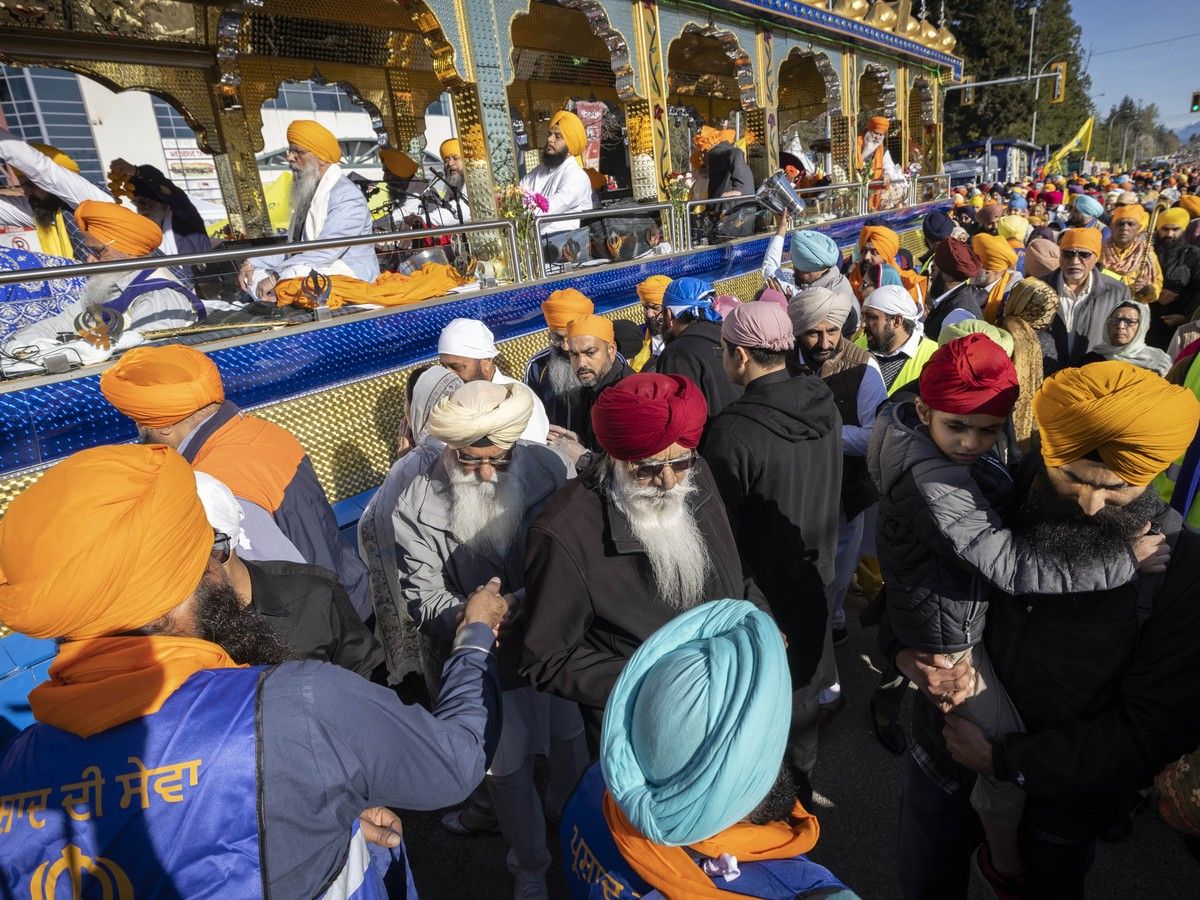
Before sunrise Saturday morning, Moninder Singh stood silently inside Gurdwara Sahib Dasmesh Darbar in Surrey, palms pressed together, waiting.
A warm bowl of parshad was placed into his hands after he paid his respects at the Sikh temple. Tasting the soft, sugary brown pudding marks the start of each year’s spring harvest festival for the longtime organizer of the Surrey Vaisakhi parade.
Singh said the sacrament reflects his work and that of 5,200 volunteers over the last year who helped run this year’s event, celebrating the birth of the Khalsa, founded by Guru Gobind Singh in 1699.
“A core value of Sikhism is equality,” he told Postmedia News, noting that parshad is made of equal parts flour, clarified butter and sugar and is shared among all temple visitors.
Hours later, Singh’s day spilled onto the streets of Newton, as hundreds of thousands of people flooded the closed-off roads outside the Gurdwara Saturday morning for the city’s annual Vaisakhi parade . The procession set off at 9 a.m., winding along 124 Street, turning onto 75 Avenue, then 76th Avenue and 128 Street, before looping back to the temple.
Floats rolled through the route as guests in colourful suits packed the sidewalks, watching. By mid-morning, the parade had become a dense flow of people — part religious observance, part street fair.
“I’m not even sure if Surrey has this many people, especially within the Sikh community,” Singh said about the parade’s record-high attendance.
This year, organizers also increased security with more road barriers and perimeter gates, working closely with the City of Surrey and the province. The parade also had more plainclothes police officers on patrol.
Along the parade route, dozens of volunteers from schools, businesses and community groups worked under tents, serving tea, juice and homemade vegetarian dishes along with Punjabi snacks and desserts to strangers as part of the Sikh tradition of langar, or free communal food.
Some tents were operated by local churches. Others were run by mosques, Singh said.
“Vaisakhi is an opportunity to experience one another, not only just people from Surrey’s Sikh community, but people from all different walks of life.”
If strangers can come together to share food and laughter at Surrey’s Vaisakhi parade and set aside religious and cultural differences, Singh said it shows what is possible in the world beyond it.
“We want to create a better future for everyone with this event.”
For Vancouver resident Mo Dhaliwal, Saturday felt like a homecoming.
Dhaliwal, 47, said he has been attending Surrey’s parade since he was a teen living in Abbotsford, and has watched the festival grow each year with his cultural community.
On Saturday, he was on the hunt for a festival favourite, gol gappay, which he described as small hollow crispy dough balls filled with a spiced potato mixture.
“It’s rare to find,” Dhaliwal said. “It’s difficult to make for an event of this size.”
He said that for many attendees, the annual Vaisakhi festival doubles as a family meetup. “You just bump into different relatives at the food stalls,” he laughed.
Dhaliwal said the steady growth of the event shows it’s about more than just a religious celebration.
“This event is what radical inclusion, which is the core of Sikhism, looks like,” he said. “It’s about offering the same generosity to everyone, regardless of who they are, as you would to your own family.”