 BURST
BURSTI’m putting out the round-up a day early so that I can include my July 4th message. There is a lot of monopoly and finance-related news, as usual.
A few years ago, I started doing something that was common in the 19th century - a Fourth of July Oration. Today, on this holiday, we gather and do bbq’s with friends and family. Back then, Americans would do the same thing, except they’d also give political speeches. It was their way of linking themselves explicitly to the founding of America, a scene considered pure moral virtue, in some ways like the way older men obsess over World War II. Usually Americans would link the formation of the nation to current political topics, things like slavery or industrialization.
The most famous oration is Frederick Douglass’ speech in 1852, titled “What to the Slave is the Fourth of July?” It was a bitter bromide about American values, but one that did carry hope. Today, July 4th does still include some of this tradition. The President gives a speech, so do some politicians, and there are essays in the media. But I like the practice of having random people say what they think about the country in which they live. And the internet is a great forum in which to do it. So I’m going to do it again. As usual, I’ll be putting Thomas Jefferson’s ice cream recipe at the end.
Happy birthday, America. Most of the time, I write about the “anti-monopoly tradition,” in America, but there is another equally potent historical framework - and that is the pro-monopoly vision. To see it in action, look at what is happening in the physical city of Washington, D.C. today. In most parts of the country, people are having fun; in New York City, people will see a bunch of tall sailing ships. But in D.C., it’s not a good scene.
The mall, a park between the White House and Congress, is usually an open area with families ambling through, admiring the historic Smithsonian buildings and various monuments. For the 250th July 4th, however, Donald Trump put together something called “America’s Great State Fair.” The mall is peppered with high fences and corporate sponsored obnoxious exhibits. Few have attended.
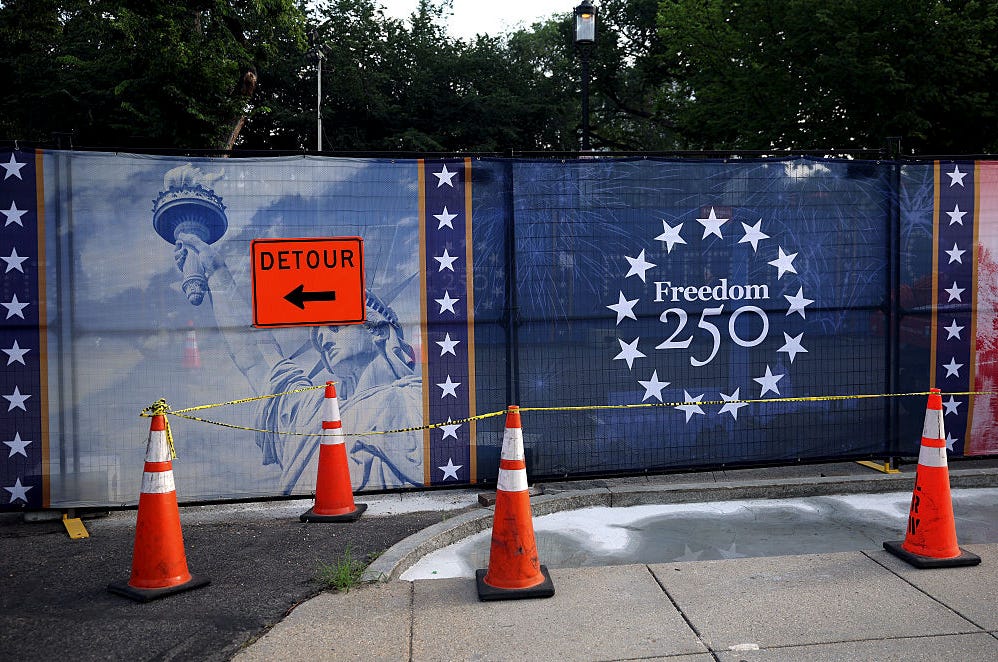
It’s not all Trump’s fault. A brutal heat wave of over 100 degree temperature, a result of climate change that no one wants to discuss, is adding to the festivities by sending dozens of the few attendees to the hospital with heat-related illnesses. The parade is canceled.
Further, tonight in this dry and massive heat dome, Trump will oversee a fireworks display so unusually big it will cause dangerous air pollution, though the administration hid documents saying that. Still, this kind of display might be worth it, but it will take place at 11pm, so most kids will be in bed. Meanwhile, hundreds of masked white supremacists in a group called “Patriot Front” are marching around the Capitol area saying they will reclaim America.
That said, there are big fun celebrations in D.C., but they are private ones sponsored by defense contractors and Silicon Valley oligarchs. According to the American Prospect, these parties are part of a baroque scheme to simply steal money appropriated for the public festivities.
I had low expectations for President Donald Trump when he was elected, but I did think he’d be able to throw a good party for America. But even on that, he has disappointed.
The metaphor here is too on the nose. Last year, according to the financial disclosures he released this week, Trump made $2.2 billion, mostly through pyramid schemes and bribery through the veil of cryptocurrency. $680 million of that came from his own Trumpcoin, which was theft from his supporters, millions of whom lost $3.8 billion in total, after the coin fell 97% in value.
Another $799 million came from his investment in a company called World Liberty Financial, which sold $2 billion of crypto to the government of Abu Dhabi after Trump got elected. Trump also bought $1.4 billion of stock in 2025, and a lot of it looks like insider trading. He engaged in hundreds of purchases just before pausing tariffs in April of 2025, sparking a huge market rally. He claims his assets are managed in a blind trust, but whatever.
Then there’s his family business. His sons, Don Jr and Eric, invested in defense contractors that received Federal funding, and more than a dozen mining ventures their father brokered as part of building out a critical minerals supply chain, even as his son-in-law Jared Kushner raised billions from Arab funds while engaged in diplomatic negotiations with those same nations.
The President claims he is simply making money because everyone in America is making money through the stock market. And as for his family’s enrichment, he is not only unapologetic, but says he feels bad for his kids, that they are “burdened” by “inside information.”
I find myself frustrated at this moment, because criticizing Trump as personally venal feels like it lumps you in with a bunch of obnoxious resistance liberals obsessed with fake Russia conspiracies. But Trump’s first and second terms really are different. Though there has always been self-dealing within our political class, we have never seen this open level of self-enrichment by any American political leader. And the fusion of government, big law, and financial oligarchs is a step change from where it was.
The market power link here is obvious; a record merger boom is occurring precisely because there’s a pay-to-play political group in charge. Monopolization doesn’t matter, since agencies drop cases in return for lobbying and money. And if you have been convicted for corporate wrongdoing, that doesn’t matter either. “It is general knowledge in our practice that for $2 million, you can have a pardon,” said one prominent white-collar defense attorney in reporting by the Atlantic.
That said, seeing this problem as purely a result of Trump’s personal moral choices is an indulgence, and an inaccurate one. What he is doing reflects not just his own attempt at graft, but an elite world, including and especially this Supreme Court, that has long viewed corruption and dishonesty as the currency of the realm and has changed the laws to enable it. And there is of course a much longer background here, one worth exploring.
If I were to designate the patron saints of today’s grim festivities, I would pick two men: Roy Cohn and Aaron Director. Cohn created America’s modern political culture, while Director structured its legal assumptions.
Roy Cohn is a famous icon, the deeply cynical political consigliere of Donald Trump. He first came to national prominence in the 1950s, when he helped Senator Joe McCarthy organize the anti-Communist witch hunts. With his perch and his alliance with J.Edgar Hoover, McCarthy eliminated scores of leftist New Dealers from American political life, using his platform in the Senate to whip up a “Red Scare” about Communism. To his supporters, McCarthy could do no wrong, and any criticism was a result of leftist conspiracies. McCarthy was the first modern right-wing pundit, and Cohn helped him create a political template based on polarization.
Yet Cohn far surpassed McCarthy. In a famous case, he tried Ethel and Julius Rosenberg for espionage, illegally conferring with the judge before, during, and after the trial to ensure they would be sentenced to death. As a kid, he bent the rules, avoiding service in World War II by using his family’s political connections. He served as a government prosecutor while also also illegally having a private law practice, and earned money from mobsters.
Cohn was raw politics. He aided Ronald Reagan’s rise and mentored Donald Trump. I’m reading American Scoundrel, a biography of Cohn. It turns out Cohn’s family wealth came in part from the Bank of the United States, one of the big bank failures in the Depression, where his wealthy Jewish uncle stole from hundreds of thousands of Jewish immigrants. Cohn saw this collapse as a conspiracy against his family, but the truth is he didn’t believe rules should apply to powerful insiders.
Then there’s Aaron Director, an equally cynical academic operative who created the law and economics movement. Director founded in the late 1940s, taking money from a right-wing foundation, the Volcker Fund, to build a set of scholars who would fight back against the New Deal. What he called the Free Market Study was massively influential, serving as the pro-monopoly incubator for Robert Bork, George Stigler and Milton Friedman.
Director’s goal was to restore the framework of pre-New Deal America. He started with antitrust, which was the tip of the spear for attacking corporate power. Director framed himself as “an economist,” but in fact he was a social theorist, a pupil of the fascist satirist H. L. Mencken. “The ambition of Director,” wrote Director’s ally George Priest years later, “was essentially to ridicule the Supreme Court’s treatment of antitrust as well as of other forms of government interference with the market.” Director’s people simply lied about important precedents, like the 1911 Standard Oil case, until liberals shrank in fear. And his key funder backed McCarthy, with his network bathing in the anti-Communist hysteria.
Cohn and Director had a lot in common. Both were Jewish and hated the WASP establishment, though also disdained left-wing Jews. Both turned from leftists to far-right Republican. Their goal was not to undo snobbery, but to make sure that they would be the insiders sneering at the liberals, who they would strip of power. To do that, they would have to get rid of New Deal limits on capital. Director pursued his values using the language of fake economics, Cohn did so with charm and bribery. But it was the same goal, and together, their vision animates modern American institutions.
Director seeded a series of corporate lawyers, who built the Federalist Society and now staff much of the judiciary, with the help of the people Cohn helped elect. This network adopted a rhetorical mechanism to eliminate traditional anti-corruption and anti-corporate measures, narrowing the ability of government to do much to protect the public.
Cohn is the more storied figure, and Trump’s raw graft, and his constant stream of gaslighting, reflects Cohn’s influence. And the bevy of cases that have come out over the past few years is a straightforward endorsement of political nihilism.
For instance, this week, in National Republican Senatorial Committee v. FEC, the court just got rid of more limits on campaign donations, which will de facto raise campaign contribution limits from $6k to hundreds of thousands of dollars. Why? Well, the six conservatives on the court claimed that where states have no restrictions on campaign spending for state candidates, there is simply no “evidence of corruption” that “has materialized.”
The fact that the public feels otherwise is irrelevant, because in 2010’s Citizens United decision, the court only recognized “quid pro quos” as corruption, meaning influence peddling is legal unless you are explicitly offering a bribe for a favor. The court hasn’t stopped with Citizens United. A few years ago, six conservative justices decreed that a federal anti-bribery law doesn’t bar “gratuities,” only bribes. What is the difference? If you get the money after you do the favors, it’s a gratuity, if you get it before the acts, it’s a bribe. I’m not kidding.
And there’s more. Political officials can only be bribed if they are doing an “official act,” which the Supreme Court unanimously said is a very narrow set of activities. And what about Trump, who clearly is transgressing even these modest restrictions? Well, the Court said in a different case that the President isn’t really subject to any of these limits, because he might be afraid of vigorously pursuing his “core constitutional powers” if he feels he is subject to criminal sanction.
In other words, the Supreme Court defined bribery laws out of existence, and then said the lack of bribery shows how little corruption there is, and thus how no limits on other forms of corruption are permitted. Also, the President is above the law.
Fortunately, after decades of awful decision-making, people have started to notice the courts are highly political and corrupt. A few years ago, it would have been scandalous to criticize the courts. At this point, it’s routine. Here’s Senator Chris Murphy, in a tweet that is notable for how unremarkable it is:
But married to political corruption and bribery is respect for Cohn’s family background - finance. And here we see Director’s influence. This week, the court elevated Wall Street to a fourth branch of government. And in this case it’s with liberal votes.
This one came down in two cases this week. In Trump vs Slaughter, the Supreme Court overruled a doctrine known as Humphrey’s Executor, which allows Congress to make rules limiting independent regulators to be fired only for cause. The court ruled that historically, the President must be able to fire regulators as part of his core constitutional powers. The executive branch must execute the laws, they said. So “if anything more is left of Humphrey’s, the Court overrules it.”
But then, the very same day, in Trump vs Cook, the Supreme Court - liberals as well as conservatives - said this decision doesn’t apply to the Federal Reserve Why? Well, the central bank is a “special arrangement sanctioned by history.” It’s hilariously inconsistent nonsense. Wall Street gets its independent bailout machine, free from Presidential interference. But all the grubby regulators who work for the public, they can easily get fired. Or in Supreme Court-ese: "The Court declines to sow doubt as to the status of one of the Nation’s (and the world’s) most important financial institutions."
Here’s Joe Weisenthal:
There’s a nihilism now, a straight-up robbery of every nook and cranny of a nation. On Wednesday, I wrote up how egg producers harvested billions from us openly, and got away with it. On the popular podcast Odd Lots in 2023, Glenn Hickman, the CEO of Hickman Farms, explained how avian flu was spiking egg prices. It turns out, even as he was lying to those journalists and listeners, Hickman himself was rigging prices so openly he was texting and emailing fellow egg industry CEOs. Hickman openly made a fool of these respected Wall Street reporters, and I doubt anyone in that world will care.
And why should they? That is just how things work according to pro-monopoly scoundrels. We’ve long had partial impunity for the superrich. Corporate America, for instance, used the 9/11 attacks to reward CEOs through accounting fraud. That was twenty five years ago. In 2008, many of Bernie Madoff’s investors knew he was a crook, but they assumed he was engaged in insider trading on their behalf, not a Ponzi scheme to steal from them. And of course, no one went to jail for the financial crisis. In 2014, the Obama administration cut the sentence of Enron fraudster Jeff Skillings.
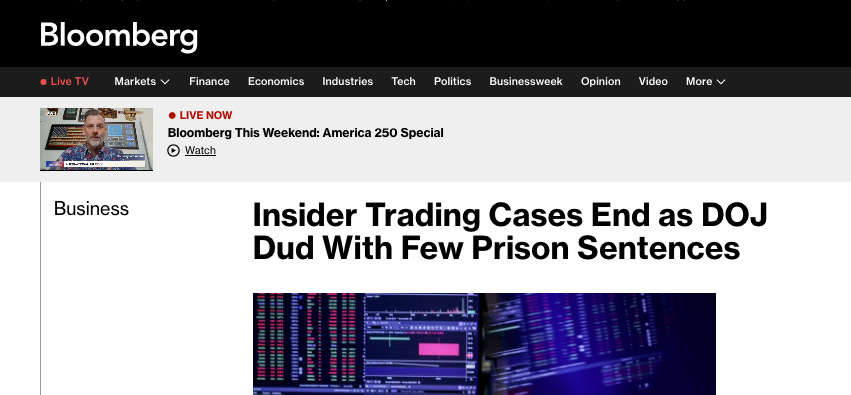
You can just read Bloomberg or the Wall Street Journal, and you’ll get a few travesties every month. Here’s one that came out today.
If you think these things are wrong, Roy Cohn’s heirs will simply call you a liberal or a Communist or a nerd or woke. Elizabeth Warren, who is constantly correct about scams and fraud, nonetheless gets routinely dismissed as “Pocahontas.” That’s modern American political culture, backstopped by the Supreme Court.
So that’s where we are. I don’t want to overstate the gloom of this July 4th. It is a holiday, it is fun, and I am proud to be an America. We still are a democracy.
Last year, in my Fourth of July Oration I asked a question: Can America Recapture Its Populist Soul? The essay linked the grim Trump era to Henry George, the great 19th century land reformer, worldwide celebrity and a candidate for mayor of New York City.
George believed our common resources should be used for the common good, and situated inequality, particularly the ownership of land, as a signal that they were not. While George lost, his ideas carried forward and helped form a 20th century middle class. That is, until they were rejected by Chicago School thinkers like Milton Friedman and Robert Bork, and enacted during the Reagan revolution of greed. Zohran Mamdani, then a candidate, was a signal the public might want to resurrect the Georgist tradition.
A few months later, Mamdani won the election, and he is now the most popular Democratic Party figure in America. We’ll see how he governs, but his win answers the question. Yes, America can recapture its populist soul.
Still, I think we have a long way to go. We are living in a very strange time, where it’s perfectly reasonable to talk as if our different levels of government, which we elect and fund, are alien and hostile forces. I once had a conversation with Neal Katyal, Obama’s former solicitor general turned corporate lawyer, and Katyal talked about how the founders formed the nation to protect the public from the government. He believes that, and so do most elite lawyers.
Yet of course that’s not only false, it’s false in a very specific way. Here’s the Declaration of Independence, and I’ve bolded the relevant part.
“We hold these truths to be self-evident, that all men are created equal, that they are endowed by their Creator with certain unalienable Rights, that among these are Life, Liberty and the pursuit of Happiness - That to secure these rights, Governments are instituted among Men, deriving their just powers from the consent of the governed.”
There it is right there - we institute governments to secure our rights. The way we ensure that government is legitimate is through consent. That is a radical vision, the notion that people get to have a say in their government. The false claim about nature of American political power as inherently malevolent comes precisely because of threat to the powerful from this radical vision.
To put it differently, if the government were a hostile alien force bent on taking away our liberties, why would we establish it in the first place? Every time you hear someone bash Congress, or politicians, or elections, just remember that. We built a government to secure our rights. If it is not doing that, we must change it. That is how virtually all Americans understood our society for most of our history, even when we failed to achieve our goals. It is not how we see things today, because Roy Cohn and Aaron Director won the intellectual, legal, and cultural debate.
That said, it is pretty clear that left-wing populists are on the march, and though they lack the institutional capacity to govern as coherently as they might need to, they will have their chance. Americans, in their hearts, believe in self-government and liberty. And now they are seeing all around that the institutions governing them don’t uphold those values. And that means the victory of Cohn and Director is already over.
And now, the rest of the news round-up. The great anti-monopolist Phil Weiser won an upset and will likely become governor of Colorado, there’s a class action antitrust suit alleging price fixing of memory chip makers, a mattress roll-up continues apace, and Meta is in crisis as Mark Zuckerberg pivots to another likely failed strategy around selling AI compute.
Read on for that and more, including Thomas Jefferson’s ice cream recipe, after the paywall.