 BURST
BURST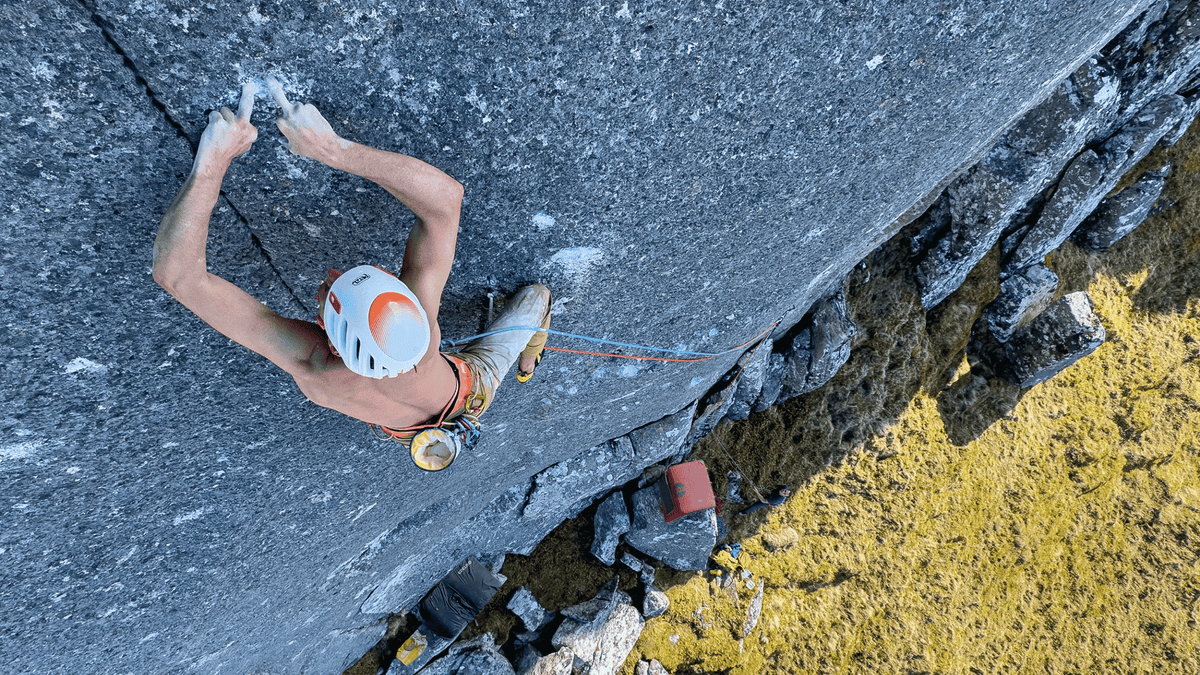
Earlier this month, Welsh climber Franco Cookson added yet another unbelievably bold pitch to the world of desperate trad climbing. Cookson made the first ascent of But Nothing Is Lost, a four-year project in northern Scotland, and suggested E12. This makes it the only route of its kind in the U.K., and just the second E12 worldwide.
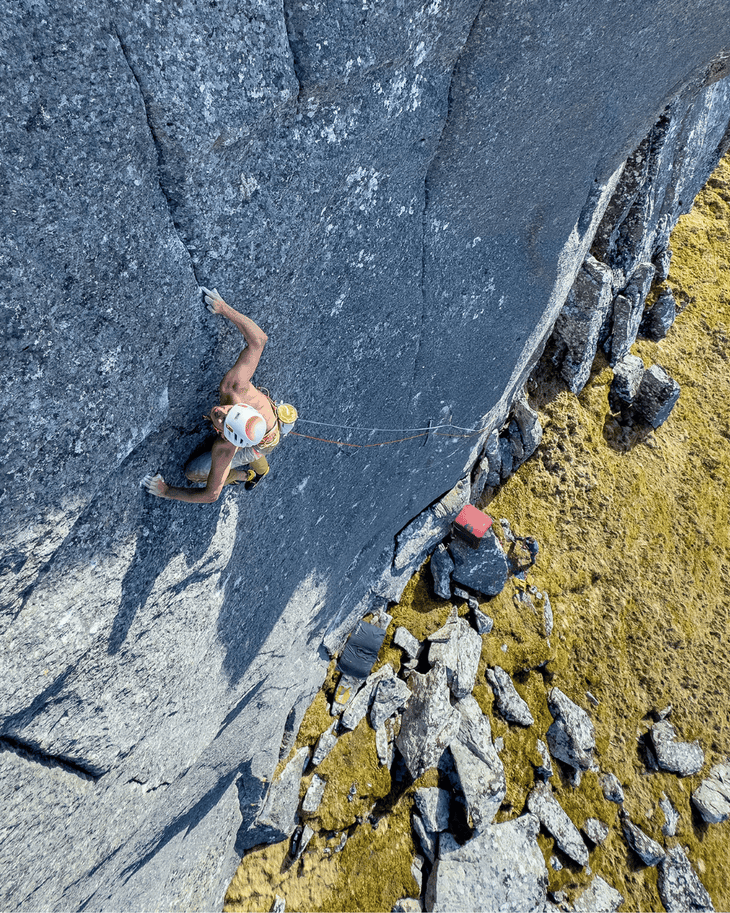
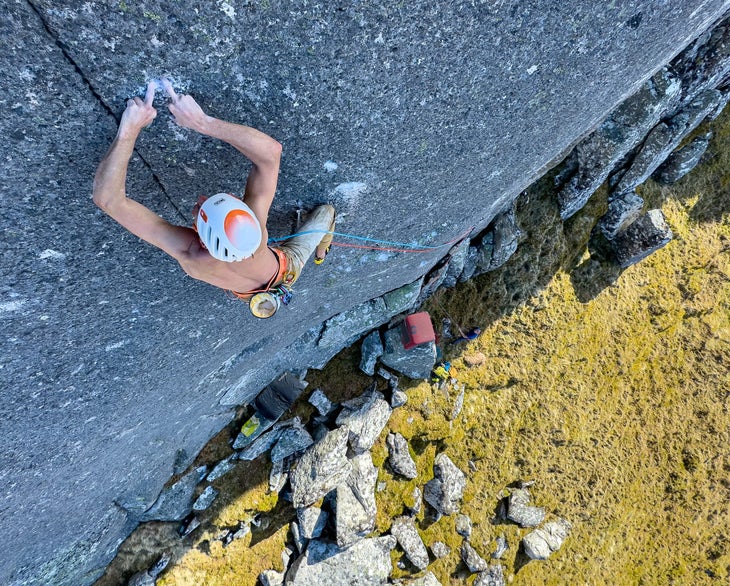
The British E-grade system attempts to capture both difficulty and danger in its rating. Bon Voyage, the world’s other E12, in France, is quite a bit harder than this one at 5.14d, but not terribly dangerous—if you have a top-notch belayer. By comparison, But Nothing Is Lost entails numerous perilous sequences. The route opens with an unprotectable 25-foot V9 above a mess of sharp boulders. A singular steel skyhook, delicately crimped on a protrusion of granite, protects the crux sequence. Cookson told me that it “maybe wouldn’t feel so hard if you had a bolt there instead of a hook. But I was pretty scared. If the hook blew, you’d be dead.”
The 32-year-old Cookson is a frequent flyer in the uber-niche of dangerous, near-limit trad climbing. He has racked up a dream ticklist that would qualify as a nightmare for most climbers: Hold Fast, Hold True (E10 7a), Nothing Lasts (E11 7a), and the optimistically named Immortal (E11 7b), which was so bold and striking that BritRock Films made an entire film based around it.
Unsure how E-grades and American YDS grades match up? Check out our comparison chart for a (rough) idea
Cookson’s Instagram bio might cheekily read “Pro top roper,” but there is an obvious, alarming distinction between him and someone else who rarely ties into the sharp end. When he does finally pull the rope after working a route and commit to the lead, Cookson commits entirely. The routes he rehearses are ankle-breaking at best and lethal at worst. His toproping enables a level of mastery and commitment that few can—or should—imitate.
I recently called up Cookson to talk about his new route, why he spent the winter hanging out in India rather than training, the finer points of skyhook-protected trad, and why this style of dangerous climbing speaks to him so clearly.
Climbing’s interview with Franco Cookson
This conversation has been lightly edited for length and clarity.
Anthony Walsh: How did you first find out about this project?
Franco Cookson: Simon Nadin showed the crag to me before it had any routes. When finding the line, I realized it was sometimes easier to move sideways than go upwards. It took me more than two years of climbing on it until I actually found the line of the route. I would abseil down in different places, then link a sequence together, but then find myself marooned in the middle of the wall with nowhere to go. It was like piecing a jigsaw together.
I do think it’s a bit over the top when people describe new-routing as “artistic” or “creative,” but it’s about as close as you can get to that; the wall is so open to interpretation.
Difficulty wise, it was obvious straightaway that it was a similar difficulty to what I’m used to—except normally the routes I do only have five or 10 meters of hard climbing. Whereas this one is quite sustained for 35 meters. I knew this route would take me ages to do, since when you’re climbing something this dangerous you have to know the sequences quite well.
Walsh: So tell me about the crag. How is the rock?
Cookson: You do a rising right-to-left traverse on a rock called cyanite, which is like granite except it’s got no quartz in it. It’s incredibly well-weathered. I don’t know how old it is but it is the most bombproof granite you’ve ever seen—it’s better than Yosemite.
For protection, there’s the odd pocket where you get small cams, and there are cracks but most of them are vague seams that don’t have gear in them, or even handholds, really. So the route protects with the odd cam and lots of skyhooks.
View this post on Instagram
 (@francocookson)
Walsh: Are you tensioning the skyhooks, or taping their necks with duct tape, to keep them in place?
Cookson: There’s actually been a bit of a revolution for hard, scary trad in the last few years. There’s a guy in Argentina who started making the Punky Hook, which are rated to 10-12 kilonewtons, meaning they can actually hold a big fall. Most of the hard climbing on this route is protected by Punky Hooks. Previously I’d used Black Diamond’s skyhooks, which are not rated to be fallen on, and when I have fallen on them they’ve just bent open. This route would be crazy without these new-school skyhooks.
Walsh: So the route opens with some very bold E10 climbing, right?
Cookson: Yeah, you’re mostly on your feet, and your handholds are just terrible—tiny, single-finger sidepulls, rubbish slopers, and stuff. If you’re talking about it in the grand scheme of really hard climbing, it’s not all that hard. [Laughs.] But it’s really dangerous. It’s like the ultimate of British trad climbing, where it becomes hard because it’s so bold.
Walsh: Did you ever fall off that opening section?
Cookson: No, no. You’d be fucked.
Walsh: Because you’re climbing a tenuous slab that you easily could fall off of, above a mess of jumbled boulders?
Cookson: The landing is laughable. You climbed seven, eight meters up these pinnacles, then stick your left foot up really high, and pull onto this crazy rockover. So as soon as you pull on you’re facing an eight-meter fall onto pinnacles below. You climb a few slabby moves until you slap to this pocket, where you can place a hook.
Walsh: So how does the route break down?
Cookson: Into seven sections, I suppose: the solo, about E10 [very dangerous V9] and then some decent gear; then a harder bit, but safer, with a rest after—which I need because I’m not very fit at the moment. Then you’ve got to run it out up a flake for a while, with sloping feet, facing a likely ground fall, which ends with a couple of moves where you are absolutely shitting yourself. You swing around onto this sloping ledge where you place a single skyhook, which is your only piece for another E10 section, which maybe wouldn’t feel so hard if you had a bolt there instead of a hook. But I was pretty scared—if the hook blew, you’d be dead.
Then you make a big reach to a pocket where you can place a cam that is not very good, and then a long section of steeper climbing which felt so pumpy to me. Just several deadpoint reaches between undercut pockets to a decent hold, where you can place a Black Totem cam. Then you do two more massive runouts separated by a bit of gear. And then finally a real crack to end.
Walsh: It must have been an ordeal finding a belayer for this sort of route. Did you have issues getting someone to hold your rope?
Cookson: Yeah, and the route is also in the middle of nowhere. It’s a two-hour drive from Inverness, then a two-hour walk from the road. So it’s difficult to get people up there at all. But Robbie Phillips ended up messaging me asking to come up. Simon Nadin, who I mentioned before, said he was willing to belay me, but not very keen on it. It’s pretty full-on belaying a route like that.
But it’s not the kind of route you want to give many lead attempts on. You only lead it once you think you can actually do it.
Walsh: You’ve mentioned you’re not feeling very fit at the moment. Looking at the videos, the sequences look very difficult to me.
Cookson: No, no. I’m really not one for false modesty. I see it sort of as a badge of honor, honestly: to be so weak. Especially as the years tick by, professional climbers are getting so good—I’ve climbed with Connor Herson and Seb Berthe, Jacopo Larcher and Babsi Zangerl. And it’s hilarious. I’m just so shit in comparison.
But it just doesn’t matter. What I’m doing with my climbing is a completely different thing. And I think it’s really nice in climbing when different people are doing different stuff. Even within trad climbing, lots of climbers are doing safe, hard routes. And when you’re like me, basically doing the opposite, there’s pretty much no one else doing these really dangerous routes at a high level. In one sense, it might be nice to have some competition; it would make me motivated to do routes more quickly. But it’s also cool to just be able to try whatever I want, whenever I want. For example, I was able to post really openly about this project because no one else would want to do it! [Laughs.] But if the route was a steep, safe thing, there’d be hundreds of people who could do it.
Walsh: What sport grade would you give this pitch?
Cookson: It’s hard to say since I’ve done so little sport climbing. I’ve only climbed two 8a’s [5.13b] and one 9a+ [5.15a]. I think the best comparisons are with other trad routes. The crux of this route is very similar in difficulty to Steve McClure’s GreatNess Wall, which is E10 7a [“safeish” and hard 5.14], whereas the bottom dangerous bit is like Hold Fast, Hold True [another E10, however 5.13 X]. Then there are the other five sections which are all quite difficult, too. But it really is hard for me to give an accurate grade to everything as I am in genuinely quite shit shape at the moment. I didn’t climb for three months over the winter—I was just hanging out in India.
Walsh: What prompted the trip to India?
Cookson: I’m really into psytrance music so I did some partying, went to the Western Ghats range and looked for elephants, then up to Rajasthan, soaked in some culture, food, and dancing.
[A long pause…]
I’m not really a climber, is the best way to understand it. It’s difficult to describe. I use climbing as a trip to experience something.
This project, regardless of how hard it is, gave me a complete, maximal experience. I really scraped my way up it—balls to the wall, pretty scary. In a sense, that is the maximum experience I’m going to get on a trad route.
[Another long pause…]
But I have a project right by my house, in the Slate, that I’ve been trying for years and years—getting onto 10 years now. There’s a 9a sport route called The Meltdown, and this project climbs the 5.15a direct start to The Meltdown on trad gear. And it has a probable groundfall for the top third of the 30-meter pitch.
I’ve had a dream of climbing a route like that since I was a kid, and I’ve had more than a hundred sessions on it. I can link it and I know I can do it, but it’s really hard, and because it’s slate rock it’s very slippery. That route is ultimately why I ended up in India, really. I came to realize I didn’t want to do the route, but I couldn’t figure out why. It has always been my dream to do routes like this.
But I guess as I’ve gotten older I’ve become less bold, and in my thirties I had a bit of a crisis. Like, Why don’t I want to do this? I’ve based my whole life around doing routes like this—my job, my life, my finances. I knew I could physically do it, but I just didn’t want to push it so far. A big part of me doesn’t want to die.
Walsh: I know what you mean. At least for me, when I was 20, when I was thinking of trying a dangerous route, if I knew I could do it, I needed to do it. It was impulsive. I had to prove to myself I was the person I dreamed I could be.
Cookson: Yeah, yeah. I promised myself when I was young I wouldn’t become one of those old people lecturing about the “arrogance of youth,” but I’m letting myself down.
Walsh: So what is it about very dangerous climbs that appeal to you, in comparison to something that is safer and harder?
Cookson: It’s just more of an experience, isn’t it? It’s like comparing sport climbing to bouldering. Sport is just so much more involved. And being from Wales, this kind of trad is part of my culture, and I get pretty protective of that.
In one sense, trad is alive and kicking, with Herson or Pete Whittaker climbing these super hard yet safe routes. But if that’s all that trad becomes—not to put down those guys, it’s very cool—then I think something is lost.
The post Interview: Franco Cookson’s ‘But Nothing Is Lost’ (E12) Is One of the World’s Hardest Trad Routes appeared first on Climbing.