 BURST
BURST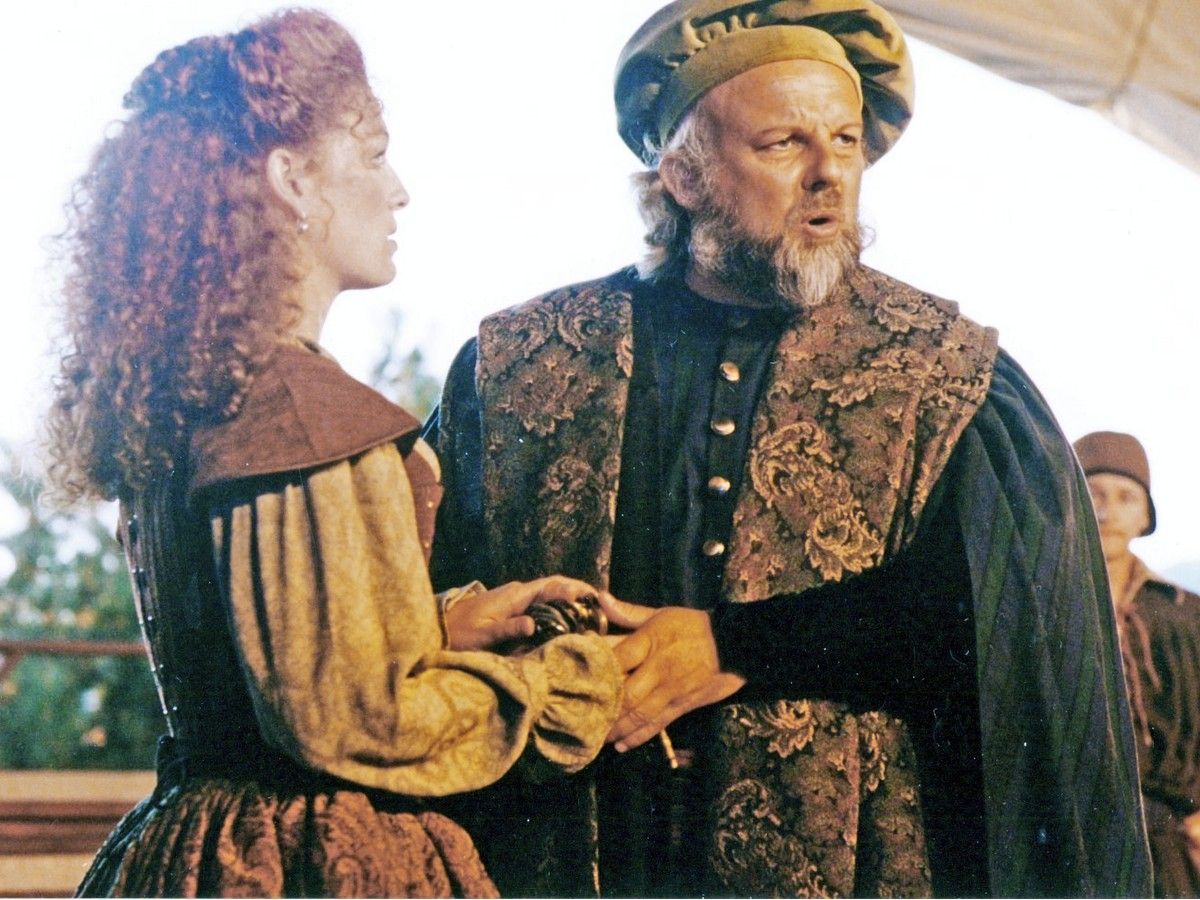
Christopher Gaze, the founder of Bard on the Beach, recounts the thrills and challenges of the first opening weekend of his Shakespearean theatre company in summer 1990 in excerpts from his new memoir, The Road to Bard.
Our opening night kicked off with an Elizabethan spectacle. Vancouver actress Gillian Barber and a gang of theatre chums commandeered a Coast Guard vessel and set sail in period costume, with Gillian as Queen Elizabeth I and a local actor named John Payne playing Shakespeare himself. The Coast Guard played up to their little pastiche, doing a short tour around the mouth of False Creek before dropping them off. Though Gillian was pregnant at the time, laced into a corset and nearly overcome by fumes from the diesel engines, she managed to make her stately way down to a red carpet on the dock for the cameras. The group then strolled through Vanier Park to the site, where we had various street performers and jugglers entertaining the crowd, and stopped beside the tent to give speeches.
Finally it was time to bring the audience into the tent. My sons — Josh, who was nearly nine, and Zac, who was seven —had little customized Elizabethan outfits made by Merrilyn’s mother, Gwen, and they handed out programs. Merrilyn was not in the show but supported us with much volunteer time, as did her parents with childcare and other kindnesses along the way. It was a family affair.
Once everyone had settled, Queen Elizabeth I and the other actors joined me in character onstage while I made a little presentation about the beginning of the theatre. Finally I stepped aside to let the actors get to work.
People loved the show. It had a lightness and gaiety to it and, as theatre critic Max Wyman said in his Province newspaper review, “It was good old-fashioned barn-storming Shakespeare!” Essentially the same assessment was made by the Vancouver Sun’s Lloyd Dykk, a meticulous old-school critic, but in a much more anatomical way: “It’s a very public-hearted show! You are essentially outside in beautiful weather and enough of what makes [the play] great can usually be counted upon to come through …” Coming from Dykk, who could be very cutting, this was a reasonable review …
Of course, new challenges came along. For instance, the Symphony of Fire ran their second show on either the Saturday or Sunday night following our opening performance. Word had gotten out about the fireworks, and the second crowd to mob Vanier Park was much larger than the first. People had also arrived earlier to get good vantage points. The only problem, of course, was where they might go to the bathroom after a few hours of waiting. Unfortunately, bright blue porta-potties are rather conspicuous things.
People started coming into our site while the show was going on to use the porta-potties. And I thought, My God, we’re going to have to pay for an extra pumping-out. This is going to end badly. So I stopped the next person and said, “Excuse me, could I help you?”
“Yeah! I’m gonna use your loo!”
And I said, “I’ll tell you what, you can use one if you go over to our concession where we’ve got some bits and pieces for sale. If you go and spend some money there, you can relieve yourself in our lavatories.”
This was the start of people tottering into the porta-potties with all sorts of new purchases in hand: Mr. Big chocolate bars, red licorice and goodness knows what else. We made a fortune — or at least enough to have the loos pumped out more regularly!
When you are a co-op, you do everything. One of the actors, Scott Bellis, helped at the bar. He’s always been brilliant like that. Actors don’t generally like to get out of the dressing room and be with the public before the show or during intermission—they just want to do their work backstage and onstage — but he did, and he was great. The bar made no money at all, so I drank heavily to sponsor it!
My mother advised me, in writing this, to remember just how hard it was, how incredibly difficult it was for me and for everyone involved to bring Bard together. As for me, I think I only started feeling my own deep exhaustion once we’d established a bit of a groove with the production. I remember my first night on guard duty, thoughtfully pacing the stage before those 250 empty seats, a higher and higher percentage of which were occupied with every performance. In fact, we’d had just about a full house that night. Then, and only then — out of sober respect for my dear father — did I allow myself the thought, the memory of the words of Douglas so very long ago: “You are going to do something!” Well, it seemed perhaps we had.
And how complex, how joyous, how frustrating, how wonderfully and terribly challenging it all had been. I jumped down and walked slowly up the aisle. Outside, I secured the flap. All was quiet as I patrolled the site, working my way around to the backstage area, where I’d parked our VW Vanagon. I was pretty satisfied there were no thieves about, so I climbed in and closed the door with a clunk. God, I was tired. At any rate, I instantly fell into a deep, dreamless sleep. In fact, I didn’t wake until the camper had grown uncomfortably warm in the morning sun. No matter: nothing had been stolen. …
•••
“There is a tide in the affairs of men, which, taken at the flood, leads on to fortune” — so says my friend William Shakespeare. And he has been a friend. I find in these words the very beauties of life, of love, of living.
Even in my early schoolboy days, there was something in Shakespeare’s words that beguiled me, that reverberated in my heart and soul, that gave me a direction. The stories were massive, sometimes deeply complex, but rich and bottomless.
Harold Bloom, a Shakespearean academic, in his book Shakespeare: The Invention of the Human, starts this way: “There is the Bible, there is Shakespeare and then there is everybody else.”
The books of my youth were books of poetry. In these poems lay my grail, my feelings, my desires, all wrapped up in divine words. I wanted to share them with anyone who would listen. I knew what I wanted to do very early in my life. I wanted to be an actor.
My mentor in this endeavour emerged as Douglas Campbell, a great pioneer of Canadian theatre. How fortunate I was to make his acquaintance! A true aficionado of Shakespeare, he hired me as a young actor. He inspired me to come to Canada to expand my horizons and participate in the wonders of this unique and marvellous land.
Mentors are so important — indeed, Douglas’s mentor was Sir Tyrone Guthrie, the first artistic director of the Stratford Festival in Ontario. How I would have loved to have met and worked with him! Guthrie came out of the theatre in the UK with the likes of Laurence Olivier, Dame Sybil Thorndike and Alec Guinness. My good companions at Bard on the Beach and I are the direct recipients, the legatees of these legendary forces in the theatre. They are not dead; they are alive and well in us.
Guthrie once said, “I knew nothing lasts forever, particularly the ephemeral theatre. Such is the transitory and fluid nature of existence. Indeed, no enterprise has ever fulfilled or can ever fulfil its purpose completely. The most you can hope for is to take a respectable shot at an unobtainable goal and to succeed partially and intermittently.”
Bard on the Beach, Western Canada’s largest not-for-profit professional Shakespeare festival, is the Camelot that I dreamed about. It is an event of simple but potent proportions that has touched hundreds of thousands. It is a sharing of Shakespeare in an idyllic spot — Vancouver’s Sen̓áḵw/Vanier Park, with its spectacular backdrop of mountains, sea and sky — that has a profundity and a mystery we celebrate and marvel at.
For when the tents and infrastructure of Bard are built every spring, Vancouver knows that summer is just around the corner and that soon enough Bard will be playing again — it’s a tradition that has become central to summer in our city.
My primary reason for writing this memoir is to describe the founding and sustaining of the festival. As time goes by, people may be interested in how it all began, so I feel compelled to tell the story.

Back in 1990, I had been a professional actor for seventeen years, and I had talked of creating a theatre company for a very long time. The time was right; I had watched and learned from others, and I was extremely motivated.
I had seen how potent the alfresco experience of a tented Shakespeare festival was through my own professional theatrical opportunities. I wanted to create it in Vancouver and was determined to make it sustainable…
For those of you who follow after the dust has settled on my life, I wish you joy and happiness in presenting Bard. May the dream go on — and may millions of people continue to be inspired and entertained at our unique and glorious festival.
Edited excerpts from The Road to Bard (2026) published with permission from Harbour Publishing.