 BURST
BURSTWe’re about six months away from the midterm election, when voters get to make their voice heard on whether they approve of the current administration agenda. And so far, it doesn’t look good for Donald Trump and the GOP. On Wednesday, Trump hit his second term low in the polling averages, with 39% of Americans approving of his job and 57.7% disapproving, which is, as Nate Silver noted, “right around where his net approval was at the end of his first term, in the aftermath of January 6th.”
There’s more. Since the middle of 2025, Democrats have over-performed in virtually every special election. And there are likely more severe shocks coming from the Iran war, even as consumers give the economy some of the lowest marks on record. Given these trends, the conventional wisdom is that Democrats are almost certain to win back the House, and perhaps the Senate.
What are they likely to do with their newfound power?
Well, it’s tough to know. A change in party control of Congress is actually consistent with recent political trends. It happened in 2006, 2008, 2010, 2014, 2016, 2018, 2020, 2022, and 2024. And despite their likelihood of winning power, the Democrats themselves are absolutely hated, with just 28% of voters approving of the Democratic Party and 56% disapproving. That’s actually worse than it was in November of 2024, meaning the Democrats have lost popularity in the second Trump era. Still, much of the disdain comes from people who hate the Republicans as well, the so-called “double haters.” And that group is leaning to the Democrats in the midterms.
The reason for the hatred of our political establishment is simple. The main dynamic in American society is, as I have noted many times, the power of the stock market to block any political action to raise wages, help consumers, or empower the American family. Americans have noticed this trend, and since the Bush/Obama bailouts, have increasingly soured on political elites. Just today, GDP growth numbers came out, showing that most of the increase in economic activity in the first quarter is coming from ephemeral things like intellectual property and software, that don’t require workers. The actual real economy outside of financialized sectors looks to be in a recession.
So what will an opposition party do about this state of affairs? On Sunday, I described a little noticed set of actions by the corrupt side of the Democrats promoting the stock market AI sector. That side of the party has been dominant for as long as I’ve been alive, which is at this point quite a long time. But yesterday, we got a different and more compelling vision from a few different people.
Senator Cory Booker, along with Elizabeth Warren, Martin Heinrich, Chris Murphy, and Mazie Hirono, introduced an important bill that would genuinely discipline Wall Street and reorder corporate America to serve Americans. It is called the “CLEAN Mergers Act,” and it would automatically undo every corporate combination above $10 billion occurring during the Trump administration, as well as smaller deals organized through corrupt means.
Some of the deals that would be undone include Paramount and Warner in media, Sysco and Restaurant Depot in food distribution, Compass-Anywhere in real estate, Hewlett Packard-Juniper in networking, Google-Wiz in cloud computing, Union Pacific-Norfolk Southern in rail, et al. There is some wiggle room, if the corporations can prove their merger didn’t reduce competition. But this bill draws a line in the sand, warning Wall Street that anything they do merger-wise in the Trump era could be undone.
And that’s necessary, because the Trump administration just isn’t enforcing antitrust law anymore against unlawful combinations. It’s so bad that CEOs are publicly bragging about their acquisition of market power. For instance, billionaire Brad Jacobs has been buying up the building products space. His holding company, QXO, acquired Beacon Roofing Supplies in 2025 for $10 billion and Kodiak Building for $2 billion a few months ago. He just bought TopBuild for $17 billion, making his firm the biggest distributor of insulation and roofing supplies in America.
What’s astonishing is that Jacobs then went on the Odd Lots podcast to talk about how the new company now has a competitive advantage due to its buying power. “We will get, because we deserve, a better price from the manufacturers,” he said. “Bigger customers get bigger discounts, bigger rebates than the smaller ones.”
That’s a CEO bragging about prospective unlawful behavior in the middle of a deal that hasn’t closed! Here’s the audio:
Booker’s bill is a statement that these kinds of deals are just not kosher when there’s no antitrust enforcement.
And that’s not all. In March, Senator Chuck Schumer, of all people, proposed a bill along with Ruben Gallego, Peter Welch, Booker, Chris Murphy, and seven other Senators, to break up the big meatpackers. The bill would force them to sell off plants so they aren’t regional or national monopolies, and make them specialize in a single type of protein, so they can’t leverage dominance across lines of business.
Finally, there are a host of bills, put forward in bipartisan fashions but usually with more Democrats in support, to break up the health care conglomerates. That is, Congress could just by statute take apart UnitedHealth Group, which is the largest health insurer, physician employer, and medical payment network in America, as well as a major PBM, bank, and software provider.
Having a slice of Senate Democrats put forward legislation to break up companies by statute is a major shift in thinking. Typically most politicians hand wave and say “oh we need an antitrust investigation” or something like that, but antitrust law, while it’s useful, just can’t deliver with the courts as meek as they are. For instance, the last court-ordered break-up was in 2025, when door maker Jed-Weld had to sell off a factory it had illegally acquired. Yet the process took more than decade.
Reversing the massive number of acquisitions happening illegally under the Trump administration can’t happen through the antitrust regime, so it’s good that there are laws now in the hopper to make it happen across the economy.
So that’s the Senate. There are real, if tentative, attempts to discipline the power of monopoly capital.
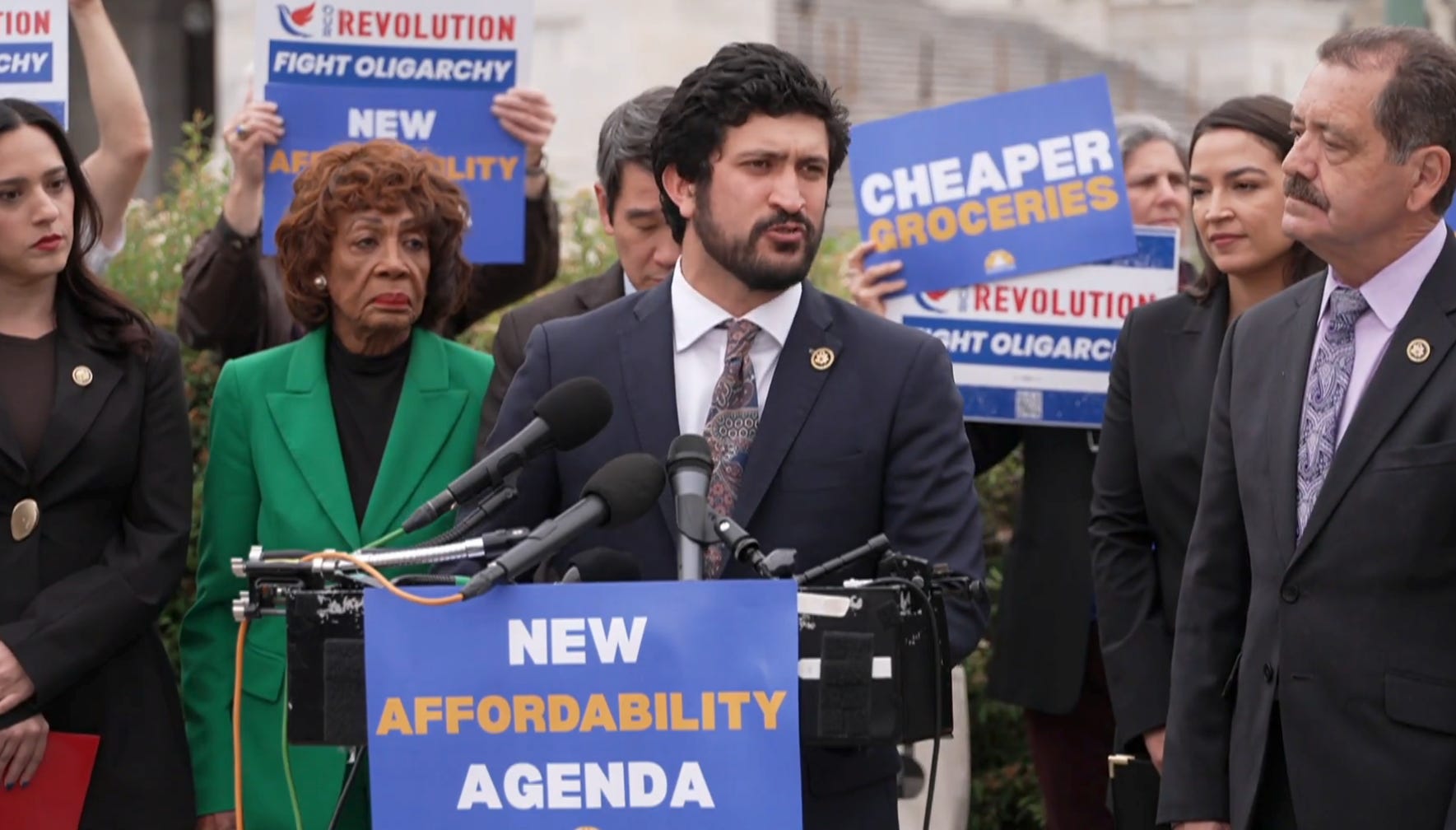
Then, on the other side of Congress, progressive Democrats, led by Texas Congressman Greg Casar, introduced the the Progressive Caucus plan on affordability, which they liken to the 1994 “Contract with America” introduced by Newt Gingrich. They have ten proposals, several of which will be recognizable to readers of BIG. “After the 2024 election loss, Democrats from across the ideological spectrum were saying that we lost the trust of working people,” Casar said. “This is our chance to regain that.”
The most significant is a ban on surveillance pricing, which they will do through something called the Stop AI Price Gouging and Wage Fixing Act. This bill prohibits personalized price setting, an increasingly pervasive phenomenon in the economy.
Another piece of legislation would have the Federal government just start manufacturing generic medications like Nalaxone and insulin. That’s already worked with California producing insulin for $11 per pen. The agenda also includes strengthening antitrust law by allowing state enforcers to go after price discrimination, and reducing the power of corporations to patent seeds.
It includes a crackdown on utilities getting excessive rates of return to pay off shareholders, which is something BIG first discussed last year. This legislation could save $500 per family a year, which is not nothing. It also would improve the electrical grid by forcing utilities to efficiently allocate capital, instead of gold-plating stuff they don’t need so they can overcharge rate-payers.
There’s other stuff as well, but I don’t want to do more laundry listing. Basically the populist faction of Democrats are increasingly focused on going after concentrated capital, simply because that’s the only way they think it’s possible to reduce prices for ordinary Americans. I suspect they’ll get to things like media consolidation, noncompetes, arbitration clauses to enable more jury trials, and whatnot. They don’t have one spokesperson articulating a theory of the world, or willing to talk about what a good society looks like. It’s mostly accepting the affordability frame put forward by others. But in the actual legislation is some embedded ideology.
How likely are any of these provisions to pass? No one knows. If there’s a huge incoming majority, then those new members will likely be more radical, and the House leadership will have to deal with a big and unwieldy caucus. If it’s a narrow majority, then the House leadership will be able to impose a lot more control.
But the truth is, there are some fundamental disagreements within the Democratic apparatus about what is wrong with the American order. While there are increasingly regular conversations among Senators about how big business is screwing Americans, there’s no consensus about whether America is too financialized or not financialized enough. And this debate is occurring as major centers of power in America, like Hollywood, turn radically against concentrations of economic power. The Paramount attempt to buy Warner has set that town afire, and that’s happening in less prominent ways across industries.
Yet even as progressives introduce bills banning surveillance pricing, the House Democrats more broadly are split. The Democrats are led by a corporate lawyer named Hakeem Jeffries, and he has delegated AI policy to a group of corrupt legislators, like Valerie Foushee, Zoe Lofgren, and Josh Gottheimer. The head of fundraising for Congressional Democrats is a member named Suzan DelBene, a former Microsoft executive and ardent stock market cheerleader. These people are mostly thoughtless and uninterested in the experience of ordinary people, but that’s true of much of our economic, academic, and political elite.
In other words, there’s a bitter intra-party fight, which is either going to happen openly or behind closed doors. And it’ll last until 2028, when Democratic primary voters themselves make a decision about what they want out of their party.
That’s how these things always happen.
Historically, the New Deal was a foundational part of the American experiment, an expansion of unions and government. But if there’s one main thrust of what Franklin Delano Roosevelt sought to do, it was to break the tyranny that Wall Street had imposed over Americans. As Roosevelt put it, “A small group had concentrated into their own hands an almost complete control over other people’s property, other people’s money, other people’s labor—other people’s lives.” The same as today, at that time any serious political agenda had to start and end with disciplining the power of monopoly capital.
Yet that notion was not a consensus nor was it inevitable; the Democrats had put forward Wall Street friendly candidates in 1924 and 1928, focusing on social questions. When the stock market crashed in October of 1929, the country slid into recession. A year later, in 1930, voters still returned a narrow Republican majority in the House, because they just didn’t trust the Democratic Party. Over the next year, 11 members of the House died, replaced in special elections. Finally, in November of 1931, a conservative Democrat named Richard M. Kleberg won a Texas special election, giving the Democrats control of the House for the first time in fifteen years. But it was not a left-wing majority, at all. They proposed higher taxes on working people, budget cuts, and culture warring around prohibition. The depression got worse.
And then at the 1932 Democratic National Convention, FDR, despite widespread popularity, nearly lost the nomination due to opposition from electric utility interests, who were the sort of big tech of their day. Ironically, Herbert Hoover, thinking Roosevelt was a lightweight, intervened by encouraging media baron William Randolph Hearst to push Democratic delegates to FDR. Roosevelt, with populists and huge protests backing him, then won overwhelmingly, and governed to smash the power of the money barons. That’s how it worked, the people versus organized money.
There are other darker analogies, like the recession of 1873, which led to the end of Reconstruction and the rise of Wall Street dominance. Or the Panic of 1893, which fostered Jim Crow and the corporatization of American business. When a system falls apart, the stakes of the political debate go up. And that’s where we are today. as populism courses through an angry America. Some Democratic political leaders have begun adopting a political economic agenda to gingerly address oligarchy. The question is how far they can take it. Like most Americans, I’m not particularly optimistic. But it’s worth noting that there is some movement in a good direction.
Thanks for reading! Your tips make this newsletter what it is, so please send tips on weird monopolies, stories I’ve missed, or other thoughts. And if you liked this issue of BIG, you can sign up here for more issues, a newsletter on how to restore fair commerce, innovation, and democracy. Consider becoming a paying subscriber to support this work, or if you are a paying subscriber, giving a gift subscription to a friend, colleague, or family member. If you really liked it, read my book, Goliath: The 100-Year War Between Monopoly Power and Democracy.
cheers,
Matt Stoller