 BURST
BURST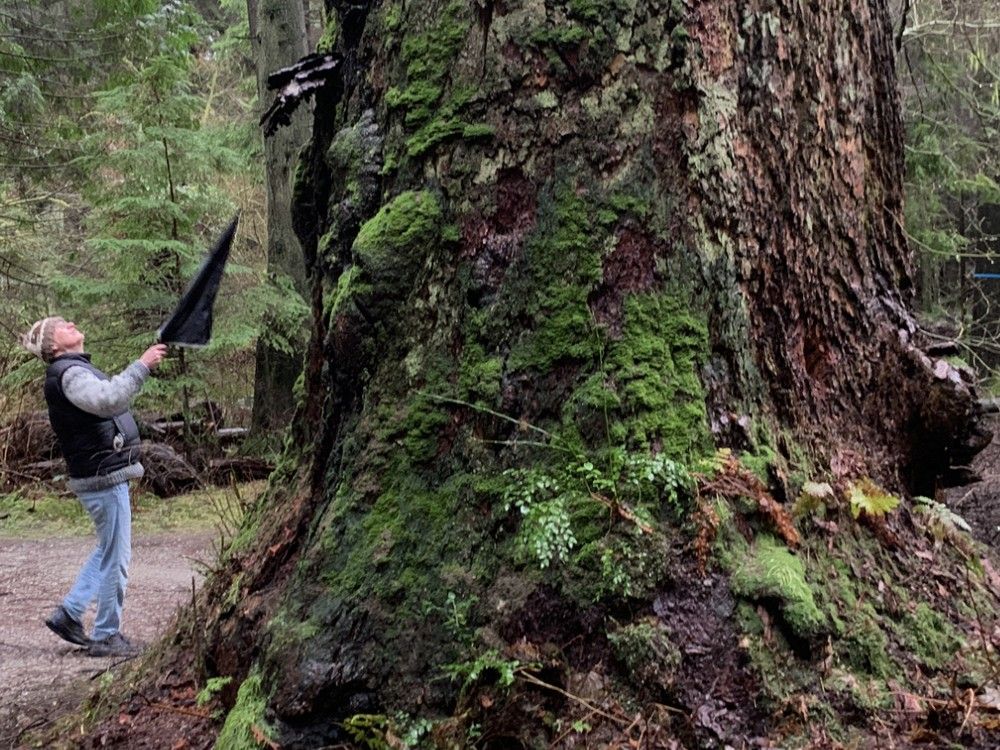
Stanley Park tree advocates are fighting to save a 500-year-old Douglas fir tree as part of the continuing removal of trees affected by a hemlock looper moth infestation but the Vancouver park board says it’s not marked to be felled.
The Stanley Park Preservation Society held a news conference in the park on Wednesday, arguing the 27-metre-tall tree has recreational and wildlife value and doesn’t need to come down.
However, the park board said in an emailed statement that while the tree in question is dead “as it experienced a substantial failure several years ago, with its living top breaking off,” it hasn’t been marked for removal.
“The misunderstanding appears to have stemmed from the assumption that all the blue ribbons indicate trees marked for removal. Which in fact is not the case,” the park board said. “ These ribbons serve as reference points for various types of work, which includes retention, protection, pruning, monitoring and other actions.”
Postmedia News has asked the park board to clarify what a blue ribbon does indicate.
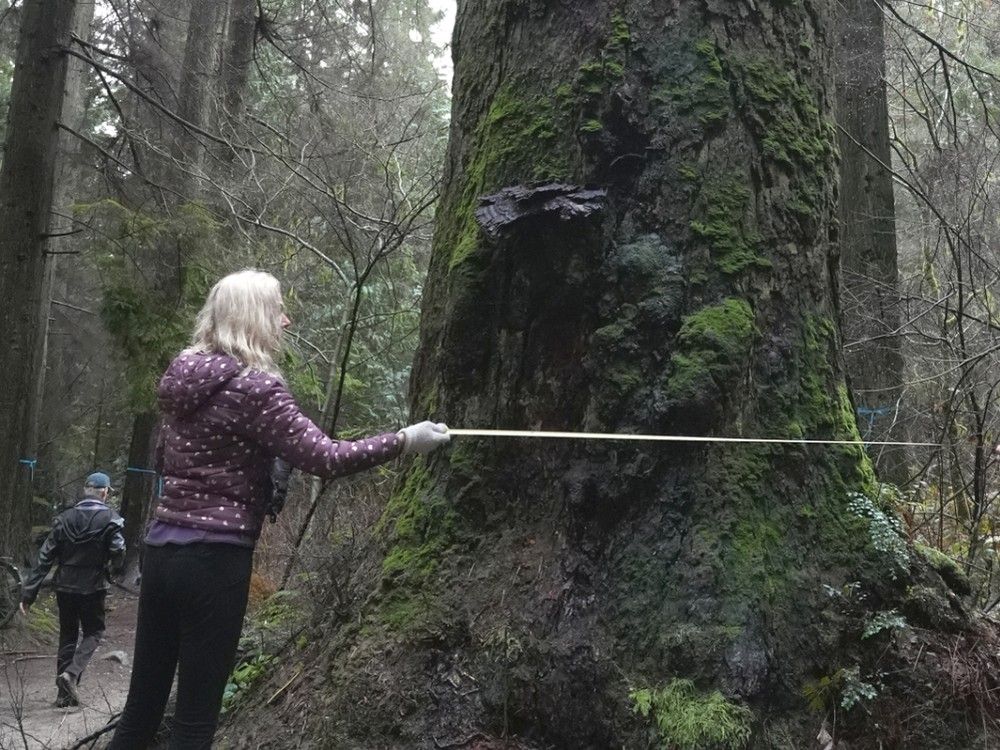
Norm Oberson, an arborist hired by the society, says the city is cutting down trees that may have some rot but don’t pose a safety risk. Standing in front of the Douglas fir, Oberson said he thinks the city needs to do further assessment using more advanced techniques before making a decision.
He suggested the city conduct increment boring, which is a technique using a specialized tool to extract a thin, pencil-sized core sample of wood without harming the tree.
He said the top of the tree is showing signs of “normal deterioration” that could be trimmed back a bit to ensure safety.
He also said some trees in Stanley Park are being hacked unnecessarily, pointing to an example of a nearby Western red cedar.
He added the assessor may have suspected some rot in the trunk but hacking it damages the tree.
“So now it’s an infection site and it will become infected and unfortunately that’s the beginning of the end of that cedar tree because once you damage it like that it becomes rotted and it could be 30, 40, 60 years down the road the rot gets into the bud and the tree does become unstable,” he said.