 BURST
BURSTLots of important monopoly-related news, as usual. The Trump administration is fighting internally about whether to drop their antitrust case against Ticketmaster, profit margins are at their highest level ever, and a series of shocking special electoral wins by populists shows we could be on the verge of a political earthquake. And much more.
But before the full news round-up, I want to go into depth on two parts of our economy that got hit badly over the past few weeks in the financial markets. The first is crypto, and the second are software and analytics companies.
We’ll start with bitcoin and the proverbial “crypto winter.”

I’ll be brief, because this one doesn’t matter that much. Crypto has gone down by $1.7 trillion in market value since its October peak, with the decline accelerating last week. I have no idea why there was a market collapse, it may have to do with a hedge fund blowing up or some sort of market mechanic. Maybe we’ll never know. Crypto falls periodically. What matters is that this time there is a lack of confidence in the crypto narrative.
The reason is that the crypto story has fallen apart. That story, briefly, went as follows. The blockchain is a foundational groundbreaking technology, only known to a niche segment, and hamstrung by a hostile political environment. When it becomes legal and mainstream, cryptocurrencies would skyrocket in value as use cases became clear. There were a host of hopeful future events that investors could expect to drive value.
When Trump got elected, the story seemed to play out. Bitcoin jumped in value, and the first “crypto President” appointed friendly regulators. Congress passed the GENIUS Act to legalize "stablecoins" a type of financial instrument based on crypto, and there are now easier ways for investors to buy and sell various coins. There is even a decline in faith in the dollar, which supposedly bitcoin hedges against.
Only, it turns out there are no real use cases for crypto except for money laundering and fraud, and little real interest beyond “number go up” speculation. It’s not a very interesting technology, with AI taking the spotlight and legalized gambling and future markets taking the froth. Even some of the big crypto firms, like Coinbase, have given up on crypto and are just trying to become less regulated dollar-based banks. I suppose there’s still the possibility of a bailout or something, but at this point everyone knows that crypto is a legal way to gamble that is more boring than other ways to legally gamble. And that’s all it’ll ever be.
So that’s the crypto collapse.
The second collapse is far more interesting, and it has to do with a whole set of companies that make software, like Adobe, Zoom, Salesforce, WorkDay, ServiceNow, LegalZoom, Thomson Reuters, and even Microsoft. The S&P Software & Services has gone through “Software-mageddon,” losing a trillion dollars in market value in a week. This collapse is hitting software focused private equity firms like Thoma Bravo, who I once called the “bridge trolls” of corporate software, and Vista Equity Partners. The fear is that their business can be automated away, or significantly harmed, by the new AI tools allowing for the automation of the creation of computer code.
Still, financial markets can go down, and it doesn’t necessarily mean anything. So is the fear reasonable that AI will undermine the viability of many software companies? Software company CEOs think, by and large, the answer is no. At least one Wall Street analyst said the selloff is overdone, that he doesn’t think “every company will hereby write and maintain a bespoke product to replace every layer of mission-critical enterprise software they have ever deployed.” Nvidia CEO Jensen Huang thinks that replacing all software with AI is dumb, akin to re-inventing the screwdriver rather than just buying one that already exists.
Anyone who has used the new AI tools to do research or code knows they are good at getting you 85% of the way there, but they get significant things wrong. That said, I think the answer is yes, but not for the reasons you might expect.
The System of Record Problem
First, let’s start by looking at how software in America works these days, or rather, doesn’t work. Software companies often have very high margins. The stated reason for high profits is the marginal cost of selling another unit of software is zero. If your product catches on, profits roll in.
There are many different types of software firms, but one particular type is both essential and lucrative. Analyst Brendan Keeler, a health care software expert, described the main business model of the most profitable software firms as “system of record” providers, serving as the nervous system of an organization.
America is full of these enterprise software packages. There big ones like SAP, Salesforce, Microsoft and Oracle. There are niche solutions like Workday, Kronos, and Rippling for specific functions of an organization.
But there are sector-specific ones as well, in every nook and cranny of American business. Yoga studios run on something called Mindbody, auto dealers use CDK Global or and Reynolds & Reynolds, real estate companies use Yardi or RealPage, engineers use Autodesk, hospitals use Epic Systems. Gas stations, K-12 schools, churches, and estate liquidators have their own consolidated software platforms. So do cities. Tyler Technologies provides software that manages municipal functions, everything from “permitting, police dispatching, jail booking, property appraising, campground reservations, restaurant inspecting, cannabis licensing and school bus tracking.”
Pretty much every one of these platforms is just a database hooked up to a user interface. So what makes a software package unique and useful aside from the code? Every compelling business software product is, as former venture capitalist Benedict Evans said, the result of someone identifying an organizational problem, sitting down and mapping out a workflow for how to solve it, and then embedding it into a software package. They then sell it to corporate America, along with support systems, quality assurance specialists, and security teams. There is “one throat to choke” for clients.
Companies always have the option of not buying these systems, or creating their own bespoke solution. But these have downsides. Sure you could do your human resources management on spreadsheets and email, but Workday takes a weeklong task, simplifies it, and ensures your organization is doing it the way other organizations do it. Over time, companies like Epic Systems embedded themselves in complex organizations like hospitals, expanding out with software as hospitals expand, and becoming intertwined in ways that make it almost inseparable. At this point, in regulated sectors, the software is impossible to dislodge.
In general, system of record companies are not well liked by users. That’s in part because the executives who buy these systems are not the end users who must put up with using them. Bill Gates in the 1980s often sold subpar software, but the quality of the software wasn’t as important as the way he created standards for industries. Software systems must work well enough to cover most situations, but don’t have to excel at anything except sales.
The bad experience is also a result of bad behavior by these companies. They charge junk fees, their products have bad looking interfaces, and their products are often crappy and extractive.
One of the more interesting meetings I had as a Congressional staffer was in 2016, with a group of listless community bankers. They were coming to ask me to get my liberal boss to support getting rid of some consumer protection law, which everyone knew wasn’t going to happen. At the time, I had gotten interested in monopoly questions, so I changed the subject, and asked about their “core” providers, an oligopoly of software vendors (FIS, Fiserv, and Jack Henry) that provide the guts of the operation for their banks.
And the room lit up. Every single banker in the room started complaining.
“It’s expensive.”
“Terrible.”
“I hate it.”
To give you a sense of just how bad it is, here’s the ancient graphical user interface from Fiserv, one of the three dominant “cores” (via Keeler).
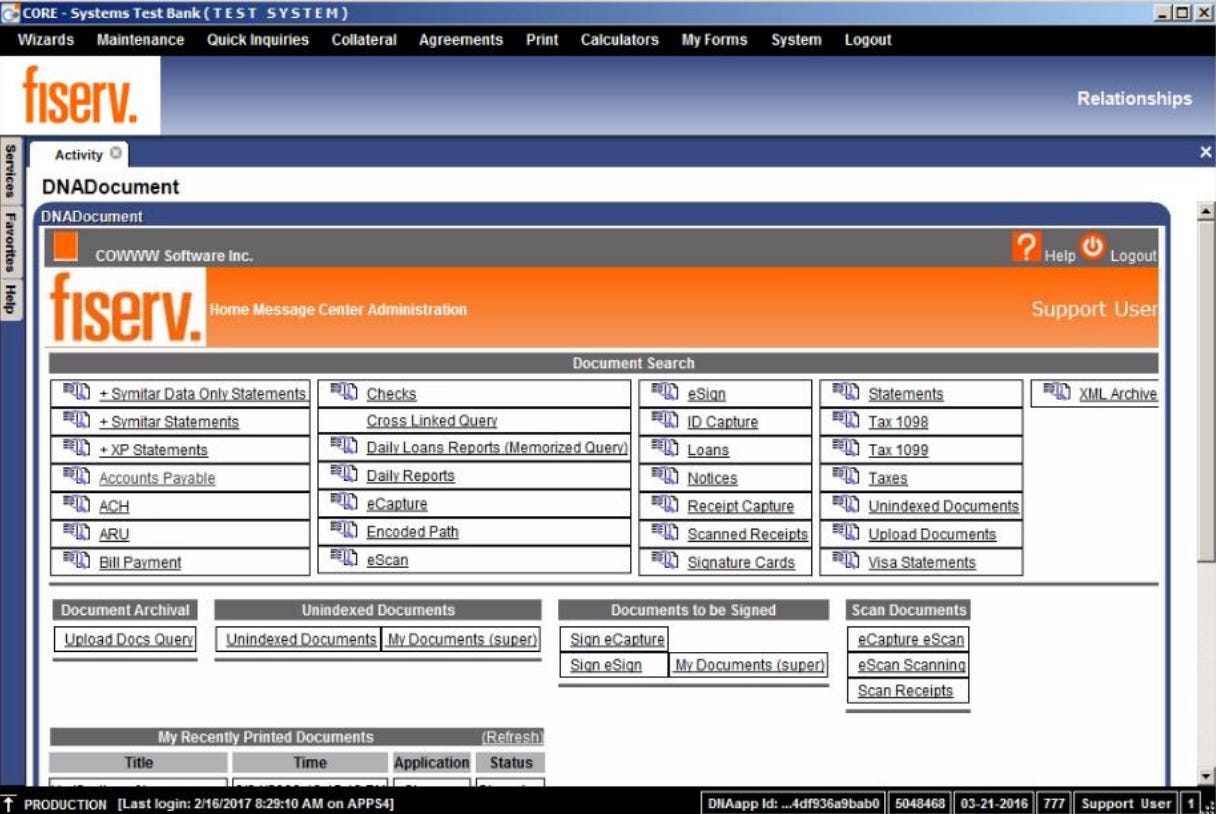
Beyond the poor quality of the software, the bankers had to sign non-disclosure agreements around price and terms. Several had hired consultants just to negotiate. And moving from one provider to another was a nightmare, taking 18 months and huge operational investment.
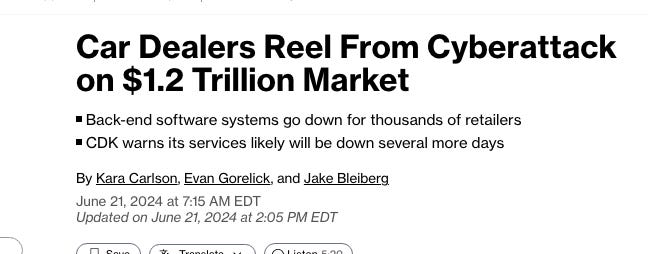
This kind of situation is common - just talk to any yoga teacher about Mindbody - and it is not just bad user experiences. We are now routinely seeing bad software becoming a vulnerability for most corporations. In 2024, for instance, I wrote up how Americans across the country had trouble buying cars. Auto dealers were reliant on a software monopolist named CDK Global, which supplies their enterprise software. And it got hacked.
Enshittification is a word for a reason, and it’s not just applicable to the big platforms. Leaving these platforms for a better quality one is virtually impossible. This dynamic happens across all system of record platforms, as Keeler notes.
Systems of record don’t accidentally become extraction machines - they’re following the most rational path available to them. Once they’ve achieved market dominance and high switching costs, the economics heavily favor growing wallet share, first by relentless feature expansion but, as that falters, often by bundling, lock-in, and ecosystem control. Growth becomes predicated on wringing every last drop out of a saturated market. The Tidemark framework shows this isn’t a bug in B2B software - it’s a fundamental feature. They win their category, expand their offerings, then extend through the value chain until they control entire ecosystems.
As Keeler notes, all of the software incumbents close their ecosystems to prevent rivals from selling to their customers. There are endless examples - Slack, Atlassian, Shopify, Figma, Notion, and Epic Systems have all sought to limit access to data or APIs or are in legal disputes alleging they are doing so. Microsoft killed Lotus 123 and replaced it with Excel, it did the same thing to Netscape and Sun middleware in the 1990s. You can find this kind of behavior going all the way back to the granddaddy software monopolist, IBM, which sought to prevent the use of third party software on its IBM 360 until it faced an antitrust suit in 1969.
In other words, system of record software systems have public utility-style characteristics. Many of the best antitrust cases, like that against IBM and Microsoft, succeeded by allowing competition via new platforms. The IBM 360, a bundle of software, hardware, networking and printing, got competition in every part of the stack, creating several multi-trillion dollar industries. The same thing happened with Microsoft’s antitrust case, which allowed the flourishing of the 2000s web. In the health care space, there are data portability and interoperability requirements embedded in the Cures Act, which has some interesting ramifications.
If a new company can come in and interoperate with a dominant platform, it can offer a new feature and help make the software ecosystem better. It doesn’t need to displace the platform; you could sell an emergency room management module without kicking Epic out of the whole hospital. The basic idea is to put competitive pressure on these firms to make them improve their quality and better their pricing.
And that’s where generative AI comes in. Over the past couple of weeks, like a lot of journalist-adjacent political types, I’ve spent time using Anthropic’s new tool for creating computer programs. Generative AI tools, from Google’s Gemini to Anthropic’s Claude Code, are now quite useful. They aren’t super-intelligent, they are fundamentally pattern recognition and copying machines, and they still hallucinate and lie. But unlike crypto, there are important use cases where people can deploy these tools to do things they couldn’t do before.
I spent a bit of time last month building a site to solve a problem I’ve always found super-annoying about the legislative process. It’s hard to read Federal bills because they don’t map to the underlying code. Anyone who has worked in Congress knows what I mean, you get a bill that says “change this word from ‘may’ to ‘shall’ in section XYZ of Federal law.” To understand what it does, and find possible loopholes they are trying to sneak in, you have to go to that underlying Federal law and look at where it says “may” and then put “shall” in there and read it. It’s basically like a manual version of copy and pasting, except much more complicated and with lawyers trying to trick you.
So I wrote an app that lets you upload legislation, and it automatically shows you how it changes Federal law. There are commercial versions of this software, and some states do it for their proposed legislation. But I haven’t seen anything on the Federal level that is free, so I built it. (The code is here.) It’s not very good. It’ll probably break a lot. There’s no “throat to choke” if you use it and it’s wrong. And my guess is that Anthropic or Gemini ultimately will be able to do this function itself eventually. But the point is that if I can build something like this in my spare time and deploy it without any training at all, then it’s just not that hard for an organization with some capital to get rid of some of its business software tools.
And that appears to be happening. Companies are using Anthropic’s new tools to replace legal software services, and are finding ways to build custom software as well.
Among those cutting some software contracts and turning to AI is the San Diego-based technology company GroWrk. It has saved roughly $50,000 on an annualized basis by eliminating tools like the project-management platform Asana and others in recent months, and an internal team is now weighing what to build versus buy. CEO Carlos Escutia said he would hold on to some software essential to the company’s operations, but would increasingly lean on tools like Claude Code to cut out some vendors. “Now you can build these tools internally,” he said. “That’s a good thing.”
I know of companies that use generative AI to radically accelerate creating tools for projects, but those projects only need to be 90% correct. That’s not the case with, say, health records, or bank transfers. Those have to be correct every time. And if AI systems are given access to important file systems they can accidentally do great damage. But used carefully, generative AI can foster significant gains. A real engineering department can use vibe coding and AI to create reliable and useful software. That means companies can build their own custom software to replace or supplement their existing purchased programs. And it’s easier to create rivals to existing incumbents. Basically, the leverage an incumbent software company has is much lower than it used to be. And this dynamic is especially true where the software is expensive and bad.
In other words, it’s not that generative AI is that good, it’s that software industry models in the U.S. are shaped around monopolization, offering low quality and bad security for high prices, increasingly with customer support from chatbots. So poorly done AI-built software is just not that much worse than what exists now. If you’re going to get customer support from AI, does it really matter if that chatbot is run on your own server or on one from Salesforce or SAP? And since software vendors don’t accept liability when their software causes your company to screw up, is your own custom software really that much worse?
Ultimately, the high margins of incumbent software providers are not a result of zero marginal cost production of an additional unit. Costs actually do go up, in the form of dealing with hacking, the need for customer service, fixing bugs, and helping with new use cases. It’s just that if you don’t cover these things, you are offloading the costs to customers and keeping the profits for yourself. Monopolization and lock-in are a helluva thing.
Right now, policymakers should help accelerate this shift away from the high margin low quality software paradigm by focusing on getting rid of attempts at locking in customers. It’s the perfect way to use this technological inflection point to make our software, and lives, way less annoying.
And now, the rest of the round-up. Lots of important stories. Trump signed PBM reform into law, more Epstein blowback including polling showing that billionaires are in political trouble, and real anger after New Hampshire regulators allow a 43% increase in electricity rates. Yes, you heard that number right. Plus ads about junk fees on the Super Bowl, a shocking win by a populist left-winger in New Jersey, and several surprising victories Democrats in Trump districts in the deep South. America is turning populist.