 BURST
About our reporting: Associate editor Sam MacIlwaine spoke with the president of Ridge Meadows Search and Rescue, Brent Boulet, about how he and his fellow volunteers rescued two climbers on Edge Peak on September 22 and how that operation fits into mountain rescue trends.
The most time-consuming rescues are often some of the most preventable. In fact, the more I report on rescues, the more I realize that the same themes tend to show up, over and over again. Climbing’s spectacular growth as a sport has attracted tons of motivated individuals, but it’s also opened a mentorship gap that leaves many new climbers facing high-stakes situations alone. Mountain rescuers see this more clearly than anyone.
Two weeks ago, a climber in British Columbia called for their third rescue in 2026 after they and their partner got stuck on a 1,600-foot alpine climb on Edge Peak, east of Vancouver. The route they were climbing, White Dyke, is an alpine scramble up approximately 500 meters (~1,640 feet) of low fifth-class and fourth-class terrain en route to the summit of Edge Peak (5,512ft), in the Golden Ears Provincial Park.
To understand what went wrong and how it could have been avoided, I spoke with Brent Boulent, a 15-year veteran of Ridge Meadows Search and Rescue and one of the first responders on scene.
How two climbers got trapped on the White Dyke
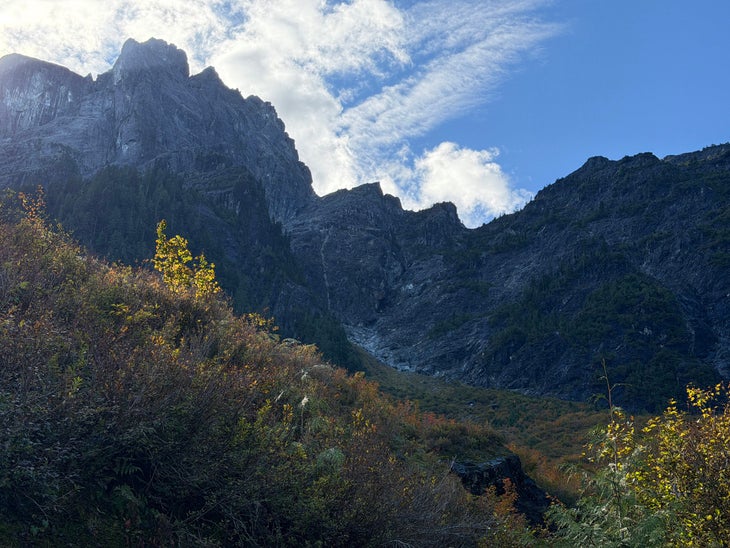
Although it doesn’t see as much traffic as Half Dome via Snake Dike (5.7 R; 2,000ft) in Yosemite, Edge Peak via White Dyke is an increasingly popular day mission for Pacific Northwest climbers looking to escape Squamish’s summer crowds.
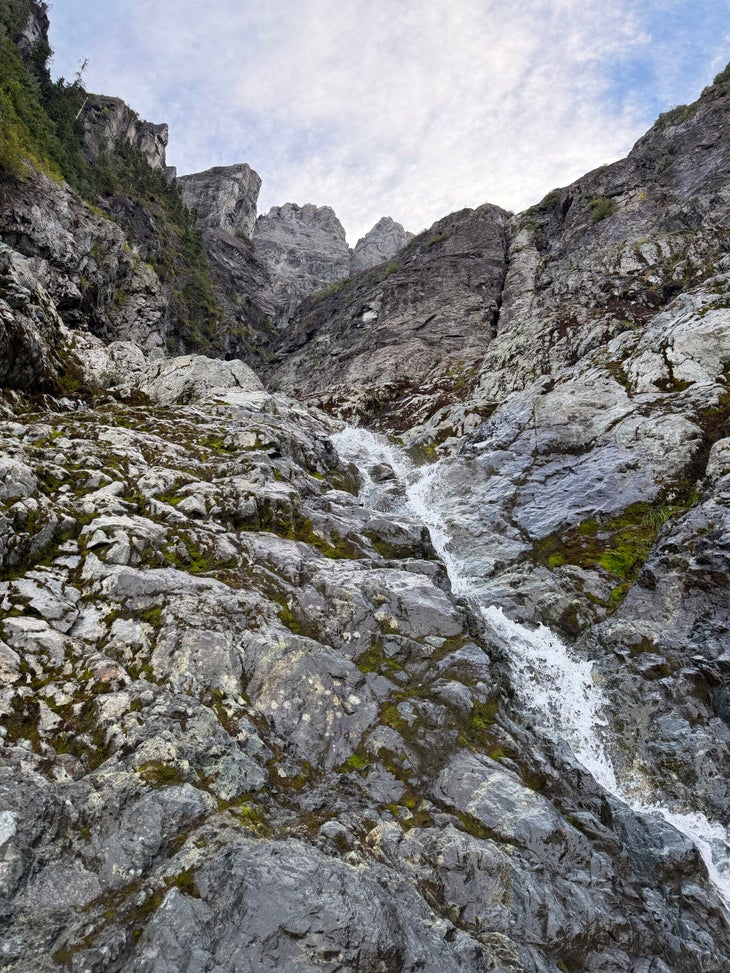
From the approach, the White Dyke appears as a visible bleached streak through dark gray granite. According to Boulet, the first five pitches—all ungraded fourth-to-fifth class scrambling, about half of the route—each have bolted anchor stations for rappelling. The more common descent, however, is via a longer but less technical trail that climbers scramble and hike down. “You can probably get away with a half rack and a climbing rope [for protection],” says Boulet, who says he dabbles in mountaineering but doesn’t climb often outside of search and rescue.
On September 22, two climbers (whom we’ll reference henceforth as “Climber A” and “Climber B”) left the trailhead at about 8:30 a.m. and began hiking the eight-kilometer (~4.9 mile) approach to the base of the White Dyke. They both tied in with two 60-meter half ropes. As the more experienced climber—and the one who had been rescued twice already in 2026—Climber A led pitches while Climber B followed. However, they were running late for their goal of summiting; by the time Climber A had reached the top of pitch two and started to belay Climber B on toprope, it was already 4:30 p.m., just three hours before sunset.
“The second climber was, at that point, now struggling,” said Boulet. “My understanding was that at that point, that person was already very fatigued from hiking in.” Boulet believes that Climber B also tried to ascend the rope instead of climbing, but was not successful. “At that point, they told the lead climber above them, ‘I’m too tired. I can’t go up, I can’t go down. I’m stuck here,’” said Boulet.
For two hours, the climbers attempted to self-rescue. Then, at 6:30 p.m., Climber A pulled out their Garmin InReach and pressed SOS.
Volunteers respond to the overnight rescue
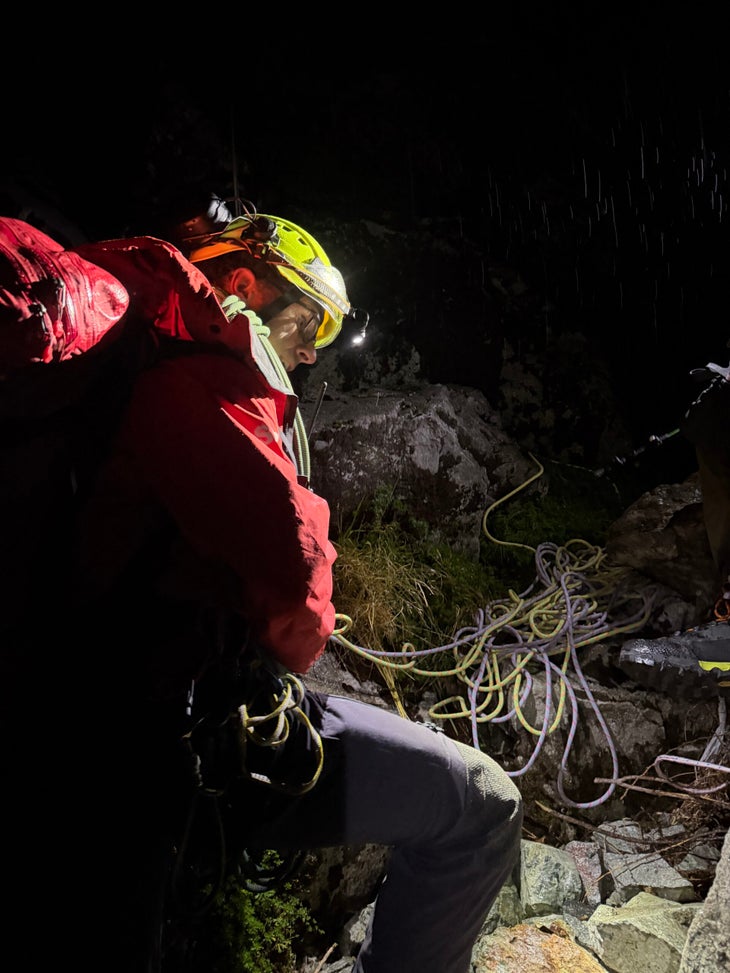
Boulet’s all-volunteer team at Ridge Meadows Search and Rescue responded to the call, along with British Columbia-based Talon Helicopters. A backup team from Coquitlam Search and Rescue also mobilized in case the rescue required a mid-face hoist operation, which Coquitlam could perform.
“At first, when the call came in, it didn’t seem urgent,” said Boulet. He explained that the climbers told SAR, “We’re on the White Dyke, we’re stuck, we’re not injured, we have supplies, we’re okay.” As a result, the volunteers decided not to risk a night operation and wait until morning. However, as more information came in, the rescuers realized that the climbers were still tied into the rope. “With them still mid-climb, there was the risk of overnight exposure, weather was coming in, and we’re assuming that they’re dangling from a harness, so there’s the thought of suspension trauma,” Boulet explained. “So we felt it was justified to do a night rescue.” He also noted that his SAR management recognized the name of the caller as someone that his team had rescued recently.
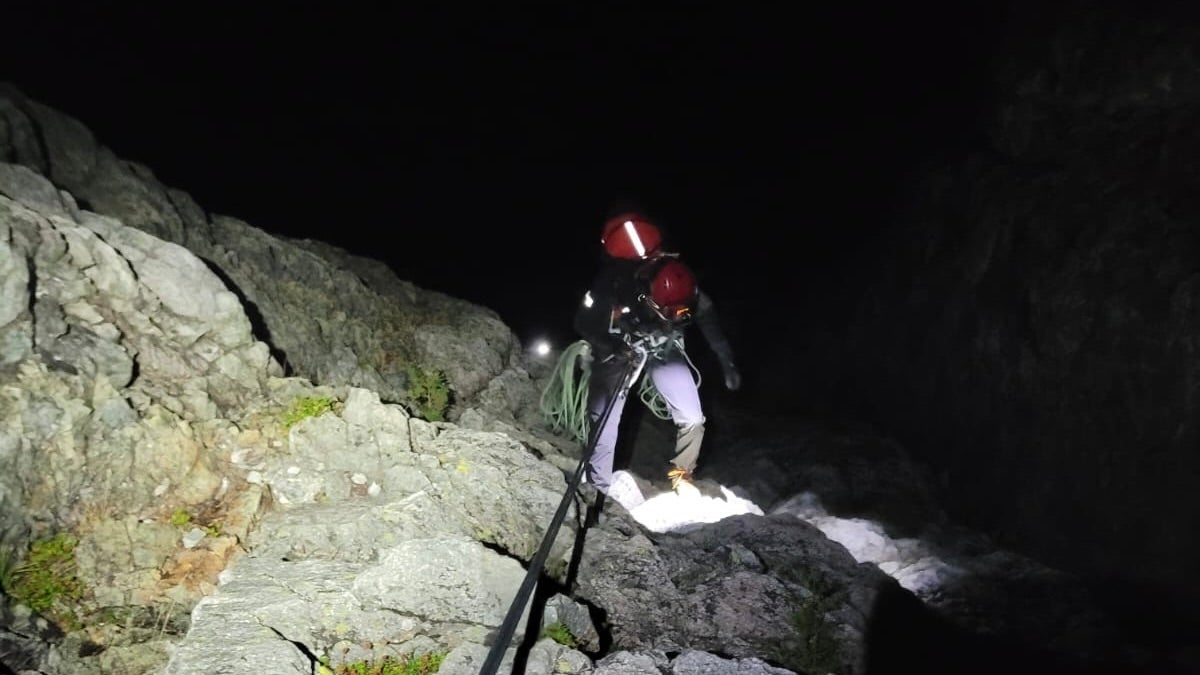
After nightfall, a helicopter dropped off Boulet and his partner on White Dyke above the climbers. The rescuers scrambled down, then started rappelling at the third pitch anchor. When they reached the second pitch anchor, they encountered Climber A attached to the anchor with a personal tether, with both ropes coiled beneath them. Boulet’s partner then lowered Boulet down to the first anchor to reach Climber B, who was attached to the anchor and also tied into both ropes.
The plan was to lower both climbers to a safe ledge, then evacuate via helicopter. Using a munter hitch, Boulet lowered Climber B to a flat ledge at the base of the route. Climber A then rappelled down two pitches, with Boulet’s partner overseeing their rappel setup.
“The one climber who was fatigued was in really rough shape, just super tired,” Boulet said, referring to Climber B. “They were a little sketchy even on their feet, so we didn’t want to risk moving them any further.”
However, by the time all four people were on the ground, it was around 3 a.m. and weather was coming in, which Boulet said made it too difficult for the helicopter team to use their night vision. For the next two hours and 30 minutes, the rescuers hunkered down with the climbers under a nearby overhanging wall, out of the rain, with some additional layers. Finally, at 5:30 a.m., the helicopter arrived and successfully hoisted all four people from the ground. It was 11 hours after the call went out and 21 hours from when the climbers began their hike. No injuries were reported.
What a 15-year rescue veteran says we can learn from this
Maple Ridge and Pitt Meadows Search and Rescue has 31 active, volunteer members and usually gets about 40 calls per year, from searches for missing hikers to boating emergencies on Pitt Lake. In the past few years, the total number of rescues has remained steady, but Boulet has noticed a recent increase in the proportion of technical rescues like the one on White Dyke on September 22.
“Instead of going to the busy area—the North Shore [of Vancouver], Squamish—people are now starting to work their way out [east] and try different routes in Golden Ears Park that are less common,” he said. “I think with social media, and seeing all those different objectives, it’s bringing in less experienced people.” In the last 40 years, Boulet’s team has almost never done a rescue off Edge Peak because the only climbers who go there are typically very experienced. In the last five years, however, they’ve done at least six—including two for the same person.
Boulet’s team had rescued Climber A once more about three months prior to the White Dyke rescue. At that time, Climber A was attempting to summit Edge Peak via the 15-mile round-trip Golden Ears Summit Trail. “I believe they had tripped and fallen and hit their leg,” said Boulet, “and felt that they needed rescue because they hurt their leg.” Although he wasn’t mobilized on that rescue, Boulet confirmed that his co-volunteers performed a helicopter hoist rescue during daylight hours. He added that Climber A had been also rescued in a different region, by a different SAR team, earlier in 2026; it is unknown whether that was a climbing or hiking incident.
Regarding the September 22 rescue, Boulet says that paying more attention to the big-picture timing of the day could have helped prevent the rescue. Due to the late start at 8:30 a.m. and the pace of the climbers’ hiking, by the time they got to the base of the route, it likely was already too late to successfully summit and return before dark. “They should have been like, ‘Hey, I’m not feeling it,’” said Boulet. “You’re looking up at a 500-meter vertical wall. Can you do that before dark?”
Boulet stressed that being willing to “turn around and go home” is one of the biggest skills to have in the backcountry, and recommends that all climbers plot out their day missions with a back-up plan to soften the blow of retreat. But he also emphasized the importance of properly assessing a partner’s capabilities before going out to the mountains. To help with this, he recommends joining an outdoor group, such as the British Columbia Mountain Club, to learn how to plan trips from more experienced people.
“[For] anyone that you’re going climbing with…start small,” he said. “Go on just a hike. Assess how the two of you are: Are you actually friends? First build a relationship with that person so you have mutual friends, then go on a hike and be like, ‘What’s their stamina like?’” Any bigger objective with someone should come after several smaller ones. “I want to be able to trust my life to that person belaying me,” he said. “You should have that base relationship first.”
The post Canadian Crew Rescues Climber Who’s Now Called for Help Three Times in 2026 appeared first on Climbing.