 BURST
BURST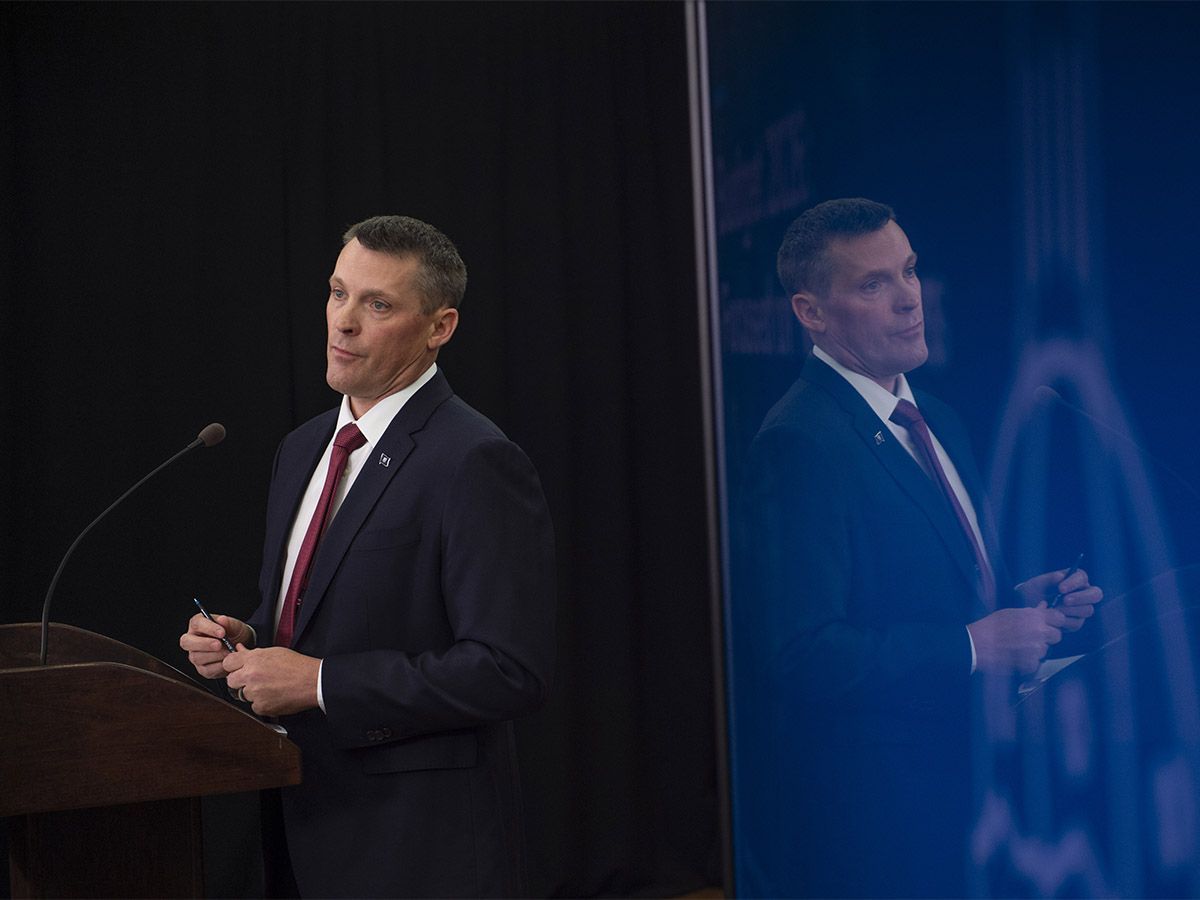
Alberta budgets follow a cinematic format — the good, the bad or the ugly.
The latest is a pile of bad news unlike anything seen since the oil crash of the teens or the fiscal crisis in the oughts.
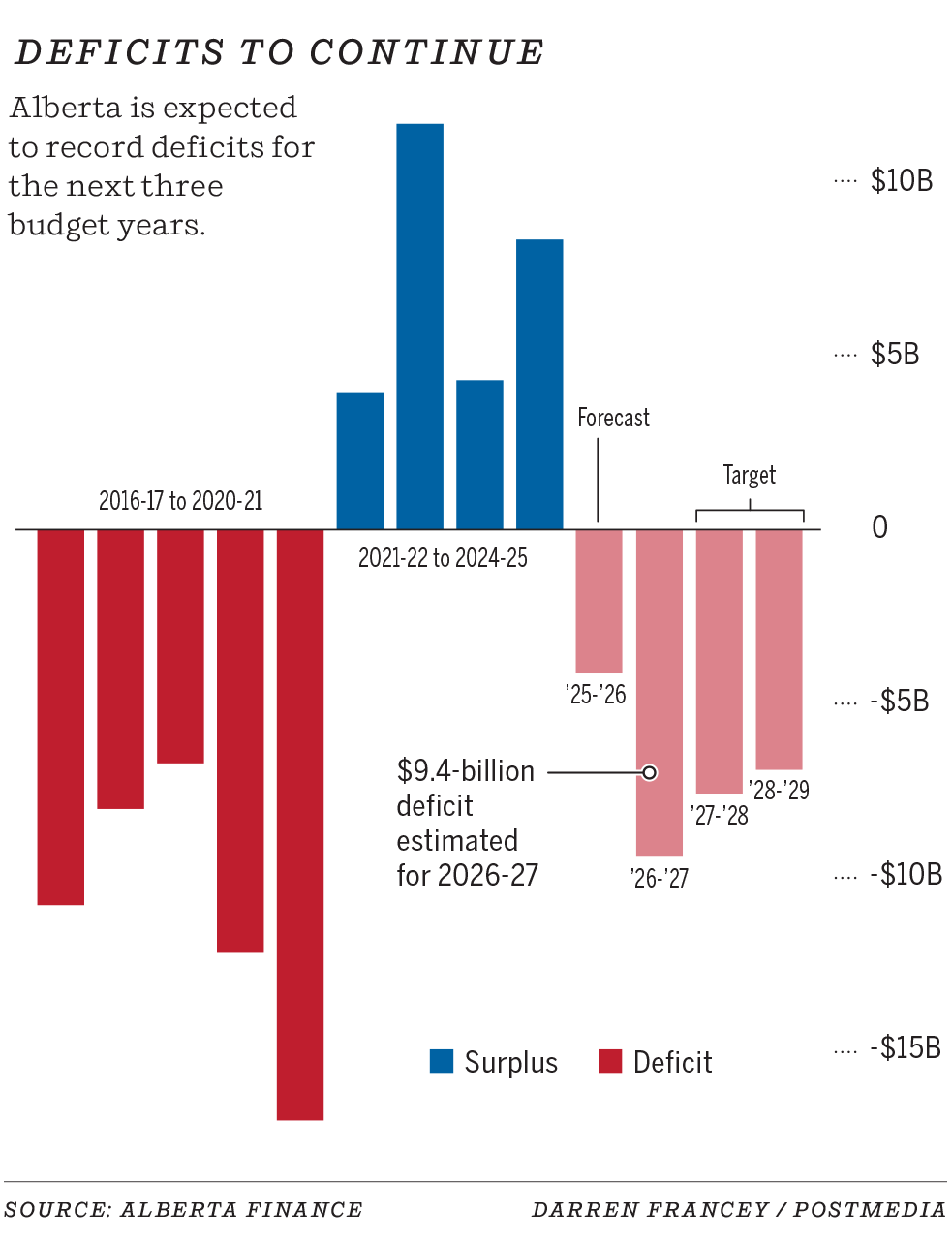
Four years of deficits are expected.
Not just little ones. These deficits will add $28 billion in new debt.
All taxpayer-funded debt will total $109 billion at the end of the current fiscal year, and hit $137 billion as 2028-29 limps to a close.
This year alone, interest payments on the debt will top $3.4 billion.
Related
Premier Danielle Smith’s vaunted fiscal framework is challenged, if not dead.
That policy allows for three years only of consecutive deficits. Now we have a prediction of four — a technical breach for which the UCP won’t punish itself.
But they join an exclusive club — founded by the NDP.
Under premier Rachel Notley, the NDP clocked four straight deficits from 2015 to 2019.
The deficit expected for the current year ending March 31 will be $4.1 billion.
And then “budget 2026 includes deficits of $9.4 billion in 2026-27, $7.6 billion in 2027-28, and $6.9 billion in 2028-29,” says the government’s new fiscal plan.
Four in a row. The NDP will have a laugh, but it’s not funny.
This is serious fiscal trouble that edges Alberta closer to nine debt-plagued, high-tax provinces with no oil revenue to rescue them.
Alberta’s net debt to GDP is 10.5 per cent. Ontario’s ratio is 36 per cent. It’s 38 per cent in Quebec, and 44 per cent in Newfoundland and Labrador.
The province looks pretty good. But the debt snowball, once pushed, can roll downhill fast.
Finance Minister Nate Horner, challenged on maintaining high spending as deficits roll in, asked if Albertans would want him to slash $4.1 billion to stay within the fiscal framework.
Probably not. That isn’t the Alberta way.
Horner’s dilemma reminded me of what happened in 2011 to his cousin, Doug Horner, who was finance minister during the Alison Redford era.
Redford pledged to avoid borrowing, but she and Horner were caught out issuing “social infrastructure bonds,” when the Edmonton Journal’s Keith Gerein realized they’d admitted as much at a news conference.
All the way back to Ralph Klein in the 1990s, Conservative governments have borrowed, then paid off debt, then promised never to borrow again, then borrowed again.
Horner admits it. He’s a straight talker, not prone to fiscal b.s.
“If you look back at the charts over recent history in Alberta, spending increases greatly during the surpluses and then really hard cuts follow when the price drops.”
Only one part of that is wrong — that cycle goes back at least 50 years.
Nate Horner developed the fiscal framework. The prospect of breaking it, he says, “hurts me more than it’ll hurt anybody else.”
Alberta is facing “a hard year head on . . . I recognize that this is a tough pill to swallow.”
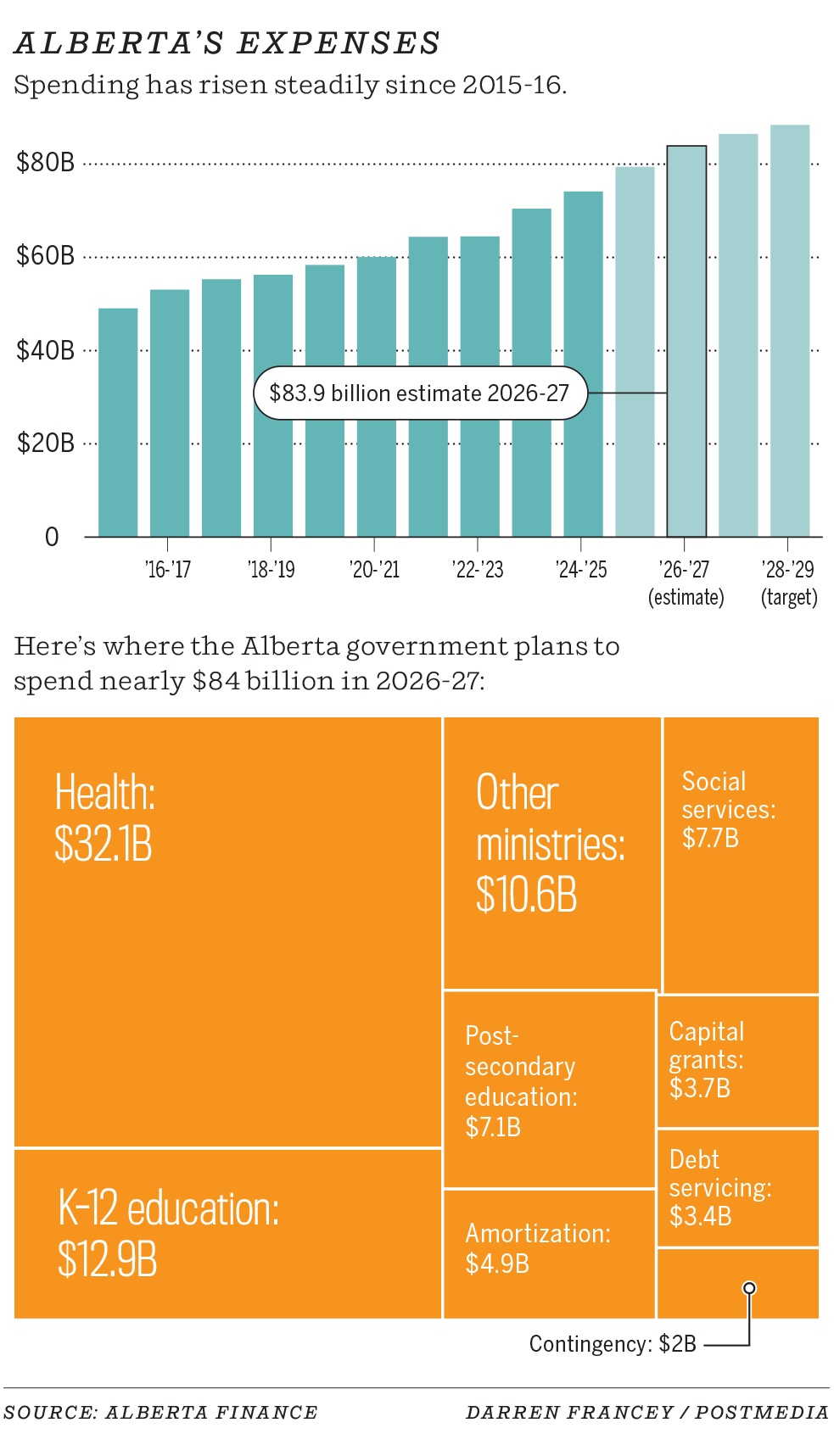
Despite the trouble, the government is now spending $83.9 billion for 2026-27, up more than $4 billion from 2025-26.
Revenue is expected to be only $74.5 billion. That’s how you get a deficit of $9.4 billion.
On the political side, the premier blamed immigration for much of the trouble , even after the UCP begged people to come here.
A population increase of nearly 10 per cent over three years obviously caused strain, especially when GDP wasn’t growing along with it.
But this is yesterday’s problem. Population growth over the next four years will be no higher than 1.4 per cent, and as low as 1.1 per cent.
The cuts have begun. True to form, they’re at the low end of the economic scale.
About $223 million will be trimmed from programs for people with developmental disabilities.
They say no person will receive less. It’s all about structural reform. But the PDD people have been there before. They know the signs.
Similarly, the income threshold for the seniors’ benefit has been changed, meaning thousands will be dropped from the rolls.
There is a traditional, made-in-Alberta solution. Pray for an oil price boom.
Don Braid’s column appears regularly in the Herald