BURST
BURST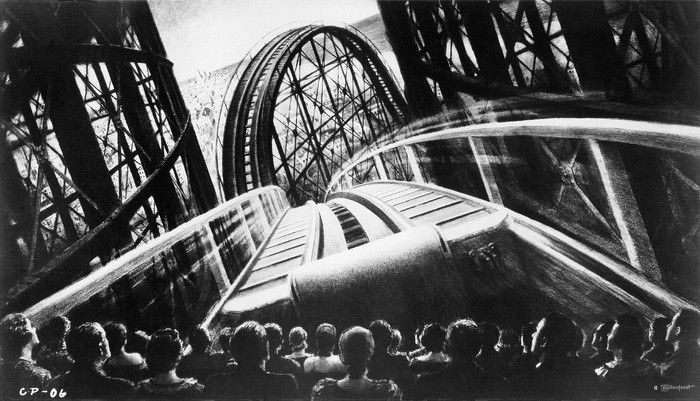
When Cinerama came to Vancouver on March 7, 1958, the hype was beyond belief.
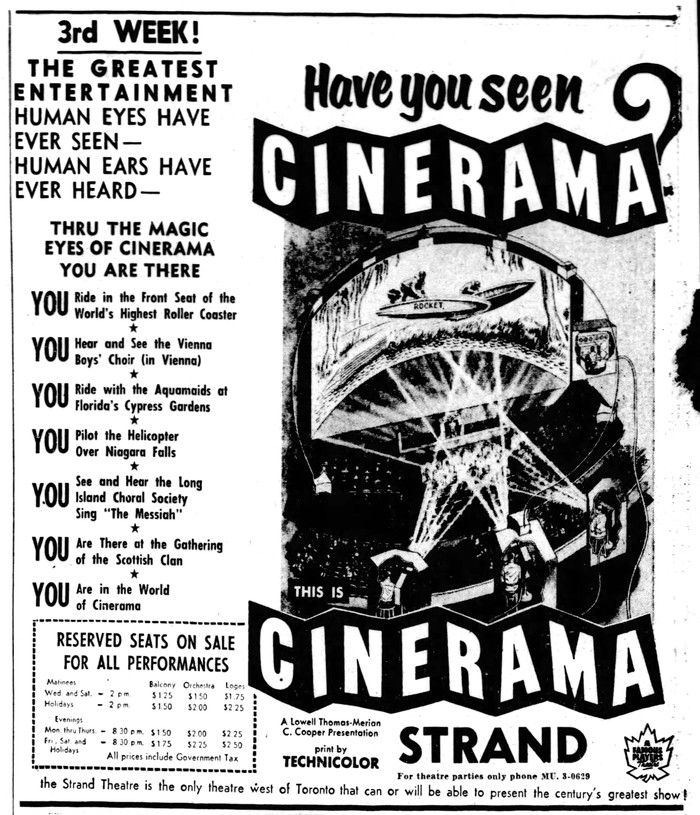
“THE GREATEST ENTERTAINMENT HUMAN EYES HAVE EVER SEEN — HUMAN EARS HAVE EVER HEARD,” trumpeted ads in The Vancouver Sun and Province.
“CINERAMA is more than a novel motion picture technique,” said another ad. “It is an entirely new method of human communication.
“CINERAMA is not opera, travelogue or a motion picture, but a combination of all of them.
“CINERAMA puts you in the picture. In CINERAMA you are there.”
What was the big deal?
Cinerama was a new type of motion picture experience, promising much more vivid and lifelike films than before. Cinerama screens were taller, wider and curved at the ends, and featured seven stereo tracks for audio, rather than the mono of most 1950s movies.
According to Ben Rowe of the Calgary Cinematheque, motion pictures filmed in Cinerama “sought to replicate the wide angle of human vision by using three 35mm cameras filming simultaneously to capture a 146 degree horizontal arc of vision.
“These three interlocked cameras used 27mm lenses which replicated the focal length of the human eye.”
In Cinerama theatres, Rowe said “the three film prints produced would be projected in synchronization by three projectors to produce a wide-screen image with three times the image fidelity of a single film strip.”
The first Cinerama production was This Is Cinerama, a two-hour travelogue that took viewers on a series of thrilling visits to exotic spots around the world.
“When the camera goes for a roller-coaster ride, you’re right with it, and if your stomach doesn’t do a slow roll, and your lips let loose some fast screams, you’re just not human,” said Les Wedman of The Province after This Is Cinerama opened at the Paramount Theatre in Seattle on Aug. 24, 1956.
“The same goes for water-skiing in the Everglades or flying in a helicopter over Niagara Falls or in a fast plane over the Grand Canyon and other U.S. beauty spots. The effect is the real McCoy.”
The American Widescreen Museum website run by Brett Hart of Hart And Soul Entertainment has a detailed history of Cinerama, including an illustration from an ad showing an audience immersed in a giant screen showing the roller-coaster ride.
“The result leaves the audience ‘wrapped in action and bathed in sound,’” said a Sept. 29, 1952 wire story by Richard Kleiner after Cinerama’s debut in New York.
“‘The audience isn’t just looking at a picture,’ says Fred Waller, ‘they’re going through a real, physical, emotional experience.’”
Cinerama was the brainchild of Waller, an American inventor who patented the first water-skis in 1925 and did short films for Paramount Pictures in the 1930s.
During the Second World War he helped design a multi-projector system that was used for artillery training, and after the war, he designed Cinerama, with sound developed by Hazard Reeves.
Well-known broadcaster Lowell Thomas signed on to narrate the Cinerama shows, and Cinerama was a sensation in New York and several cities across the United States.
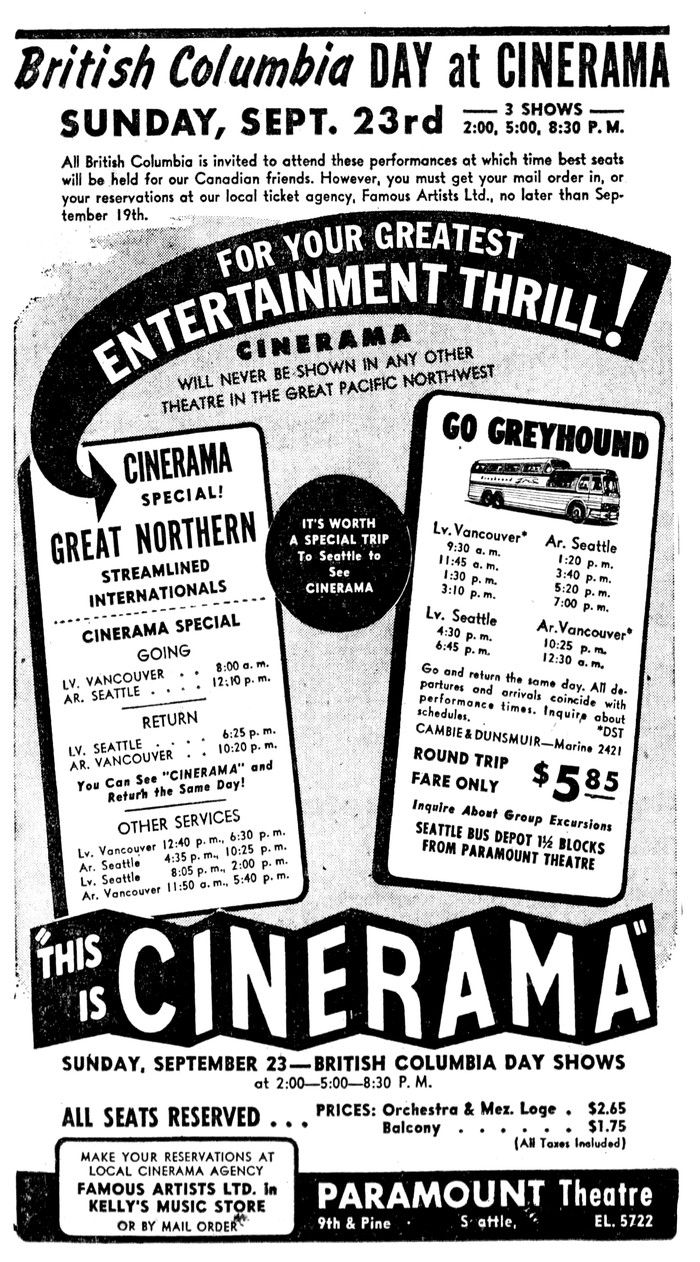
The Seattle show at the Paramount Theatre was so popular that the Paramount theatre took out ads in the Vancouver papers. A Sept. 15, 1956 ad included a “Cinerama Special” Great Northern train that left Vancouver in the morning and returned at night.
The 1956 Seattle ads promised “You will never see Cinerama in Vancouver,” but it would end up being installed at the Strand Theatre at Georgia and Granville less than two years later.
Cinerama shows played the Strand for several years, but the technology never really took off, probably because it was expensive to film and/or set up a Cinerama theatre.
In 1963, Hollywood producer Stanley Kramer employed a new Cinerama process for his movie It’s A Mad, Mad, Mad, Mad World, which converted film done on one camera into a print that could be shown with one projector, which was much less costly.
But there were only a handful of Cinerama features made in the 1960s, such as How The West Was Won in 1962 and Khartoum in 1966.
Eventually, new technologies and theatres such as IMAX came along. But there is still a much-beloved Cinerama Theatre in downtown Seattle. In 1998, it was threatened with demolition, but was saved and restored by the late Microsoft co-founder Paul Allen. It is now owned and operated by the Seattle International Film Festival .
Related