 BURST
Lots of monopoly news, as usual. Oil prices are skyrocketing, as are health care prices everywhere except in the Consumer Price Index, which reported this week that health insurance dropped by 8.5% over the past year. I’m not kidding.
But before getting to the full round-up, I want to delve into the full scope of the Anthropic AI takeover of politics happening over the past week. Yesterday, the company’s CEO Dario Amodei came out and explicitly asked for antitrust laws not to apply to the biggest AI firms. His biggest rival, Sam Altman, quickly agreed. And they are suggesting this legal change just before Anthropic seeks to sell shares on the stock exchange, minting a whole series of AI millionaires and billionaires.
Why do they want to suspend antitrust laws for AI firms? Well these guys say they need the industry collectively “pace the frontier,” aka in their framing, slow development of this technology so as to reduce the probably of human extinction at the hands of autonomous swarms of AI bots. And they can’t do that, they argue, without suspending laws prohibiting price-fixing cartels.
Then the Information reported today that OpenAI, Anthropic, and Google have been having backchannel conversations about establishing an AI standards organization, which presumably would coordinate this cartel.
Let me start with a very simple point. It is already illegal to release products that hurt people. It is illegal to compete by releasing products that hurt people. If these guys are genuinely manufacturing things that kill innocent people, the FBI should be arresting them immediately. The idea that they would not only release such products, but also issue stock for the American people to invest in multi-trillion dollar initial public offerings for such ventures, as Anthropic is planning, is utter lunacy.
I wrote about this attempt to terrify us into giving away our liberties on Friday, in a piece titled “Stop Panicking About AI.” But the IPO is something I didn’t think through. Apparently they think we should all get rich building world-ending product lines.
All that said, whether Anthropic goes public isn’t just up to the people at Anthropic. I asked some former Securities and Exchange Commission officials, and they told me that the SEC effectively has the authority to block initial public offerings. Here’s how.
Every company, before it goes public, submits an S-1 initial registration statement to the SEC. And the SEC can refuse to clear it if the commission believes that it doesn’t adequately disclose the risks a corporation’s securities present to investors. Technically, the SEC could go to court and get an injunction to block the IPO, but it rarely comes to that - the lack of clearance for an S-1 is red flag for investors so companies won’t go public until they get it.
In a functional system, there would be a dozen accountants and disclosure experts with sector training going back and forth with the lawyers telling them to expand on this or that, etc. And the commissioners either themselves or on a delegated basis won’t clear it until they’re satisfied. Today, it’s more likely that Trump himself just decides. Regardless, if Anthropic goes public, it’s not just because of the corporate insiders, it’s because Trump explicitly allowed it.
If I were a member of Congress, I’d be screaming mad right now, and yelling at Trump and the SEC to stop this event which will bestow hundreds of billions of dollars of wealth on a strange doomsday cult.
The Business of Selling Foundational AI Models
Beyond the venality of the Anthropic IPO itself, there is another a question worth asking. Why exactly do these guys want to “pace the frontier?” Why would they want to welcome a some sort of regulatory framework right before selling stock to investors? No doubt, they do believe they are building highly profitable doomsday machines. But there’s another angle, raised by none other than Wall Street mascot and CNBC anchor Jim Cramer.
Anthropic’s paperwork for its initial public offering will look better, aka “dazzle,” since the company won’t have to spend as much money developing new AI models.
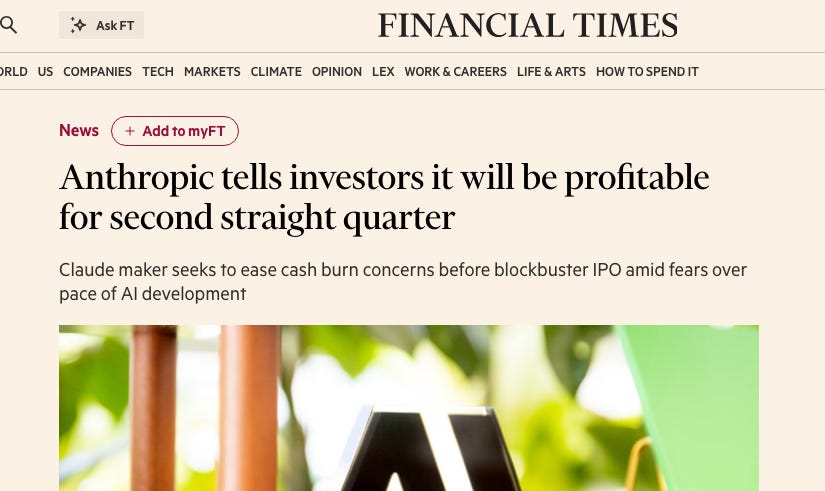
To understand why, let’s go into the finances of these companies, neither of which is public. We do know what OpenAI’s finances look like; its spending went up eightfold last year and it lost $26 billion in 2025. That’s pretty ugly, but OpenAI is known to be the much weaker of the two. Anthropic’s finances are likely much better. According to the Financial Times today, corporate insiders are telling investors that it has been profitable for two quarters in a row, if you exclude the cost of stock compensation.
This sentence is the key to understanding the situation.
Anthropic’s gross margins are above 80 per cent before accounting for revenue shared with distribution partners, including Amazon, and the cost of training its models, according to two of the people.
That sounds like a very high gross margin, but it’s a misleading figure. These companies sell expensive forms of AI computing resources to corporations, in the form of “tokens.” To over-simplify, if you ask Anthropic’s services for some LLM output, it will churn around for a while and deliver it to you, and you pay a price for the compute you use, which is Anthropic’s cost, plus a significant mark-up. That’s the 80% gross margin figure.
However, there’s a significant cost being excluded. Anthropic/OpenAI also have to pay to develop newer and better models and products, which is the bulk of the cash bleed they are experiencing and the reason these companies keep having to raise tens or hundreds of billions of dollars from investors.
Couldn’t they stop developing new fancy models and just harvest cash? Well, not really. You see, they actually have to compete with one another, and there are price wars. More than that, they have to compete with much cheaper Chinese open source models, which their customers can simply download and install. These open source models aren’t quite as good as the top models from Anthropic and OpenAI. So these two U.S. firms can charge a lot, as long as they stay ahead of the Chinese.
The problem is the Chinese are constantly catching up, meaning there’s a recurring cost of developing new models. That 80% gross margin, in other words, doesn’t really tell us much about how profitable the company really is. Seen in this light, “pacing the frontier” might be a way to cut the amount spent on training new models. Or as Cramer put it, it would help their numbers further “dazzle” investors.
While it’s easy to look at AI firms and imagine they have business models similar to big tech monopolies, it’s not clear what kind of moat there is. So Anthropic and OpenAI have to pick between two scenarios: (1) keep spending large amounts on training or (2) forfeit pricing power. Maybe their training spend isn’t that significant compared to their pricing power, or maybe it is. We just don’t know. And we also don’t know what kind of distribution costs there are.
So where does AI Safety come in? Well, Amodei did say he wants to keep the frontier labs ahead of China, just not quite as far ahead. That might be his reason. But that also sounds like a path of keeping some pricing power while lowering cash burn. There’s also the theory that these companies are trying to exclude Chinese open source competition from the U.S. through intrusive regulation, thus eliminating substantial competition.
So that’s a thesis. But since we don’t have financial data, as we don’t enforce securities laws anymore, it’s not clear what is happening. All that said, if it is true that OpenAI and Anthropic are going to spend less, it may have implications for the stock market, because one company’s spending is another company’s revenue. And Anthropic and OpenAI are the buyers of services from the big tech “hyperscalers,” aka Google, Amazon, Microsoft, and Oracle, as well as the neoclouds. And those are the companies buying chips from Nvidia, Broadcom, and the whole ecosystem of semiconductor firms. Much of it is funded by opaque private credit firms and bond investors; circular financing is great on the way up, it’s terrible on the way down.
I wouldn’t presume to know when a bubble will pop. But it would be funny if Anthropic, in order to set itself up for a better IPO, ended up deflating the AI mania in the process.
There is one more point to cover. There is an ongoing political campaign to do something about AI, with a large swath of elites demanding action. That includes Barack Obama, who rarely demands anything except the most banal conventional wisdom. So when he says “AI policy is critical’ to Democrats, you know that it has reached peak elite acceptance. Still, what is that ‘something?’
The basic fight is over framing, not risk. Everyone sees risk here, but the root cause differs based on your perspective.
The AI doomers want their systems to be imagined as rogue agents bent on civilizational conquest, or as some sort of inevitable new technological paradigm that needs an entirely new legal framework superseding existing inadequate laws embedded in those musty old nation-states. Amodei argued the industry should have self-regulation, some sort of antitrust exemption to collaborate across the industry, and a global agreement among AI firms within democracies on how to manage risks. These developments, to Amodei, are inevitable, no human is responsible, though we must all act quickly.
Generally, this side is winning the debate. For instance, Senator Jon Ossoff, a 2028 hopeful who generally echoes whatever seems to be the most appealing line of Trump criticism of the moment, has mostly adopted that frame. Bernie Sanders seems to have given up on his campaign against oligarchy to promote Dario Amodei’s ideas. And in the core of the Democratic establishment, this view has taken hold. For instance, here’s Senator Brian Schatz of Hawaii, the likely successor to Chuck Schumer, praising Amodei.
There are many calls to convene Congress in emergency session to act, and Trump’s advisors are trying to get him to announce immediate emergency action. Given that the big AI companies are already having discussions about coordinating their AI model development, it seems like they are just pushing for final legal permission to openly run AI as a cartel.
The debate, however, is not quite over. So what’s the alternative view? Well, the rule of law adherents look at these AI systems merely as unsafe products. As such, their request isn’t for new laws, but enforcement of existing rules. All products are subject to standard nuisance claims and other torts, unfair and deceptive practices laws, and so forth. Agents are, as Cory Doctorow notes, malfunctioning machines, or “autonomous malicious software” operated by reckless people at OpenAI and Anthropic. Moreover, it is actually illegal to build unsafe products as a method of competition, or to keep up with rivals by also creating unsafe products.
Former FTC Chair Lina Khan listed a bunch of laws that could already apply. And she let slip that state attorneys general are looking at potential criminal liability for AI CEOs.
(Khan did actually start enforcement against AI developers when she was Chair. And it notable that one of the very first things that Trump-Vance FTC Chair Andrew Ferguson did was set aside the penalty of an AI developer she penalized for creating unsafe and fraudulent tools.)
So who will win? Well I am fairly pessimistic, as the bludgeoning from the superrich works in crisis moments, especially when Bernie Sanders is on the side of the establishment.
But the debate doesn’t fracture on obvious partisan or factional lines. Much of the industry is going to be split on the matter. For instance, David Sacks, a generally malevolent crypto investor and technologist, is making cogent arguments, because his crew would be excluded in an OpenAI/Anthropic cartel world. He’s a die-hard Trumper and despised Khan when she ran the FTC, but he retweeted her argument here.
A lot of policymakers, such as Senators Richard Blumenthal, Rep. Ro Khanna, and others, see liability as an obvious way to shape the industry to be more safe. The Senate is also full of people who are used to blocking each others’ legislation; Maria Cantwell and Ted Cruz are trying to work together on AI safety, but are fighting over whether to preempt state laws.
There are a host of proposals out there, and the details will matter. And there is something of a stampede for an emergency session to take action. If Trump chooses to accept the need for action, then it’s likely the Anthropic/OpenAI/Google types will get what they want. If not, then the debate will continue, perhaps until the financial markets impose a different mental model.
At any rate, we can all agree that Anthropic shouldn’t go ahead with its IPO. Or at least, that’s something we should all be able to agree on.
And now, the rest of the monopoly news round-up. Lots of interesting stories. Stephen Miller’s wife likely violated influencer disclosure laws, Los Angeles sued the alleged fire truck cartel, and the Iran war may foster a real energy crisis, as stockpiles are gone. That and more, after the paywall.