 BURST
BURST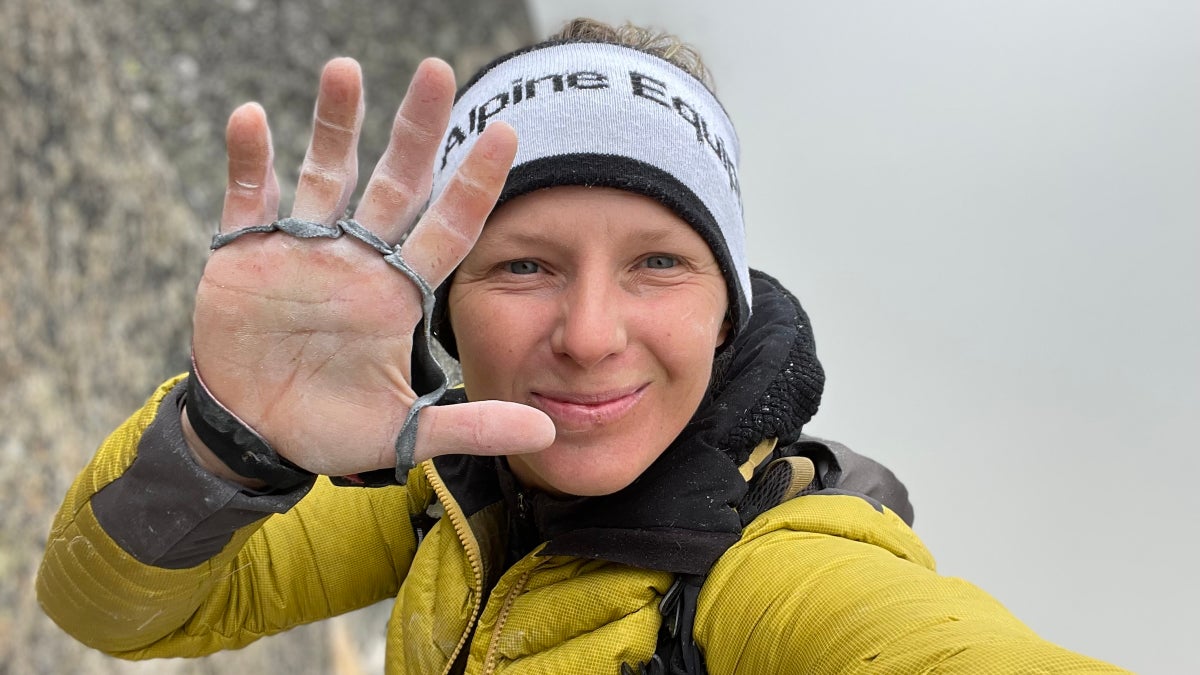
The list of noteworthy female free solos in history is remarkably short. That’s not entirely surprising since study after study demonstrates that men take more risks than women. While the list of men who have free soloed routes of 5.11 and up is quite long, we could find only three women who have climbed that grade or higher without a rope. Now, a fourth woman has joined the list.
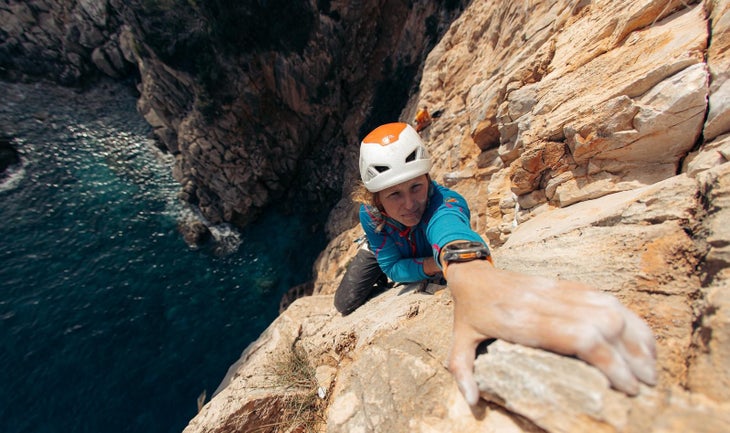
On May 3, Aleksandra “Ola” Taistra made a ropeless ascent of Alfredo Alfredo (7a/5.11d), a limestone line up Monte Oddeu on the island of Sardinia where she lives. Not only is this one of the hardest known free solos by a woman, but it’s also rather committing: 200 meters (656 feet) of climbing over six pitches, which Taistra linked into one long push.
“Whenever I push into a new grade or face an intense challenge, I don’t panic or freak out,” Taistra told Climbing. “Instead, my focus becomes incredibly sharp. In those moments, nothing exists. I accept the next move. Alfredo Alfredo, I would say, was pretty much the same …I completely jumped into it and enjoyed it very much.”
The hardest female free solos on record
In 2017, American climber Brette Harrington free soloed Chiaro di Luna (5.11a, 2,500ft) on the tower Aguja Saint-Exupery (8,400 feet) in Patagonia. Steph Davis is also known for notable free solos, including Pervertical Sanctuary (5.10d/5.11a) on The Diamond in Colorado’s Rocky Mountain National Park. The Moab-based climber also free soloed Coyne Crack (5.11d) and Scarface (5.11) in Indian Creek.
French “rock queen” Catherine Destivelle was well known as a free soloist, in addition to her reputation as a talented competition climber and alpinist. In 1987, while shooting the short film Séo!, Destivelle free soloed an unnamed route in Mali that she said included difficulties up to 5.12a/b. In an email to Climbing, Destivelle wrote of that filmed ascent: “The maximum grade was 7b. It was the traverse under the roof. But it was not so high, 10 meters above the floor.” (For anyone bad at metric conversions, that’s 30 feet above the deck).
Confused on conversions between French grades and the Yosemite Decimal System? Read this.
But in the nearly 10 years since Harrington’s massive ropeless climb in Patagonia, few notable entries in the list of hardest female free solos have transpired—until now.
Who is Aleksandra Taistra?
Since Taistra’s May 3 free solo of Alfredo Alfredo, we wanted to learn more about this Polish climber. After all, by grades alone, it would be considered the second or third hardest known female free solo in history. It’s also the most notable female free solo in the past decade, following Harrington’s ropeless Patagonia ascent in 2017.
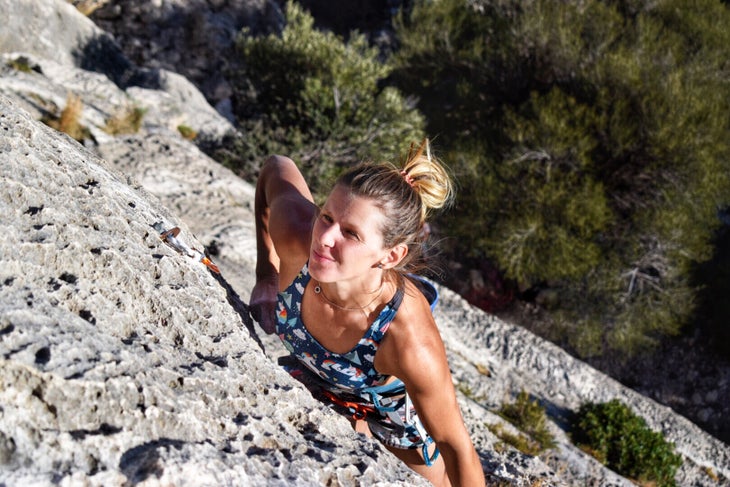
“Climbing is at the center of everything I do,” Taistra told Climbing from her backyard on a hot day in Sardinia. When she’s not climbing, Taistra works as a climbing instructor, coach, physical therapist, and climbing content creator. She calls teaching her “second great passion.”
Decades ago, Taistra started out as a dedicated sport climber, peaking at the grade of 8+/5.14b. But after an alpinist friend took her multi-pitch climbing in Sardinia, she shifted her purview from performance to adventure. Free soloing began as a way to train her mindset for bold multi-pitch climbs, but it soon became her “whole thing.”
When we asked Taistra how she measured Alfredo Alfredo against other free solos by women, she said, “Every free solo ascent is extraordinarily demanding. I don’t think it’s appropriate to view them as a competition or to establish any sort of ranking.” Though she admitted that she had done some research into other notable women’s free solos to see how she stacked up.
[Editor’s note: Climbing agrees with Taistra’s sentiment that free soloing shouldn’t be competitive or ranked. We stand by the mixed feelings this publication expressed regarding free soloing coverage back in 2017. However, as ropeless climbing continues to occur, leading to accidents, deaths, and, more positively, notable ascents, it’s also an active and indisputable extant pillar of our sport that we feel is important to discuss, in all its nuance and complexity.]
However you feel about this controversial discipline of climbing, our conversation with Taistra was illuminating. We learned more about how she started climbing without a rope in the first place, heard about her experience on Alfredo Alfredo, and gained interesting insights into the mind of a female free soloist.
Our interview with free soloist Aleksandra Taistra
This conversation has been lightly edited for concision and clarity.
Maya Silver: When did you first start climbing?
Aleksandra “Ola” Taistra: In 2000. So 26 years ago, when I was 17, I discovered climbing through this little climbing camp organized by the Polish Alpine Club. From that moment on, I was completely hooked. Just, you know, falling in love.
Silver: What type of climbing did you do when you first started?
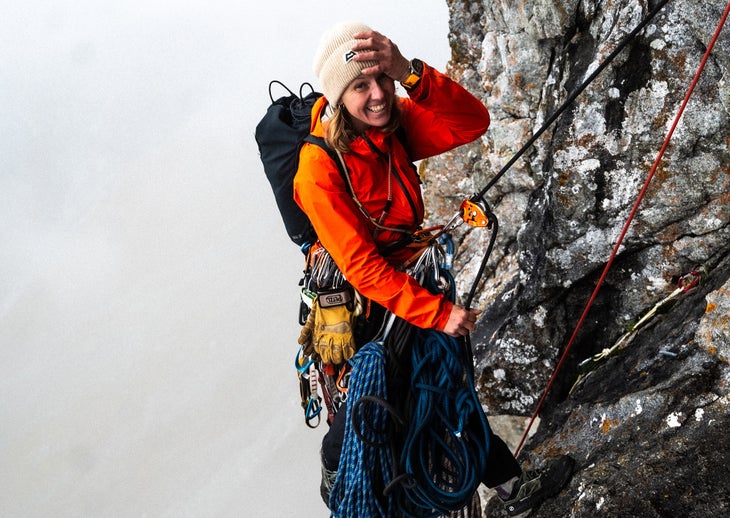
Taistra: After finishing high school, I took a gap year and did nothing but train, sleep, climb. That was pretty sweet. I progressed very quickly in sport climbing. I focused almost exclusively on performance. But everything changed in 2018, when a super strong alpinist brought me here to Sardinia and introduced me to multi-pitch climbing. That experience completely changed my perspective. I found myself drawn into [multi-pitch climbing] completely. That was my world. Being far away from the bottom and just climbing.
Silver: What was the transition like from sport to multi-pitch as your focus?
Taistra: It’s pretty interesting because to go from sport to multi-pitch climbing, you can still feel these desires about grades, about hard climbing. I climb a maximum of 500 to 700 meters. They’re not mountains—it’s still sport. But it went from sport climbing to really sketchy multi-pitch—bolted but dangerous.
Here in Sardinia, they have this scale from S1 to S5. So S1 is climbing in a gym and on S5, you can die. I found myself pretty interested about the quattro, meaning S3, S4. I started climbing smoothly, but there was a lot of stress behind it.
Silver: How did you transition from these higher risk multi-pitch routes to free soloing?
Taistra: Free soloing helped me improve in multi-pitch climbing where I have poor protection. But then it became a project on its own. So at first, the free solo had been training to not be stressed, to not be scared in my multi-pitch projects here in Sardinia, where the runouts are huge. And now here I am. It became the whole thing.
Silver: Do you remember your first free solo? Was it pretty mellow on a grade well below your ability?
Taistra: The first free solo was super short and really easy in the Polish Tatra Mountains. The feeling was really interesting. You don’t give yourself permission to feel any stress. This first free solo means so much to me because it opened my eyes and literally changed me.
Silver: What led you to try that first free solo in the Tatra Mountains?
Taistra: It was by chance, actually. I came back to Poland and I grabbed my best friend and said, “Could you go with me to the mountains to just hike? Maybe we’ll climb a little bit.” Then I saw this wall and I said, “Listen, maybe the next day, we can come back and climb up.”
She said, “Sure.” Then I had this idea. “‘What would you say to support me?’ I will go first to try on toprope, and then I will go to the top without a rope.” And she was like, “Sure, no problem.” But then I felt sorry. I put her in a little trouble because she probably didn’t expect that—such a strong emotional experience.
Silver: How did free soloing transform your perspective on climbing?
Taistra: That time was totally different than right now because I climbed a really easy route. I felt very comfy. When I started free soloing more and more, I prepared myself incredibly well. I’ve just realized that free soloing gives you such strong and different emotions. There is nothing more than this moment—just another move. That didn’t exist before in my sport climbing. You know, somebody speaking loud, heavy quickdraws, or I didn’t poop in the morning—all these thoughts drilling in my head. Free soloing, there is just nothing. Completely nothing.
For such a long time, I couldn’t find myself. I couldn’t be in this peaceful and relaxing situation while climbing. I always had a million thoughts and I was scared to fall. With free soloing, it’s just enjoyment. I don’t feel any stress and fear.
Silver: Is that feeling of extreme focus and being in the present addictive?
Taistra: Obviously, it tastes really good. I will not lie. It tastes very good because you’re being in the present. I never had that before.
Silver: Tell me how you set Alfredo Alfredo as a goal.
Taistra: Alfredo offered a style of climbing I had never tackled before: free-soloing technical crack and corner systems, with short overhanging sections—another barrier to break through. That was precisely what motivated me so strongly.
One of my friends, a climbing partner, said, “This is impossible to free solo. Don’t do that.” I didn’t want to hear that, actually, because I didn’t know what to do with it. Like, why are you telling me that?
Silver: How did you prepare for this climb?
Taistra: Tons of hours in a gym, on a wall, brushing, trying to find solutions. I should say I prepared myself for 26 years to be in this moment, to be ready.
I tried it many times in April. In May, because the conditions were so incredibly different, I didn’t rush myself. When you do the preparation or you feel that this day is coming, you’re not rushing. Sometimes I woke up in the middle of the night feeling like, “Oh God, maybe tomorrow. That’s the day.” I climbed it a lot, practiced it a lot.
I devoted several toprope solo sessions to the route. At the same time, I continued climbing other routes, including a number of much easier free solos. From a methodological standpoint, these climbs progressively opened the door to my planned rope-free ascent of Alfredo Alfredo. So-called “step-backs” are also highly effective mentally, helping to avoid becoming overly obsessed with a single objective. As a result, those easier solo ascents gave me a greater sense of openness and flexibility while preparing for Alfredo.
Silver: Did you just wake up one day and say, “I’m doing it”? Or did you set a date ahead of time?
Taistra: Exactly like that. I woke up one day and my best friend was there, Aneta. During breakfast, I just looked at her and said, “Well, what would you say to support me today as a filmmaker and photographer on Alfredo?” And she was like, “Yeah, okay, okay.”
I knew exactly when the sun went down in this part of the wall, which holds could still be warm, which are not for a warm-up—I knew exactly if I was ready to try it or not.
Silver: What were the trickiest parts of this free solo for you?
Taistra: There was one pitch with a few really reachy moves and super polished rock. That was pretty tricky. But what I find really interesting is that whenever I push into a new grade or face an intense challenge, I don’t panic or freak out. Instead, my focus becomes incredibly sharp. In those moments, nothing exists. I accept the next move.
So Alfredo Alfredo, I would say, was pretty much the same. Even though I knew that the grade was higher. Even though I knew that it’s way more sketchy than the stuff that I climbed before, I completely jumped into it and enjoyed it very much.
Silver: How long did it take?
Taistra: It was quite fast. Maximum four or five hours. My partner needed a bit more time to prepare everything, so I didn’t want to make her stressed because then I would stress myself.
Silver: What did you carry with you on this free solo?
Taistra: In my backpack, there was some water, gel, and a power bank for my phone because I listen to music when I’m climbing, so I needed [an] extra battery. Just in case.
Silver: What were you listening to while climbing?
Taistra: Oh, everything. When I need to calm down and slow down, I just play something super relaxed. And when I need a hit, then I listen to something more intense.
[Editor’s note: You can listen to one of Taistra’s free soloing playlists here.]
Silver: Is there anything else you want to say about your experience on Alfredo Alfredo?
Taistra: Nowadays, on every single free solo, I feel so much peace. In normal climbing, I don’t have it.
Silver: Do you feel at peace with what you’ve accomplished? Or do you feel like you need to try something harder?
Taistra: I hope that my father will not watch it, so I don’t quit free soloing [laughs]. I’ve already started working towards two major routes here in Sardinia that I would really, really love to solo one day. They’re definitely hard. They’re long and intense because every single pitch is spicy and every single pitch, something’s going on. From the beginning ‘til the end, you need this focus.
Last summer, I also spent four months in Poland trying one route that’s 500 meters (1,640 feet), plus a 200m (656ft) scramble over bedrock that’s more like walking than climbing. This is one of the things I really would love to try—maybe next summer. This route is so different than everything that I’ve tried before because the conditions change. Every single day is different. All these pitches where you have cracks that can be humid, or rockfall. That’s why Brette Harrington climbing in the real, crazy mountains is so badass, you know? It’s impossible to compare.
Silver: What’s your philosophy on taking risks as a climber? Where do you draw the line?
Taistra: I believe we should prepare ourselves as well as possible. If we talk about spicy climbing—I don’t want to say danger—there will always be something we cannot control, right? If we never step outside of our comfort zone, then how do we truly grow as a human being? Taking a risk and pushing beyond what feels comfortable is what makes me feel really, truly alive.
But it doesn’t mean that I’m crazy. The words “being crazy” are not nice. If we would be crazy, there would be only one try. We need to be prepared for potential stressful situations. But the focus and what I’m standing behind is so solid. This is not for everyone. And that’s totally okay. But for myself, going out of my comfort zone is literally what makes me feel happy.
Silver: Do you get called “crazy” by your family or friends?
Taistra: I won’t lie that I’ve never had this. Like, “Stop it,” or “Can you change your passion?” or whatever. But I just say, “Don’t put your stress on me.” Telling somebody, “Maybe it’s not the right day, maybe you should wait, maybe you should be better prepared” is fair enough. But telling somebody, “Don’t” is not right.
I really don’t want to hurt anybody and I really don’t want to hurt myself. Let me do what I love.
Silver: How do you feel about encouraging others to try free soloing? And what’s your perspective on sharing stories of your free solos?
Taistra: It’s everybody’s choice. But if you want to do anything that is more challenging or extreme, think twice about what it brings to your life.
I would never ask somebody to free solo with me. I want to mention that a couple days ago, I had a situation with an Italian climber. We planned to go climbing and I said, “What would you say if after leading this route, I free solo it?” He froze. He didn’t respond to me. And I felt so angry. I felt so not okay, because actually, I shouldn’t have even asked him.
It’s not normal for people to watch somebody soloing. This is not fair. I’m going by myself or I’m taking people that are filming me or taking pictures, but only my closest friends and the ones that I know feel comfortable. Because it’s an intimate experience having someone watch you [free solo]. Watching my videos is weird sometimes. When you are there in the process, when you are doing it, it’s totally different.
And I would say even more, don’t do it. Just don’t do it.
The post Polish Climber Pulls Off One of the Hardest Female Free Solos in History appeared first on Climbing.