 BURST
BURST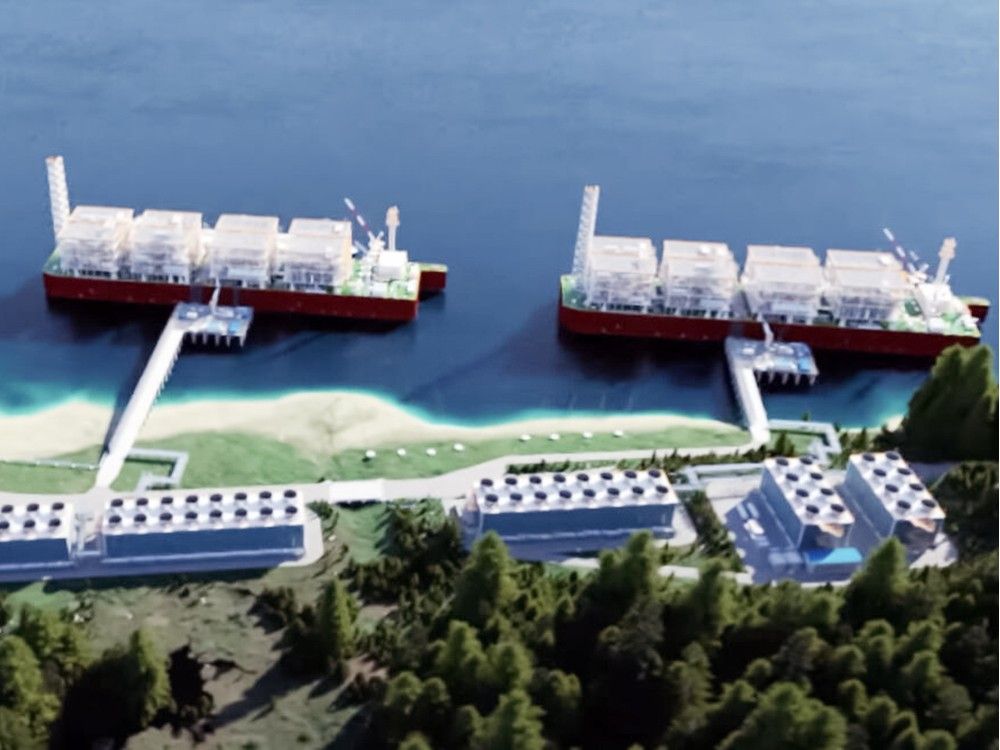
B.C. is promising to deliver an amount of renewable electricity equivalent to half the output of B.C. Hydro’s Site C dam to the proposed Ksi Lisims liquefied natural gas project on the province’s north coast by 2030.
On Tuesday, Energy Minister Adrian Dix and B.C. Hydro CEO Charlotte Mitha unveiled an initial agreement alongside Nisga’a Nation president Eva Clayton at the B.C. Natural Resources Forum in Prince George.
The deal is intended to provide “clarity” on how and when B.C. Hydro will deliver as much as 600 megawatts worth of renewable electricity to the Nisga’a Nation-led Ksi Lisims LNG project, which will secure the proposed facility as Hydro’s first major customer for its yet-to-be-built North Coast transmission line.
The Ksi Lisims project’s partners, including Nisga’a, are working on a final decision on what could be a $30 billion investment, and Clayton called Tuesday’s agreement “a critical step to connecting Ksi Lisims to B.C. Hydro’s clean electricity grid.”
“It gives us the clarity that we need to continue to advance our project toward producing the world’s lowest-emission LNG, while reflecting the Nisga’a Nation’s commitment to development that protects our environment and creating lasting benefits,” she said.
Mitha called Ksi Lisims “a significant customer” for the $6 billion North Coast transmission line proposal in what she called “a foundational investment” that unlocks economic opportunity in a rapidly growing region.
The agreement was unveiled while B.C. Hydro is still in a period of net electricity imports, a hangover of low snowpack conditions from previous years, which has critics of government energy policy questioning where the power to meet the commitment will come from and whether the North Coast transmission line will be built on time.
Dix, however, said B.C. Hydro’s objective is to have “shovels in the ground in 2026,” for the transmission line, and that B.C. Hydro is responding to the need for more electricity through its 2024 call for power from independent producers to deliver more than 1,600 megawatts of power between 2028 and 2033.
The minister also touted it as infrastructure that will help unlock LNG developments, mine proposals and northern port expansion to create up to 9,700 jobs, generate $10 billion a year in economic activity, and $950 million in government revenue.
“I’m not saying because we’re doing this, they’re going to get the final investment,” Dix said. “But they would not be able to get to final investment if we had not done these things, and that is the role of B.C. Hydro.”
The timelines for both the North Coast transmission line and at least some independent power producers to start delivering electricity by a 2030 deadline poses “pointed questions” about B.C. Hydro’s planning process, according to policy critic Barry Penner.
“We’ve seen deadlines get missed (on) many construction projects. It’s difficult to stay on track,” said Penner, chair of the think-tank Energy Futures Initiative.
Penner noted that while the latest integrated resource plan that B.C. Hydro submitted to the B.C. Utilities Commission, which outlines the utility’s forecast for power demand, includes estimates for potential LNG development, its reference case — the most likely outcome — doesn’t include them in the medium term.
Penner said he hopes the BCUC will be able to ask those questions to bring more transparency around how B.C. Hydro expects to deliver power on those timelines.
He added that independent power producers have been given the additional hurdle of Canadian retaliatory tariffs on imported steel that companies have warned will add significant costs that weren’t accounted for in the terms of their contracts.
“So who will bear those costs,” Penner asked.
“There’s very large dollars at stake,” Penner said about the North Coast transmission line. “The project went from being an estimated $3 billion to $6 billion in the course of about two or three years, so I think ratepayers have a right to wonder exactly what the details are.”