 BURST
BURST
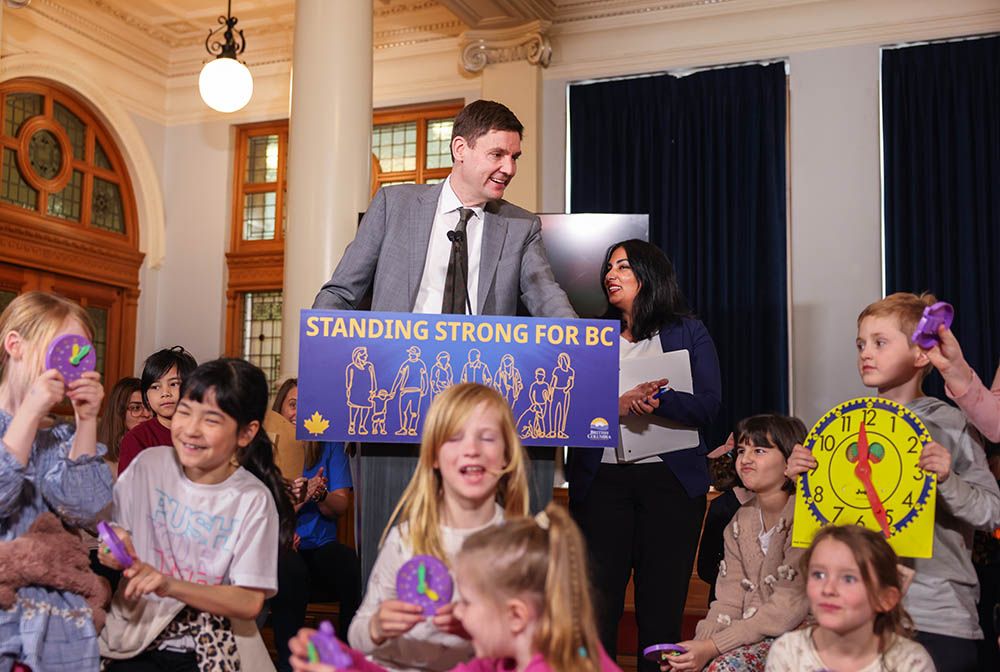
British Columbians have mostly been in agreement for years that moving to permanent daylight time is a good idea. Finally, on Sunday, March 8, 2026, the time has come. Most of B.C. will move clocks ahead an hour for what will now simply be called “Pacific time” — and there the clocks shall remain forevermore.
The decision by B.C. to finally take the leap opens up a host of questions about what happens next. Let’s take a look at some of them.
Who’s with us?
The lengthy delay in dropping the time changes has been about neighbouring jurisdictions. The majority of residents of Cascadia — B.C., Alaska, Washington state, Oregon, California — support an end to seasonal time changes.
But the coastal states are stymied by the need for a federal law abolishing or staying on daylight time, which has not been forthcoming. Several efforts to pass such a law over the past few years at the Senate, Congress and state levels have failed. For now, it looks like the U.S. will end up falling back again in November.
Alberta finds itself in a tricky position. Its eastern neighbour, Saskatchewan, mostly does not observe daylight time. Instead, the Prairie province is essentially on permanent daylight time by observing central time despite being mostly in the mountain time zone. Premier Danielle Smith has signalled Alberta may join B.C. to align with its immediate neighbours. Will that happen this summer? Too early to say.
Yukon, in its own time zone, abolished daylight time in 2020. The time there will now be the same as B.C. year-round because we’ll be on daylight saving — ahem, might as well get used to it, on Pacific time — permanently.
Health experts generally support leaving clocks unchanged on the rationale that the changes disrupt circadian rhythms and cause sleep, fatigue and health problems, including an increase in car accidents and strokes in the weeks following the change, especially when we spring forward.
Who’s against us?
While a 2019 survey showed that 93 per cent of those polled supported permanent daylight time for B.C., barely more than half liked the idea of going it alone because of the logistical problems it might cause.
Some in B.C. continue to point to that in opposing daylight time. Business groups like the Greater Vancouver Board of Trade don’t disagree with permanent Pacific time, but warn doing so unilaterally could lead to business uncertainty. President and CEO Bridgitte Anderson called it “an unwelcome distraction that will make it more difficult to attract and retain businesses in British Columbia.”
Former premier John Horgan vowed in 2019 to wait for neighbouring jurisdictions, and the board of trade said a survey at the time showed less than 20 per cent of Lower Mainland residents supported going it alone on permanent daylight time.
Though supportive of leaving clocks alone, health experts have also said permanent daylight time could cause its own seasonal problems. Those who oppose it note that early morning light is healthier in terms of keeping your circadian rhythms in sync, and that it will make both waking up in the morning and getting to sleep at night more difficult — especially for children.
What time is it now, and where?
When permanent Pacific time kicks in Sunday, Feb. 8, B.C. will be on the same time as its neighbours along the coast.
The disruption will come in early November when B.C. doesn’t fall back. That will leave all our Cascadian neighbours an hour behind B.C., while Alberta would be back on mountain standard time — meaning it will be the same time in B.C. and Alberta despite being in different time zones. Another way to look at it: At 5 p.m. in early November, the sun will be setting in Calgary while it will still be shining in Vancouver until around 6 p.m.
Barring change in other jurisdictions, from November 2026 to March 2027, B.C. will be:
• Two hours behind Ontario and Quebec
• On the same time as Alberta and Yukon
• An hour before Washington, Oregon and California
• Two hours before Alaska
When others change to daylight time, March to November 2027, B.C. will be:
• Three hours behind Ontario and Quebec
• An hour behind Alberta
• On the same time as Washington, Oregon, California and Yukon
• An hour before Alaska
How disruptive will it be to be out of sync with others?
There are dozens of implications and logistical changes needed if we fail to line up with other jurisdictions, though not all are problematic.
Werner Antweiler of the University of B.C.’s Sauder School of Business doesn’t think B.C.’s November non-change will be too difficult. Businesses “all have plenty of time to prepare,” he said, while those doing business in Alberta could see a small benefit being in the same time zone through winter.
Flight schedules might be tweaked with subtle shifts in demand, but Antweiler predicts airlines “will figure this out pretty quickly after the first year. By the second year, nobody will really notice, is my best guess.”
Is this the end of the debate in B. C.?
In all probability, this is finally a done deal. But as Antweiler points out, California just reintroduced a proposition to voters on ending time changes there, with the twist that this time, residents are being asked if they want to adopt permanent standard time. If it passes, it has the advantage of being able to move ahead under existing U.S. laws.
Should that happen, B.C. and the coastal states would likely come under pressure to align under standard time. “So perhaps the last word on this subject matter may not have been spoken quite yet,” said Antweiler. “There is still value in alignment of time zones along the entire coast.”
There are even rumblings in the U.S. House of Representatives about moving clocks permanently by only half an hour, splitting the difference between standard and daylight time, as in Newfoundland and Labrador.
“If we all end up time-zone confused, blame it on a ‘temporal anomaly’ in the space-time continuum, as is familiar to all Star Trek fans,” mused Antweiler.