 BURST
BURSTLots of monopoly news, as usual. The Ticketmaster antitrust trial starts tomorrow, supermarket competition is heating up a few years after the Kroger-Albertsons deal was blocked, and Hollywood’s wealthiest producers back the Paramount takeover of Warner.
But the big story is of course the war in the Middle East launched on Saturday morning. And while war often seems distinct from the question of political economy, in this case the two are intrinsically linked.
Let’s start with the contours of the conflict itself, which is the second attack on Iran since last June. In that first conflict, Israel killed many people in the regime, and weakened the country significantly. But it was a largely choreographed response, with Iran sending a barrage of rockets repelled by defenses across the Middle East, and then the whole thing ended with a cease fire. Oil prices didn’t much move, and neither did stocks.
This time, it could be different. So far, the U.S. and Israeli forces used air power to kill much of Iran’s leadership. The Iranians haven’t hit back with major missile barrage, but are using a “drip attack,” which is to say, firing small barrages of rockets and drones across Middle Eastern nations, from Israel to Bahrain to Iraq to Kuwait to Saudi Arabia to Jordan to the UAE. They have hit some military bases, but are aiming mostly at soft civilian targets and energy infrastructure, and even data centers. Israelis are in bomb shelters, and some U.S. bases have been hit. Three U.S. solders so far are dead.
It’s not clear whether the Iranian approach is a result of weakness, the lack of a military command, or some sort of strategy. It’s possible their regime will falter, since it is domestically unpopular. Or they could be seeking to get their opponents to waste missile defense assets, and scaring Arab allies into pressing Trump for a cease fire.
But Iran’s bad position doesn’t mean the situation is great for the U.S. and its allies. After the first day, which seemed to be a shocking win for the U.S. and Israel, some sort of fear or exhaustion has set in. The U.S. has used up years of production of high-tech weapons and may run out, while also testing cheap drone technology that it ironically copied from Iran. There is now panic across the wealthy cities of the Middle East, as the airports are closed and the luxury hotels are under sporadic siege by drones and rockets.
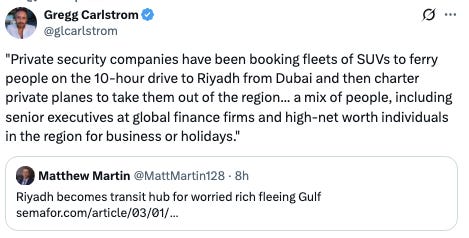
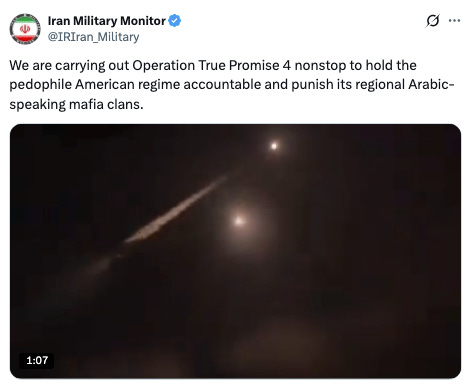
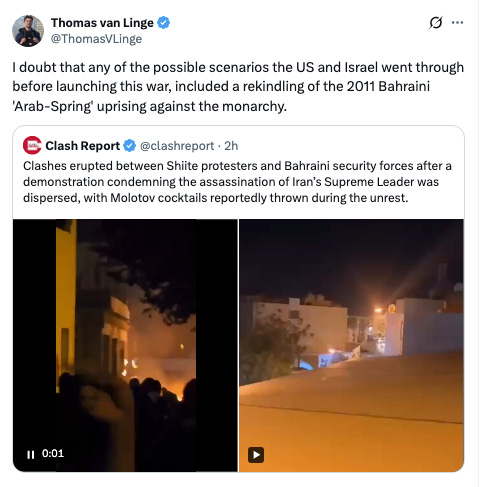
It’s never clear what happens in war, so this fight could end tomorrow, or it could go on for weeks. Already Trump is indicating he’s open to negotiations, and the Iranians are making tentative noises to that effect as well. Oil seems to be spiking, which didn’t happen the first time, and there are indications that stocks could be affected. The war is also extremely weird, with the Iranian regime using Twitter to call the American regime a group of pedophiles, and potential civil unrest within Western-aligned Arab states.
So that’s the conflict, summarized by a non-military person reading the news and talking to random military sources. I thought an attack on Iran was a bad idea if for no other reason that Iran can shoot back. I guess we’ll see.
But something about the war did surprise me. When the U.S. launched the attack, I assumed that the decision was a result of some sort of combination of Donald Trump’s rashness, domestic hawk pressure and Israeli interests, all going against world opinion. But as it turns out, much of the elite Western and Middle Eastern world was pressing for this conflict or was fine with it once it started. Rachel Maddow, not exactly a dove, pointed fingers at “the Gulf Arab states who want Iran removed as their regional rival.” Unsurprisingly, both the Israelis and the Saudis lobbied for the war. But when Trump went ahead, he got support from Canada’s Prime Minister Mark Carney, as well as Germany and France and much of the Arab world.

And this support isn’t trivial, the French are sending a strike group to the region. The GOP and national security establishment is mostly satisfied, and half of the Democratic Party took the attitude of California Governor Gavin Newsom, which is to say they are happy for the war, but wish they had been given a heads-up first.
In other words, Trump, far from a unilateralist, is operating within an orthodox foreign policy consensus about the need to topple the Iranian regime. And I found that puzzling. Ten years ago, I worked in the Senate, and I used to ask around about the obsession with Iran. And every foreign policy staffer, no matter how lefty, would say the same thing. “You can’t trust the Iranian regime.” And I would always ask why? The answer, repeated, was “You can’t trust the Iranian regime.” There are many regimes you can’t trust, I would observe, the Saudi government was involved in 9/11. So why is this one so bad? The response was just, “You can’t trust the Iranian regime.” And I could never get a real answer.
There are many theories about this obsession; the Iranians embarrassed the U.S. in the 1970s, and some hawks in America have always wanted to destroy the regime. Israelis are vying for influence with Iranians, and AIPAC gives a lot of money to U.S. politicians. It’s about oil. Neocons have influence in both parties. True, and true. But the bigger dynamic here is bureaucratic.
I’ve long noticed the endless parade of investors heading over to Saudi Arabia, the UAE, and Qatar, getting investments for everything from banking to artificial intelligence. Elon Musk secured money from the Saudis for his AI venture and his takeover of Twitter, Sam Altman sought billions from Abu Dhabi, Anthropic went after money from UAE and Qatar. And JP Morgan, Goldman, Morgan Stanley, Blackrock and Citigroup are competing heavily in the region.
And this trend is not new. In the 1970s, newly wealthy oil princes suddenly found themselves with over four hundred billion dollars, and had to put it somewhere. The deposited it in American banks, who then lent it all over the world, in what was known as “petrodollar recycling.” The corporate, banking, and oil prince worlds have only drawn closer and closer since. In the early 1980s, the merger boom unleashed by the Bork revolution started in the oil patch, and endless waves of mergers have been financed by Arab money. In the 2000s, on a political level, the Bush family linked Texas, the CIA, and the Saudis. In 2013, Al Gore sold his CurrentTV channel to the government of Qatar for $500 million. And in the shale revolution of the 2010s, Texas producers joined Saudi-led OPEC to keep oil prices high.
Today, the Middle East is full of investors in every major venture in the U.S., and most of our think tanks and diplomatic corps are part of that world. Arab elites are also part of the Western establishment. For instance, the giant video game company Electronic Arts was bought with Saudi money, in part because the Saudi prince, Mohammed bin Salman, is a gamer. He also brought the top U.S. comedians to his country for the Riyadh Comedy Festival last year.
The cultures are now so close that Saudi Ambassador Prince Bandar bin Sultan had a private jet painted with the Dallas Cowboys logo, as he was good friend with Cowboys owner Jerry Jones and loved American football. Indeed, while there’s a longstanding pretense of Arab antisemitism and dislike of Israel, it’s notable that both Arab and Israeli elites, including MBS and Israeli Prime Minister Ehud Barak, were extensively involved in the network of Jeff Epstein.
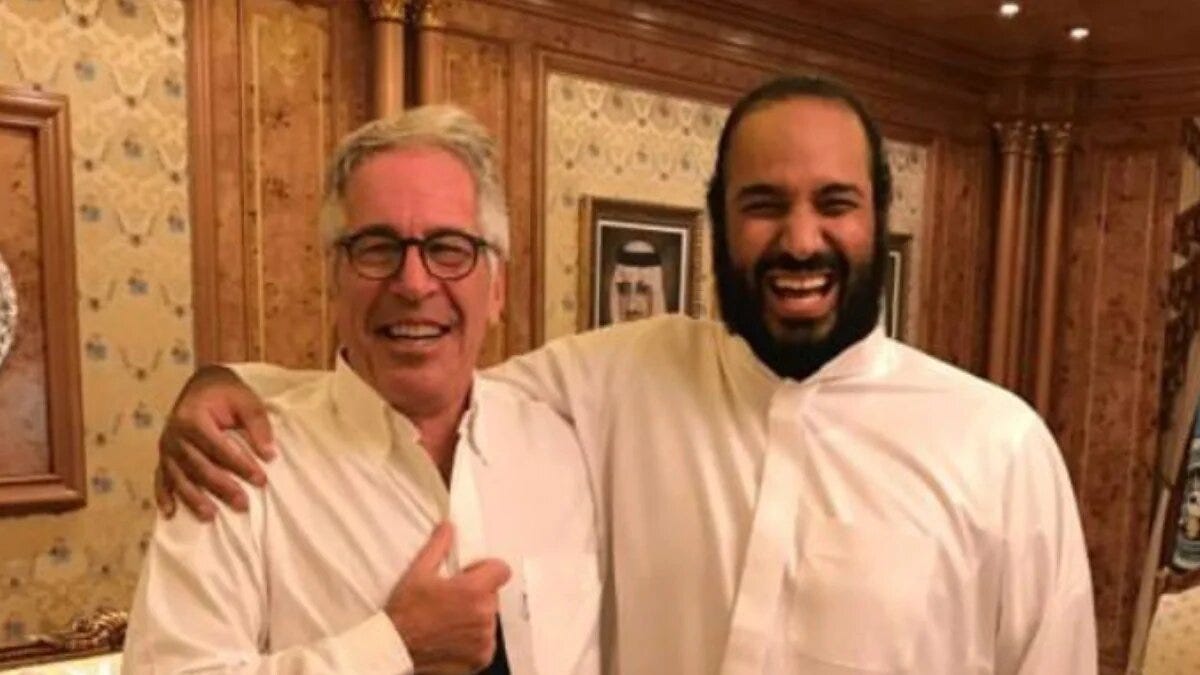
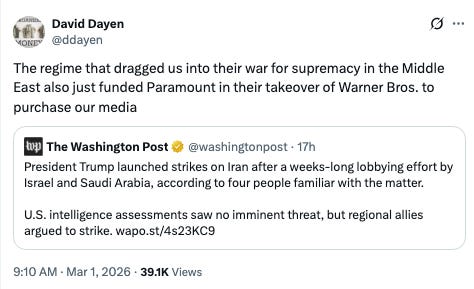
Ultimately, Western elites have dropped any pretense they care about human rights, and Arab elites have dropped any pretense they care about nationalism or Islam. It’s now one giant Davos blob. Here’s David Dayen making the point very clearly.
And indeed that’s true.
According to reports, the Paramount deal has been made possible in large part thanks to equity from Qatar, Abu Dhabi and Saudi Arabia. Middle East money is already flowing freely through global entertainment and media but many are wondering what strings will be attached to this latest and biggest U.S. media investment. These weren’t charity donations.
And that brings us to the collective distrust of Iran throughout all of these networks. Iranians aren’t part of the transnational Davos elite, and are always trying to annoy the people in it by expressing their desire for regional power. So the answer to why you can’t trust the Iranians is that they aren’t part of the club. They don’t paint Cowboys logo on their private jets, nor do they invest in private equity and AI companies, and they aren’t part of investment syndicates for Hollywood studios.
In other words, this attack on Iran isn’t a civilizational conflict, it’s anger from the Epstein class of elites towards a separate group of elites in Iran. Of course, the everyday people who live in these countries want nothing to do with these factional spats. The Americans who have to fight in this war, and the public that must finance it, are unhappy.
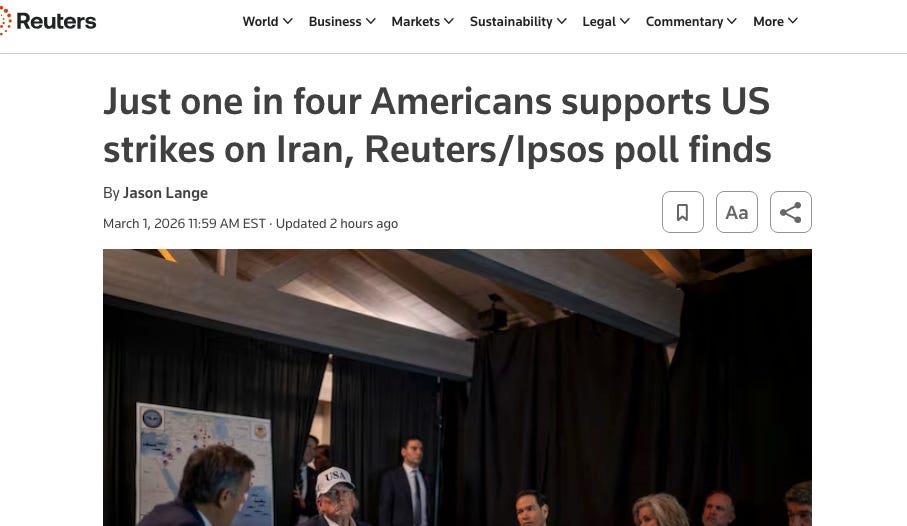
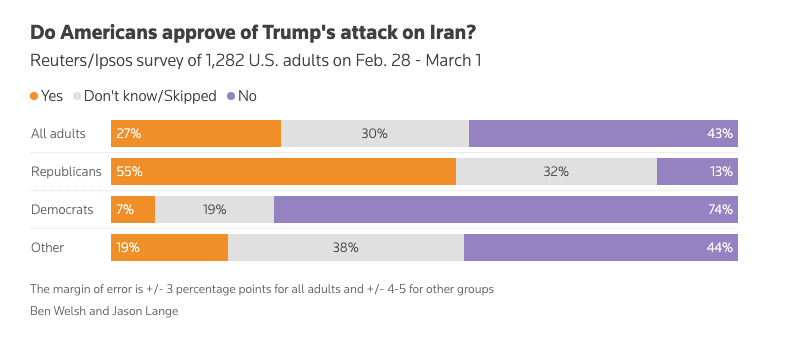
The split between elites and the public is vast, and growing. Wars rarely get more popular over time. And this attack may not be one of those conflicts of choice where the cost is mostly invisible to the U.S. It’s possible Iranian missiles and drones could cause meaningful damage to U.S. military assets. It’s possible they actually cause a downdraft or crash in the stock market, and harm the actual investors that called for this war. Or maybe it’s a blip, and Trump decides to declare victory and the Iranians assent to ending it. I don’t know. But the Epstein class, while wealthy and powerful, is greedy and short-sighted. And that means they take all sorts of immensely stupid risks, assuming someone else will always clean up any mess.
And now, the rest of the monopoly news. Last week, the courts made a string of good antitrust decisions, AI continued to be an excuse for layoffs by bad CEOs, and Burger King was found to use artificial intelligence to make its employees say please and thank you. Not creepy at all!
Plus price-fixing clip art, a Norwegian ad council skit on “A Day in the Life of an Ensh*ttificator,” and some Ticketmaster oddities right before jury selection in its antitrust trial.