 BURST
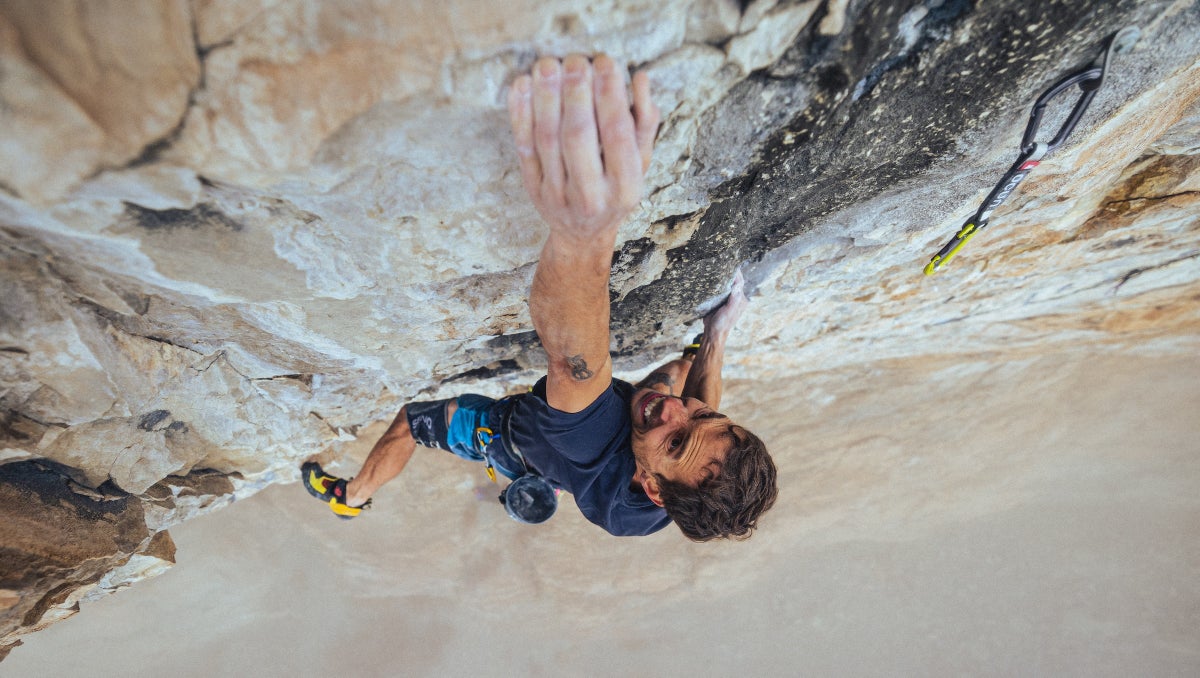
On October 19, likely the last climbable day of the season for the area, Jonathan Siegrist sent his 100th route graded 9a (5.14d) or harder: Video Killed the Radio Star (5.15b) at the 5G crag outside Las Vegas, Nevada.
Siegrist bolted the route in 2020 and chose its name shortly afterward, borrowing the title of the Buggles song whose music video was the first-ever broadcast on MTV. The name fits the technology and communications theme of the routes at 5G.
The route represents the culmination of two decades in near-constant motion. The 41-year-old has chased hard routes across the U.S. and Europe, while training relentlessly. The number of times he has sent a route on “the last day” of a trip is almost comical; his friends have started referring to it as “Siegrist-ing”.
The first ascent of Video Killed the Radio Star
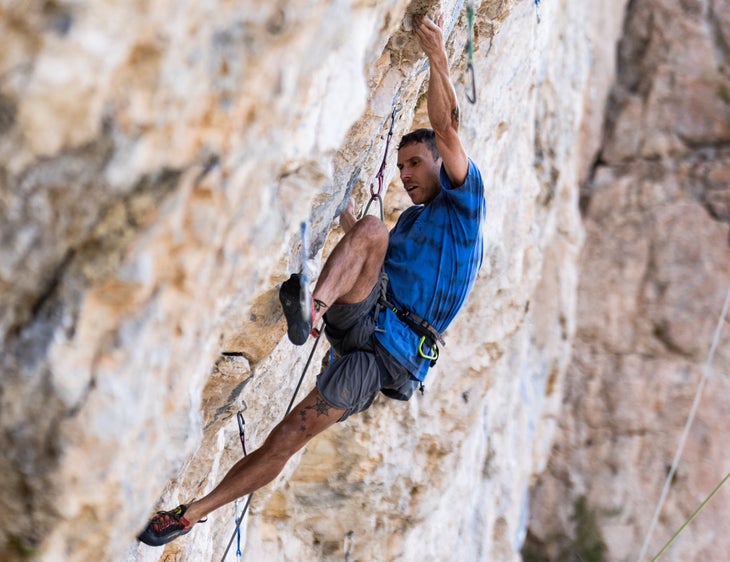
Siegrist’s 100th route was no exception. He described the first ascent of Video Killed the Radio Star (5.15b) to Climbing as a “massive and emotional battle.” He sent on Monday, October 19, likely the last climbable day of the season before deteriorating weather shut down the crag, which typically runs about 30 degrees colder than Las Vegas.
The send came on his third and final attempt of the day. October 19 also marked the first time he’d ever made it through the route’s lower crux, where he’d fallen countless times before. From there, he still had several cruxes and plenty of climbing above, along with the challenge of keeping his nerves in check.
Sending Video Killed the Radio Star also brought an enormous sense of relief. Siegrist had struggled through a frustrating year of injuries, unfavorable weather, and unfinished projects, leaving him questioning whether, at 41, he could still perform at the level he’d come to expect of himself. The pressure had been building for months. With the season coming to an end, he’d begun to doubt whether he would finish the route at all. Even after the send, he was still processing the experience and the emotional toll of repeatedly putting himself under that kind of pressure.
The breakdown of Siegrist’s 100 routes at 9a and up
Once again, Siegrist had come down to the wire, and the resulting résumé is ridiculous.
“I’ve learned a lot,” Siegrist told Climbing of the 9a routes he’s sent. “I used to think that with more experience you would understand grades better, but I almost feel the opposite.”
By modern standards, grades like 5.14d/9a, 5.15a/9a+, and 5.15b/9b almost begin to sound pedestrian. They are not. Siegrist climbed his first 5.14d in 2010, his first 5.15a in 2014, and his first 5.15b in 2018. Now, 16 years after that first breakthrough, his tally has reached 100: 64 routes at 5.14d/9a, 28 routes at 5.15a/9a+, and eight routes at 5.15b/9b.
Put another way: For 16 years, Siegrist has averaged more than six 5.14d-or-harder routes per year.
Yet this remarkable sport climbing achievement only tells part of the story. Siegrist has also bouldered V14 and climbed 5.14 big walls, including in the alpine. He’s headpointed dangerous trad routes. Across styles, disciplines, continents, and generations, he has climbed very hard. By modern elite-climbing standards, he even got a relatively late start, not seriously pursuing climbing until he was 18.
How many people have climbed at least 100 9a (or harder) routes?
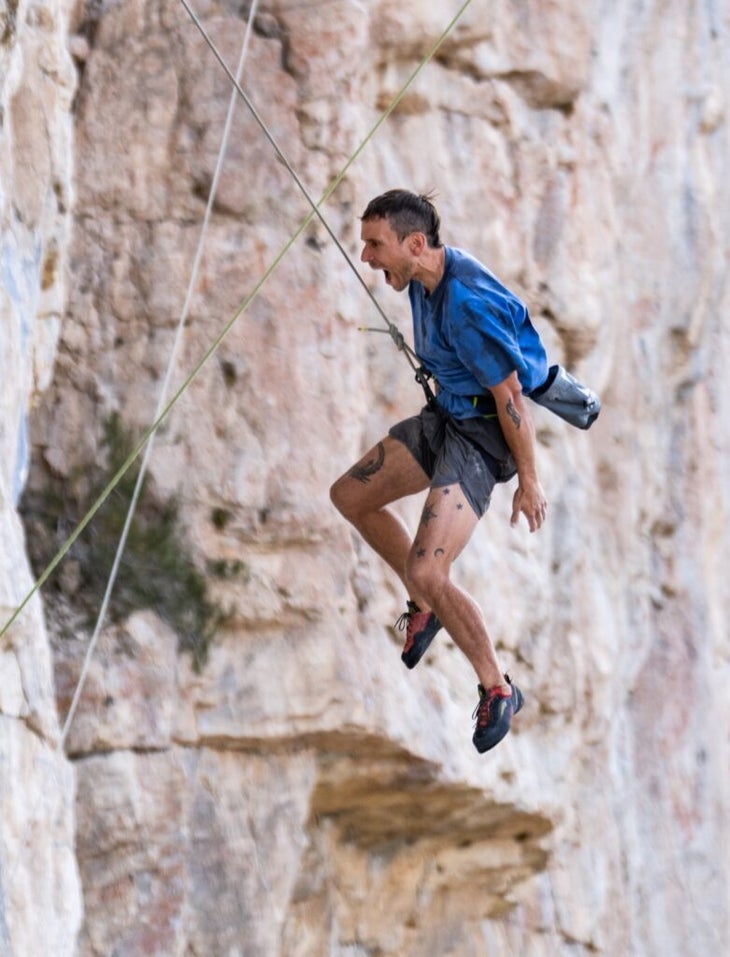
One hundred is a mind-boggling number. More people have walked on the moon than have climbed that many routes at the grade.
It’s also a strangely difficult milestone to contextualize.
No official league or database exists to govern hard-climbing records. Documentation is often incomplete, and for the most part, climbers are responsible for recording—or simply announcing—their own ascents. For decades, 8a.nu has served as the closest thing climbing has to a public ledger. Pros, aspiring pros, and everyday climbers alike use it to record ascents and compare themselves with their peers.
Siegrist keeps a meticulous logbook there. So does Adam Ondra, whose total, as of press time, sits at an absurd 215 routes at 5.14d or harder. After Ondra, things get murkier across a slew of European hard climbers. Jorge Díaz-Rullo has 90 recorded on 8a.nu, but has publicly said he has reached 100. Italian climber Laura Rogora has reached 58, by far the highest total among women. Stefano Ghisolfi sits at 60, Sébastien Bouin at 57, and Ramón Julián, 51. Alex Megos does not maintain nearly as complete a public record and, by Siegrist’s estimation, may already be at or above 100. Siegrist suspects others, Bouin among them, may also be closer to the milestone than their public logbooks suggest.
Regardless of how complete these records are, this does place Siegrist among only a handful of climbers to have achieved this “9a century” of sorts. It also makes him the only American to have climbed 100 9th grade routes.
Why Jonathan Siegrist is the unofficial champion of logging routes
All of this makes Siegrist’s own record interesting for another reason: He wants it documented.
To him, the logbook is not merely spray. It is, as he puts it, his “body of work.” The logbook represents a public record not only of the successes, but of the years of travel, failed attempts, obscure crags, first ascents, and unfinished projects that produced them. He sees a certain vulnerability in that transparency, and a responsibility, too. If climbing is his profession, he believes the work should be visible.
That mindset is revealing, because Siegrist’s career has never really been about a single breakthrough. It has been about accumulation: of routes, of experience, of increasingly refined judgment about what deserves his time and what does not.
The obvious American antithesis to Siegrist is Chris Sharma. By comparison, Sharma has climbed harder, established new grades, and helped redefine the upper limits of sport climbing. But how many routes 5.14d or harder has he climbed? Who knows.
Unsurprisingly to anyone who has followed his career, Sharma does not keep a public logbook. His résumé has always held a slightly mythological quality. Major ascents appear in interviews and old reports, while others seem to survive mostly because somebody remembers he did them. It fits the larger Sharma mythology: the barefoot, wandering savant projecting an almost preternatural sense of it’ll happen when it happens…
Siegrist is wired almost exactly the opposite way. He keeps meticulous records. He makes plans. He trains his ass off and gets things done.
There is, of course, immense natural ability underlying all of this. But Siegrist has never seemed content to simply possess that gift. He has wrung an extraordinary amount out of it.
And after nearly two decades of doing so, something is beginning to change. From the outside, Siegrist seems as committed to sport climbing as ever. But when I spoke with him at length a couple weeks ago, he admitted that his interest in it has begun to wane. For years, his friends have teased him about wanting to become a “trad dad,” only to watch him disappear onto another sport-climbing project.
These days, Siegrist talks increasingly about big walls, trad climbing, and new-route development. He seems more and more drawn to the simple novelty of arriving somewhere unfamiliar—learning a new rock type, figuring out where to camp, discovering the warm-ups.
Even Siegrist’s relationship with difficulty has apparently shifted. There was a time, he says, when a route being hard constituted reason enough to try it: Oh, is it hard? I have to do it. That impulse is fading. He is less interested in collecting another hard tick simply because it exists, and more willing to spend his time—and even fail—on the routes that genuinely matter to him.
That makes the timing of route No. 100 feel almost too perfect. Siegrist has reached one of the most pointless, yet impressive statistical milestones in modern climbing at the same moment that he is reconsidering the next phase of his career.
In the conversation below, Siegrist reflects on what 100 routes at 5.14d or harder have taught him. He also considers how his relationship with grades and projecting has changed, and what—after nearly two decades of hard climbing—still motivates him.
Interview with Jonathan Siegrist
This interview was conducted in early September, when Siegrist had climbed 99 routes graded 5.14d or harder. We have updated portions of the conversation to reflect his 100th ascent. The conversation has also been lightly edited for concision and clarity.
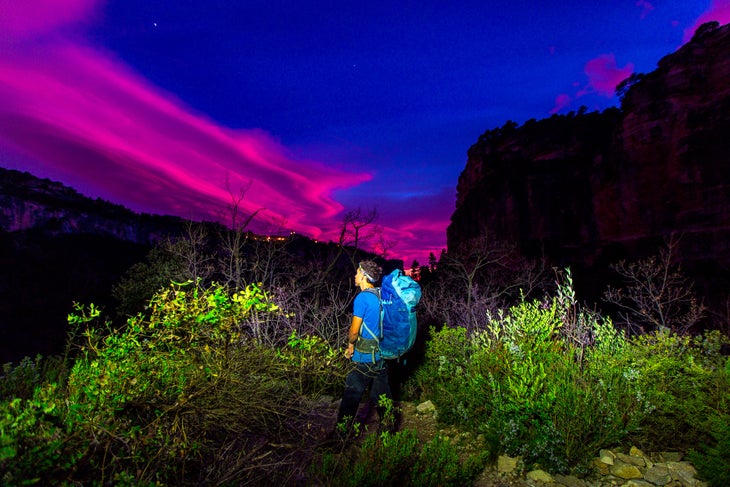
Brian Stevens: You were introduced to climbing through your dad when you were young, but you’ve said you didn’t really start climbing until you were 18. What did those early years look like?
Jonathan Siegrist: My dad has been a climber since the ’70s, so I was exposed to climbing when I was eight or nine years old, but it was like once a year, following 5.6 trad routes. I normally say I started climbing when I was 18, just out of high school, because now when someone says they started climbing at age 11, it often means they were in a youth program doing comps and campusing.
My own interest in climbing started when I was 18 in Boulder, Colorado, and my passion for it just grew over the years. I eventually moved out of Boulder and lived in my pickup truck for seven years to pursue climbing. At the end of 2017, I moved to Las Vegas, and I’ve lived here ever since. But I still probably travel in pursuit of climbing seven or eight months of the year.
Stevens: In a 2013 Enormocast interview, you said you weren’t sure you’d stay psyched on sport climbing forever and figured you’d eventually move toward hard big walls and bigger alpine objectives. Thirteen years and 100 routes at 5.14d or harder later, how’s that working out for you?
Siegrist: It’s interesting you would ask that because, while it maybe wouldn’t seem this way from the outside, my interest in sport climbing is waning.
My close friends make fun of me because I’ve been telling them I wanted to be a “trad dad” for five or 10 years. And then I just keep sport climbing. If anything, I’ve become more focused on sport climbing over the last five years.
I used to integrate more wall and trad climbing, but I don’t think I’ve done any in the last five years. My last trad trip was to the Gunks in 2020. Then I went to the New River Gorge with every intention of just trad climbing, but I was introduced to this project [Full Metal Brisket, 5.15a], got really psyched, and it totally derailed my trip.
Stevens: What will transitioning to more trad and wall climbing look like for you?
Siegrist: It’s not that I won’t ever sport climb again, but I have a few remaining goals. Earlier this summer, I failed on a big objective in Wyoming. Afterward, I started thinking about my favorite climbing trips and where I could go next. You know that moment when you go to a spectacular area for the first time? You’re doing the warm-ups, learning about the place, seeing that epic route you’ve heard about forever for the first time, figuring out where to get groceries, where to eat, where to camp.
Those moments are so invigorating, and I don’t get to have that experience very often anymore. I really look forward to doing more wall climbing and trad climbing because I like the novelty of going somewhere new, learning a new style, being challenged by a new rock type. That and new-route development are where most of my interest is now.
Stevens: What has this process of climbing 100 9a’s taught you? Are you physically a better climber now, or mostly better at projecting?
Siegrist: The reality of climbing this many hard routes is that you can’t do them all in your preferred style. You’re forced onto different angles, hold types, rock types, environments, conditions. Eventually it becomes more about certain areas, conditions and styles feeling a certain way, rather than a grade strictly feeling a certain way.
Especially with first ascents, I have a really difficult time grading things now. If something suits me really well, does that mean it feels easy for me, but it’s hard for someone else? Or maybe it actually doesn’t suit me, but I like the climbing, so I think it does. I have no idea.
I don’t necessarily always feel my strongest, but experience really helps with problem-solving, strategy, and the logistics around projecting. I see younger climbers who are much stronger than me making so many mistakes when it comes to giving themselves the best opportunity to send something quickly. But then I see how insanely strong they are, and I’m like, “Holy shit, that’s crazy.”
Stevens: On the flip side, is there anything that Jonathan at 9a number 10 had that you don’t have now?
Siegrist: Interestingly, I actually think my willingness to fail is greater now.
One thing that has waned over the last couple years is that a route being hard used to be enough for me. It used to be, “Oh, is it hard? I have to do it.” That’s starting to fade. I don’t feel like I need to do every linkup or every one-star route. I’m much more drawn to really motivating routes and willing to fail on them, rather than feeling like I need another tick just because it’s hard.
Stevens: What do you have to work harder to hold onto now at age 41?
Siegrist: The main thing I had in my late 20s was that I recovered so quickly. If something at your absolute limit requires 15 or 20 good climbing days, back then I could get those days in a single season.
Now, if I want to rest as much as I need to, that can be really difficult. If I climb day on, day off, 20 climbing days takes 40 days, assuming the weather is perfect. Sometimes the key window for an area is only four weeks. Then you’re like, “Fuck, you don’t have enough time.”
The other difference is that I wasn’t married. I didn’t own a house. I lived in my car. Climbing was literally everything, and I was completely happy with it being that way. I was pursuing climbing every single day.
It was an awesome time, and I miss it sometimes. But I also love having other focuses in my life and other ways to get fulfillment. It’s nice to feel like an adult sometimes, too, and have a house and have enough money to buy blueberries.
Stevens: Was there a particular route when you felt yourself become a different climber—a clear before and after?
Siegrist: Absolutely. It happened a couple of times, but the most remarkable was climbing Biographie, my first 5.15a, in 2014.
I first tried it in 2012 on my first climbing trip to Europe. I went to Céüse, tried Biographie, and was like, “Holy shit, this is so hard.” On paper, I had the ability to try it, but when I actually got on it, I remember thinking, “This is insane. This is so over my head.”
When I had the opportunity to go back to Europe in 2014, I realized that whatever I had been doing naturally to get to that point wasn’t going to be enough. I had basically never trained. I’d never worked with a coach or done anything other than go to the gym and flog myself.
Around then, Mike and Mark Anderson released The Rock Climber’s Training Manual. If you were climbing at that time, it was a fucking sensation. It was like the climbing textbook. It really spoke to me because I’m very much an engineer, mathematic type. I reached out to Mark and said, “I want to go to Céüse and climb this route. I have to get better. Would you train me?”
I spent a winter training in Boulder at the Boulder Rock Club, and it changed my climbing forever. I’d spent years climbing à muerte outside, so I had learned how to move my body and use my feet. Then I added the strength and finger-strength elements on top of that, and it was like I took rocket fuel.
Then I went to Céüse with this singular goal. Biographie is really mentally difficult. It’s slippery, the crux is at the top, it’s hard to get there, and the rest before it sucks. It tested my mental capabilities in a big way. Trying a truly limit route while traveling, rather than in my backyard, was scary to me, too.
There were so many elements that came together. When I sent that route, my climbing changed forever. There was before that route and after that route.
Stevens: Biographie was a well-established benchmark. But 27 of your 100 routes at 5.14d or harder have been first ascents, many of which you bolted yourself. How different is that process?
Siegrist: It’s really different. First, there’s just so much more work involved.
If I show up at a cliff and start trying a 9a that already has chalk, quickdraws hanging, and beta I can share with somebody, I’m probably starting two or three weeks ahead of where I would be with a route I bolted. With a new route, first you bolt it, then clean it, then climb on it and realize you need to move a bolt. You’re discovering all the beta yourself.
But there’s also something fundamentally different about knowing a route has been climbed and can be climbed. With a first ascent, especially at 9a+, 9b, or even 9a sometimes, you’re genuinely unsure whether it even goes until you do it.
That’s very different emotionally and mentally from knowing five people have done something before you. Maybe one is your size, you know what they’re good and bad at, and you can see their beta.
It’s like when you’re trying a boulder problem and you can’t figure it out. You’re like, “This is fucking impossible.” Then your buddy does it, you try again, and suddenly you do it. Something changes inside of you just from knowing it’s possible.
So first ascents are a much more drawn-out, introspective, and intense process than repeating something. And I really enjoy it. Earlier in my career, developing was partly, “Well, I need stuff to climb on, so I should go check out that cave some guy said was cool.” Now I enjoy the process itself even more.
Stevens: Of those 100 routes, is there an obscure one that means far more to you than people might expect?
Siegrist: One that’s really important to me that basically no one has ever heard of is L’Étrange Ivresse des Lenteurs at Céüse. It’s on the Biographie sector, right there where people walk past it every day. Adam Ondra did the first ascent, then Megos climbed it, then me.
It’s one of the best routes—top three of my whole life. It was a long process because of wetness; it’s like the only route at Céüse that seeps. I also tore my LCL on it on the first day of my second trip trying to finish it.
It has everything. It’s hard, it’s beautiful, the rock is insane. It’s also violently run-out—borderline dangerous. I fell at the anchor, and so did Megos. If the last bolt failed, you could potentially hit the ground from like 100 feet. It’s scary, bold and somehow obscure despite being in the middle of one of the most famous hard-climbing zones in the world. That route is really special to me.
Stevens: What about a route that you feel doesn’t quite live up to its reputation?
Siegrist: I’m sure I’ll get dogged for this: La Rambla. It’s historically important, and it was an important route for me, but I can’t say I loved it.
The rock in the crux is great, but a lot of the other rock is kind of meh. I have really dry skin, and El Pati is always windy, so I always felt really slippery on it. If La Rambla wasn’t as hard as it was, I think it would be a good route, but there are so many better routes at the grade. To put it in the same category as Biographie or even Papichulo, in my opinion, is wrong.
That being said, La Rambla is like a rite of passage. You’re interacting with history in a way that’s pretty interesting.
Stevens: Is there one that got away—a route you still think about?
Siegrist: Oh my God, there are so many. I have a running list.
My mega-project at the Fins is one. I haven’t been back for seven or eight years. I tried it on a couple different trips and got close, but it’s this crazy style that’s really hard to be good at. And it’s a hard route, period. I’d love to go back.
The one at the front of my mind right now is a route I bolted in Wyoming and tried this summer. I fell on the very last move probably 10 times in the final week. Then the heat of summer came, and I wasn’t able to finish it.
That one means a lot to me. It’s really, really good and very hard. I cannot wait to go back, but sadly I have to wait until spring.
Stevens: You’re one of the few professional climbers who keeps a remarkably detailed public logbook. Why is documenting all of this important to you?
Siegrist: It’s so important to me because it’s my body of work. I’ve dedicated so much effort and time over such a long period to traveling, exploring, doing first ascents, and visiting areas that interested or inspired me.
I’m proud of what I’ve done, and I want people to be able to feel inspired by it or get some kind of motivation from it. I haven’t logged every 5.13 I’ve ever done, but all the hard stuff is super accurate.
At the end of the day, it’s my job to work with my brands, but also to share inspiration and stories with the community, my friends and people who follow along. At a minimum, I’d like them to be able to know what I’m up to and what I’ve done in the past.
If you were any other type of professional athlete, your downfalls, shortcomings and successes would be available to other people. I’m not afraid of being vulnerable in that way.
The post Exclusive: Jonathan Siegrist Just Climbed His 100th Route Graded 9a/5.14d or Harder appeared first on Climbing.