 BURST
BURST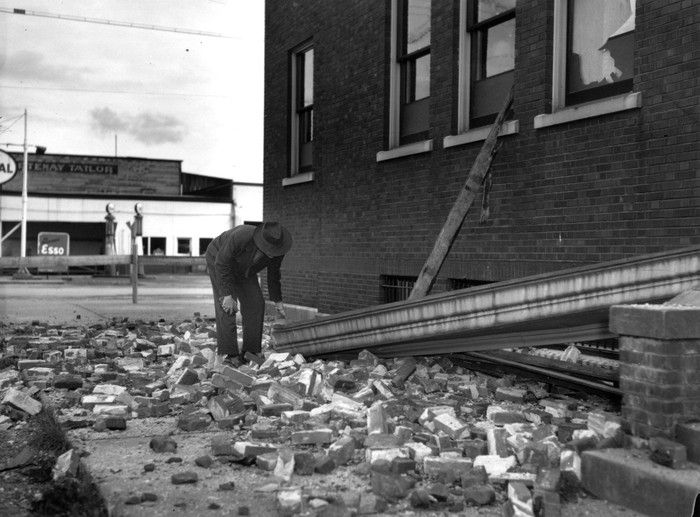
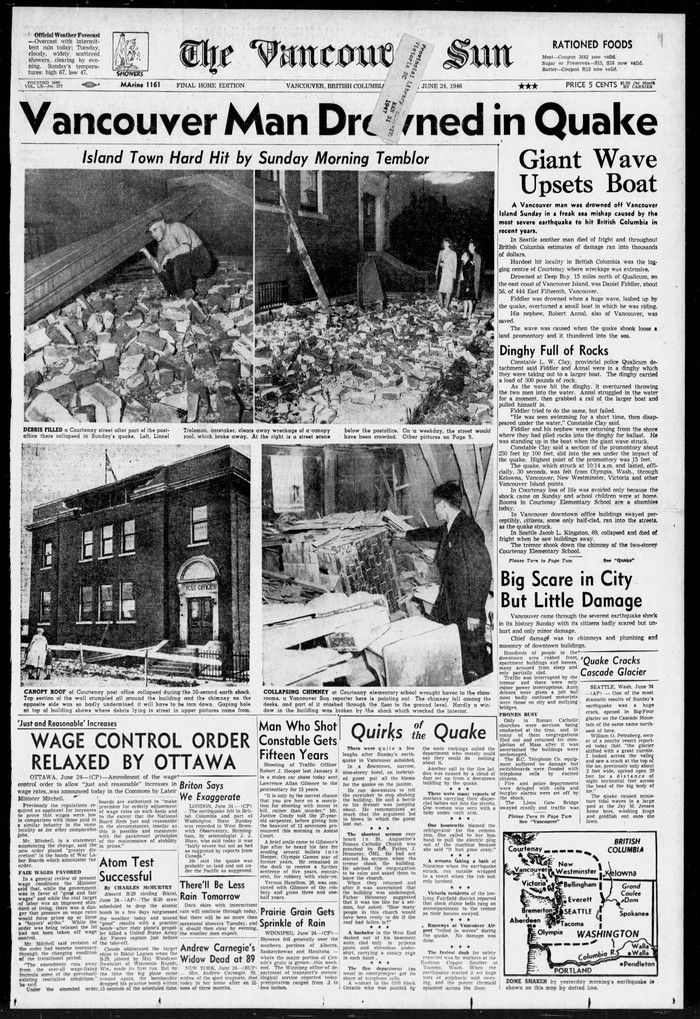
The Big One hit Courtenay at 10:13 a.m. on Sunday, June 23, 1946.
For 30 seconds, “the earth quivered and swayed” in a 7.3 magnitude earthquake, which Earthquakes Canada calls “Canada’s largest onshore earthquake.”
The Canadian Press reported the quake was “accompanied by a low rumbling sound, like a deep growl.”
Brick chimneys crumbled, glass shattered in windows, and people were scared witless. There were land and rock slides on Vancouver Island, including a 25-storey high cliff that slid into the waters of Deep Bay, near Qualicum Beach.
This set off a giant wave, which swamped a small boat, drowning a 56-year-old man.
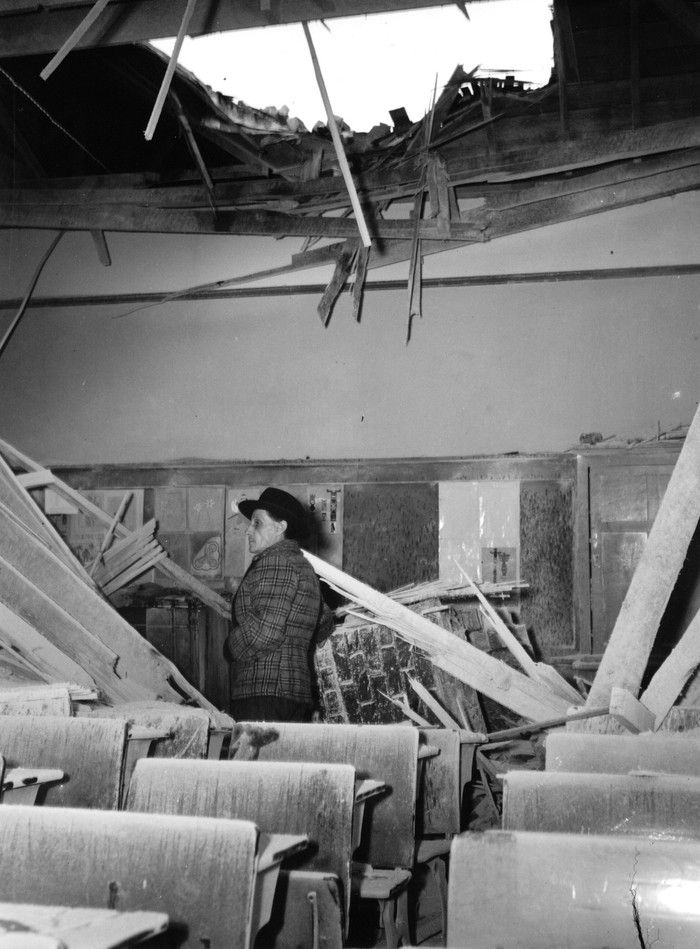
In town, the worst damage was to Courtenay’s elementary school and post office. The Vancouver Sun reported the upper floor of the school “was almost completely wrecked by (a) falling chimney, parts of which plunged through to the floor below.”
The upper part of Courtenay’s post office “fell away, scattering wreckage in every direction.”
Three quarters of the chimneys in Courtenay, Cumberland and Union Bay were damaged, and there was also damage in Comox, Port Alberni and even Powell River, across the Strait of Georgia.
But the timing of the earthquake limited the damage to people. There were no kids in school, and few people in downtown Courtenay, where a couple of banks were also damaged.
Earthquakes Canada calls it the “ M7.3 Vancouver Island Earthquake of 1946. ”
The epicentre was in the Forbidden Plateau, about 30 kilometres northwest of Courtenay. It was felt as far south as Portland, Ore., as far north as Prince Rupert, and as far east as Kelowna, “where a slight tremor caused some people to leave church.”
The shaking in Seattle scared a resident so much they had a heart attack and died.
In Vancouver, the Sun reported “its citizens were badly scared but unhurt.”
“Chief damage was to chimneys and plumbing and masonry of downtown buildings,” said the paper.
“Hundreds of people in the downtown area rushed from apartment buildings, many aroused from sleep and only partially clad.”
The Lions Gate Bridge “swayed crazily” in the tremor. Two young women were riding their bikes across the bridge when the quake hit. Shirley Mulch thought the bridge was going to collapse, and tried to get on her bike so quickly she fell.
But the bicyclists were unhurt, as were the occupants of the two cars crossing the suspension bridge at the time.
The worst property damage reported in Vancouver was at the Canadian National Railway station, where a 25-pound piece of masonry fell to the sidewalk.
The giant neon clock atop the Vancouver Block also stopped at “14½ minutes after 10 o’clock.”
But the overall feeling was relief. The Sun had a story called “Quirks of the Quake,” which collected humorous anecdotes from Vancouver’s 30 seconds of terror.
“In a downtown, narrow, nine storey hotel, an inebriated guest put all the blame for the quake on a janitor,” the Sun reported.
“He ran downstairs to tell the caretaker to stop shaking the building. He said a bottle on his dresser was jumping about. He remonstrated so much that the argument led to blows in which the guest lost out.”
The City of Vancouver commissioned a study about the possible effect of a 7.2 magnitude earthquake on the city, which is much more densely populated than in 1946.
The 2024 study said it could damage 6,100 buildings and lead to 1,350 deaths. The city recently announced plans to put together a “high risk building inventory” of privately owned buildings that could be damaged in an earthquake.
But the damage in an earthquake depends on many factors, such as where the epicentre is and how deep the quake is — shallower earthquakes usually cause more damage than ones deeper in the earth.
The biggest earthquake affecting B.C. was in the water off the west coast. The M9 Cascadia Megathrust Earthquake of Jan. 26, 1700, had a magnitude of 9 and stretched 1,000 km along the Cascadia fault from Northern California to B.C.
“The shaking was so violent that people could not stand and so prolonged that it made them sick,” says the Earthquake Canada website. “On the west coast of Vancouver Island, the tsunami completely destroyed the winter village of the Pachena Bay people, with no survivors.”