 BURST
BURST
Jack Sieman was no Al Capone. But in 1929 and 1930, the Canadian “dope peddler” was front-page news in Vancouver and San Francisco for his misdeeds.
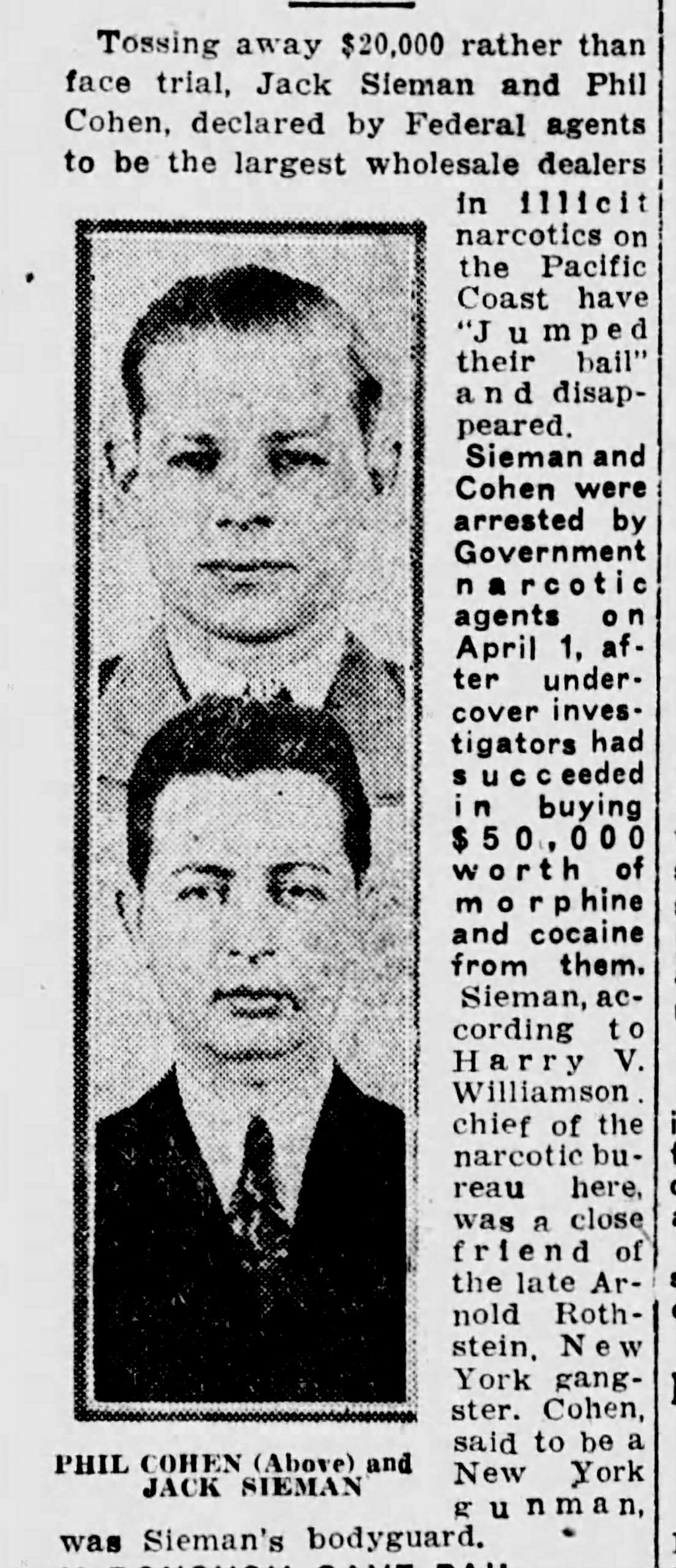
Sieman was busted in San Francisco on April 1, 1929, after undercover agents purchased $50,000 in cocaine and morphine off Sieman and his cohorts, Phil Cohen and Mario Balisteri.
“A federal officer whipped out a revolver and covered Sieman just as the alleged smuggler reached for his own gun in a shoulder holster,” said a story in the April 2, 1939, San Francisco Bulletin.
Sieman was released after posting $10,000 in bail. But when Balisteri was sentenced to 12 years in jail, Sieman fled across the border.
The chief of the San Francisco narcotics bureau alleged that Sieman was a cohort of the notorious New York gangster Arnold Rothstein, who had been murdered a few months earlier.
A story in the May 22, 1929, San Francisco Examiner said the narc squad believed Sieman “had been operating on the (west) coast for at least 12 years and did a business of a million dollars a year.”
Sieman was a rival of another big-time dope peddler, “Black Tony” Parmagini. The police believed Black Tony had hijacked $30,000 worth of drugs off Sieman, which led to the Rothstein gang sending Phil Cohen to San Francisco to be Sieman’s bodyguard.
Sieman was arrested in Vancouver on Jan. 20, 1930 and fought extradition to the U.S. He tried to escape from the Vancouver city jail on April 29, 1930, using a saw that had been smuggled in, and with a 22-year-old accomplice, to try to cut through four bars on a window.
But they had to jump down two storeys to escape, and the 42-year-old Sieman was injured, captured, and taken to Oakalla Prison. His extradition fight was rejected May 17, 1930, and he was handed over to U.S. authorities at the border.
He arrived in San Francisco under heavy guard May 19, 1930.
“Reports that an attempt would be made to rescue Sieman from his guards caused (the police) to take extra precautions,” said the San Francisco Call Bulletin.
Four days later, Sieman entered a surprise guilty plea, “demanding at the same time that he be sentenced immediately” by a judge who was unfamiliar with his case.
U.S. Attorney George Hatfield objected, “on the ground Sieman obviously had pled guilty on a chance that the judge would give him a light sentence.”
The judge agreed, the case was moved back, and Sieman was sentenced to 10 years in prison on June 30, 1930. He did time at Alcatraz.
When he got out of jail, Sieman came back to Vancouver, where he got up to his old tricks.
On Feb. 12, 1944, the RCMP and American federal agents claimed they had “upset an international drug-smuggling ring operating in Vancouver, California and Mexico” with the arrest of several people, including Sieman.
The RCMP seized $10,400 in cash that was in Sieman’s safety deposit box at a local bank, and another $2,500 that Sieman had on him when he was arrested.
The roster of people arrested included a New Westminster customs clerk, one of Black Tony’s old California lieutenants, and Sieman’s paramour, Elsie Arnett.
Customs clerk Morris Irwin had been arrested in Glendale, Cal. when he got off a train with $8,000 worth of opium. Sieman had given him an envelope to give to Black Tony associate Willie Levine, and Levine gave him some “dirty tins” full of opium, which he was arrested with.
The 56-year-old Sieman and 30-year-old Arnett were freed on bail and were married on Feb. 26, 1944. The Sun noted “according to Canadian court procedure married persons can decline to give evidence against one another.”
Sieman was sentenced to seven years in jail, but charges were dropped against his bride Arnett.
On March 23, 1953, he was in trouble again after Vancouver police found him with 312 capsules of heroin. He posted $10,000 bail, but failed to show up for an April 21,1953 court date.
When police went to Siemen’s residence, they found a note that read “I just can’t face going to the pen.”
He was never found.
