 BURST
BURST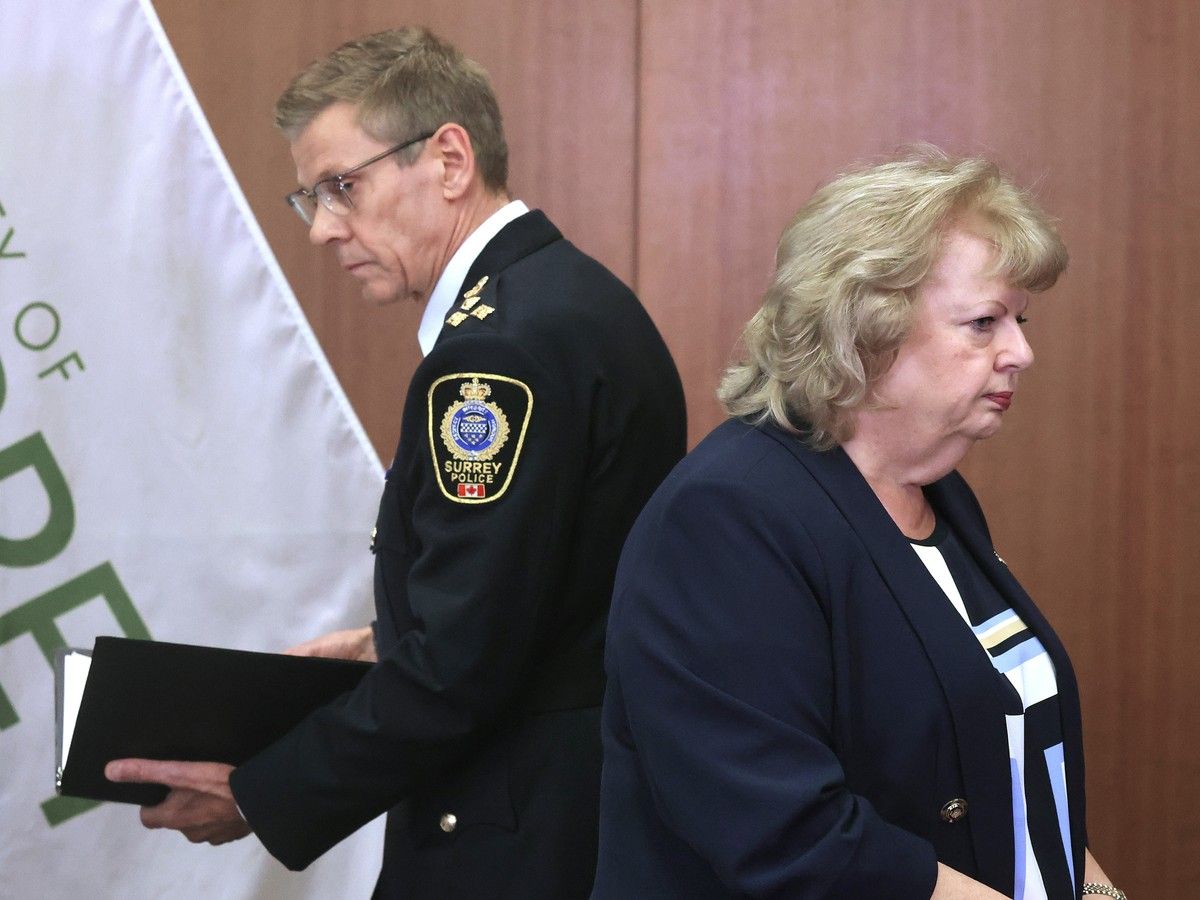
When the Surrey Police Service was set to take over command of policing in B.C’s second largest city from the RCMP 18 months ago Chief Const. Norm Lipinski said they were ready.
“We feel confident,” Lipinski told the Surrey police board at the time about the difficult, often politically charged turnover.
Lipinski was appointed to lead the move to an independent, municipal police force away from the RCMP in November 2020, the biggest ever change in a city of that size in Canada. His contract was renewed for another three years in October 2025. It included an option for another two-year extension.
Now he’s out.
And his abrupt departure, some experts say, is a very rare occurrence, particularly where there is no evidence provided of egregious or unlawful behaviour or mismanagement.
Curt Griffiths, a professor emeritus of criminology with Simon Fraser University, said that with no explanation for the removal of Lipinski it raises the question whether this is a political decision, a continuation of a political fight that started years ago.
“This decision is quite ominous actually in terms of what it means for policing and the legitimacy of police. I think there is a lot of eyebrows being raised by a lot of different stakeholders,” said Griffiths, who has worked on reports of the transition.
Politicization can undermine public confidence and legitimacy of the police, the last thing you want in a community, said Griffiths, who noted the transition appeared to be going “quite well” recently.
On Monday, Postmedia News reported that Lipinski was given until Thursday at 4 p.m. by the board to resign or be terminated without cause from his position.
On Tuesday, in a written statement, the board confirmed that Lipinski had left the force but didn’t provide a reason.
At the same time, the board’s chairman, Harley Chappell, chief of the Semiahmoo First Nation, said he was stepping down in protest of the decision. Chappell wasn’t at the recent board meeting where Lipinski’s termination was decided.
The transition to the new force, which started more than six years ago, has been acrimonious and has moved slowly, with completion not expected for another year or more.
The Surrey police have hired 659 officers, according to the SPS, still short of their 835 authorized-staffing level. The force now covers four of five policing districts in Surrey, with the RCMP still providing policing in the Guildford-Fleetwood district.
The RCMP wouldn’t say Tuesday how many officers they have covering Surrey.
The transition ran into a major obstacle in 2022 when Surrey Mayor Brenda Locke campaigned and was elected on a promise to retain the RCMP, reversing a decision by former mayor Doug McCallum and his city council to create a municipal police force.
An 18-month battle to halt the transition only ended in 2024 when Locke and her council agreed to a $250-million deal with the province to assist with the costs of the transition. That was after the mayor and council lost a B.C. Supreme Court attempt to block the transition that the B.C. government wanted to go ahead.
During the drawn-out fight, Locke and her council had refused to fund a ramped-up transition and the hiring of new officers essentially halted. Disagreements over funding have continued, with council providing $46 million less than what the police board asked for in February of this year.
In March, the province appointed five new board members in consultation with the city, a move the SPS said was a surprise , noting that a t no point did the province advise that the outgoing board members’ performance fell short of expectations.
Irwin Cohen, an associate professor of criminology at the University of the Fraser Valley, noted the tensions over the recent budget and criticisms voiced by Locke over pulling away resources from the SPS gang unit to cover off regular policing duties in the Cloverdale district mean it isn’t necessarily surprising that Lipinski is gone.
But a major decision by board members with just 10 weeks on the job is surprising, said Cohen. It was also unexpected since Lipinski had recently had his contract renewed, and normally transitions for police chiefs in big cities are planned well ahead, he added.
“I am sure that those who oppose the mayor will suggest that you created a board that is in line with your thinking,” said Cohen.
Kash Heed, a former B.C. solicitor general and ex-West Vancouver police chief, said the removal of Lipinski as chief wasn’t surprising as most police chiefs have a best-before date of about five years.
He noted the Surrey police transition has been chaotic throughout and that Lipinski had an uphill battle from Day 1.
“The question is what type of leadership are you looking for now?” said Heed.
Lipinski had spent five years as deputy police chief in Delta before his appointment in Surrey, 32 years with the Edmonton Police Service including as deputy chief, and served as an assistant commissioner of the RCMP.
In a written statement released Tuesday, interim Surrey Police Chief Const. Todd Matsumoto thanked Lipinski for his 47 years in policing: “The milestones and accomplishments achieved by SPS are a reflection of his commitment to the service, the community and the city.”