 BURST
BURSTFor those interested in the Paramount-Warner acquisition’s economic impact, AELP is hosting two in-person roundtable events. One is in Los Angeles on June 6th from 1-3pm, you can RSVP for that here. One is in New York City from 2-4pm on June 13, you can RSVP for that here.
Among American elites, there appears to be an aggressive embrace of new technologies, whether crypto, generative artificial intelligence, or automated systems in war. But there is an important exception. If you deploy energy systems at scale that compete with fossil fuels, you will be ignored. The reason is both the narrative power of oil companies, and the Trump administration’s view that fossil fuel infrastructure is a deep source of American strength.
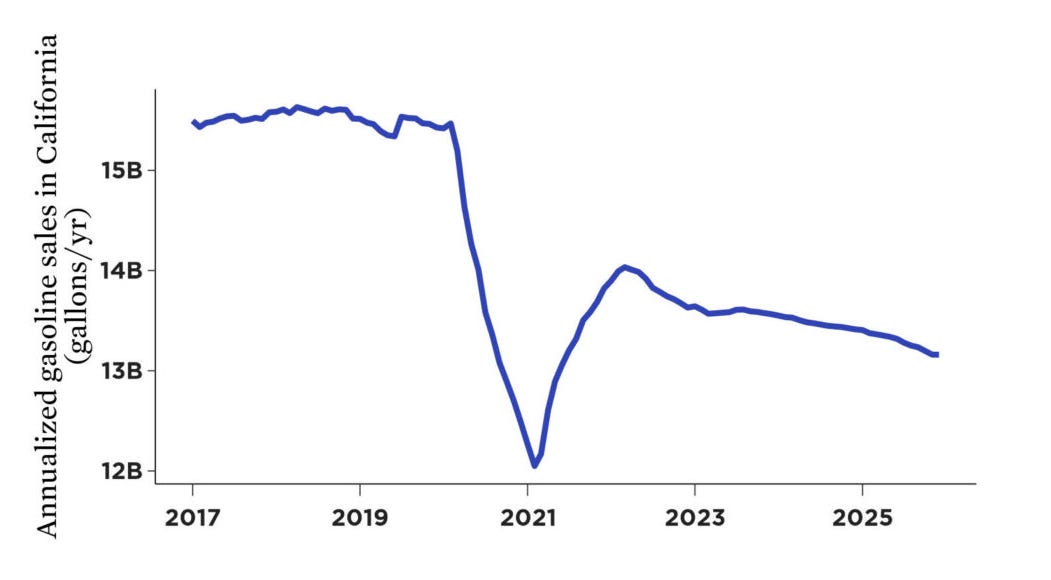
What’s interesting about this dynamic is that clean tech systems - batteries, solar panels, electric vehicles - are having real impacts, far more measurable than crypto or AI. Here is a chart of annualized gasoline sales in California, which has dropped by 2.5 billion gallons a year since 2019, despite more cars on the road. And California is leading the way in America; a quarter of new cars there are electric.
These investments are becoming more valuable over time, not less. With the war in Iran, interest in electric vehicles nationwide has spiked by 25%, and states like California disproportionately benefit from consuming less oil. But aside from a few liberal civil society groups that still take climate change seriously, you don’t hear about the policy success of challenging the incumbent fossil fuel companies. Instead, there’s a subtle and very powerful argument from those incumbents meant to roll back this competitive threat.
And it goes like this:
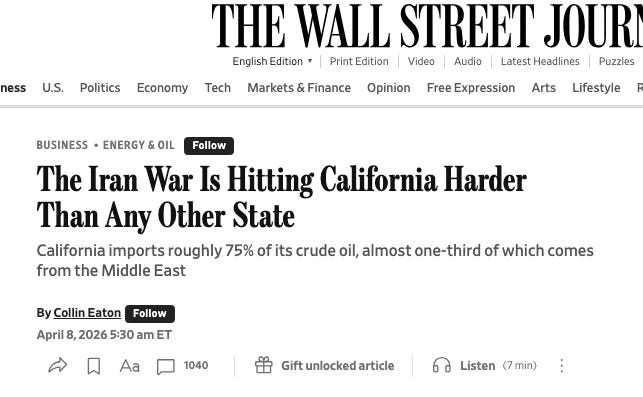
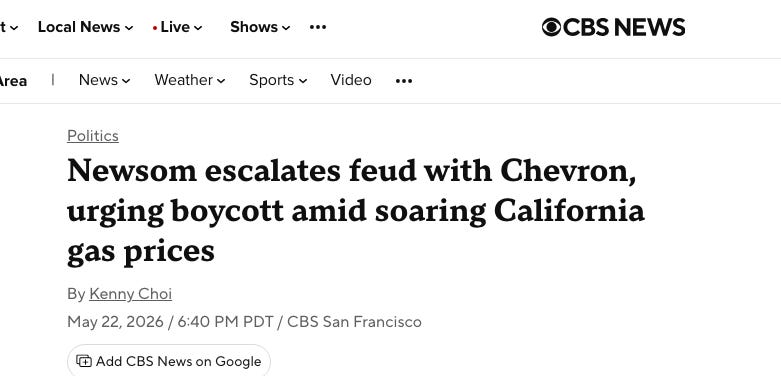
Gas in California, in other words, is really expensive. The talking points write themselves; in late March, one notorious Los Angeles station charged $8.71 a gallon. And there are political dynamics as well; Newsom, a prospective 2028 candidate, is in a fight with the dominant oil incumbents, especially Chevron, over these costs.
What I want to do in this piece is suss out what is really going on.
Chevron vs Newsom
Let’s start with the critique of California government, the Chevron critique. This theory is that California has policies to encourage overpriced green energy, which helps the rich who have electric vehicles, but also over-regulates fossil fuels, which hurts everyone else. It’s classic unpopular limousine liberal politics.
As Chevron’s Andy Walz told the Wall Street Journal, California policymakers have “progressively driven the fossil-fuel industry out of business because they didn’t think they needed fossil fuels,” Walz said. “They thought everybody could drive an electric car and transition to wind and solar—and it hasn’t happened.”
There’s more. California has its own blend of gasoline, known as CARBOB (California Reformulated Gasoline Blendstock for Oxygenate Blending), which is particularly clean. That said, this desire for a more environmentally friendly blend has turned California into an “energy island,” which must either produce its own gasoline through its own refineries or import it from specialized foreign refineries that can produce what California needs.
This problem is compounded by California’s regulations, which make it very hard to produce gas in the state. So refineries have been shutting down, a dozen since 2000. The state is also cut off from the shale boom, without pipeline connections to Texas or the Dakotas, which means it’s cheaper to get fossil fuels from the Middle East. So California imports 75% of its oil, and large amounts of gasoline and jet fuel from East Asian refineries. Those refineries are most exposed to the Strait of Hormuz.
The GOP is all in on this narrative, hoping to tie Newsom to the anchor of high costs, which helps them avoid the topic of the war in Iran. Here for instance, is Senator Ted Cruz bragging about Texas gas prices being “only” $3.99, pretending the war in Iran was unimportant, and the problem is simply California regulations.
So that’s the theory. Is it right?
Refinery Shutdowns Aren’t a California-Specific Dynamic
One problem with that narrative is refineries have been closing everywhere in America, not just in California. Last year, LyondellBasell just shut its Houston refinery, and that’s not because Texas is hostile to oil and gas. U.S. refineries are old and small. Larger and more efficient refineries have been coming online in parts of Africa, the Middle East, and East Asia.
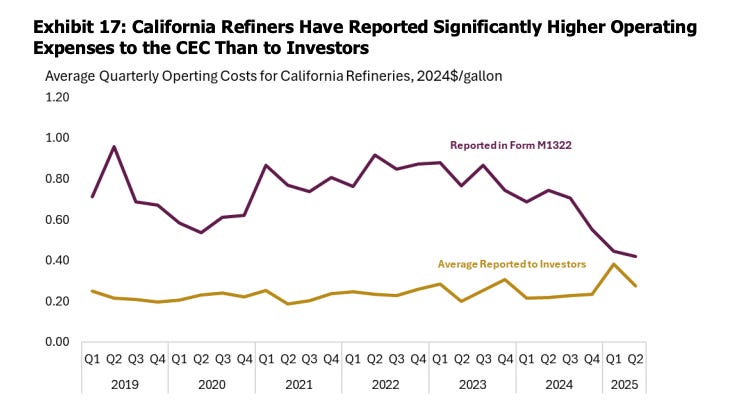
Another problem is that California refiners seem to, well, lack credibility. They are telling investors their refining expenses are 24 cents per gallon, but giving a different story to the the California Energy Commission, explaining to the state that those same expenses are 72 cents a gallon. It’s hard to know what’s going on when there are two sets of books.
Regulation Isn’t the Main Driver of Gas Prices
There is a more fundamental problem with Chevron’s theory. Let’s start with the breakdown of gas costs, which you can see in the figure blow.
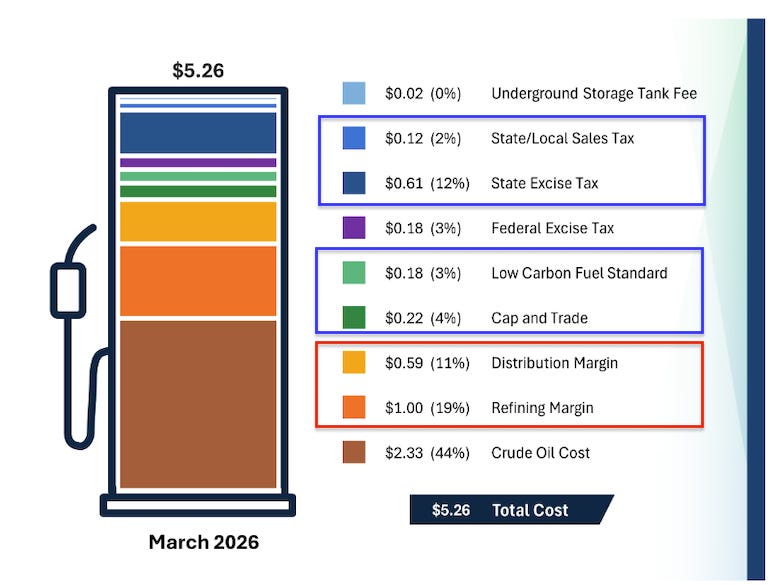
I’ve boxed the regulatory costs and taxes in blue. For a gallon of gas in March, the average price was $5.26. Just 7% of that, or 40 cents, was made up of environmental regulations. Another 14%, or 73 cents, came from local or state taxes, though taxes are spent on things like roads, so there is an upside. But we’re talking a fifth of the cost, at most, is coming from what Chevron is complaining about.
Where does the rest come from? Well 44% is the cost of crude oil, which can’t be avoided. And then, and I’ve boxed it in red, comes profit margin. A whole dollar a gallon goes to refiners, and another 59 cents goes to distributors, who are often the same incumbents. That’s 30% of the cost of gas as profit margin to, well, Chevron.
Still, margins like that don’t necessarily prove there’s something funky going on. What they do show is that the direct costs of regulation aren’t driving higher prices, margins are. So the next question is whether there is something unusual about those margins. And it turns out, yes, there is.
California’s "Mystery Gasoline Surcharge”
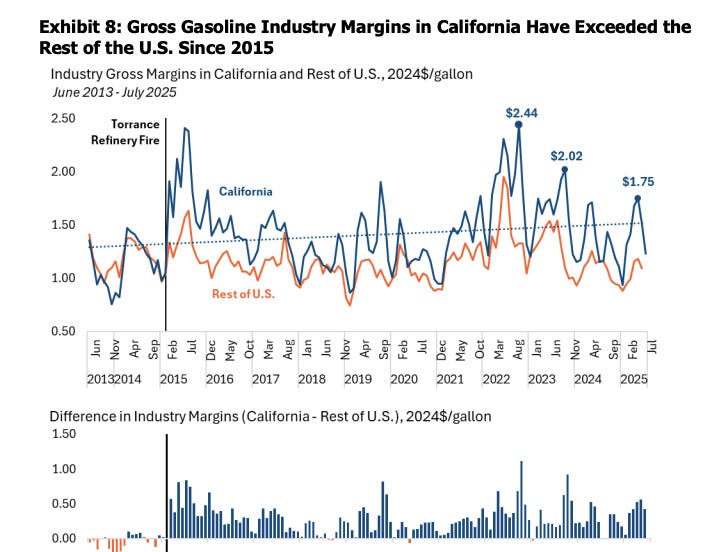
California has always had a slightly higher price of gas due to environmental costs and the geography of producing and moving oil, but that gap was not very significant until 2015. That year, a fire broke out at the Torrance Refinery, which shut down production for a year.
This disruption opened a bigger gap in price between California gas and the rest of the country, which is not unusual for an event like this. But what was unusual is the gap never went away, even after the infrastructure was repaired. This gap has persisted ever since, from “$0.54 per gallon pre-2015 to an average of $1.23 per gallon post-2015 (in 2024 dollars).”
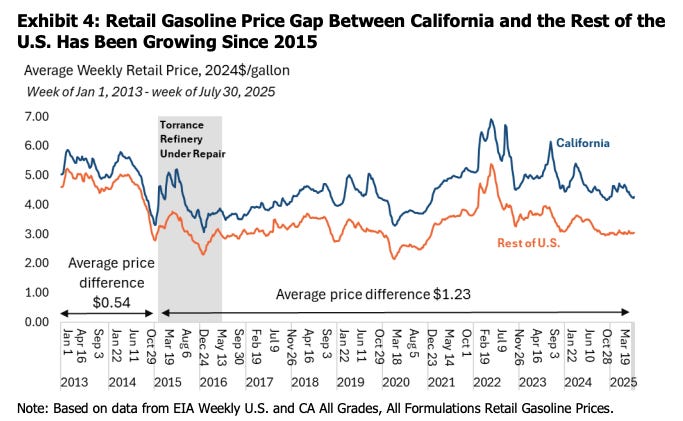
This gap, a higher price than can be explained by environmental regulations or taxes, became known as the “mystery gasoline surcharge.”
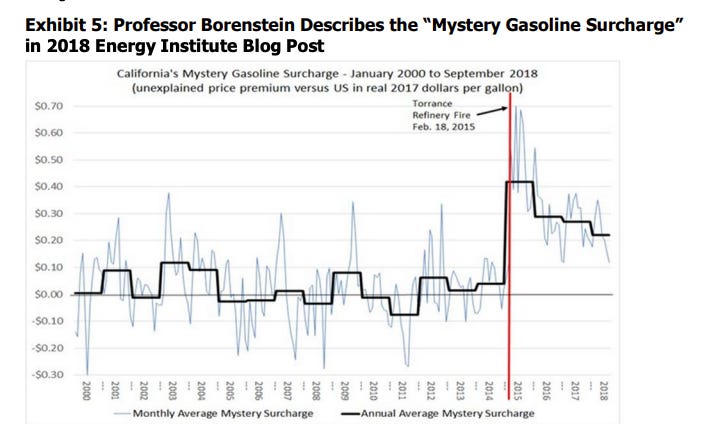
California has an oversight agency called the Division of Petroleum Market Oversight, and the DPMO confirmed this surcharge cost state residents $59 billion between 2015 and 2024. Unlike taxes and regulations, which cost money yet offer public benefits, this amount represents pure margin to incumbents with no benefits to anyone else.
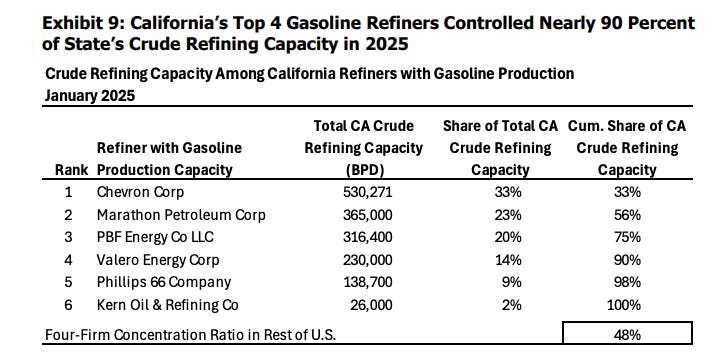
Where does this surcharge come from? Well, in part it’s about a refining oligopoly led by Chevron. In the U.S. writ large, the top four refiners control 48% of the market. In California, it’s 90%, with Chevron alone at 33%. And the net result is that it’s much much more profitable to refine oil in California.
There is another dynamic, which goes beyond refinery margins, and that’s vertical integration in retail sales. Chevron isn’t just the dominant refiner of oil, it controls distribution, marketing, and retailing as well. There are roughly 1,800 Chevron-branded gas stations in the state, many of which are franchises, while Marathon owns ARCO stations in Southern California. And this vertical integration is unusual in America; most gas stations buy their gas wholesale from the cheapest provider, but in California, the Chevron branded stations have exclusive contracts with Chevron to buy it.
This marketing channel is distinct from refining; Shell doesn’t own any refineries in California anymore, but it has infrastructure to import gas and marketing capacity. Branded incumbents have immense control over the retail price, because they can simply raise the wholesale price if they want to do that to their outlets. 50% of sales in California are through vertically integrated channels, vs just 9% of sales in the rest of America.
The net effect is a much higher difference between the price of gas at branded stations in California than unbranded ones. In California, it costs 31 cents more per gallon to buy from a branded outlet, in the rest of America it’s an average hike of just 6 cents. And Chevron is far higher, something like 60-80 cents.
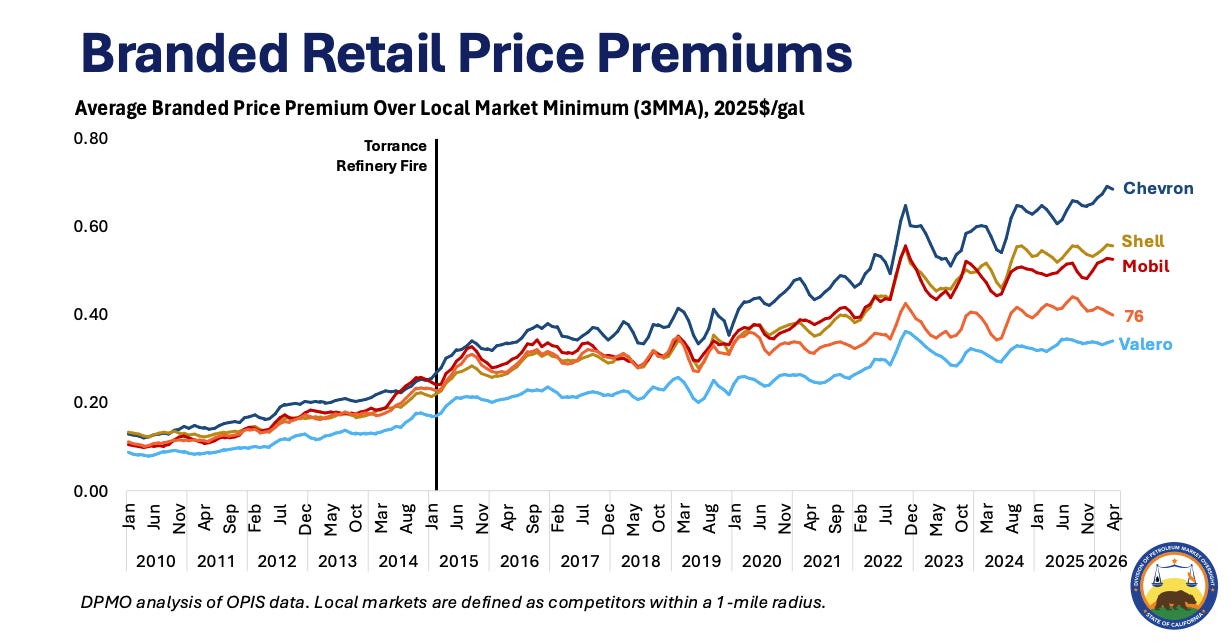
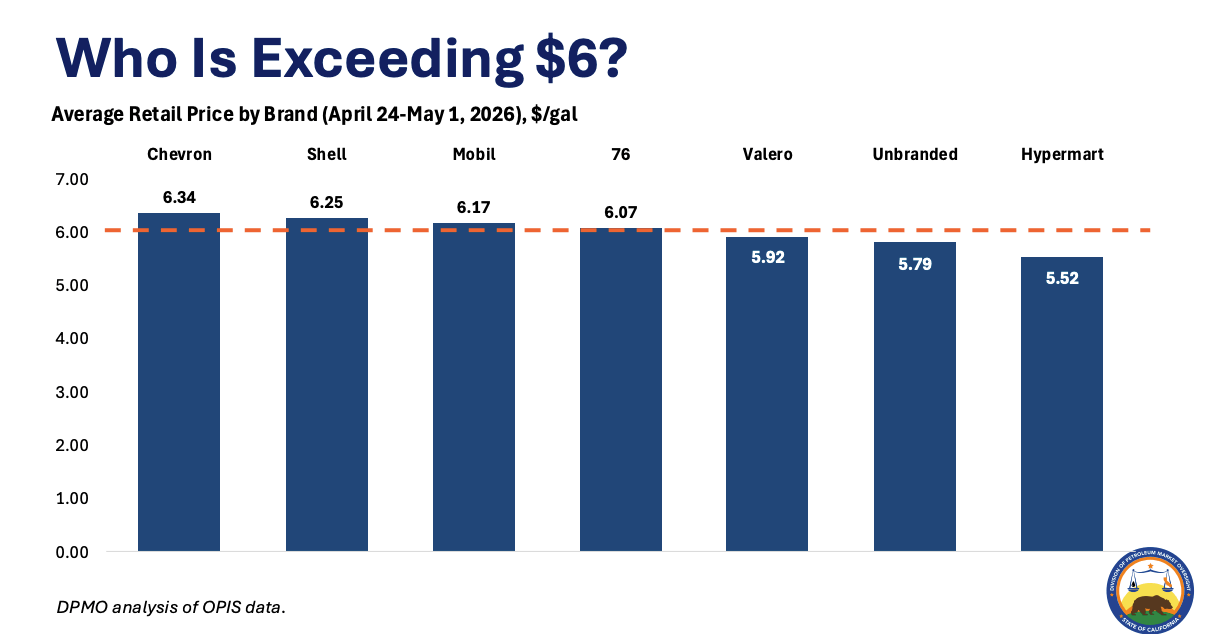
There are a variety of reasons for this dynamic, including advertising, gas station placement, and brand power. Chevron spends a lot of ad money trying to convince people that its “Techron” fuel additive is an important differentiator, even though gas is a commodity. But by far the most significant driver is the ability of incumbents to control the wholesale price that branded gas stations pay. In most of the U.S. thousands of gas stations have choices of who they can buy from, in California a big chunk of those stations do not. And consumers pay a higher price as a result.
Chevron Loves Those Environmental Regulations
However, the most interesting flaw in the Chevron theory comes from the politics of the oil industry itself. I found a letter from the Western States Petroleum Association, aka the oil lobby, calling for more environmental regulation on gasoline production.
The refining and importation infrastructure in California is highly consolidated, which is why it’s hard for new entrants to get into the market and start competing over this margin. This dynamic could be mitigated in part if California stopped using its special blend of gas, CARBOB, and standardized on the gas used by the rest of the country. After all, you don’t need special refining and blending capacity if your gas is the same as everyone else’s.
The Union of Concerned Scientists, made this point, noting that the improvements to regular gasoline, plus reductions in gas usage in the state, mean it would be a good idea to let Californians use non-CARBOB, aka normal, gas. They recommend pairing this change with a fee which could help subsidize taking dirty older cars off the road.
And while it could be done legislatively, it could also be done by regulators. There is in fact a board in California, the California Air Resources Board, which could grant a waiver to make this happen. But it has never been used. If there’s a critique of Newsom to be made on gas prices, it’s that he hasn’t gotten tough enough with the oil companies.
Finally, another piece of legislation that could bring down gas prices is a proposed state law, the COMPETE Act, to outlaw monopolization that just passed the state Assembly last week. Such a bill would give another tool to the state Attorney General or private lawyers to attack the exclusive contracting that forces branded gas stations to take a higher wholesale price. The bill must pass the state Senate and then get signed into law, but it would attack the marketing margin.
Chevron, of course, has a lot of political power, and is right now supporting the likely successor to Newsom, a candidate named Xavier Becerra.
Leaving America in the Dust
Since the 2024 election, it has been uncool in elite circles to mention climate change, but that is largely because it is out of fashion, not because the seriousness of the problem has changed. The silver lining, and it is significant, is that the technology to generate, store, and use renewable energy has gotten much better, such that it is now competitive with fossil fuels.
The war in Iran has made it even more obvious that fossil fuel infrastructure is unreliable. The rest of the world is making investments consistent with that obvious dynamic, spending $2.2 trillion on “grids, storage, low-emissions fuels, nuclear, renewables, efficiency and electrification,” and just $1.2 trillion in fossil fuels.
The global lead in this bundle of technologies is China, by far. Their electric vehicles are clearly superior in terms of feature set and maintenance costs than internal combustion vehicles, and the adjacent tech stack fosters innovations in drones and a whole series of important lines of business.
But despite the best efforts of the Trump administration, and the ripping up of tens of billions of dollars in investment from domestic automakers, the U.S. is actually rebuilding its domestic full-stack solar supply chain, and expanding battery production. The logic of competing with the fossil fuel stack is so compelling that it is even continuing in America.
The lead in the U.S. in this project is California, a state widely derided as an ungovernable mess. But this state has a set of policies, overseen by longstanding Governor Gavin Newsom, to encourage competition with fossil fuel infrastructure. And those policies are working. The Chevron critique is that those policies are also driving up gas prices, that there’s a need for a regulatory change. In a sense, Chevron’s lobbyists are not entirely wrong. California does need to reorganize its regulatory policies. It’s time to crack down on Chevron, for real.
Thanks for reading!
And please send me tips on weird monopolies, stories I’ve missed, or comments by clicking on the title of this newsletter. And if you liked this issue of BIG, you can sign up here for more issues, a newsletter on how to restore fair commerce, innovation and democracy. And consider becoming a paying subscriber to support this work, or if you are a paying subscriber, giving a gift subscription to a friend, colleague, or family member.
cheers,
Matt Stoller