 BURST
There’s a lot of good and bad monopoly news this week, as usual. The Federal Trade Commission is making tentative moves on surveillance pricing, online food delivery is consolidating, and healthcare middlemen are in the crosshairs of the Trump Administration. All of that and a lot more is below the jump, for paid subscribers only.
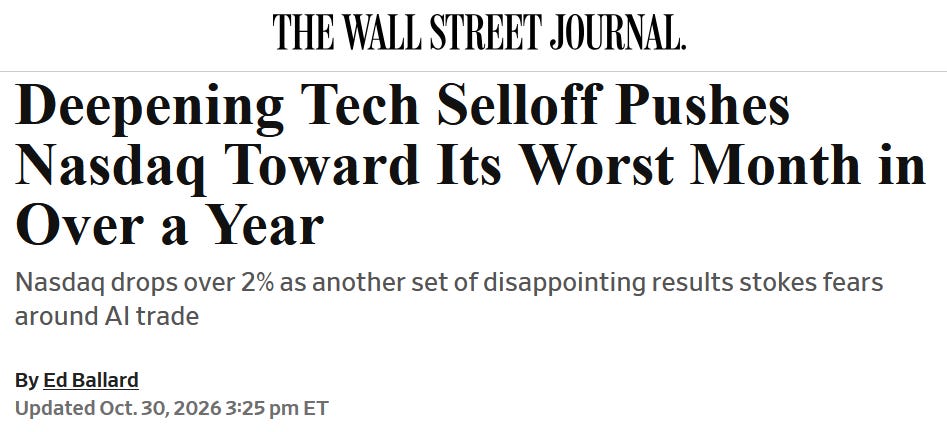
But we’re two days away from what could be a pivotal midterm election, so I want to spend a bit of time on that. Affordability, corruption, artificial intelligence, the Iran War and Gaza, healthcare, and billionaires are on the ballot. Inflation is persistent, the tech stocks keeping the market afloat just wiped out $1 trillion in value, and artificial intelligence is making everything more expensive and less secure. Air is leaving the AI bubble; perhaps a light breeze moves through your hair.
To understand the stakes, I wanted to start with the Trump victory in 2024, and how far we’ve come. When he won his second term, Trump was popular, with a majority of the public having voted for him and finally having the legitimacy he sought. Democrats were shattered, helpless and discredited, having lied about Biden’s mental acuity dealing with a very bitter public, angry about the cost of living. His successor, Kamala Harris, had dithered, unable to even defend Lina Khan after her billionaire donor ally Reid Hoffman demanded she fire Khan during the campaign. She lost, and it was humiliating. For a few months, Trump, Elon Musk and DOGE ransacked liberal pride, getting rid of USAID, proudly slashing government workers, and seizing control of scientific and academic research funding choices.
But then something interesting happened among Democrats. Bernie Sanders, considered a left-wing radical, launched what he called the “Fight Oligarchy” tour.

I want to revisit a BIG post from February 2025 about it, which we called a “populist revolt.” BIG saw it as the political support for what had been, under Biden, a mostly insider crusade against corporate power.
A year and a half later, has it come to pass? I’ve gone over a bunch of the ads and messages in these midterm campaigns, and there are definite signs that it has, and that we’re in a distinctly populist moment in American politics. Yet the more important question is not just whether surging populism on the left can win elections, but whether it can produce a governing agenda going forward. And, as I’ll discuss below, that battle is taking place within the Democratic Party, but it’s coming for Republicans, too.
Over the past 18 months, the Fight Oligarchy tour has packed basketball arenas, outdoor civic spaces, and theaters with tens of thousands of people, spanning urban, rural, red, blue and purple districts. Here’s a crowd shot I took last year of the Fight Oligarchy stop in Denver, Colorado. The red arrow points to then-recently-fired FTC Commissioner Alvaro Bedoya on stage amid a sea of 34,000 people:

The tour is ongoing. A couple of weeks ago, Bernie made multiple stops across California with Rep. Ro Khanna and CA Working Families Party Director Jane Kim to support Prop 40, the billionaire wealth tax, and he’s spent the last two weeks plowing through Florida and Texas, supporting the Senate campaigns of Angie Nixon and James Talarico.
Here’s what BIG said in February 2025:
Sanders seemed to have tapped into something. An argument about who holds power, a sense of broad popular rage at the perception that this country is now run by a small group of billionaires and corporate elites. For the first time since November, parts of the public are listening to political arguments again.
And the more you zoom back, the more you see that the populist frustration is real, deep, and broad. Take electric utilities. On the eastern shore of Maryland, a Republican area, twenty thousand people have signed a petition demanding an investigation of Delmarva Power, a subsidiary of utility giant Exelon, for overcharging them. That’s almost 5% of the whole customer base. You see the same anger in New York City about ConEdison, or in St Joseph, Missouri, about Evergy.
“Data Center Darline”
Again, there are two questions at play here: whether populism can win elections, which we’ll know more about on Tuesday, and whether it can convert to a governing agenda. Before I get into where I’m concerned, here’s where I’m optimistic: Bernie’s Fight Oligarchy tour has largely succeeded at setting the tone of the midterm elections, breaking out of the sandbox on the left. And he’s done so by seizing specific frustrations early on, putting forward actionable policy, and building something that looks like a political movement.
Let’s take a specific example: data centers. In December 2025, Bernie became the first member of Congress to endorse a moratorium on data centers. He was early to recognize that while AI was contributing to general, abstract anxiety, data centers were a physical symbol you could point at. More than just a symbol, they threatened to hike your utility rates and compete for allocation of water. Data centers were (and remain) intrinsically linked to a massive public surveillance operation – they were spending billions of dollars on building ugly, loud monstrosities to process your data. And the polling flipped, from public support among those who knew about them, to broad opposition as more and more people started paying attention. In March 2026, Bernie and his Fight Oligarchy tour-mate Rep. Alexandria Ocasio-Cortez introduced an AI data center moratorium in Congress.
Critically, there was something to be done about it, because states and cities could act. By July, New York Governor Kathy Hochul, who two years earlier had launched an “EmpireAI” initiative to attract AI infrastructure investment and research to her state, had signed an Executive Order declaring the first statewide moratorium on data center construction.
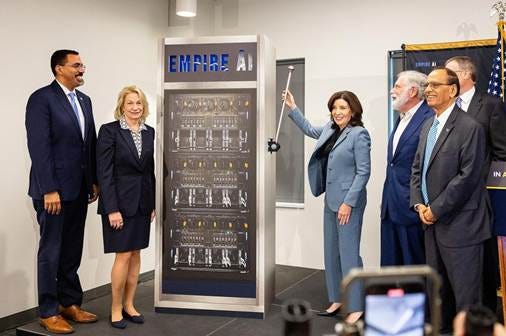
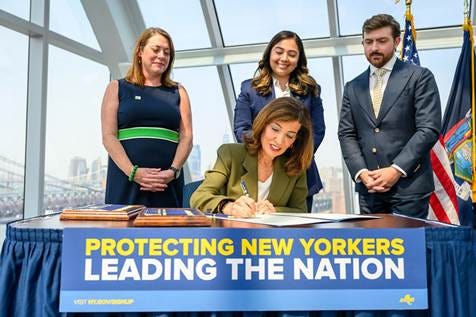
I’m glad Governor Hochul’s thinking evolved, because it’s a sign that we still live in a democracy where political outcomes are informed by public sentiment. In just the past few years, familiarity with AI has increased across all age groups, and so have negative attitudes; particularly among young people, where nearly half (47%) now belief AI does more harm than good, up from 27% in 2024. Across all demographics, just 9% of people think AI does more good than harm. There are bigger issues at hand if our politics isn’t responding to these dismal numbers.
Still, one of the larger challenges for democracy is the conflict between majority — or at least plurality — sentiment and the distortive impact of unlimited campaign spending. Bernie recognizes this more than perhaps any other political figure of our generation, and the Fight Oligarchy tour was more than a message; it was about building a movement with a shot at upending the top-down orientation of politics. And that wasn’t a partisan question; the fights over money happened as much within parties as between them. In Michigan, anti-monopolist Abdul El-Sayed defeated corporate candidate Haley Stevens in the Democratic primary. (You can listen to El-Sayed’s conversation with Matt Stoller and Dave Dayen on Organized Money, if you’re interested in his views on market power.)
A record-setting $12 billion has been spent on the 2026 midterms, according to OpenSecrets. That includes $3.9 billion in outside spending, an 85% increase over the amount spent by outside groups in the last midterm election in 2022. A separate count by Public Citizen found that over a third of that total fundraising, approximately $4.2 billion, is attributable to just 515 individuals. And $445 million - nearly 4% of every dollar spent in the 2026 election - is attributable to one individual.
A central pillar of the Fight Oligarchy tour has been that such money in politics undermines the responsiveness of candidates and elected officials to the concerns of their constituents. Even by mid-September 2026, there were reports that some Democratic consultants were advising candidates against talking about artificial intelligence for fear of attracting opposition spending from AI boosters. Ironically, one of the sources of that opposition spending was billionaire Democratic mega-donor Ron Conway’s Leading the Future PAC.
Ultimately, it was Conway who was cowed. By mid-October, Conway was using the press to communicate regret for his pro-AI campaign. More recent reporting shows that the pro-AI SuperPAC Leading the Future is in retreat. And as of last week, one week out from Election Day, the Democratic Congressional Campaign Committee, a $250 million juggernaut behind dozens of hotly-contested races across the country, had settled on its closing message:
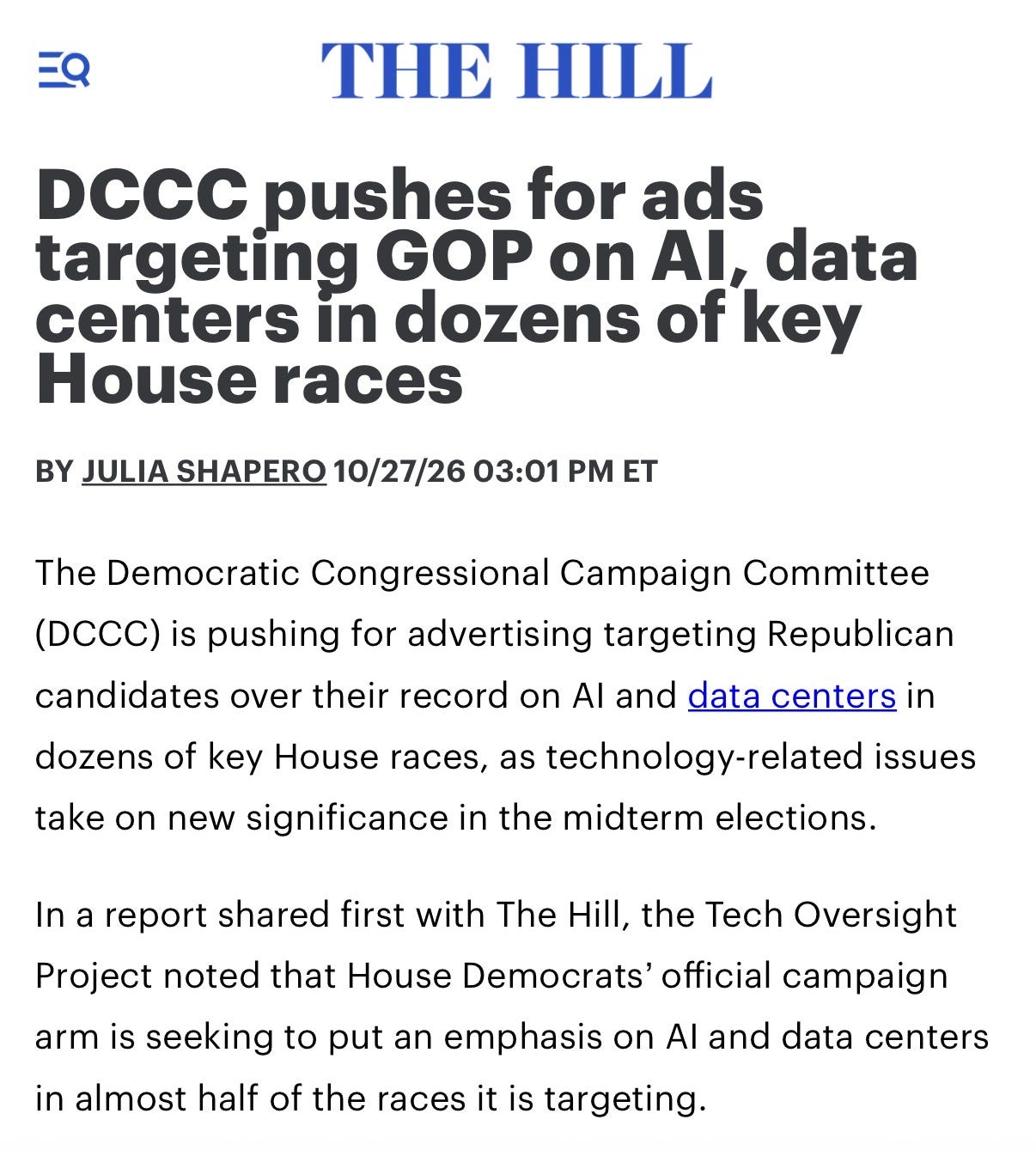
And this messaging isn’t some niche lefty thing, but is pervasive across the board. Perhaps the greatest sign of Bernie’s success is “Data Center Darline,” the schoolyard taunt for Republican Senate candidate in blood red South Carolina, Darline Graham Nordone. According to one recent poll, her Democrat opponent Annie Andrews is now polling 3.5 points ahead of Graham Nordone among all voters and among undecided voters, for a seat that hasn’t been occupied by a Democrat in over two decades. I don’t want to speculate on outcomes, but it’s clear that the anti-data center oligarchy message resonates among all voters.
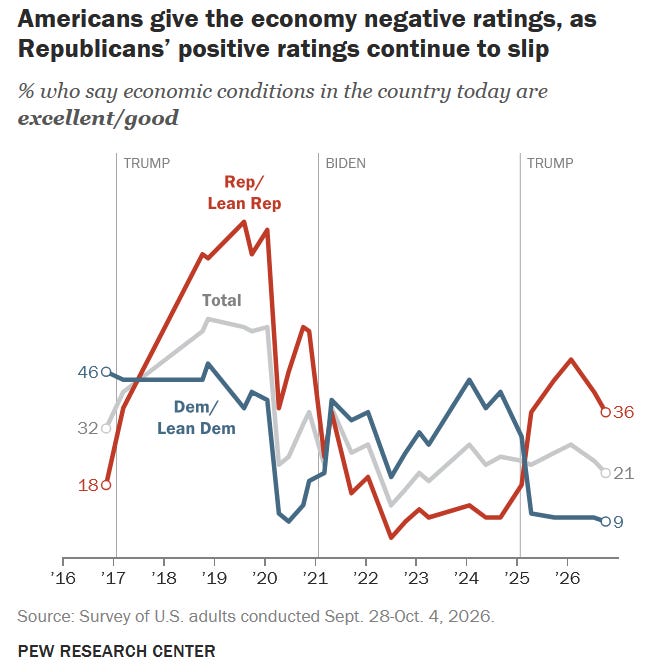
According to that same October 19 poll of South Carolina voters, Andrews is looking to win some 11% of Trump voters in 2024. At this point, Trump seems to be limping along, about to enter a prolonged lame duck of his term, and, like Biden before him, is stuck with little choice but to champion an economy that everyone hates. According to the latest Pew Research poll, only 36% of Republicans see the economy as in excellent or good shape, down from 41% in July. About a quarter of Republicans (23%) now say conditions are poor, up from 19% in July.
And Republicans are almost perfectly split on whether Trump has had a positive or negative effect on the economy, a huge shift from earlier this year. As of the October 8th poll by Pew Research, 39% of Republicans say Trump’s policies have made economic conditions better — down from 47% last fall and 57% in January — and 35% of Republicans say Trump’s policies have made things worse — up from 18% at the start of the year.
So it’s no surprise that Bernie’s message on data centers and Big Tech and oligarchy is breaking the partisan molds. Florida Governor Ron DeSantis is ditching Trump’s feverish support for data center buildouts too, and Florida Senate Candidate Angie Nixon eyes a win over Republican Ashley Moody while campaigning for a data center moratorium.
And in South Carolina, it’s no surprise that “Data Center Darline,” which serves as a proxy for the historically low trust in the institutions of Big Tech, is sticking, in a place that hasn’t seen a toss up election in a long time.
Data centers are far from the only election issue with Bernie’s imprimatur. In California, the Prop 40 billionaire wealth tax is obviously and inextricably linked to Bernie’s fight against oligarchy. On June 29, 2025, Senator Sanders delivered a speech on the floor of the Senate decrying Trump’s One Big Beautiful Bill Act (OBBBA) as “an absolute reflection of a corrupt campaign finance system that allows billionaires to buy elections.”
In perfect parallel, California’s one-time 5% tax on billionaire wealth tax is designed, at least rhetorically, to back fill the loss of federal healthcare funding caused by the OBBBA. And the near $326 million being spent to oppose it — and to support additional limits on the state’s ability to impose future taxes — is a test of the political purchase power of the state’s billionaire tech titans.

The populist movement to fight oligarchy has shown up elsewhere, too. It’s the groundswell that contributed to Mayor Mamdani’s victory in New York, as Politico signaled potential broader shifts in American politics. In Florida, Democrat candidate for Senate Angie Nixon is campaigning not just on the data center moratorium, but on breaking up concentrated tech monopolies, banning surveillance pricing, and an annual 5% wealth tax on the state’s billionaires. In Nebraska, Independent candidate for Senate Dan Osborn is running an explicitly populist campaign to break up the big meatpackers, break up the Visa-Mastercard duopoly, restrict surveillance pricing, and end the vertical integration of health plans, PBMs and pharmacies.
There are many others - look at Hallie Shoffner’s “prairie populism” in deep red Arkansas, or El-Sayed’s populist healthcare-focused campaign in Michigan — but the broader point is that however the midterm election turns out on Tuesday, the mandate is obvious. That’s one reason the Congressional Progressive Caucus, the lefty part of Congress, has introduced a resolution opposing a bailout of AI firms. It’s a line in the sand for both parties.
Are Democrats Still the Party of Nervous Lawyers?
Still, even as Bernie ran his tour, there was skepticism at the time about whether all of that energy could hold, and whether this aspirational vision of politics can transform frustration into action. Even if Democrats perform well on Tuesday, which some are predicting could be more of a flood than a wave, the more important question remains: Can they actually transform rhetoric into governance?
Populist rhetoric, as we saw with Obama in 2008, does not necessarily mean there will be a coherent governing agenda to prioritize the middle class. And media and economic elites are already showing why skepticism is warranted. Here’s Obama’s chief economic advisor Jason Furman, preemptively excusing inaction on the issues that matter most to voters:
“There is nothing the next Congress can do about the level of prices,” said Jason Furman, a top White House economic adviser to President Barack Obama. “They will remain very high.”
To govern, Democrats will have to ignore their economic advisors that ruined the Biden administration framework. And I’m not sure they can.
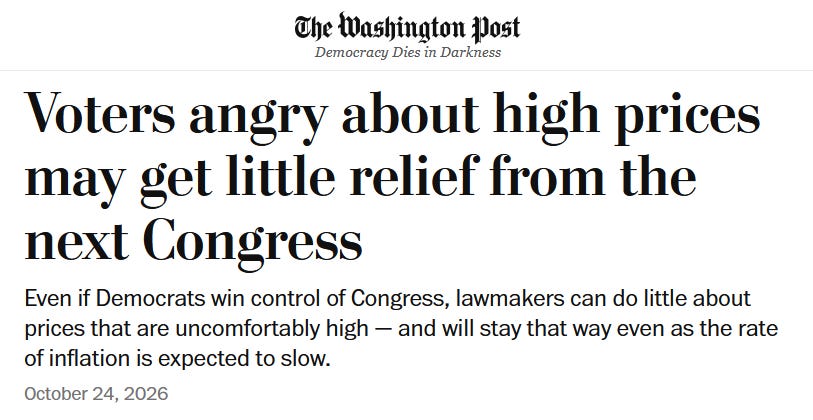
It’s true that Congress is limited in its ability to directly force the White House’s hand, but that’s not Furman’s argument. He simply doesn’t think it’s possible to lower prices without fostering a massive recession, regardless of political constraints. And he believes this theory even as we see headlines in politically structured markets like health insurance.

So the question is whether newly elected Democrats will even try to move an agenda that points to something other than learned helplessness. And there’s a quiet internal debate over that question among Democrats in Congress: Just 10 days prior to Election Day, on October 22, Democratic Senator Brian Schatz went on CNN to argue against an agenda that includes anything President Trump might veto, advocating against a “more aspirational” or “bold” approach:
Rep. Greg Casar, Chair of the Congressional Progressive Caucus, responded by arguing that Democrats might win the election, but would still be seen as “the party of nervous lawyers who just tinker around the edges” until they actually voted to root out “rampant corruption” and deliver “higher paychecks and lower prices.” It was not enough to be anti-Trump, he argued. Democrats had to “crack down on corporate greed to bring down the cost of health care, housing, child care, groceries, and gas,” as well as doing oversight of the White House and big business. If Trump vetoed good bills, “we’ll run on them in 2028 and pass them in 2029.”
This debate is taking place among Democrats during an insurgent midterm election cycle, but Republicans are approaching their own factional war. It’s not just DeSantis breaking from Trump’s AI boosterism. In fact, most GOP politicians have begun distancing themselves from the toxicity of data centers, usually landing short of calling for a moratorium by projecting a need for local control:
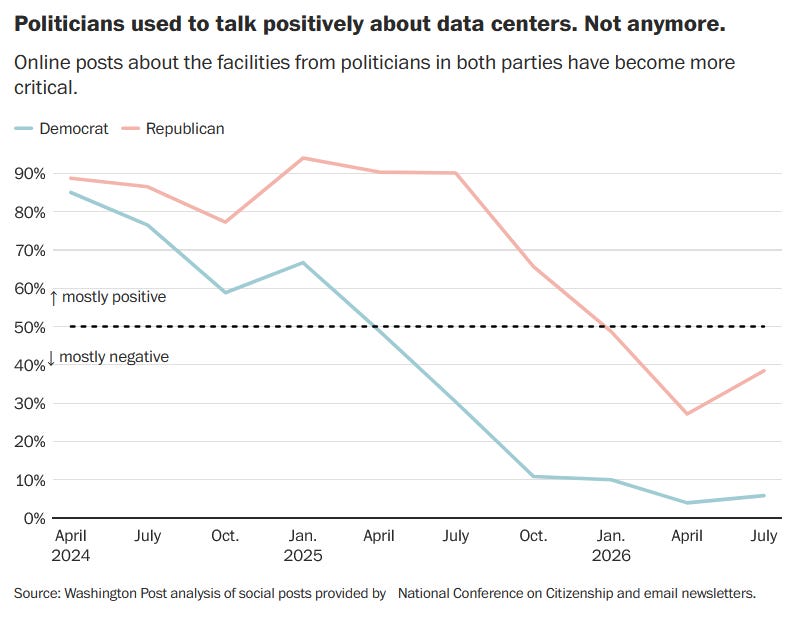
And Republican voters are increasingly defecting from the Trump administration with frustrations aimed at Wall Street, Big Tech, and financial regulations. According to an October 29 poll, 50% of Republicans think Wall Street has too much control over the economy, and 53% think Big Tech has too much control. Sixty percent of Republicans think the crypto industry has too much influence in Washington, and 75% think crypto donations will “buy dangerous policy.” Eightyone percent of Republicans are concerned about private equity takeovers. In a rebuke of Trump’s dissolution of the Consumer Financial Protection Bureau, 80% of Republicans want more stringent consumer protections for new financial products, and 77% favor the CFPB after hearing a description of the agency and its mission.
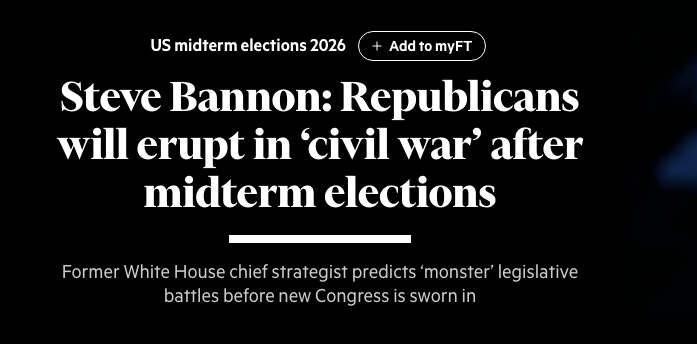
The question for Congress, irrespective of the midterm outcomes, is whether either party will leverage these sentiments, which cut across traditional political boundaries, to do something about it. Eleven of thirteen elections this century have been “change” elections, meaning there was a change in party control over the House, Senate or Presidency. If no one will seize the mantle, we can expect more of the same, which is to say, more volatility, more unrest, and bolder demands for change, wherever that change may come from. And given the rumbling we’re starting to see in the financial markets, there might be a lot of pressure to govern, fairly soon.
Now, on to the good and bad news, after the jump. A successful corporate breakup, lots of news regarding Pharmacy Benefit Managers which are now a mainstream and bipartisan concern, the AI bubble wobbles, and you’ll never guess who might have been the target of a Chinese spy plot (ok, you might actually guess…)