 BURST
BURSTTo understand what is likely to happen in corporate America, increasingly you have to think like a criminal. And increasingly, that’s what I’m finding fancy corporate lawyers on both sides of the aisle do for a living.
Yesterday, I read a filing from some state enforcers on a $6.2 billion merger between two companies called Nexstar and TEGNA, which together would own hundreds of local broadcast stations. It is one of the craziest legal filings I’ve ever read, even surprising me in terms of the brazenness and disregard for the law. At the same time, I’m seeing in a different case - the Paramount-Warner merger - a possible scheme based on Supreme Court corruption that would have been unthinkable just a few years ago.
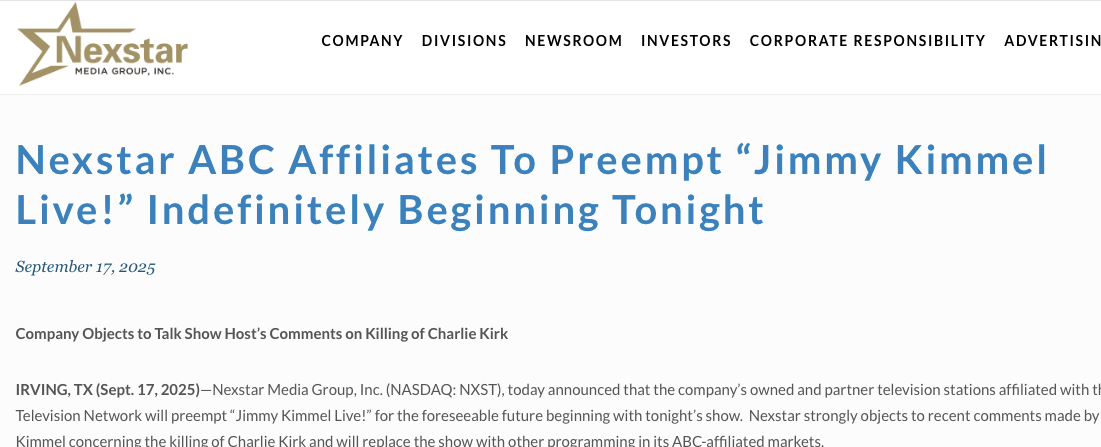
Here’s what happened. We’ll start with Nexstar-TEGNA, two companies that, while not well-known, were actually at the heart of Trump’s attempt to have comedian Jimmy Kimmel kicked off the air. That moment was a message to the press to give the administration positive coverage, or face retribution. But to understand this attempt to creating a censorship machine, we have to understand how our media companies make money.
Local broadcasters operate in a regulated environment, and seek to make profits based on their regulatory framework. Specifically, the American broadcasting system splits national broadcasters from local affiliates. Disney owns ABC, which offers Jimmy Kimmel’s show, as well as sports and national news, but it is carried by local affiliates, your KXTV local ABC channel in Sacramento, for instance. Those local affiliates have some power over whether to carry national ABC content, and offer their own local news, weather, traffic, syndicated shows, and so forth.
And lest you think that streaming has made this system obsolete, think again. FCC regulations require all cable-TV style systems, including streamers, to buy must-have content from local broadcast affiliates. As Nexstar noted, “Big 4 broadcast networks carry the nation’s most- watched programming by a significant margin (including the substantial majority of [NFL] games).”
Nexstar and TEGNA companies are major players here, having rolled up much of the market. If combined, Tegna and Nexstar would own quite a lot - 265 television stations in 44 states, reaching 80% of households. With their market power, they have been able to force up prices for pay-tv across the board, for pay-tv on cable and streaming, up roughly 2000% since 2010. When they acquire two stations in the same market, they not only hike costs, they also lay off local tv journalists.
Now, it’s illegal to let these companies merge, if for no other reason than they have overlapping stations in lots of markets. Enter corruption. Last September, both companies demanded that Disney get rid of Jimmy Kimmel, or they would refuse to carry ABC programming. Why? Well, they wanted favorable treatment from the FCC and the Antitrust Division, who would have to approve this merger.
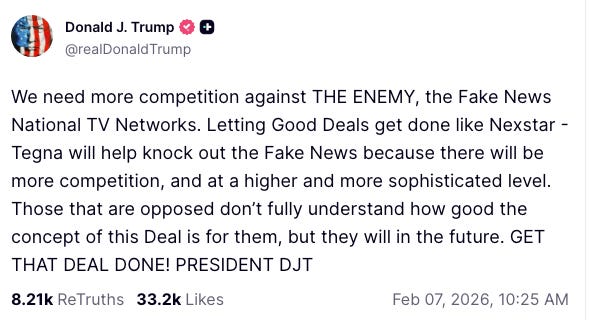
To give you a sense of how illegal this deal is, in Trump’s first term, his agencies did not allow Nexstar to buy what it wanted, and this deal is much much bigger. Yet in February, just a few months after these companies did Trump the favor of getting Kimmel temporarily pulled, Trump supported their combination.
As with Ticketmaster, some state attorneys general on a bipartisan basis chose to challenge the merger. And so did DirecTV, because it’s a pay-TV operator that has to buy from Nexstar and TEGNA, and doesn’t want much higher costs.
But in a brazen move, the FCC and Antitrust Division approved the deal, and within minutes, Nexstar and TEGNA closed their transaction. They paid out golden parachutes to executives and began integrating the lines of business, so as to force any judge trying to oversee the deal to have to granularly manage an unwinding and, in the hopes that a judge would find that too annoying to deal with and simply let the merger happen. While aggressive and dirty tricks are common, the explicit nature here is novel, because the goal of these companies is not just dismissive of enforcers, but of courts as well.
But the judge in this case, Troy Nunley, wasn’t fooled, and agreed with the states and DirecTV. He issued an injunction in April ordering Nexstar to hold the two companies separate so as “to not influence the management of the held-separate TEGNA business unit” while the case goes to trial. Basically, he said these are independent competitors and will have to be treated that way unless they can overcome his skepticism about their violation of anti-merger statutes.
Ok, so what did the filing yesterday say? It turns out that Nexstar, instead of obeying the judge, stacked the board of TEGNA with its own and former executives. And then they tried to keep the names of the board members secret from plaintiffs. Here are the people on TEGNA’s board.
Perry Sook - Nexstar’s CEO
Michael Biard - Nexstar’s President & COO
Lee Ann Gliha - Nexstar’s Executive Vice President & CFO
Elizabeth Ryder - Nexstar Executive Vice President & General Counsel & Secretary to Nexstar’s Board of Directors
Timothy Busch - Former President of Nexstar Broadcasting (who had worked for the company for more than twenty years) and current Nexstar consultant.
Nexstar’s own CEO Perry Sook went off and bragged to investors that TEGNA “operate[s] as a [Nexstar] subsidiary,” that TEGNA leadership talks to Nexstar executives, and that Nexstar is making decisions on TEGNA stations.
The plaintiffs are asking for the judge to address the violation of his order by forcing Nexstar to actually keep the companies separate. That’s not nearly enough, Sook and the involved lawyers should be held in contempt of court for this open flouting of the judicial order. And Judge Nunley does seem angry.
What’s notable is that while this whole saga involves White House-related corruption, the lawyers engineering the legal strategy for Nexstar are not MAGA in any way. Beth Wilkinson and Sarah Neuman are prestigious corporate lawyers at the firm Wilkinson Stekloff. Wilkinson is a highly sought after litigator and a Democratic donor while Neuman is proud of her pro bono work helping asylum victims escape vicious regimes.
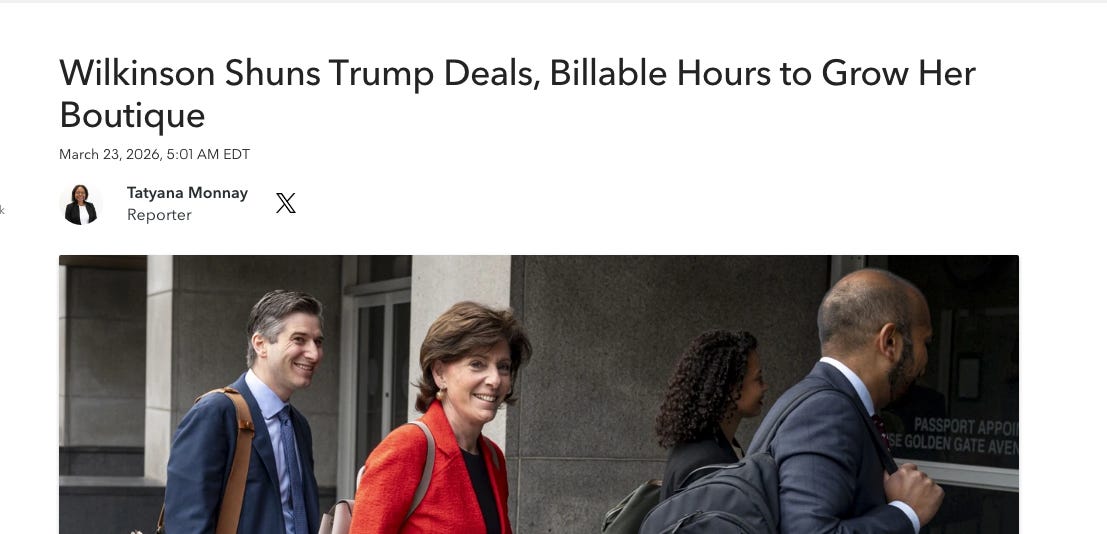
And the moral ardor is rich. A few months ago, while representing Nexstar, Wilkinson criticized Paul, Weiss, the corporate law firm that cut a deal with the administration, saying that was “not a place where any well-regarded litigator wants to be—I don’t think that’s good for your brand.” She added, “I don’t think that’s good for what we’re supposed to stand up for, which is fighting the government and fighting for the rule of law.”
It’s a fascinating moment, to watch Wilkinson advise on how to get a deeply corrupt merger closed by flouting the law, while she talks about her professional responsibility of “fighting for the rule of law.”
The more telling phrase is when she discusses “fighting the government.”
A quick glance at other clients shows just what that means. She was the lead lawyer for Microsoft in buying Activision, which ruined video gaming. She works for VISA against the antitrust claims brought by the Biden administration, and which no doubt right now VISA is trying to corruptly influence their way out of. Philip Morris, the NCAA, Bayer, PFAS and “forever chemicals,” it’s hard to find a noxious corporate cause she hasn’t defended.
Here are a few telling sentences from a profile of Wilkinson’s firm.
“We wanted to prove that you can have a diverse workforce that works at the highest level,” Wilkinson said of her firm. “That’s been very rewarding…”
Two years into her new venture, she represented then US Supreme Court nominee Brett Kavanaugh during confirmation hearings when he faced sexual misconduct allegations that he’s denied.
The level of deep-seated legal corruption, and its relationship with legal elites on the Supreme Court, is important to internalize.
So that’s example one of thinking like a criminal.
It Takes a Village to Corrupt a Merger
Example two is the Paramount-Warner merger, the $110 billion deal roiling Hollywood. In previous eras, to understand such a merger, you’d look at financing, merger law, national security frameworks, judicial orders, and so forth. But today, you have to incorporate the likelihood that someone will bribe or force their way to a decision from the Supreme Court, with support from a nakedly bought-off administration trying to force changes to CNN coverage.
This combination should have been opposed by the Federal government, but Larry Ellison, the billionaire behind it, gave $45 million to President Trump, who then had his Antitrust Division override the law to approve it. Part of the reason is that Ellison promised Trump that he would revamp CNN, a property owned by Warner, if he took control. That would be outrageous in most eras, but today it’s a snoozer, a sort of “did you expect anything else you rube” moment. Everyone, it seems, thinks like a criminal.
Indeed, Ellison’s people constantly leak to the New York Post that anyone who opposes their deal is a Communist, a Chinese agent, an anti-semite, and hates America. Makan Delrahim, his general counsel, openly called me an antisemite on LinkedIn! Ho hum, whatever. You can imagine the furor if Lina Khan said or did anything remotely similar, but today, big law and corporate leaders just don’t care.
For instance, here’s Richard Grenell offering a racist comment about the judge, Araceli Martinez-Olguin, in this merger case. And Grenell isn’t just anyone, he’s a board member of Ticketmaster, a former top intelligence official under Trump, as well as the acting executive director of the Kennedy Center.
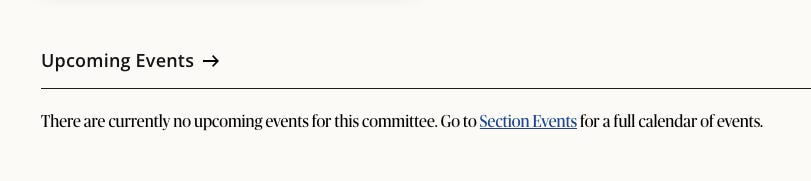
Despite the corruption, the ABA Antitrust Bar is silent. Here’s the schedule for the next meeting of the Ethics & Professional Responsibility Committee of the American Bar Association Antitrust Section.
The thing is, in this case, the original architecture of the American state worked, splitting up power and having redundancies in important areas of law like antitrust. State-level enforcers filled in the gaps left by the Federal government, and challenged the case. And on Monday, the judge ruled for the state governments opposing the deal, temporarily blocking it. She will have a hearing in August to see if it makes sense to put in place a slightly stronger order, what’s called a preliminary injunction, until the trial. She has also, importantly, said the Writer’s Guilds will get to present their case against the merger on labor grounds on an expedited schedule as well.
The decision by the judge is a bad outcome for Paramount, because time is not on their side. The company has to pay a “ticking fee” to Warner shareholders of $6.9 million a day starting on October 1. Half the funding for the deal is coming from Middle Eastern sovereign wealth funds, namely the United Arab Emirates and Saudi Arabia, both of whom require the U.S. military shield to deal with Iranian missiles. Are there rules prohibiting or discouraging foreign governments from buying major U.S. media outlets? Yes, except Trump enforces those rules, so it’s another “did you expect anything else you rube” moment. If, however, Saudi Arabia just doesn’t have the money because of the revival of the war in Iran, well that would be different.
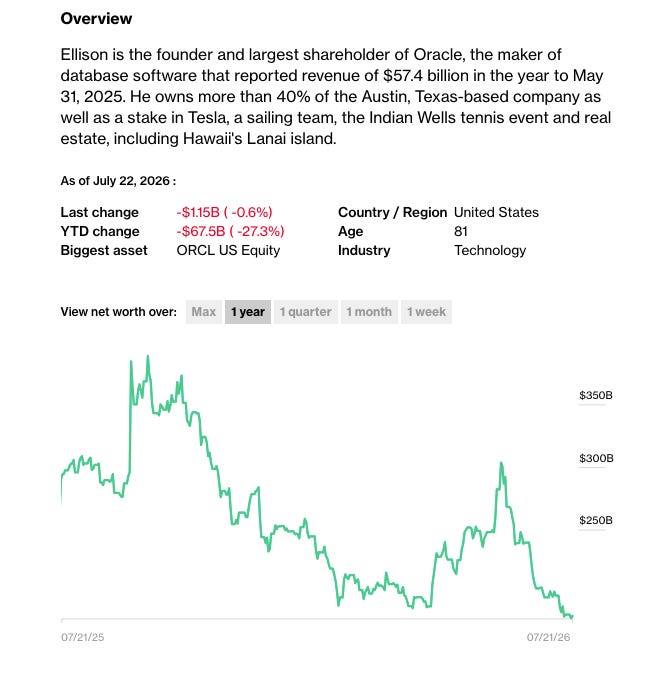
Then there’s Larry Ellison’s net worth, which has collapsed in the last six months. Most of his wealth is locked up in Oracle stock. That company bet heavily on the AI buildout, particularly OpenAI’s success, and that’s quite risky. The rest of his net worth is in Tesla stock, which fell by 15% yesterday, as well as Paramount and SpaceX, both of which have dropped. So not great, considering he has a $40 billion personal guarantee for the Warner acquisition.
All that said, let’s think like a criminal. What’s the most conspiratorial way to get this merger done? Well, if the judge grants a preliminary injunction, Paramount’s general counsel, Makan Delrahim, has said they will appeal all the way to the Supreme Court to overturn key antitrust precedents on mergers. Delrahim was a Trump official, and he was what is known in politics as the official “sherpa” helping to convince the Senate to approve Neil Gorsuch to be on the Supreme Court. So he’s connected in that world.
Normally courts are super slow, so appealing this preliminary injunction would be very costly. And no matter how connected Delrahim and Ellison are, Paramount still has to get through an appeals court before going to the Supreme Court. So to get there, they will ask the Ninth Circuit to hear their case quickly, which may or may not happen. If it does, that’s where the weirdness occurs. The Supreme Court could just rule quickly through what’s called a “shadow docket” to overturn the preliminary injunction. The shadow docket is a way the court takes a quick vote and puts out a decision without any explanation, and it’s increasingly how the court upholds controversial decisions.
So that’s the “think like a criminal” path for this merger to close. Delrahim uses corrupt connections with the Supreme Court to break merger law so as to close a merger putting media assets in the hands of a close Trump ally and Middle East countries dependent on U.S. military assets. It’s a bit of a fantastical reading. Perhaps Delrahim is bluffing about his ability to manipulate the Supreme Court, that the Middle Eastern countries run out of money because of a war that Trump started, and/or that the AI bubble pops so Ellison can no longer afford the takeover of Warner. But it’s not crazy.
So here’s the brutal ugly fight. State attorneys general are trying to uphold the rule of law, but oligarchs are bullying not only them, but even judges, with an implicit threat that the Supreme Court will ensure the outcome they want. And in both cases, the high-powered litigators at work have helped helped justices get on the court, Kavanaugh in one case and Gorsuch in another. So not only do we have to oppose these mergers in court, we also have to hope that these quasi-mobster types fail in their schemes.
It’s an exceptionally weird state of affairs, but fortunately, this moment won’t last forever. There will likely be a change in political power soon, a much more radicalized and angry Democratic Party, fighting internally over what to do and how to do it. But it’s important to recognize that this problem of corruption is deep-rooted and not unique to Trump. In both cases, Nexstar-TEGNA and Paramount-Warner, we’re seeing zero pushback from the center-left corporate legal establishment over this brazen influence peddling.
In fact, most important corporate lawyers are still upset with the Lina Khan era of antitrust, and seem quite happy with this new regime. The increasingly bitter fights in politics are about precisely this dynamic, where the voters themselves are beginning to react angrily towards the wealthy cynics across the board who organize our legal and economic regime.
It takes a village, as it turns out, to corrupt a society. And it’s going to take a lot of work to uproot what this generation of big law people have done.
Thanks for reading! Your tips make this newsletter what it is, so please send tips on weird monopolies, stories I’ve missed, or other thoughts. And if you liked this issue of BIG, you can sign up here for more issues, a newsletter on how to restore fair commerce, innovation, and democracy. Consider becoming a paying subscriber to support this work, or if you are a paying subscriber, giving a gift subscription to a friend, colleague, or family member. If you really liked it, read my book, Goliath: The 100-Year War Between Monopoly Power and Democracy.
cheers,
Matt Stoller