 BURST
BURSTLots of monopoly related news, as usual. Google is now emailing children to tell them how to avoid parental controls, a price war brought down the price of weight loss drugs, there’s cool innovation by Lego toys, and the Trump administration actually blocked a merger!
Before getting to that, let’s focus on how Trump is managing the problem of affordability and politics. Over the past week, we got a clearer idea how this administration will set itself up for the midterm elections. The President announced attempts to crack down on credit card companies, big landlords, and defense contractors, and his administration is now pursuing a high-profile criminal investigation of the Chair of the Federal Reserve, Jay Powell. The moves are all happening, more or less, because of an increasing panic in the White House over high prices, as the President sees that the public is unhappy with his performance.
In short, a key political theme of the next year for the Trump administration and the Democratic opposition is affordability, with a lot of rhetoric of cracking down on wayward corporations. Will it work? Is it sincere? That’s the lens I’m going to use in looking at the events of the past week.
To answer these questions, I’ll observe another less noticed move last week that I find more significant. The Justice Department waived through a multi-billion real estate brokerage merger in what looks like a corrupt deal to create a home buying monopoly. Though few noticed this deal, it is one of many below-the-radar choices that will likely raise consumer costs. There is, in other words, tension between the announced agenda and the real one.
From Make America Wealthy Again to Affordability
Ok, let’s start with the political context. The theme of the President’s domestic economic policy in his first year was not affordability, it was, in Trump’s words, Make America Wealthy Again. It is best summarized by this picture at the inaugural.
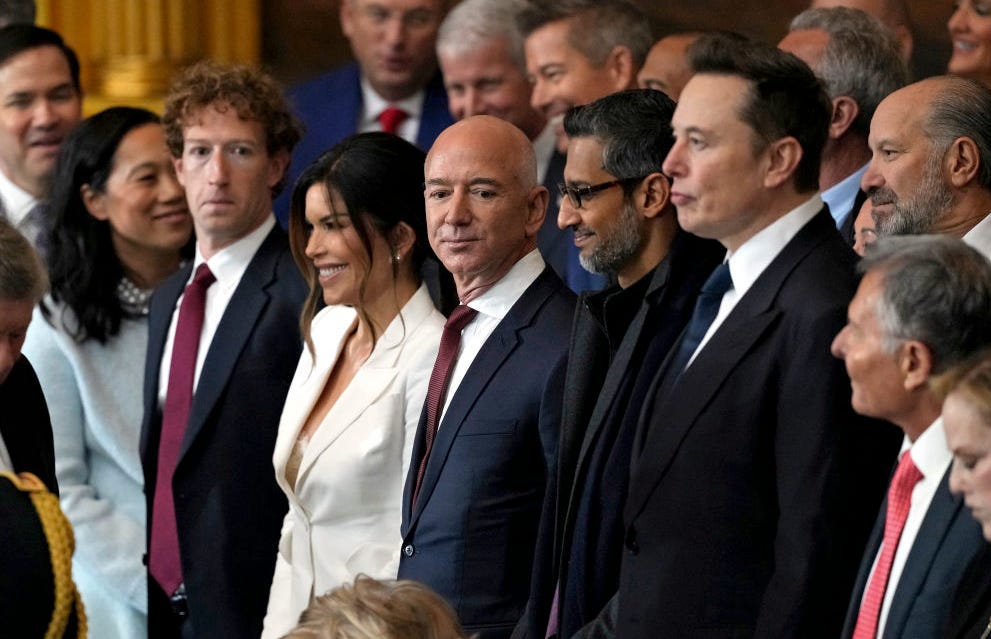
There were some tariffs, and DOGE, but mostly Trump pursued tax cuts for big corporations as a mechanism to engineer prosperity, with the view that large businesses would do much more investment if they had a lighter tax burden and fewer government rules. The elections of 2025, when Democrats romped, and Democratic socialist Zohran Mamdani won a shocking upset in New York City, show that this agenda hasn’t delivered politically. The public is upset with high prices, and now blames Trump.
One of Trump’s strengths is that he’s supremely flexible. So his response starting late last year was to talk up affordability, with a grab-bag of measures to highlight what he’s doing. Some of it is genuinely populist; USDA chief Brook Rollins has been talking about meatpackers and inputs producers like Bayer harming row crop farmers, and Federal Trade Commissioners like Mark Meador and Andrew Ferguson are now stressing costs.
The Big Pivot
And last week was the big pivot. On Wednesday, Trump called for a ban on institutional investors buying single family housing. “I am immediately taking steps to ban large institutional investors from buying more single-family homes, and I will be calling on Congress to codify it,” he put on Truth Social. Trump is going to issue an executive order to help buyers afford housing, he’s also encouraging Fannie and Freddie to buy mortgage backed securities to lower mortgage rates, and he’s trying to force homebuilders to stop sitting on land. Here’s Trump official Bill Pulte:
The anti-corporate rhetoric isn’t limited to housing. Trump also issued an executive order to ban buybacks, dividends, and cap executive compensation for defense contractors. The rumor is that DOD deputy secretary Steve Feinberg complained about the unwillingness of the contractors to do competent work. Feinberg is a private equity guy, and he proposed this crackdown.
“Many large contractors,” goes the order" “while underperforming on existing contracts — pursue newer, more lucrative contracts, stock buy-backs, and excessive dividends to shareholders at the cost of production capacity, innovation, and on-time delivery.”
Trump is addressing a real problem; the defense base is a mess, a mix of extreme financialization and monopoly power. I traced the issue in 2023 with a piece titled “The Military-Industrial Stock Buyback Complex.” For instance, one of the bottom feeders of the industry - Transdigm - just bought another sole source government contractor, this one called Stellant Systems, and is about to rip us off again by hiking prices on components by thousands of percent.
There are some questionable legal elements to the order, but Democrats were largely supportive, while Republicans and lobbyists were silent. Of course the President, also on the spur of the moment, called for a $500 billion increase in defense spending, which mollifies frustration from defense companies.
The final high-profile attack on corporate America was actually spurred by a Democrat. On Thursday, Bernie Sanders criticized Trump for failing to follow through on his campaign pledge to cap credit card interest rates, pointing out the CEO of JP Morgan made almost a billion dollars in 2025.
It’s been a year since the campaign trail, so it’s fair for Sanders to point out that Trump has focused in areas other than sleazy bank practices. There’s a reason Dimon made so much money as the head of the biggest consumer bank in America. Credit cards have four times the return for banks than any other line of business. Visa has market power, and these networks charge high interest rates and fees, and extract money from merchants through excessively high swipe charges.
Trump, after being prodded by Sanders, called for a cap on credit interest rates. A number of Senators on the right, like Josh Hawley and Roger Marshall, expressed support.
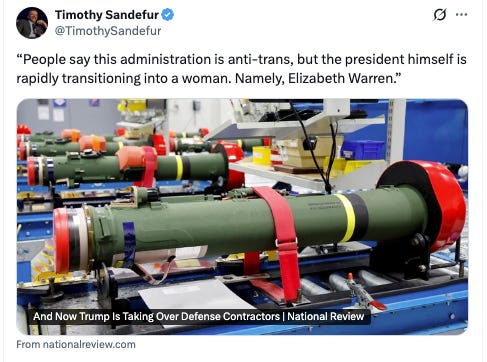
This pivot to affordability and attack on corporate power has generated a lot of anger among the superrich and libertarians. I won’t go over all of it, but here’s the National Review, with a comment combining culture warring with hostility to controls on capital.
The Real Agenda Is Not the Announced Agenda
So what’s actually going on? Is Trump sincere? Is he unveiling a real new agenda? To answer that question, I want to offer a fourth event, one that few outside of the antitrust world noticed. And that is, the largest real estate brokerage in America, Compass, cleared its $1.6 billion purchase of Anywhere Real Estate, which owns Century 21, Coldwell Banker, Corcoran and Sotheby’s International Realty. The deal cleared much earlier than the companies themselves expected it to. Why? Corruption.
The head of the Justice Department’s antitrust division, Gail Slater, wanted to launch an extended review of the merger to weigh whether it was anticompetitive, the people familiar with the matter said. Compass and its lawyers appealed above her, to the office of Deputy Attorney General Todd Blanche, arguing that any worries could be addressed without an investigation. Blanche’s office agreed, the people said.
Compass had brought on Trump-aligned lawyer Mike Davis, known for his efforts to get conservative judges seated on the federal bench, to help make their pitch. Davis has become a sought-after adviser to companies with deals facing government review. He helped Compass make its case to Blanche’s office.
It’s not clear exactly what happened, but the details are less important than the outcome. This acquisition is part of the race to monopolize home buying, and it was a highly controversial merger because it will allow Compass to have exclusive power to list properties all over the country, presumably charging higher prices or gaining leverage against brokers.
And I think in this example we see the difficulties of a Presidential pivot. Trump is certainly conflicted in his goals, he wants the stock market to go up, but he also needs costs, and thus the profits holding up equity values, to decline. But even if Trump wanted to focus on affordability, it’s not clear that he has the staff in place to actually execute on it.
Let’s go back to credit cards. I personally don’t think Trump likes the industry, he genuinely thinks they rip people off. But he’s not paying much attention to the area, if any. And the truth is that his administration has helped fortify the power of credit card banks, reversing mild attempts by the previous administration to do something about it.
Under Biden, antitrust enforcers tried to address the payments system by bringing an antitrust case against Visa over the private sales tax it levies on most retail transactions. There’s more. Biden’s head of the Consumer Financial Protection Bureau, Rohit Chopra, had an entire framework for addressing credit card market power, including publishing research that Trump used on the campaign trail. He blocked comparison sites from steering consumers to high cost credit cards, and wrote a rule to end unfair late fees.
Has any of that continued? So far, the antitrust case is moving forward, but Trump’s CFPB, led by conservative official Russ Vought, withdrew the late fee rule in April. They have also destroyed the CFPB. And the Antitrust Division, led by a meek official named Gail Slater, worsened consolidation by waiving through the Capital One-Discover merger, which was likely illegal and very ugly for poor people. The result of the Trump administration’s 2025 policy framework was the near-billion dollar payday for Dimon, and much higher bonuses on Wall Street.
But now, it’s affordability time. So Trump is proposing something he should have enacted a year ago when he was popular and Congress feared him.
Trump Morphs into Biden
There’s a basic rhythm to Presidencies. A President comes into office with a lot of momentum, installs his team, and executes his agenda. His opponents are off-balance, inherently, because they know the public supports the man they just chose to lead the country. But if the President doesn’t make policy that helps voters, he loses momentum. That’s not always the case; FDR gained over time, winning the midterm of 1934 in a smashing way. So did George W. Bush to a lesser extent. Towards the end of a second term, the President becomes a “lame duck,” meaning few believe his policy views matter.
Joe Biden’s administration is a good way to map this out. When he took office, Biden got a lot of what he wanted, passing his main agenda of Covid restrictions, semiconductor support, infrastructure and stimulus, plus continued bailouts of Wall Street through executing the CARES Act. He withdrew the military from Afghanistan. He put a cabinet in place with reliable bank-friendly people, like Janet Yellen at Treasury, Jay Powell at the Fed, and Gina Raimondo at Commerce.
As a result, he couldn’t pivot to address a new problem - corporate profiteering leading to high prices. In September of 2021, as inflation kicked up, some Biden officials announced the administration would crackdown on meat processors. It was too late. Biden had already picked his USDA chief, a former corporate lobbyist named Tom Vilsack, and he didn’t have the team or consensus to execute. In 2022, Biden announced forgiveness of student debt, but by then the courts had become comfortable knocking down the policies of an increasingly unpopular leader. By late 2024, Biden called for a national rent control law, capping rent increases at 5% a year. It barely registered. Biden was in cognitive decline, but people had stopped listening to him because what he said didn’t matter, not because he was old.
We’re not at the total lame duck stage yet with Trump. Stocks still move when he makes announcements, and corporate lobbyists care about what he says and does. But Trump has already put forward the main thrust of what he’s going to do, focusing on data centers and trickle down policy in 2025. He lacks the political consensus to get Congress to do much else. He has also staffed up his administration. His administration knows how to deport people, they get how to coerce small countries, and they can work with big business to deregulate. But they by and large simply do not believe that you can reduce costs to consumers by taming corporate power, nor do they really know how to execute on that if they did believe it. And that’s how populist Democrats are approaching some of Trump’s new rhetoric.
Messing with the Fed
And that gets to the final event of the week, news of which just came out. The Trump Justice Department is investigating Fed Chair Jay Powell for perjury over his testimony about building construction. It’s entirely pretextual, the point is for the administration to pressure the Fed to lower interest rates, with the idea that will help make home buying cheaper.
Trump will get control of the Fed just because Powell’s term is up this year, but this kind of high-profile clumsy attack will backfire. Already, Senator Thom Tillis, a Republican with leverage over nominations, just announced he won’t vote for new Trump Fed nominees until the DOJ drops its investigation.
The Fed, ironically, has power over Visa and Mastercard. But it’s fairly unlikely that Trump Fed regulatory policy, run by a Vice-Chair who has put Goldman Sachs and big law alums in charge of bank supervision, will do much on the regulatory front to help normal people.
So unless something dramatic and unexpected happens, this tension between the announced policies of Trump and the actual policies of Trump is what will characterize affordability politics of 2026. It’ll feel a lot like an inversion of the Biden administration, when the public experienced $17 sandwiches and high rents, but saw their government rushing to help bail out Silicon Valley Bank. Gradually, they stopped listening to the people in charge, aka Biden and the Democrats. I suspect something similar is going to happen with Trump and the GOP.
And now, the round-up. It’s a pretty remarkable news week, with Google announcing plans to become a centralized price setting agency across the economy, AND also getting busted for emailing children to tell them how to avoid parental controls. Plus, another meat price fixing settlement, billionaires going nuts on a possible wealth tax in California, and new RFK Jr dietary guidelines annoying the processed food lobby by telling Americans to ‘eat real food.’ All after the paywall.