 BURST
BURST
New polls on both sides of the border have found that a majority of both Canadians and Americans are upset with the ongoing trade war between the two countries. But the Canadian poll also found a decreasing number of Canadians are hopeful that Mark Carney can manage to negotiate a good deal for this country .
A survey of almost 1,800 Canadians by Angus Reid found that 28 per cent of respondents felt our country should respond to the latest announcement of tariffs with limited counter-tariffs of our own, while 34 per cent said Canada should match the U.S. tariffs equally.
Only 19 per cent thought we should negotiate with the Americans for lower tariffs, while just seven per cent said Canada should make concessions to avoid the tariffs, and 12 per cent weren’t sure.

The poll also broke down answers by voting patterns, and found that Conservatives voters were much more likely that the general populace to want to negotiate (31 per cent chose this option) or make concessions (17 per cent). Liberal voters were more like to choose counter-tariffs, with 79 per cent opting for either limited or equal measures. They were also less likely to want to negotiate, at just nine per cent.
Conservative voters were also more likely to believe that U.S. president Donald Trump would hold up his end of any trade deal. Overall, 75 per cent of Canadians said they didn’t trust the Trump administration to stick to a deal, while 13 per cent said they did, and 11 per cent were undecided.
Among Conservative voters, however, the trust level was at 32 per cent, compared to just three per cent among Liberal and NDP voters, and a negligible number of Bloc Quebecois voters.
Meanwhile, a separate poll by U.S.-based YouGov found that Trump’s tariffs are highly unpopular south of the border as well, with more than half of Americans disapproving of them, and almost three quarters saying they are facing higher prices because of them.
The survey was conducted on July 22 among 9,695 Americans and asked: “Do you approve or disapprove of Donald Trump imposing 50 per cent tariffs on most Canadian goods?”
It found that 49 per cent strongly disapproved, while another 11 per cent somewhat disapproved. Strong approval stood at 13 per cent, with moderate approval at 12 per cent, while 15 per cent were not sure.
The numbers were fairly consistent when broken down by region, gender and age, although politics played a role in the answers. Democrats registered 91 per cent disapproval and only two per cent approval, with six per cent unsure. Republicans voiced disapproval of 27 per cent and approval of 55 per cent, with 18 per cent undecided.
On the question of whether Trumps’s tariffs had increased, decreased, or had no effect on the price of goods they bought, 46 per cent said prices had increased a lot, while 26 per cent thought they had increased a little, and 14 per cent said they’d seen no effect. Just three per cent thought prices were down.
Again, Republicans were more likely to be bullish on the effects of the tariffs, but even among those respondents a majority (57 per cent) thought prices were up at least a little, while only five per cent said they were down.
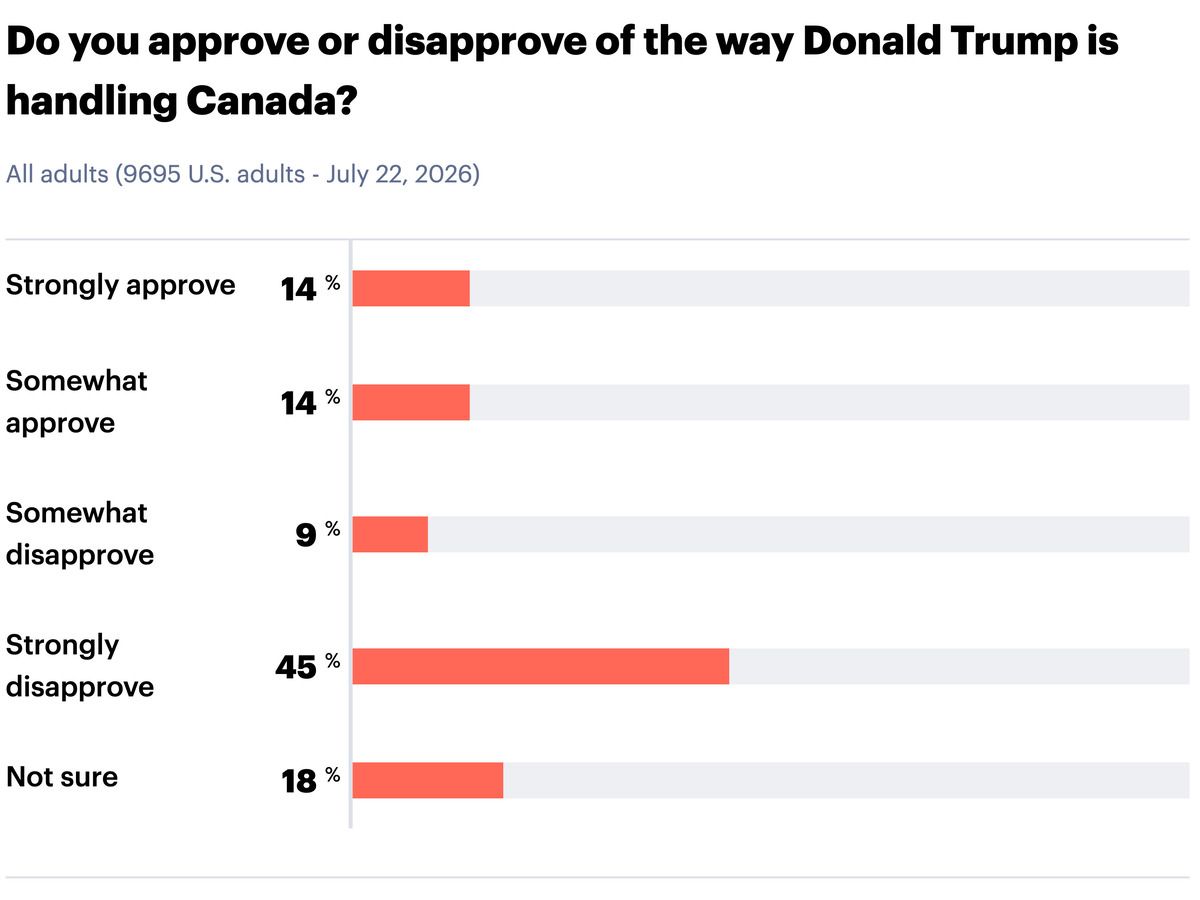
On the broader question “Do you approve or disapprove of the way Donald Trump is handling Canada?” A majority at 45 per cent registered strong disapproval and nine per cent said they somewhat disapproved, while 28 per cent chose strong or moderate approval.
Canada’s Angus Reid poll also asked Canadians: “How confident are you in Canada’s negotiating team, including Prime Minister Mark Carney, to deliver a good deal for Canada in its negotiations with the United States?”
It found that fully one half of Canadians are not very confident or not confident at all in the prime minister’s abilities, while 43 per cent were confident and another seven per cent couldn’t say.
These numbers have seesawed in recent polls, however. The same question in April found 51 percent confident against 42 per cent not confident. Go back to last September and those numbers were flipped. And a year ago they were neck and neck, with 46 per cent confident and 45 per cent not confident.
One other finding in the Angus Reid poll was that government trade deals are only part of the picture. An additional question asked respondents if they would buy more American goods if a trade deal made them more available. On the question of alcohol, which has been pulled from store shelves by most provincial governments, only 29 per cent said they would probably or definitely buy more if they could.
Another 19 per cent said they probably wouldn’t buy more, and a full 40 per cent said they would definitely not.
The Angus Reid poll was conducted from July 23 to July 25 and has a margin of error of plus or minus two percentage points, 19 times out of 20. The YouGov poll was conducted on July 22, and has a margin of error of about one per cent.
Our website is the place for the latest breaking news, exclusive scoops, longreads and provocative commentary. Please bookmark nationalpost.com and sign up for our newsletters here.