 BURST
BURSTLots of monopoly related news, as usual. Trump said he’ll blockade the Strait of Hormuz, a global chokepoint, American consumer sentiment dropped to a record low on a gauge that goes back to 1961, Hollywood starts opposing the Paramount-Warner deal as theaters come out in opposition, and Zohran Mamdani announced his NYC-owned grocery store in East Harlem.
Before getting to the full round-up, I want to focus on Ticketmaster/Live Nation. This week, a jury is going to hand in a verdict, perhaps as soon as tomorrow, on whether the company is an illegal monopoly. And Ticketmaster, more than any other monopolist, represents the obvious lawlessness among elites that we’ve been seeing for decades. I don’t know which way the jury will go, but to even get to a point where there might be some level of justice for a company this loathed and yet so untouchable is a big deal.
Let’s dive in.
In many ways, Ticketmaster’s rise is a good metaphor for corporate power in America. The company started out in 1976 as one of the many computerized ticketing services, just at the moment when the Chicago School antitrust world gained ascendancy. And its corporate growth mirrors changes in antitrust law.
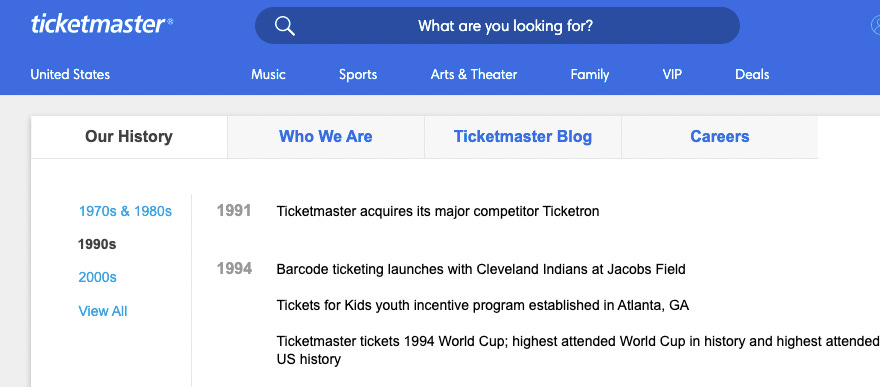
Over the next decade and a half, Ticketmaster bought up much of its competition, using mergers, pricing strategies, exclusive deals, and steering arrangements to gain control over ticketing. This roll-up strategy was so obvious that the company posted on its own website that it acquired “its major competitor Ticketron” in 1991. In a traditional legal environment, this statement would amount to a confession of violating the Clayton Act, but so feeble had enforcers become that it was merely a way to brag to investors.
While most monopolies remained unnoticed, Ticketmaster was always hated. In the 1970s, concerts were cheap venues for young people, by the 1990s they were becoming luxury events for an increasingly corporatized music industry. And this shift coincided with the rise of the ticketing giant.
Notably, in the mid-1990s, Ticketmaster fought with the band Pearl Jam over ticket prices, and Bill Clinton’s Justice Department began investigating the company. And that’s where Ticketmaster’s political savvy came into the picture. According to the American Prospect, at the behest of the company’s lobbyist Charlie Black, Republican Senator Phil Gramm threatened to kill funding for the Antitrust Division. When the investigation was dropped, funding was restored. The company’s ticketing software monopoly was safe.
In 2010, Ticketmaster faced a threat from a company called Live Nation, which was itself a roll-up of concert promotion. Live Nation was on the verge of launching its own ticketing software, until the two companies decided to merge. Live Nation/Ticketmaster would have market power over ticketing, concert promotion, and venues. It could exploit its differing lines of business by threatening to withhold talent from venues unless they used its ticketing software, or by forcing talent to use its promotional services to access venues.
Despite mass opposition in the music industry, the Obama administration, led by antitrust officials Christine Varney and Gene Kimmelman, waived through the deal, with a mild consent decree. Perhaps it helped that Rahm Emanuel was Obama’s chief of staff, and his brother Ari Emanuel served on the board of Live Nation. But once again, the story here isn’t solely about petty corruption, but a higher form of it - intellectual fraud taking over our legal environment. In 2010, the notion of “vertical integration,” or combining customers and suppliers into one firm across a supply chain, was praised as efficient, not feared as coercive. As John Malone, the financier behind the deal put it in his autobiography, “merging the largest ticket company with the largest concert promoter was an unavoidable natural evolution of business.” Most antitrust experts agreed.
After the merger, the combined company did exactly what its critics feared. It cut “off its concert tours from at least six amphitheaters that signed ticketing contracts with Live Nation’s only halfway significant rival, while simultaneously hatching an elaborate criminal conspiracy to sabotage a potential competitor by hacking into its databases to steal information.” There were many reports over the next ten years of anger in the industry, and fear.
Then came the emergence of the anti-monopoly movement, in roughly the mid-2010s. Ticketmaster was a poster child for poor Chicago School thinking, and feckless Democratic antitrust enforcement.
The first Trump administration, pressed by the new anti-monopolists, understood the problem, and reworked the consent decree. “Live Nation broke the promises they made to the court and the American people when they merged with Ticketmaster in 2010,” said Assistant Attorney General Makan Delrahim a decade later. Still, Delrahim’s approach was weak, the company continued to do whatever it wanted. And arbitration clauses prevented private antitrust cases against the firm.
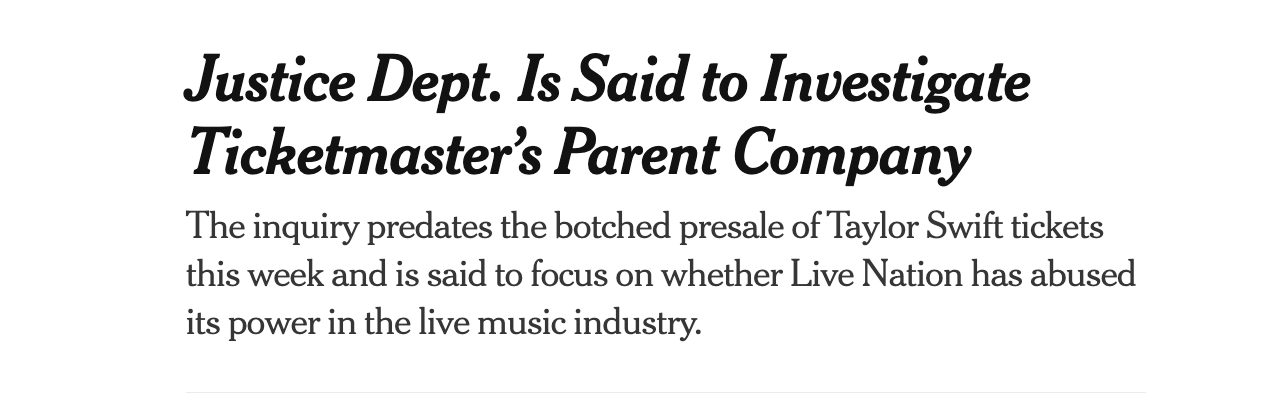
Though a frustrating monopoly, Live Nation/Ticketmaster’s existence was a useful signpost for reformers. In 2020, I co-authored a paper calling for a break-up of the company, as part of reversing the Chicago School framework. And when Biden took office and appointed Jonathan Kanter to run the Antitrust Division, the government got serious. In 2022, the company had a highly publicized disaster with the Taylor Swift Eras tour, when its technology didn’t work and millions of people felt deceived.
That was soon followed by an investigation, or rather, an investigation became publicly known.
In 2024, the Biden administration finally dropped the hammer, filing an antitrust complaint against the company, with dozens of states as co-plaintiffs. The allegation was that Live Nation/Ticketmaster used its different lines of business to coerce different players in the industry. Venues need talent, talent needs venues and concert promotion, and everyone needs ticketing software. Live Nation had such a significant share of each market that it could withhold or provide what it chose, on terms it chose.
But then Trump got elected in 2024. And antitrust law became an overt auction, where lobbyists could simply get payoffs and go over the head of the Antitrust Division to settle cases. Live Nation hired MAGA influencer Mike Davis, who had the head of the Division, Gail Slater, fired. It was also poorly litigated; Slater is not a good leader and didn’t understand how to avoid the technocratic traps laid down by Live Nation’s lawyers. But the judge, Arun Subramanian, while he dismissed some of the case on market definition grounds, still allowed it to move to trial.
The company had one more card to play. Their old friend Ari Emanuel, who had been kicked off the board of Live Nation in 2021 by the Biden administration, got Trump to settle the case in the middle of trial. Live Nation’s stock popped. It seemed to be over, the company had won, again.
And yet, there was that sticky matter of the state attorneys general, those co-plaintiffs everyone usually ignored. Still, what could they do? There were 40 DOJ Antitrust Division people working on the trial, to replace them with understudies from the states or private counsel was seen as impossible.
But the states decided not to join the settlement, and litigate it. They hired superstar lawyer Jeff Kessler and substituted in some of their own staff. The judge insisted the case move forward immediately. So while the jury remained impaneled, the quality of the lawyering from the plaintiffs was just not as good as it should have been, but the trial did in fact happen.
How did the trial go? Well, we’ve been covering it every day. Our writer, Gigi Liman, had a good summary of the closing arguments. The plaintiffs had a simple claim. Live Nation is a monopolist, and coerced customers like a monopolist. Here’s Liman:
Kessler returned repeatedly to internal company communications shown at trial, many of which discussed amphitheaters. Jurors heard phrases like “incredible moat around the castle,” “velvet hammer,” “crush the competition,” “we alone can move the market,” and “boil the frog.”
“Who talks like this?” Kessler asked. “The answer, I think you will find, is a monopolist.”
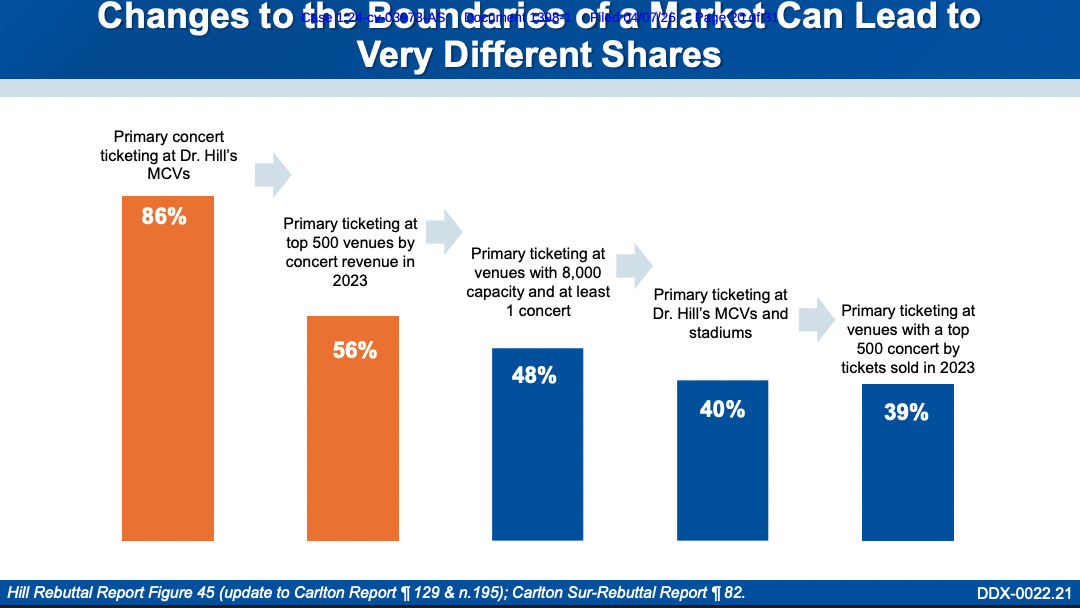
Live Nation’s defense was technocratic. The company isn’t a monopoly, so went the argument, because the plaintiffs concocted an artificial boundary for what makes a market. Here’s a slide Live Nation presented that sums up their side.
The trial ended last Thursday, and the jury began deliberating on Friday and will continue this coming week. It’s been six weeks, and these jurors are ready for it to end.
So what does the jury think? Well they chose a foreperson, and asked a bunch of questions, “ranging from expert testimony to guidance on interpreting the definition of relevant antitrust markets.”
They clearly don’t like Live Nation, but the questions they are asking suggest they are taking the company’s arguments about market definition seriously.
So that’s where we are. I can see it going either way. This case was not litigated particularly well, but after decades, we are finally going to get some sort of legal judgment on a widely disliked company - Ticketmaster.
Moreover, the states are now central players in law enforcement against corporate misconduct, taking over from a Federal government that just doesn’t uphold the law anymore. We will see more of this dynamic going forward, especially in politically charged cases like the Paramount-Warner merger, which is about the consolidation of Hollywood. In previous years, it would seem to be impossible to do something in antitrust against the wishes of the Federal government. But then, a jury is deliberating about Ticketmaster’s monopoly, and that was never supposed to happen.
Restoring justice isn’t a light switch, it’s a muscle. And finally, we are exercising it again.
And now, the rest of the monopoly round-up. Lots of good stories. Hollywood is actually doing well, finally, and starting to wake up politically to the perils of consolidation. Anthropic introduced a new AI model, ‘Mythos,’ but it’s so awesome and super secret and dangerous. Or maybe it’s a cynical sales pitch. John Deere settled with farmers in an antitrust case around right-to-repair, and the government is investigating the NFL for antitrust violations over high streaming prices.
Read on for those stories and more.