 BURST
BURST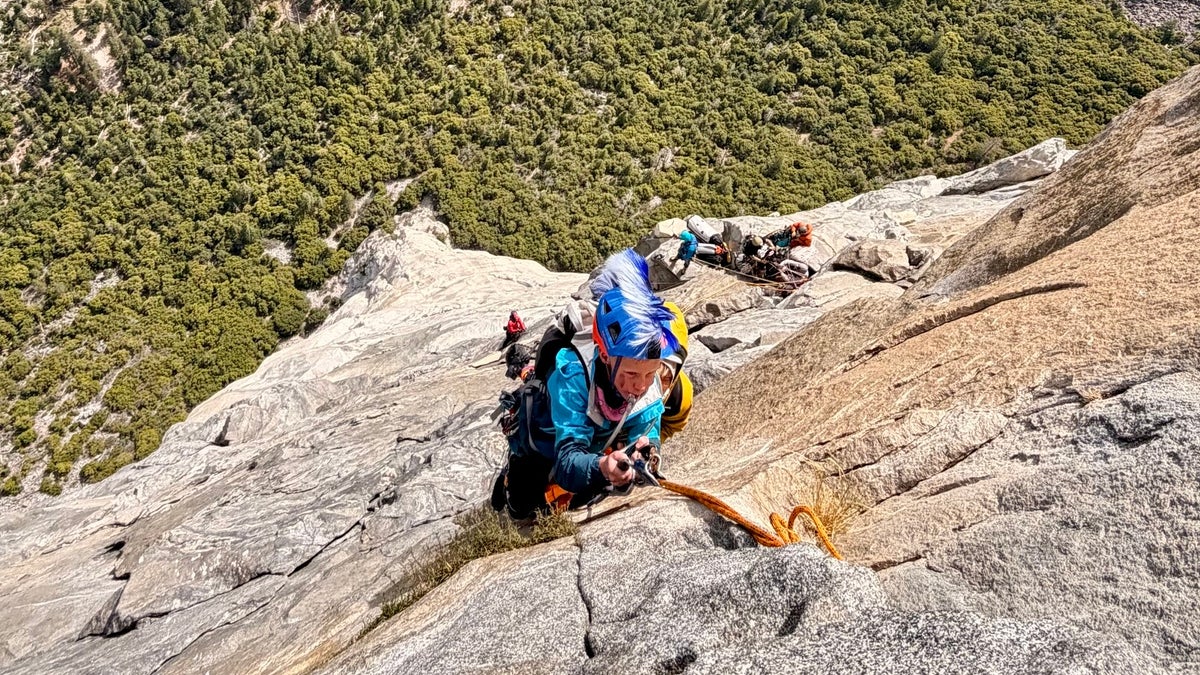
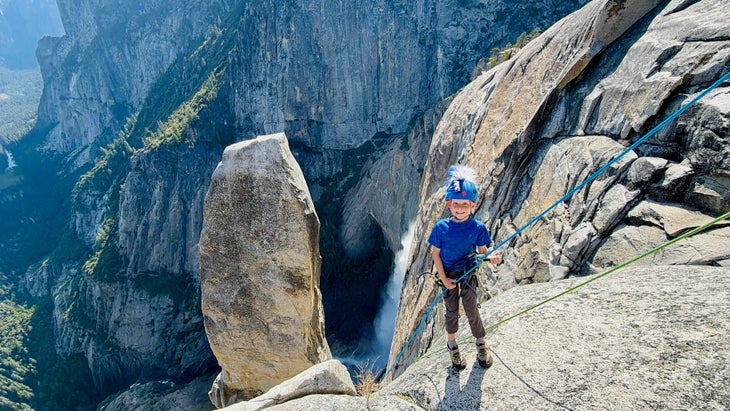
By now you’ve surely seen the headlines: On May 22, a seven-year-old boy made it to the top of El Capitan in Yosemite. In the past week, various news outlets, including People and FOX, have reported on Joey Danger Evermore, who spent five days jugging up El Cap alongside his dad, Joe, and his 11-year-old brother, Sylvan. When the group summited the Nose (5.9 C2; 3,000ft) around 1 a.m. that Friday, Joey became the youngest person in history to ascend El Cap—breaking a record set by eight-year-old Jackson Houlding in November 2024, after he jugged the Muir Wall (5.10 C3; 2,900ft) with his parents and siblings. On May 23, the most-watched newscast in the world, ABC World News with David Muir, dedicated its kicker segment to Joey.
“I’m going to the moon!” shouted Joey on camera, pushing off from the wall.
Typically, when climbing records are broken, Climbing reporters like me are quick to celebrate and share the details. But this one felt different. From my view in Yosemite, where I’m based for the season, most of the climbers I know regard the ascent—and specifically the dad in the equation—with dismissal or disdain.
Soon I heard the rumors: “It’s all for publicity.” “It’s such a junk show.” “The kids were crying the whole time.” “The dad’s got this weird, conservative agenda.” Climbers accused Joe Evermore of various crimes: hiring illegal and unqualified guides, getting in the way of a search and rescue operation, dragging up children who didn’t want to be there. Over breakfast tables and birthday dinners, I watched my friends and former colleagues debate whether the seven-year-old deserved to say he’d “climbed” El Cap: After all, neither he nor his dad led or even cleaned any of the pitches. Yet while many members of the climbing community condemned the Evermores, the world of non-climbers could not stop celebrating.
To suss out some truth from these clashing versions of the story, I spoke with Joe Evermore himself, one of his hired guides (who agreed to be interviewed in exchange for anonymity), the director of the Yosemite Mountaineering School, and two Yosemite Search and Rescue (YOSAR) members who encountered the Evermores at the summit. What I found was a complicated picture of media, climbing achievement, and parenting—and a much bigger story than what’s been told.
Kids on El Cap
Joe Evermore is not the first person to decide that a child is ready to shuffle-crunch their body up a thousand-foot mound of granite. In 1987, Mike Caldwell brought his son, Tommy Caldwell, up Lost Arrow Spire (1,400ft) at just six years old. Brands often tout Tommy’s early experience as foreshadowing for his legendary career in Yosemite big wall climbing.
Yet for most “El Cap kids,” jugging lines at younger and younger ages does not necessarily make them Caldwell-esque prodigies. In 2001, the now-grown Tommy joined Beth Rodden, Steve Schneider, and Hans Florine in fixing lines on the Nose for 11-year-old Scott Cory to jug over three days. Later, in 2012, big wall aficionado Andy Kirkpatrick climbed Tangerine Trip (5.7 A3; 2,300ft), another El Cap classic, fixing lines for his 13-year-old daughter, Ella Kirkpatrick. Seven years later, in June 2019, longtime American Mountain Guide Association (AMGA)-certified guide Mike Schneiter brought his 10-year-old daughter, Selah Schneiter, up the Nose to take the official “youngest rope ascent” record on the mountain. That autumn, the record fell to nine-year-old Pearl Johnson, who jugged up Triple Direct with her mother, Janet Johnson, and YOSAR’s own Nick Sullens. Neither Scott, Ella, Selah, nor Pearl are household “pro climber” names today.
Then there were the Hersons. In contrast to other parents, Jim and Anne Herson encouraged their offspring to actually climb the routes as much as possible, whether on toprope or lead. At age five, Connor Herson followed Snake Dike (5.7; 900ft) on Half Dome, while his sister Kara Herson completed a jumar-less NIAD (Nose In a Day) at just 14 years old. When he was 15, Connor became the youngest person ever to free the Nose (5.14a; 3,000ft), the first of his many historic climbs.
But unlike the parents before him, when Joe Evermore decided to train his children to jug El Cap, he had not yet climbed it successfully himself. In his twenties, Joe tried at least twice to aid Triple Direct (5.9 C2; 3,200ft) on El Cap and also attempted to aid up the West Face (5.7 C2; 1,000ft) of Leaning Tower. Each time, he ended up bailing.
“I’m not super stoked on my record, to be honest, of failed big walls,” he admitted, in a video interview from his home in Colorado Springs. “I didn’t have the right team.”
In late October 2022, Joe, his oldest son, Sam Adventure Evermore, and a camera crew jugged behind aid climbers on a shortened variation to Triple Direct. In order to skip the first 10 pitches of the route, they started atop fixed lines on Mammoth Terrace. To make hauling easier, the Evermores arranged for friends to rappel in from the top and leave extra food and water at two different bivy spots. Joe nicknamed his son the “El Cap Kid” and posted dozens of photos of their time on the wall. When Sam reached the summit, at eight years old, he became the youngest child to jug the 3,000-foot monolith.
From there, Joe launched his son into a press tour, including appearances on Good Morning America, CNN, and various local news stations. “This ascent gained international attention,” Joe wrote on the Instagram account named for Sam in the caption for a year-old video of Sam flaking a rope at the base of the mountain. “Over 1,600 news outlets picked it up.” The preteen appeared on international broadcasts and in several short documentaries. The family began selling merch emblazoned with “Adventure is My Middle Name.” They formed brand sponsorships over Instagram, posting constant throwbacks to the ascent. At one point, they informed the public that Sam was available for speaking gigs, and some voices in the climbing community began to criticize the ascent. “How could you possibly believe that your child, at that age, is the one who’s motivating this and not you?” said Chris Kalous on The Runout podcast. “It just all adds up to ick.”
Last fall, Joe repeated the El Cap jugging experience with his second son, Sylvan Lightyear, who was also eight years old at the time. At this point, their style of claiming highly publicized records based on jugging alone provoked more backlash from climbing’s biggest heroes. Tommy Caldwell told the San Francisco Chronicle that he found the Evermores’ ascent “slightly cringeworthy.” Longtime El Cap photographer Tom Evans had harsher words. “I see that the same people who perpetrated the scam of having a child supposedly ‘climb El Cap’ are back at it again,” Evans wrote on Facebook, where, until late 2023, he published his sporadic El Cap Report. “The brother of the child who was dragged up by guides a few years ago is now to be dragged up like his brother was … Ascending ropes hung by guides is not ‘rock climbing.’ It is rope climbing and not in any way a climb of El Cap.” (Evermore confirmed to Climbing that his children were never hauled up the routes.)
But the backlash did not deter Joe from preparing his third son, Joey, to break the “youngest ascent” record once more—and this time, he started the preparation at age five. “It’s really hard to teach a five-year-old how to jug,” Joe said. “When I worked with Joey, he would hold the ascender and I would tape it to his shoes, and then together we’d march around the house. That was how he began to get his coordination to a place where he could then jug a line … You only have a limited time to teach these handful of skills if you’re going to try to do it when they’re younger.”
When I asked why there was a time limit to learn jugging, Joe responded, “Joey’s had two older brothers who have set a bunch of records.” Beyond climbing El Cap and other mountains, such as the Matterhorn, Sam has also experienced success in USA Climbing youth competitions. “Joey saw [Sam] get all these accolades,” Joe explains. “He’s seen all of that, and now he wants to follow Sylvan and Sam.”
I understood what he was implying. If Joey waited too long, he’d lose the chance to become a record-breaker, too.
Inside Joey Danger Evermore’s ascent
One of the strangest parts of the Evermores’ recent El Cap ascent is the fact that two-thirds of their team—the ones who actually led pitches, fixed lines, and hauled the bags—have been scrubbed from any mention in social or traditional media. They’re not acknowledged in the headlines, captions, or photos. In fact, not a single one of the Evermores’ Instagram posts about Joey’s ascent, including the final summit photo, mentions their existence.
The obvious reason for erasing them is that Joe hired at least some of his team illegally, as neither party wants prosecution to ensue. In Yosemite, the only people who can be legally paid for climbing services are AMGA-certified guides from the Yosemite Mountaineering School (YMS), who possess insurance and a commercial use license within the park. Sometimes, Yosemite climbing rangers turn a blind eye to dirtbags taking paid gigs, like portering water to the base of routes or bringing a haul bag off the summit, because they are discreet and victimless. A highly publicized ascent, however, invites more scrutiny.
“I did look into that,” says Joe of hiring a certified YMS guide to lead him and his sons up El Cap. “That was never going to happen. If you do hire a guide, everybody has to be on belay, even when they’re jugging, so it’s a very complex, cumbersome process … I talked to YMS about it; they told me that if I sent them an email last November, they’d reply in February. And then they began to tell us it was likely just never going to happen. I just felt like that was not going to work for us, so I put together my own people, friends and family.”
YMS director Josh Helling declined to speak in detail on communication between the organization and the Evermores, but he did confirm that YMS guides were not involved in the Evermore family ascent. He also confirmed the school’s standard policy for El Cap clients to remain on a backup belay while jugging. “We always have a second rope in case an edge cuts a rope,” he said. Helling added that any YMS guide who takes clients up El Cap not only must be a fully certified AMGA Rock Guide, but also an experienced El Cap climber. “El Cap is complicated,” he said. “A lot can happen up there.”
For Joey’s ascent, the full team consisted of nine people: Joe, his two sons, a pair of experienced “rope guns” who led every pitch, one dedicated cameraman, a chief hauler, and two friends who helped with both shooting and hauling. Unlike Andy Kirkpatrick and the other parents who’d brought their children up the wall, Joe did not fix lines or haul any loads himself; he never wanted to leave Joey without direct supervision.
When I spoke with Joe, he originally listed eight people in the group. Then I counted them out, and he agreed that there were nine. This was a problem: Having nine people invalidated his wilderness permit and made his documentary footage unlicensed. A single wilderness climbing permit only covers eight people for overnight camping on Yosemite big walls. In addition, any filming conducted in a group larger than eight requires applying for a commercial filming permit from NPS. When I advised him to look into this, he asked me for the website with the rules.
One pirate guide’s side of the story
Paul Smith (a fake name), who spoke to Climbing under the condition of anonymity, made $4,000 over five days as one of the “pirate” laborers that Joe hired. A relatively new dirtbag to the Valley, Paul came to the fixed lines on Heart Ledges to practice jugging on Sunday, May 17. There he got recruited to haul a few bags up to Mammoth Terraces for the group. He’d never hauled in real life before, but he managed to get the bags up.
“That was a day of work,” he said. “I thought I would never talk to these people again.”
However, when he ran into the family the next day, Joe asked Paul how much it would cost for him to join them on the rest of the mountain.
“I threw out some ridiculous number: $800 a day,” said Paul. “He goes, ‘Yeah, sure.’ Then I had this ‘Oh, shit,’ moment where I had to figure out how to actually make this happen.”
Paul cancelled his plans and joined the team to haul the Evermores’ bags up the mountain. He’d never done a big wall before, let alone El Cap, but he knew how to 1-to-1 haul from videos he’d watched online. For those unfamiliar, 1-to-1 hauling is a simple technique reserved for the lightest loads. It can be downright miserable if the haul bag’s weight exceeds your body weight, as it requires enormous force to push yourself off the wall. To support the Evermores, Paul 1-to-1 hauled up to 300 pounds at a time, starting with two hauls per pitch and later condensing to one. During the ascent, another member of the team tried to teach him an easier technique—the 2-to-1 haul—but he didn’t want to experiment so far off the ground. “I was scared trying to learn that on the wall,” he admitted. A mistake could mean dropping the bags and potentially killing someone below.
“The fact that this team was able to summit in the first place is a miracle,” he said. “All the cards were against them … At least one of [the children] cried on every single pitch. The kids obviously have intrinsic motivation to be on this wall, but they’re kids. Their blood sugar starts crashing even the slightest, they’re going to freeze up and cry.”
The kids’ physical capabilities, Paul said, were sufficient: “Joey and Sylvan can both get their jugs on a fixed line with a Micro Traxion backup. When they’re not crying, they can jug with relative efficiency.” But where Paul grew most frustrated was with Joe’s requests. “Every day at camp, there was always at least an hour-long photo shoot of these kids on a ledge,” he said. “[Joe] made me wait almost two hours to take down one of the ledges because he wanted to get shots of the kids playing around on them, playing checkers … They had all these little props to get a perfect Instagram moment.”
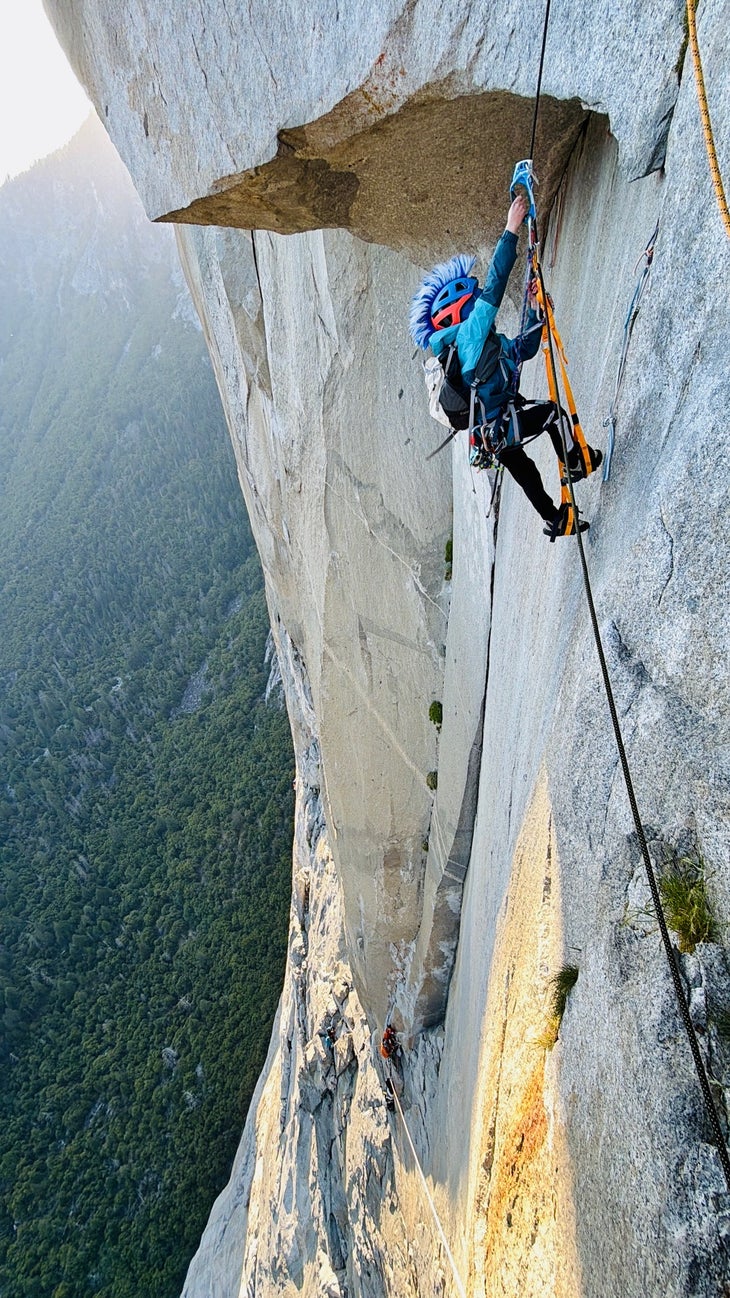
At one point, while hauling the bags in the dark to their fourth bivy spot at Camp 5, Paul finally snapped. “They had all been up there for almost an hour,” he said, “and they were asking for layers and food and different camp supplies. I was just trying to get the bags secured. At one point I had taken a tumble; I was moving around on the ledge and my foot slipped. I fell upside down—that shook things up a bit. I was a little frazzled. I said, ‘You guys have to start taking this shit seriously. We’re on a fucking mountain.’ Then I saw the red light in my face from the camera. I was like ‘Turn that goddamn camera off. You guys are making a mockery of this shit.’ Nobody had anything to say after that, but it didn’t change anything.”
The next day, the team moved out of Camp 5. At some point, Joey’s helmet had come unbuckled, and when he started jugging, it flopped off behind him, falling 2,500 feet to the ground. “It went right past my head,” said Paul. “As soon as that happened, Joe’s first thought was, ‘Shit. The media’s going to chew us up. Better find this kid a helmet.” For the rest of the climb, according to Paul, Joe traded helmets with one of the cameramen, making sure to wear it when he was in the shot.
The fifth and final night did not go as planned. From the summit, Yosemite Search and Rescue (YOSAR) had begun a lifesaving operation that involved lowering ropes down the mountain; they ordered all nearby parties to halt their progress. The Evermores were one pitch from the top, shivering on a sloping ledge. After a brief debate, YOSAR temporarily paused their operation to let the children jug the final pitch; they were crying and could not withstand the cold for much longer.
“It was a risk,” said Ben Sotero, one of the YOSAR members who participated in the rescue. “There was something to be said about leaving kids dangling on the side of El Cap at 2 a.m. on a cold night. They were dehydrated, hungry, and tired.” Another YOSAR member, Ryan Doherty, said he gave his R1 jacket to one of the kids, who were separated from their bags. YOSAR also shared their own food and sleeping bags with the children.
Two pitches below, Paul waited until YOSAR completed their operation and gave him the go-ahead to proceed. At the summit he found Joe Evermore and his sons sound asleep. Late into the night, Paul continued to haul their bags, dragging them over the final gully until he could lean them against the tree that marked the end of the Nose. At 5:30 a.m., as sunlight burst over the horizon, he finally walked over to a flat spot and closed his eyes.
When I came down from my first Nose ascent, I remember floating around the Valley, buoyed by euphoria. My two teammates and I had climbed a 3,000-foot cliff; we’d done the impossible thing. We were bonded forever by the Stove Legs, the King Swing, the Great Roof—all of these Nose pitches we’d navigated in turns and hauled together, working beyond the point of exhaustion to give each other a few more moments to breathe.
When Paul was finished relaying his story to me, he sat alone in a cafeteria chair with his head in his hands. He’d gotten paid and could now continue to dirtbag in the Valley for longer than he’d originally planned. Yet it came at a price. “I’m definitely sick of the stuff I’m seeing on mainstream news,” he said finally. “Nobody knows what has to go on in the back end to make jugging happen.”
Climbing, parenthood, and asterisks
During our interview, Joe Evermore acknowledged that he and his family face criticism from the climbing community. “I imagine this piece will be a bit controversial,” he told me. “I’ve watched the venom and anger with people online.” After Sam’s original El Cap ascent, he said the mainstream media often misquoted him, implying that Sam aided, free climbed, or even free soloed El Cap. “I’ve never once said that Sam was doing something anywhere near the level of unbelievable climbers that are freeing El Cap routes,” he said. “And I’ve always said that, but it’s not always gotten through.”
I’ve covered enough climbing news to understand how inaccurate some mainstream outlets can be. ABC’s May 22 article about Joey’s El Cap ascent, for example, lists El Cap’s elevation (7,573 feet) instead of its base-to-summit height (3,000ft), describes the difficulty of the El Cap hiking trail (which they did not take), and labels a photo of Lost Arrow Spire (an unrelated formation) as El Capitan. That’s not Joe’s fault. But from the beginning, Joe’s decision to hire illegal guides and porters for an ascent that he intentionally publicized set him up to tell a dishonest story—one in which a father shows his sons what it’s like to take on big objectives, lead, fix lines, haul, manage risk because they’re watching their father do it. It’s not necessary to say that they climbed the big wall themselves; removing their six team members from the narrative implies that no one else could have.
Over the next year, assuming they can resolve permitting issues with the NPS, the Evermores will oversee post-production for a feature-length documentary centered around their “adventurous” parenting and their boys’ outdoor accomplishments. “This isn’t just about adventure,” their fundraising website says. “It’s about restoring what our culture has lost: real fathers raising real men.” To date, the project has raised more than $450,000.
The challenge of parenthood—of how to raise a young adventurer—is certainly one worthy of study. In a powerful 2024 essay for Outside, climber and father Daniel Duane reflected on the ethical decisions that tormented him while climbing in Yosemite with his 14-year-old daughter, Hannah. At one point, Duane’s friend, the climbing legend Steve Schneider, offered to take Hannah up the Washington Column for her first big wall. She wasn’t ready to lead the pitches herself, but she could jug the fixed lines set by Schneider and still get the experience of reaching the top, just like the Evermore children did on El Cap. Should Duane allow that?
He agonized over it for months. “[M]y father taught me to climb in a methodical progression from easier routes through steadily harder ones over many years,” Duane wrote. “It was slow and I was no wunderkind, but every rung of that ladder felt precious precisely because I’d earned it and owned it. Every big climb I ever did—Washington Column included—I did as an equal partner of a team … Hannah and I were not yet ready for Washington Column, but if we kept plugging away at our current rate of progression—if we kept following the Path of the Yosemite Climber, as I understood it—we could be ready within a season. If we skipped all these intermediate steps and went up on Washington Column with Schneider, we would be grabbing a brass ring that wasn’t rightfully ours yet … if Hannah came home afterward and said, ‘Yeah, I did a big wall,’ she would be, in my view, the privileged kid who doesn’t realize that Daddy just gifted her an accomplishment.”
In the end, Duane politely declined Schneider’s offer. Hannah would wait a little longer to build up the skills she needed to climb the Column. But once she did, it would be as a climber who understood the price of the summit—and who made it happen herself.
The post The True Story Behind the “El Cap Kindergartener” Ascent appeared first on Climbing.