BURST
BURST
War was looming in Europe on March 20, 1938. So evangelist Aimee Semple McPherson warned her Vancouver followers that the final battle between God and the forces of evil might be nigh.
“Armageddon is already casting its shadow across the world,” McPherson said in a Vancouver Sun story. “A world struggle will soon be here that will make all previous wars look like a 10-cent show of fireworks. This is the final hush before the storm.”
McPherson was speaking at the Foursquare Gospel Tabernacle at 450 Kingsway, the Vancouver “lighthouse” of her religious empire in the 1920s and 30s.
Some 3,000 true believers turned up to see McPherson, who was born in Canada but was based in Los Angeles, where she had founded the International Church of the Foursquare Gospel and built the 5,000-seat Angelis Temple.
The Sun estimated several hundred more people couldn’t get in to see McPherson, a spellbinding orator who rose to fame as a faith healer in revival meetings.
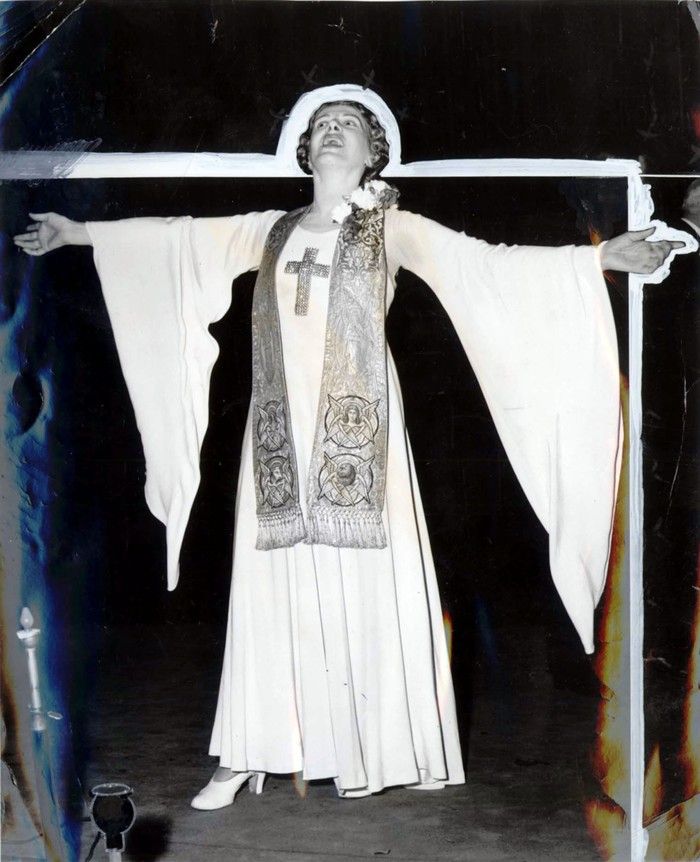
“Clad in white satin, and outlined by a spotlight, the golden-haired evangelist spoke with youthful fire and vigor,” said the Sun, noting McPherson “held aloft her famous white leather bible” as she spoke.
“We have only a short time left to carry out the work of Salvation before the final prophecies of Revelations are fulfilled,” warned McPherson.
“(But) there is no need to fear such men as Hitler or Mussolini, whose life is only in their nostrils.”
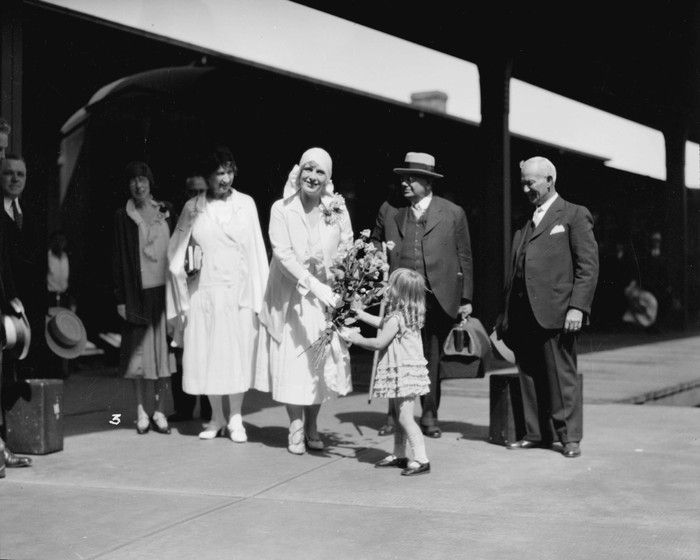
The Second World War didn’t mark the end of the world, but it did cause some trouble for McPherson. She cancelled a Vancouver visit in July, 1940, because of “immigration regulations,” which seems odd, given that she was born in Ontario.
Province writer James Butterfield offered another theory for McPherson’s 1940 cancellation. Canada had introduced limits on currency being exported to the U.S., which meant any money she collected in Vancouver couldn’t go back with her to California.
“By a peculiar coincidence, the lady devil-dodger cancelled her visit,” wrote Butterfield, who dubbed McPherson’s performances “spiritual vaudeville.”
Journalists had long been skeptical of McPherson, particularly after she vanished on May 18, 1926, and was presumed to have drowned in the ocean off Venice, California.
But there was an alternative theory.
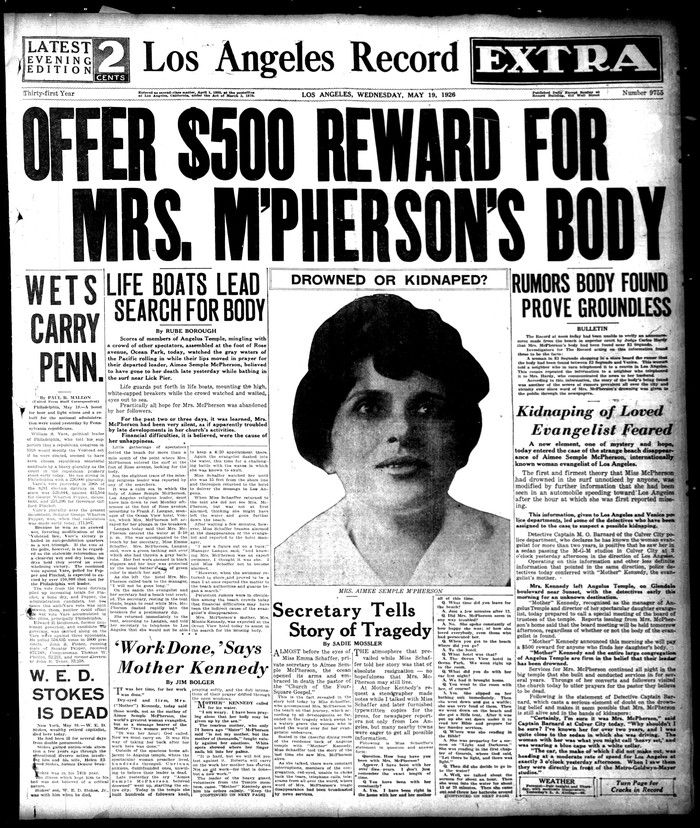
“DROWNED OR KIDNAPPED?” read a headline over a giant photo of McPherson in an “EXTRA” edition of the May 19, 1926 Los Angeles Record. “OFFER $500 REWARD FOR MRS. MCPHERSON’S BODY.”
Her disappearance brought thousands of her followers out to the beach, and lots of newspaper stories speculating what had happened.
The Los Angeles Record ran an interview with a woman who saw McPherson talking to “a young man, about 35, good-looking and dressed in gray” shortly before she went into the ocean.
It also had a “Kidnapping Feared” story that said McPherson “had been seen in an automobile speeding towards Los Angeles after the hour at which she was first reported missing.”
The mystery got weirder on June 23, 1926, when McPherson “staggered” in a “semi-conscious state” into Agua Prieta, Mexico, just across the border from Douglas, Arizona.
A story by The Associated Press said that McPherson was found “quivering with exhaustion, with her hair shorn, bedraggled and covered with mud.”
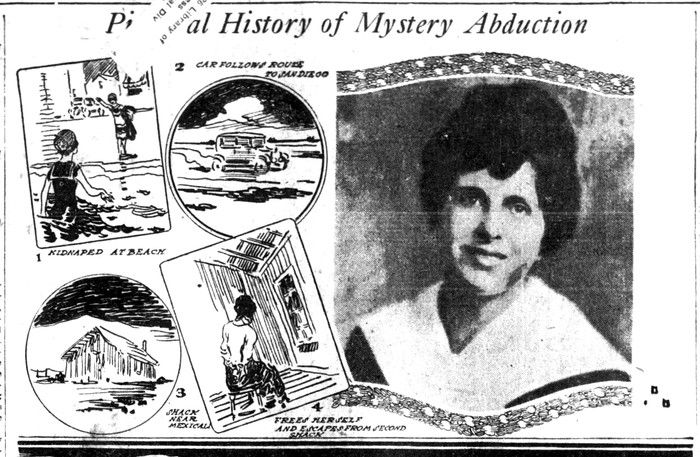
She claimed she had been kidnapped from the beach, thrown into a car and drugged by two men and two women. She stated she was held in a small shack in Mexico for a $500,000 ransom and was tortured, but escaped and made her way to Agua Prieta.
It was a sensational story, but many people didn’t believe it. A conflicting story emerged that she had been holed up in a love nest in Carmel, California, with Kenneth Ormiston, a married man who operated McPherson’s Christian radio station in Los Angeles.
Aimee and Ormiston denied it, but the press turned against her.
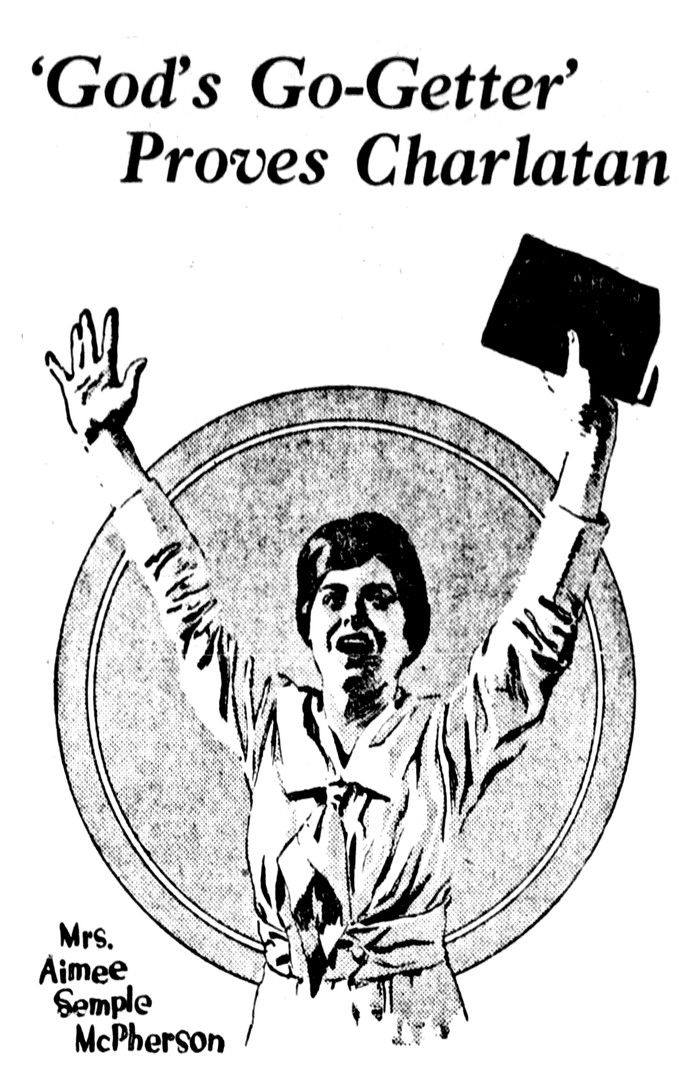
“God’s Go-Getter Proves Charlatan” said the headline of a Vancouver Sun story on Sept. 28, 1926. But even the Sun’s “special correspondent” admitted McPherson had “so much personality and appeal” that “you find yourself, against your better judgement, trying to plan ways to bolster up her hoax-defense.”
McPherson died in 1944, just shy of her 54th birthday. She never recanted her version of the kidnapping story.
Related