 BURST
About our reporting: Senior Editor Anthony Walsh interviewed two members of Robson Valley Search and Rescue and spoke with a climber who was below the wall during the first rescue attempt. He also drew upon his own experience climbing on the Emperor Face.
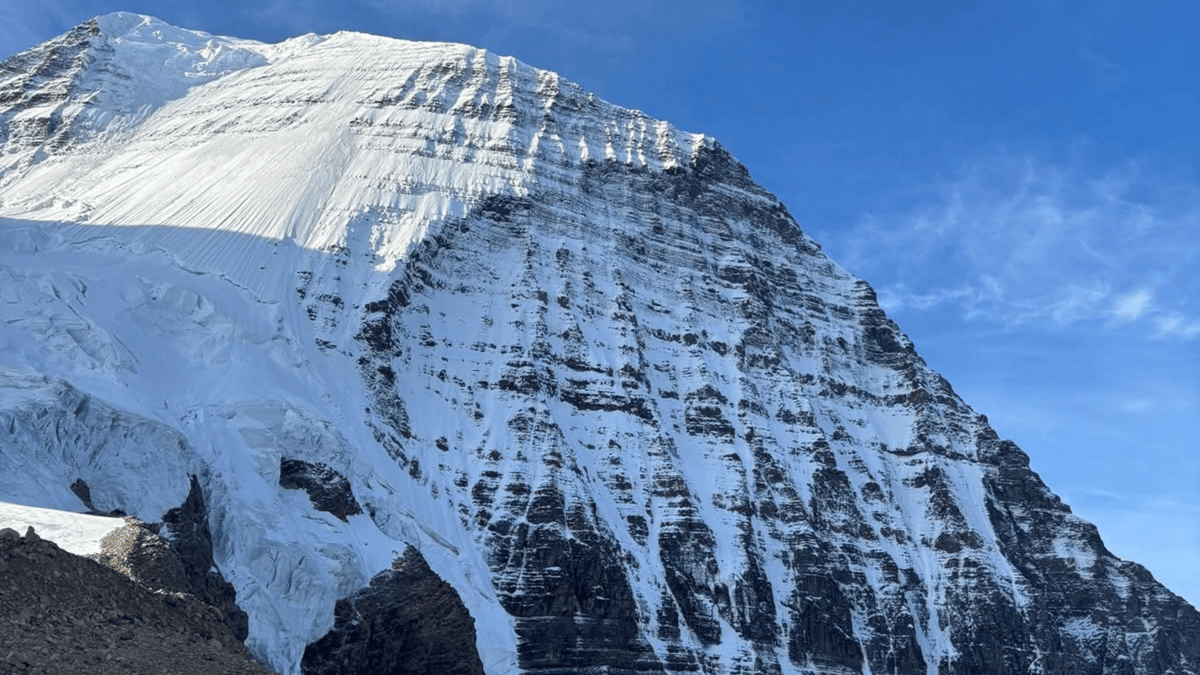
As the sun set behind Mount Robson, the tallest mountain in the Canadian Rockies, two climbers high on its steepest wall knew they were in trouble. The pair had climbed approximately 5,000 feet off the valley floor that morning via the legendary route Infinite Patience (WI5 M5; 7,500ft), getting soaked to the bone in the process.
It was September 18. That time of year, the area surrounding Mount Robson (3,954m/12,972 ft) was a land of extremes. If you were standing at the foot of the mountain by its paved, south-facing trailhead, you might be comfortable in a tank top and flip flops. But thousands of feet higher and due northwest, the mountain’s famed Emperor Face is an entirely different beast. Tendrils of freshly formed ice dress this testpiece of North American alpinism. Higher, deep snow blankets the summit ridge.
It was somewhere between these two realities that the Infinite Patience climbers found themselves stuck. They’d started up the route in cold, frozen conditions, likely pre-dawn and with a headlamp. But as the day warmed, and the sun eventually swung around to hit the face, climbing conditions nosedived into a sloppy mess of isothermal snow and running water.
I know those conditions well. I have attempted Infinite Patience twice and have watched the face morph from a frozen dream to a slushy, rockfall-ridden nightmare in less than an hour from the time the sun hits. It’s an easy place to be caught out.
Multiple attempts to rescue climbers from Mount Robson
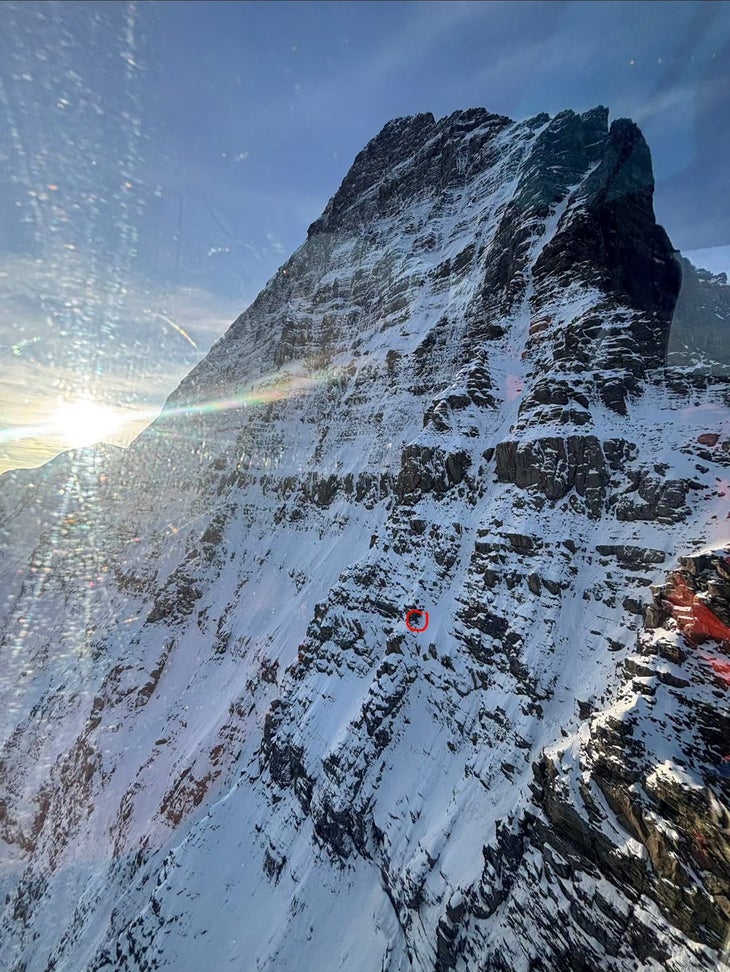
Jeff McNaughton, a search manager of the Robson Valley Search and Rescue team, received the climbers’ inReach SOS call around sunset on September 18. Seated on a narrow snow ledge at 10,700 feet, the climbers described themselves as “hypothermic” and unable to safely descend. McNaughton, clocking the rapidly cooling temperatures likely happening high on the mountain, realized they might not survive the night.
Robson Valley SAR typically works with the nearby Jasper National Park Visitor Safety team for long-line helicopter rescues, but neither team has the ability to fly helicopters at night. Given the perceived immediacy of this call, Visitor Safety got in touch with a branch of the Canadian military with access to after-dark equipment to ask for an assist.
The helicopter that arrived—a behemoth, three-engined CH-149 Cormorant—was not the tool for the job. This long-range beast can carry five-and-a-half tons of cargo but does not do well in the mountains. “That helicopter has a ceiling of about 10,000 feet,” McNaughton told me. Although the military knew the climbers were stuck quite a bit higher, at 10,700 feet, the pilot felt obligated to at least try to rescue them.
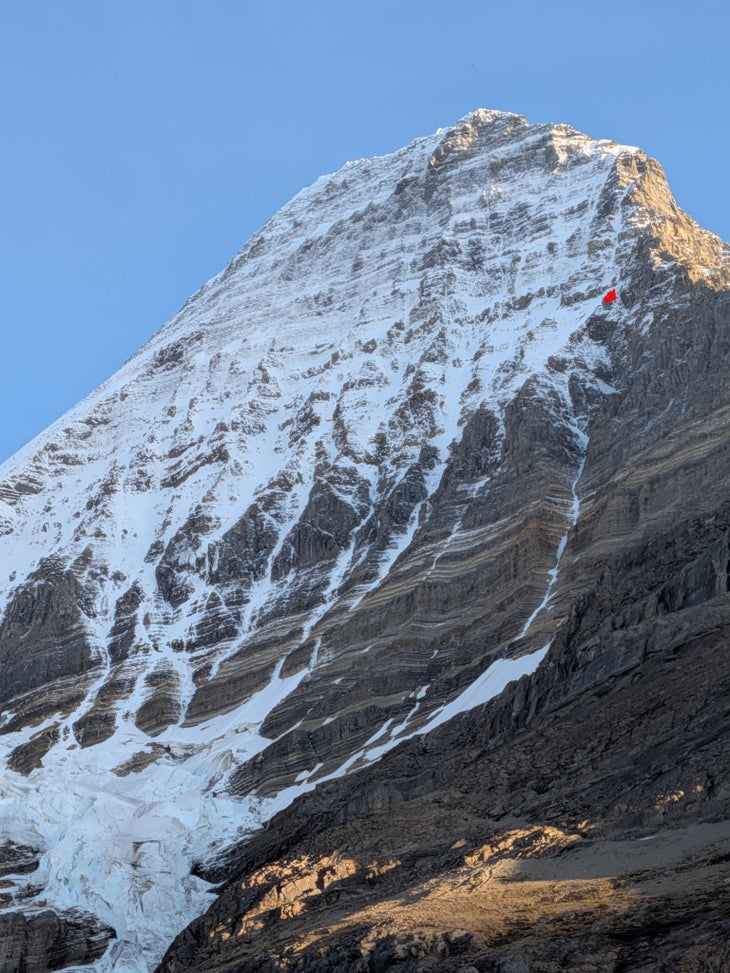
Ian Welsted, a professional mountain guide and Climbing contributor, happened to be camped below the Emperor Face that night. He and a friend planned to start up Infinite Patience the following day as preparation for an upcoming expedition to Nepal.
But as the sky turned black and the stars came out, he heard the distinct whump whump whump of an approaching helicopter. “It was crazy to watch,” Welsted texted me two days later. The helicopter circled below the climbers with a giant spotlight, illuminating thousands of square feet. Far below, Welsted watched the rescuers eventually turn away from the Emperor Face and fly back to the road, having not gained enough altitude to reach them. “They couldn’t pull it off,” he said.
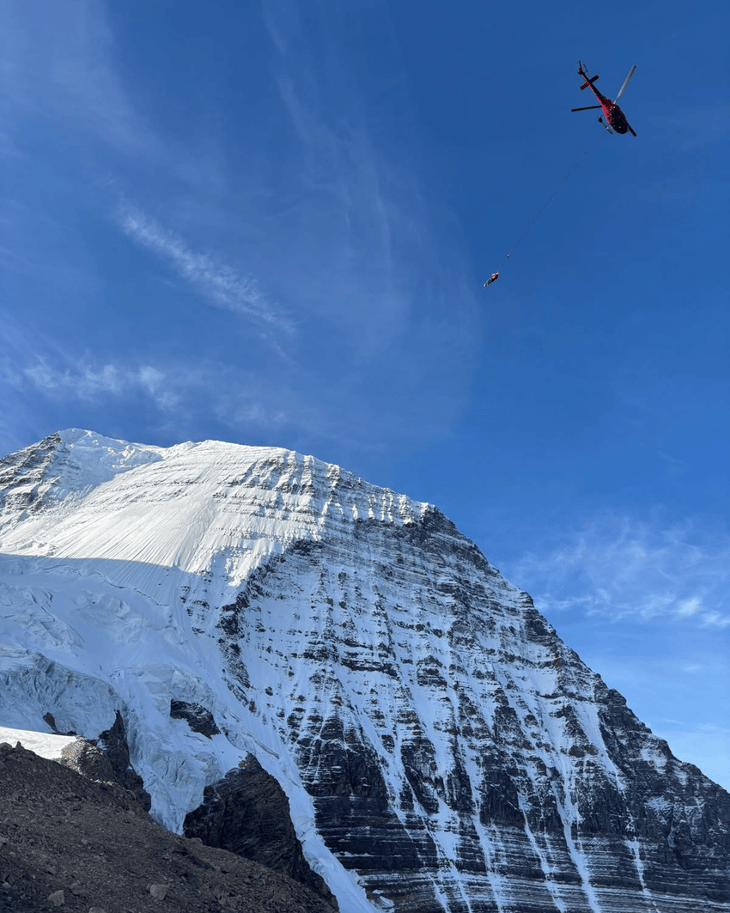
The following day, the Visitor Safety team was ready to fly at first light. Their lighter, altitude-worthy helicopter circled the face, with one rescuer dangling from a rope to make contact with the cold-stricken climbers. In an impressive display of skill and bravery, rescuers successfully long-lined both climbers off the Emperor Face and deposited them at the trailhead, where an ambulance waited.
Dale Mason, who also works with Robson Valley SAR as a search manager, spoke with the climbers when they landed. Despite the “hypothermic” report from the previous night, the climbers were healthy and in good condition. The ambulance drove away without them. “They were fine,” Mason told me. “They didn’t get too cold overnight… No frostbite.” It was the best-case scenario—but one that left me with a question.
Why did the Emperor Face climbers need a rescue in the first place?
Throughout my reporting, speaking with two SAR managers, a representative from Parks Canada, a Royal Canadian Mounted Police officer, climbers on the ground, and all the many branches of the local grapevine, I asked each person one simple question: Rather than calling for a rescue, why didn’t these climbers descend by their own means?
No one was able to give me a straight answer.
McNaughton, recalling that initial SOS message he received, said the climbers appeared to be too incapacitated by the cold to consider descending thousands of feet of technical terrain. I asked him if the climbers had brought along any equipment for an overnight—even the fittest climbers in North America have all taken some sort of stove or bivouac system up the Emperor Face. (The face has never been climbed trailhead-to-trailhead in a push; most expert alpinists require three or four days roundtrip.) He thought that they did, but, evidently, the equipment they had was perceived as not enough to survive the night.
That’s the lesson—however obvious—all climbers should take away from this accident: Always bring enough equipment to survive the night. And though it feels silly to provide a top tip for climbing one of the hardest alpine walls in North America, evidently it bears saying that, if you’re climbing a snowy alpine route in September, expect to get wet. Have a system to dry yourself out.
Speaking from my own experience on the Emperor Face, it’s also worth noting that bailing from high on Infinite Patience is extremely difficult. The limestone, like most of the rock in the range, is shattered and hard to protect. Solid anchors up there can require anywhere from two to 10 pieces of protection. On a testpiece like Infinite Patience, where few fixed anchors exist, good luck descending 5,000 feet with only a light climbing rack.
What all climbers can learn from this rescue
McNaughton emphasized how much Mount Robson has changed in the last decade. The glaciers are smaller and more broken. What was once year-round ice has melted, exposing exceptionally loose stone. The rocks themselves are more precarious due to melting permafrost, which also increases the risk of rockfall. Maybe Infinite Patience is not as classic as it once was.
“Past trip reports are not relevant anymore,” McNaughton said of the route. When a difficult feature like the Emperor Face gets climbed so rarely, blog posts from 15 years ago are interpreted as the most up-to-date beta. This is a mistake, according to McNaughton. The mountain has changed and we ought to approach it with caution and respect.
Editor’s note: Climbing attempted to contact the rescued climbers via Parks Canada and the RCMP, but were unsuccessful due to privacy concerns from both agencies.
The post In Historic First, Rescuers Retrieve Climbers From Mount Robson’s 5,000-Foot Emperor Face appeared first on Climbing.