 BURST
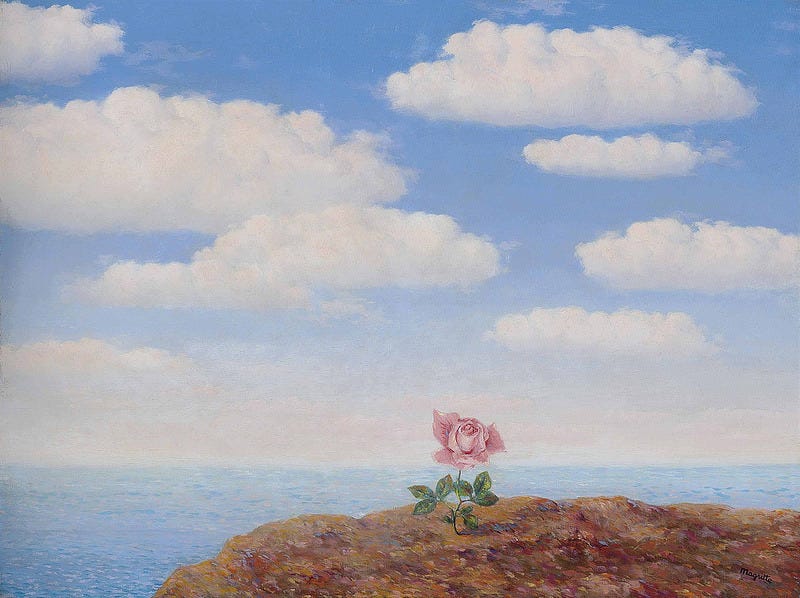
BURSTA man recovering his sight lives by the sea, and in his blindness his dreams become more vivid than reality. In his mind’s eye, he visits a mysterious coast where he scales a blue cliff to find a cave—and inside, a sorceress.
One day, while his bandages are being changed, light strikes his eyes and he realizes his sight is returning, and that his inner vision is burning away. When he can see again, the dreams vanish, and he never visits the sorceress again.
With great despair, he destroys his eyes to return to his desire. In cries of pain and triumph, he stands on the bank as bright carmine covers his cheeks and hands in blissful mortification.
Blind once again, he sees once again.
Eyes have two meanings: to look, and to see. Looking is the act of paying attention. Seeing is the embodiment of understanding: it’s what we mean when we say “I see what you mean”; it’s the vision a founder has for their company; it’s MLK Jr.’s dream. People take a (seemingly blind) leap of faith and act on their visions all the time: the college dropout goes all-in on a startup idea; the small town singer moves to Santa Monica to chase a dream; the MIT-educated neurosurgeon quits his job to trek the mountains. Pascal had one mystical vision and became a believer overnight. Whenever people describe these decisions as irrational, I think they’re forgetting that rationality is not the root lever of decision-making:
Reason is itself a matter of faith. It is an act of faith to assert that our thoughts have any relation to reality at all.
—G. K. Chesterton
The truest driver of a decision is not whether it makes sense but whether it makes you more: more awake, more free, more alive, as if a magnetic pole has been planted somewhere in the earth just to make your heart expand the closer you are to it.
I am an appetite, a will, a wanting machine with my heart dialled permanently, restlessly, and ungovernably toward metamorphosis, and will detour off sensible roads out of a deep faithfulness to the potential I know I have in me, to the self I know can be born if I gave it a chance. The diplomat forfeits his career to write freely in exile; the stockbroker gives up a comfortable life to be a painter; priests and nuns leave their institution for marriage. To be alive is to live wanting something, and it’s an idea I love so much that I wrote a book about it:
Phantom heart syndrome
When a body loses a limb, the nerves often retain the sensation of that limb still being there. I think the heart is no exception to this phenomenon: Desire signals that there is something out there that makes it complete. Like how thirst alone proves that water exists, the shape of what is absent tells you what you were made to seek.
The point of desire isn’t about obtaining or achieving something: if we were satisfied once we bought what we wanted, we would never catch ourselves overspending. The point of desire is in its direction and momentum: it’s as if every cell in your body eavesdropped on what you know you want, and that act of desiring itself changes you.
Think of what happens when you have a crush: suddenly, they become a source of motivation and everything you do is oriented toward becoming a better version of yourself in a way so that you might get their attention, impress them, and become someone they would want to be with. My friend has mused about this, about how crushes can be misplaced ambition, representing things you want to see yourself becoming.
Every great desire wakes you up to how embarrassingly far away you are from it and triggers an urgent need to move closer. The word desire comes from the Latin de sidere—to be far from the stars. We change in the direction of what we worship, and we do all things in service of it. To worship something (worth-ship, Old English) literally means to be in a state of worthiness of that thing: Every desire is a desire for being; not to have something, but to become someone.
So, what are we pursuing? What are we making ourselves worthy of and worthy for?
Country roads, take me home
I think if an apocalypse reset civilization, the first thing we’d reinvent (rediscover?) is the concept of heaven. An idea of an ultimate home, that there is something somewhere over there, and we are not there yet, but we will get there someday. Everyone feels a bittersweet pang when Take Me Home, Country Roads starts playing—people gather to chant for home (…To the place I belong…), momentarily turning back into tribal creatures around a fire, seized in joy by that primal, irrational, transcendental urge to do things like climb into dangerous caves just to leave handprints on the wall. Everything we do is, by proxy, to create an image of heaven, a little taste of Home. Our phantom heart syndrome calls us to move closer, and closer, and closer… Almost heaven, West Virginia….
That song has the power to reveal our nature as worshipping beings: we always have an ultimate object of desire, something like an ultimate crush, something that makes all we do justifiable in the very end. All walks of life happen on country roads that lead to the same place—like what psychoanalysts say about the sex drive, I think we have a heaven drive, a libido that insists on moving toward wholeness, toward what tries to satisfy the phantom sensation.
So when we feel great boredom, it’s because (quoting C. S. Lewis) our desires are not too strong, but too weak: “We are half-hearted creatures, fooling about with drink and sex and ambition when infinite joy is offered us, like an ignorant child who wants to go on making mud pies in a slum because he cannot imagine what is meant by the offer of a holiday at the sea.” We are nihilistic when “we are far too easily pleased.” The opposite of that—feeling rich in purpose—is wanting more, aiming for heaven and nothing less.
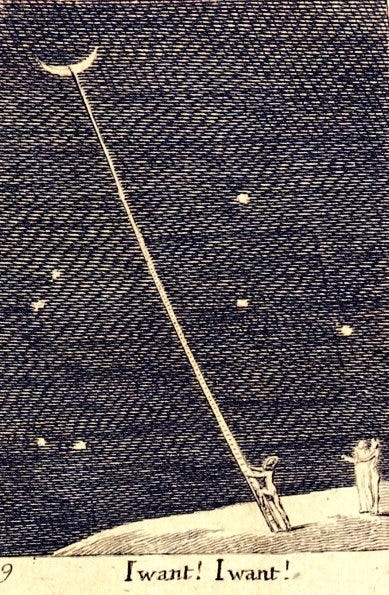
I recently read ’s Mating in Captivity, a book about how desire is the thing that doesn’t resolve, that it’s “being in the space between the self and the other.” We feel the most alive when we’re sitting on the edge of the known world, feet dangling above the abyss, while gazing into the unknown with hearts reaching for the stars. And we miss out on the glorious country roads that take us home when we treat wanting as waiting…. waiting for aliveness to happen to us when coming alive depends on us making that leap of faith into the portal of infinite otherness.
Posts that inspired this one!
Hungry for it, by
Method acting, by
Being Alive, by
Erotic Decisions, by
The Gioconda of the Twilight Noon, short story by J. G. Ballard
~
