 BURST
BURSTToday was a good day for the anti-monopoly movement, and Hollywood artists.
On Friday, lead litigator James Weingarten, representing 12 state attorneys general, argued with Paramount’s legal counsel Jeff Kessler over the company’s proposed merger with Warner. It was the first of many scuffles to come, and would give us our first indication of how the judge - Araceli Martínez-Olguín - thinks about the merger. The specific topic was whether Paramount would be allowed to merge immediately with Warner while the merger trial was ongoing, or whether the judge would keep the companies separate.
Today, we learned our answer. Judge Martínez-Olguín issued a temporary restraining order (TRO) preventing Paramount and Warner from merging for 14 days. The two companies, she wrote, “will continue to operate as separate, viable companies competing in the marketplace while they wait for the Court to adjudicate this case.” While the practical effect is minor, the ruling is a setback for Paramount.
On Wall Street, the conventional wisdom has moved from “this merger’s going through easily” to “this merger may get stopped.” And that’s a big problem for the people behind the deal, the billionaire founder of Oracle, Larry Ellison, and his son David, who are close with Trump. In February, as part of mitigating risk to the Warner shareholders for agreeing to their bid over the one proffered by Netflix, the Ellisons agreed to pay a $7 billion break-up fee to Warner if the deal gets rejected.
But that’s not all.
They also set a harsh deadline for themselves; every day the deal doesn’t close after September 30th, Paramount has to pay $7 million to Warner shareholders, a ‘ticking fee.’ The Ellisons agreed to these aggressive terms because they thought there was no chance the deal would get blocked, since they were allies with the Trump administration. They didn’t anticipate that various state-level enforcers would band together and challenge the deal. Yet that’s exactly what happened, as last Monday, California’s Rob Bonta led 12 states in opposing the deal, followed by the Writers Guilds doing so as well in a private lawsuit.
Normally, merging parties, when faced with a state challenge, agree not to close their deal until the investigation and trial are over, which usually takes eight to eighteen months. There are fights over scheduling, perhaps tough negotiations, but they don’t tend to combine lines of business, pay off shareholders and executives, and start layoffs without legal clearance. But Paramount’s general counsel, Makan Delrahim, a close Trump advisor and his antitrust chief in the first term, is wildly aggressive. So he refused to give any time to the states, in order to avoid having to pay the ticking fee.
The result was that the states were forced to go to a judge and ask for the restraining order, to stop the closing. Had the judge rejected the request for a TRO, the case would be over. But she didn’t, and handed a defeat to Paramount. We can actually calculate precisely how much of a defeat - here’s a chart of Warner’s stock today.
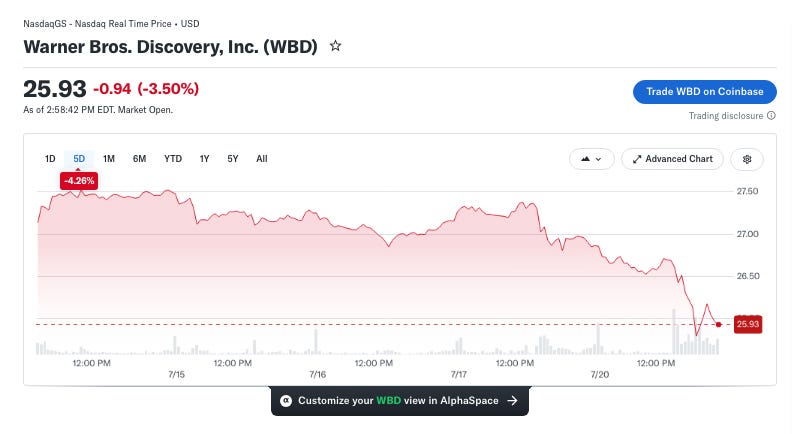
Paramount has bid $31 a share, which means that if you are confident that the merger will close, then the price should be around $31. The more of a difference between the purchase price and the actual price, the higher the ‘spread,’ or the risk the market observes that the deal won’t close.
Today, Warner fell by roughly 3.5%. That means the specialist segment of speculators - known as arbitrageurs - are less confident the deal will close than they were before this TRO ruling. If it were a major loss, you’d see a drop of much more than just 3.5%, so it’s not the end of the fight for Paramount. But it’s not good for them.
Why is that? Well, the states met the standard for a TRO, which means their case is now quite credible. There are four prongs you have to meet to get such an order, which are known as ‘Winter factors,’ after the case Winter v. NRDC
The first is a likelihood of success on the merits. That means the judge has to think the plaintiff will ultimately win. And here, she did a mini-antitrust trial based on some briefings and one hearing, and said, yup eyeballing this one, it’s an illegal deal. Here’s what she wrote:
“Plaintiffs present compelling evidence that the combined firm resulting from the transaction will possess substantial market share in the wide-release theatrical distribution market. (anticipating 27% market share for wide-release theatrical distribution market). On this combined firm market share alone, the Court is persuaded that it can presume the proposed merger is likely to violate antitrust laws.”
Not a great sign for Paramount.
Second, the states have to show irreparable harm if the transaction closes. The judge said, yup, they’ll start layoffs and reducing competition immediately, so this one’s satisfied too. Third, the states have to show that it would be worse for the public than the merging parties in what’s called a ‘balance of equities’ test. And here, Paramount is trying to say that the fact they must pay more the longer the merger is delayed should weigh on the court. The judge said that costs to the public “receive far greater weight” in her analysis. The last factor is that the TRO has to be good for society, and the judge said that the plaintiffs demonstrated they brought “suit to enforce important public interests.”
So what happens now? Well, the order issued by the judge lasts for fourteen days. At that point, she can extend it for another few weeks. But ultimately, she will have to let the merger close, or issue a slightly different order, what’s known as a preliminary injunction. And that one, if she issues it, will last until the trial, which would, if it were a normal merger trial, take place in 2027. The judge gave out a schedule, saying that there will be a hearing on August 3rd on whether she’ll issue the injunction.
The silver lining for Paramount is that they will have this hearing before their self-imposed September 30th deadline, meaning if the judge denies a PI they get to close before costs escalate. That’s not insignificant, but there won’t be that much more evidence available for her in a few weeks, so it’s hard to see a different outcome.
Ultimately, what has happened is that Paramount’s aggressive strategy seems to have backfired. Rather than taking the time to put together a comprehensive argument at trial, Delrahim forced the judge to do a snap judgment. And typically, big mergers look self-evidently bad, and the defense has to make the case for why they aren’t. In this instance, Paramount never gave itself the chance to do that.
This situation is similar to the Nexstar-TEGNA merger over local media, where the judge ruled for the TRO, then for the PI, and now it’s on appeal to the Ninth Circuit. This one could be on a similar track, except with a $7 million a day ticking fee owed by Paramount to Warner shareholders starting on September 30th. The Ellisons are threatening to appeal a preliminary injunction all the way to the Supreme Court, which I suppose is possible, but also very expensive.
There’s still a lot of litigating to go, but Paramount leaders are very unhappy right now. And a lot of people in Hollywood are breathing a quiet sigh of relief, as the doomsday for the industry gets delayed, hopefully permanently, but at the very least, for now.