 BURST
BURST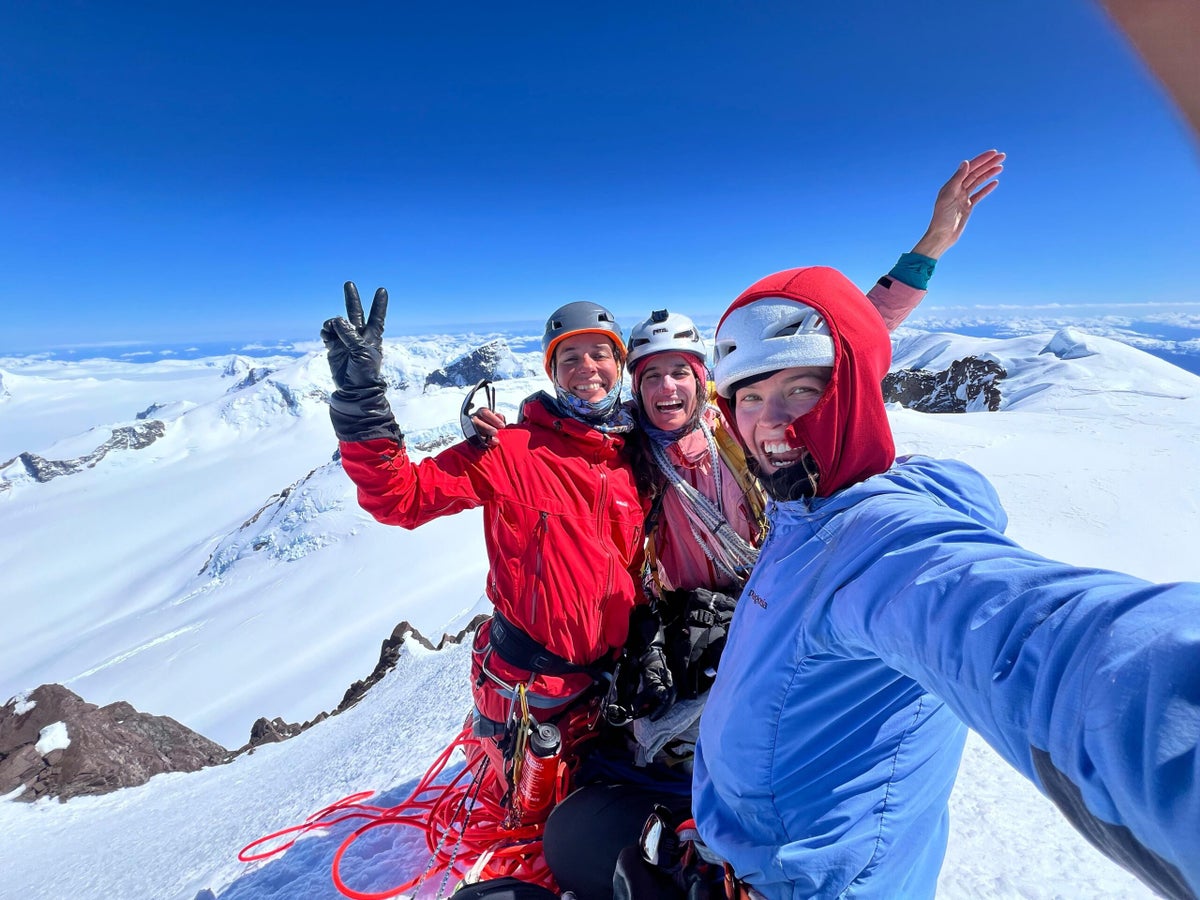
There is no convenient or welcomed time to core shot your rope, but on the very first pitch of a remote alpine face that took three days to reach—during a weather window so stable and rare you can scarcely believe it’s real—is perhaps one of the worst. But that’s exactly the situation Paloma Farkas, Catalina Unwin, and Angelina Di Prinzio found themselves in, painfully close to starting up Cerro Steffen, having their dreams momentarily come crashing down.
The team, all mountain guides, quickly assessed the situation. Di Prinzio was halfway up an extremely loose pitch of volcanic mixed terrain, having just sent down a volley of rocks. Unwin and Farkas were huddled below. None were injured, though Farkas had taken a rock to the head. They were clipped to the West Face of Cerro Steffen (3,300m), in one of the most remote corners of the Patagonian Andes, about to embark on the biggest adventure of their lives. And now one of their two skinny ropes was busted at the middle mark.
***
The idea to climb Cerro Steffen was prompted by a grant. Grit & Rock funds female expeditions around the world, and Farkas, Unwin, and Di Prinzio had all been independently searching for a team of likeminded women to experience a big trip with. While they had never climbed together as a team of three, they knew each other well and bet on a good feeling. After consulting with Rolando Garibotti, a Patagonian climbing expert and historian, they settled on Cerro Steffen’s unclimbed 900-meter West Face. Despite a number of attempts, this mountain had not been climbed since 1965, and is not visible from any town, road, or trail.
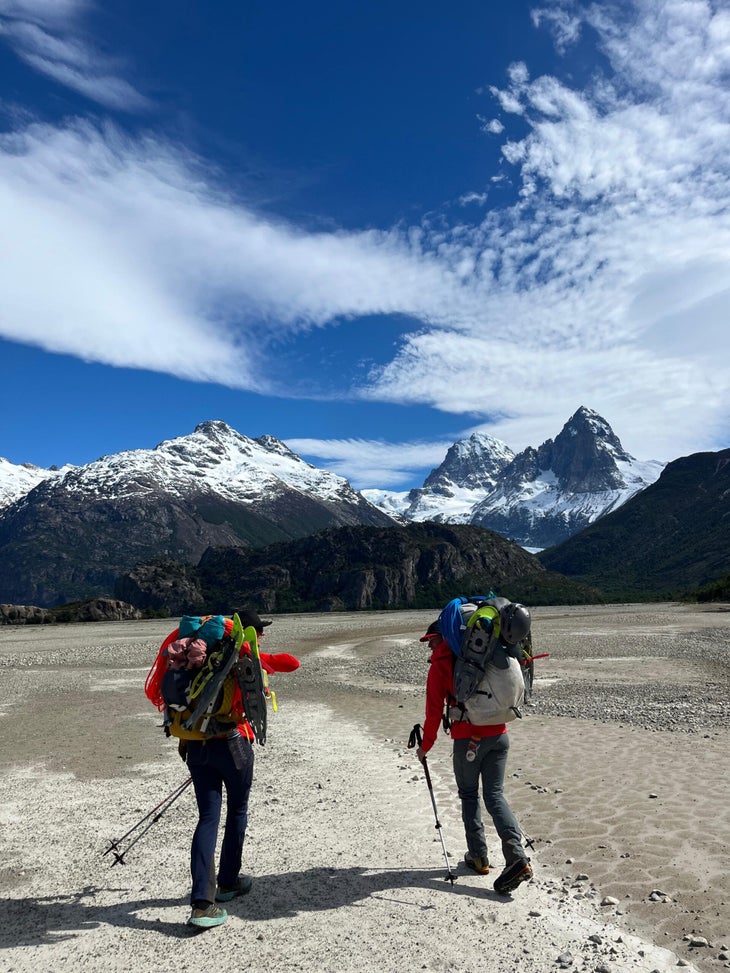
In fact, just getting to Steffen is a full value adventure. Take Chile’s famous Southern Highway (Ruta 7) to its end. Hire a boat in Villa O’Higgins. Then hold on to your hat for a choppy, 85-kilometer water crossing that can take a couple hours to all day, depending on your boat, the weather, and if the icebergs play nice. (Lago O’Higgins is technically a lake, but it’s also 836 meters deep, and Farkas said boat captains require a “weather window” just to get near Steffen.) Once off the boat, begin 22 kilometers of blue collar trekking. Don’t bother with the glacier; it’s broken and reactive. Instead, test out the lateral moraine on its edge—it’s also broken and reactive, but at least there are no crevasses. Two-and-a-half days later, if you’re lucky, you’ll crest around the mountain and see the face you’ve been dreaming about for the very first time. Then you might destroy your rope.
***
“We started early in the morning,” Farkas said, “crossed a zone with serac hazard while the day was still cold, crossed the bergschrund, then began simul-climbing up a 60-degree couloir, which, somehow, had big crevasses.” After their rope became coreshot on the first pitch, the team decided they could reasonably continue with some jury-rigging, and their upward momentum continued. The mountain’s topography unfolded in front of them. Since they had approached from the south, the West Face never came into view until they were already strapped to it. Even so, their couloir remained technical but never desperate; each member dutifully stepped up to her lead block and pushed the rope ever higher into unknown terrain.
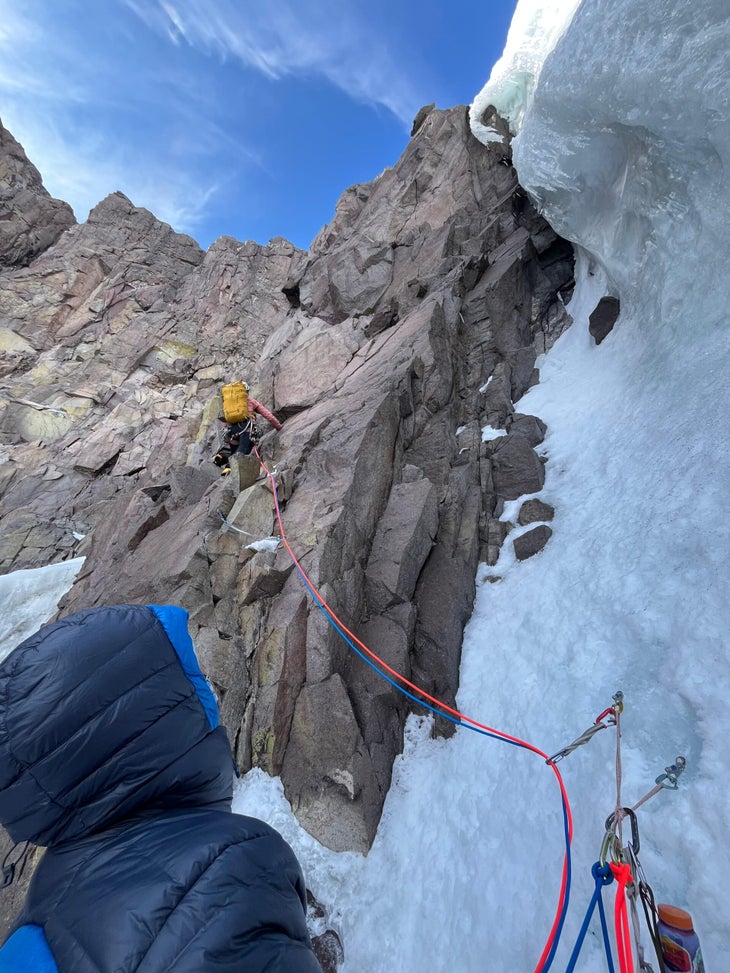
“We carried a tent with us because we wanted to spend one night on the wall,” Unwin said. “And we thought, ‘Obviously—obviously—on a 900-meter face there will be many good places to pitch our tent.’”
No such luck.
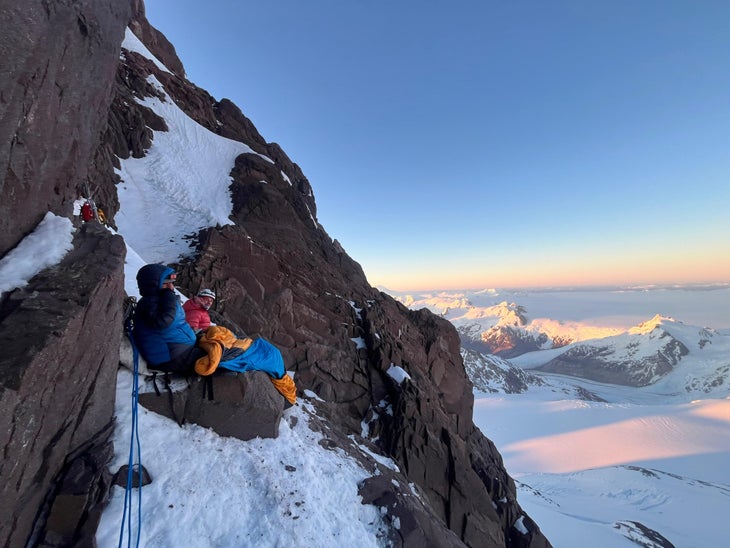
A midheight “snowfield” turned out to be 60 degrees of ancient glacial ice. Chopping a tent platform would have taken the better part of a night. As the sun set behind them, the team continued climbing, still searching in vain for a suitable ledge. Eventually they settled on a miserable little shelf that allowed them to squeeze—seated upright—side by side. “It was a rough night,” Farkas said. “The three of us were hanging from a rock anchor the whole night, our feet in sleeping bags and the tent body wrapped around our legs.” They clipped everything in to stop it from falling down the mountain.
Farkas said their only hope was “making it to morning so we could drink mate,” a caffeine-laced herbal drink sure to spike their spirits. “During the night we didn’t really talk about bailing, but I think that was the assumption after such a brutal night. But in the morning the vibe shifted, we got the mate going, and we also received an inReach message from a friend who said we might just be 80 meters below the summit—not 200 as we’d thought. We looked at each other and decided we might as well go climbing for a couple of hours and see if we could make it to the summit.”
Above, Cerro Steffen appeared to loosen its grip. Mixed pitches flew by with no further core shots, and a scary snow mushroom, looming above them like a menacing wave, offered an unlikely passage around it. Unwin led a final ice pitch to the summit ridge, and by 10 a.m. they were standing on Steffen’s calm, windless summit, registering what their team had just done.
***
Looking back at this ascent, Di Prinzio said part of what made this trip so special was that it helped her dream big. “Climbing with the girls, I could really see my potential; what I really can do. Sometimes, climbing with […] guys, they will assume they’ll lead the hardest pitch…. But here, it felt so much more natural. Someone wanted a hard pitch, they didn’t even have to fight for it. They just went for it. And you think ‘Oh my gosh, I’m actually doing it!’”
As a result, the team decided on the route name Sincronía, or Synchrony. “Everything felt so synchronized,” Unwin says, “and came together in such a magical way.”
The team would like to thank the Grit & Rock Expedition Award and NOLS Rothberg-Birdwhistell Exploration Fund for helping fund this expedition.
The post Major New Face Climbed in a Remote Corner of Patagonia appeared first on Climbing.