 BURST
BURSTLast September, late night talk show host Jimmy Kimmel was temporarily kicked off the air by Disney/ABC for making a joke about Donald Trump in the wake of the Charlie Kirk assassination. At the time, I described our concentrated communications system as a ‘censorship machine,’ because the fewer channels for speech, the easier it is to control content. Our broadcast systems have become very consolidated, and the political attack on Kimmel showed that.
Two powerful broadcasters, Nexstar and TEGNA, were at the center of the Kimmel saga. Neither is a household name, but at the time, they were seeking to merge in a highly controversial $6.2 billion deal. In order to get favorable treatment from the Trump administration for that combination, they allegedly helped to punish Kimmel.
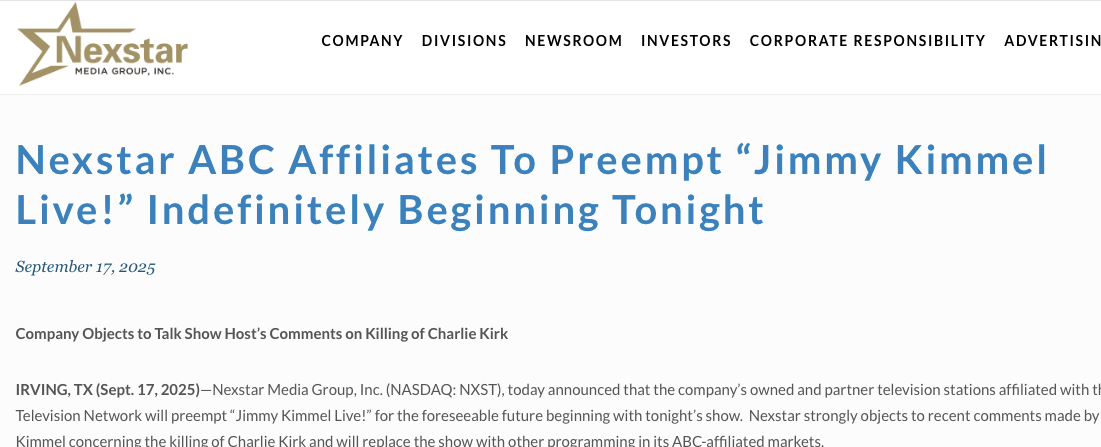
That said, it seemed to conclude with a reasonable ending - the backlash to Disney/ABC was so significant that Kimmel got his show back. You might think that would be the end of the saga. But it’s not.
Today, in an unusual assertion of state law enforcement against corporate power, eight state attorneys general, led by California AG Rob Bonta sued to block the Nexstar/TEGNA merger.
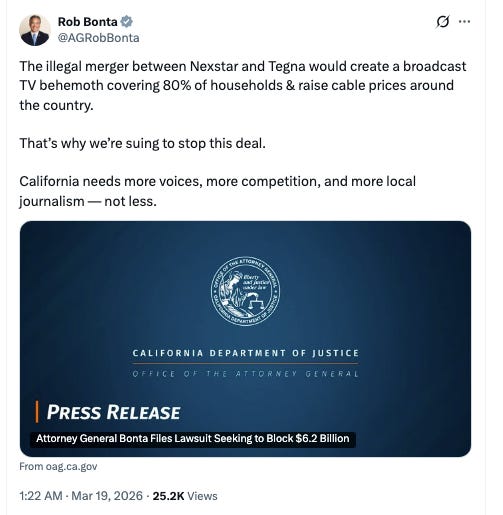
This litigation is central to the question of who gets to speak in America, and who gets to be heard, because it is about taking apart the censorship machine built over decades of media consolidation.
To understand why, we have to start with the media rules that give Nexstar and TEGNA the power to pull someone like Kimmel off the air. Since the 1930s, American broadcasting systems have been decentralized. While national channels existed to create content of interest to the whole country, policymakers wanted to ensure that broadcasting stayed under local control. So they organized a system into national channels, each of whom had a network of territorial broadcast affiliates that can create their own more localized content. So for instance, Disney owns ABC and offers a bunch of programming, like late night shows and sports, but then there are local affiliates, your KXTV local ABC channel in Sacramento for instance, that take that programming, and have their own local news, weather, traffic, syndicated shows, and so forth.
We all know the national guys, ABC, CBS, Fox, and NBC, which are each part of larger conglomerates. But over time, the local broadcasters have also been consolidated, as the Federal Communications Commission lifted rules capping ownership levels. Enter Nexstar and TEGNA, which are holding companies that own large swaths of our local affiliates. Over the past few decades, these guys have acquired their way to dominance in a particularly important niche area - broadcast TV. (Nexstar tangled with Federal antitrust enforcers over multiple mergers in the last fifteen years.)
And lest you think broadcast TV is some ancient dying realm, think again. Streaming has picked up a lot of customers, but most streamers, and in fact all cable-TV style systems, have to buy from broadcast TV. Indeed, the state complaint follows a similar lawsuit yesterday by DirecTV against the same deal, because DirecTV is a big buyer of local affiliate TV content.
So local broadcast are still where the viewers are. As Nexstar noted, “Big 4 broadcast networks carry the nation’s most- watched programming by a significant margin (including the substantial majority of [NFL] games).” When combined, Tegna and Nexstar would own quite a lot - 265 television stations in 44 states, reaching 80% of households.
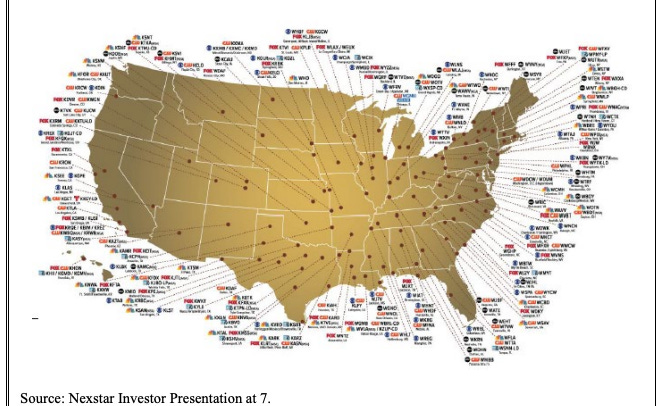
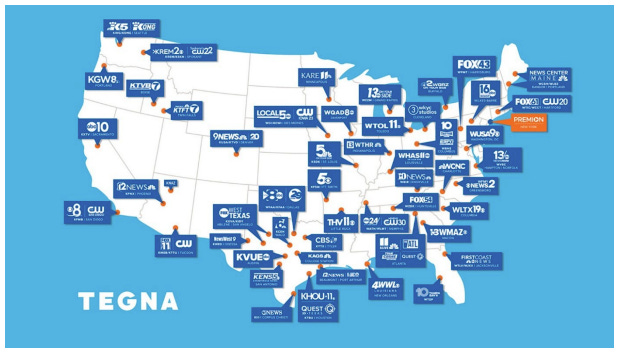
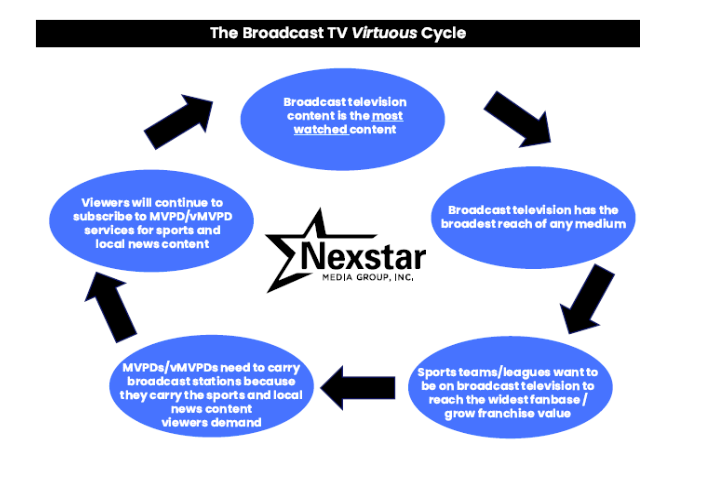
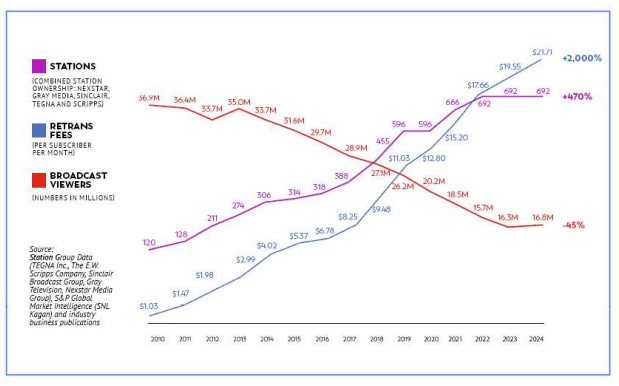
These companies use their market power in a number of ways. The first is simple. Higher prices. Pay-TV providers that have a bundle of channels must pay what are known as retransmission consent fees to the local broadcast affiliates to use their content. They then pass those fees on to the end consumer, who sees it in a higher bill from Hulu or Xfinity or whatever their service is. Here’s a graphic from a Nextstar’s investor document making the point.
These retransmission consent fees have gone way up. According to DirecTV’s complaint, retransmission consent fees have increased from $1.04 per subscriber in 2010 to $23.21 per subscriber in 2025, a jump of 2000%. And this growth went hand-in-hand with consolidation. When Nexstar bought rivals, it increased prices.
You might think that you can avoid local affiliates by watching streaming services, or pay-TV systems like cable or satellite. For streaming services like HBO Max, Disney+ or Netflix, which don’t have local sports or broadcast, that’s true. But most people still want to get local news and sports, a bundle of channels, so streaming on demand services without live content aren’t real substitutes.
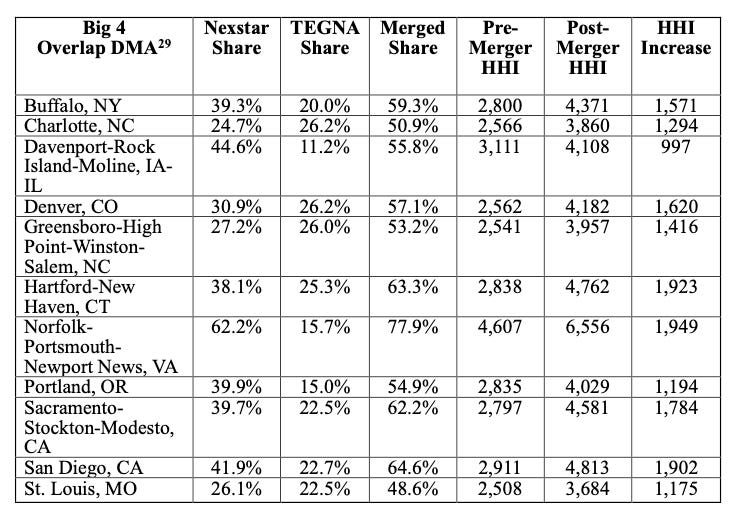
To really understand how much market power Nexstar will gain, you have to look at local market shares. To sell into an area and use broadcast content, you have to license from the local affiliates. And here are the market shares of revenue in certain local areas for the combined company, between 50-70% across a host of cities.
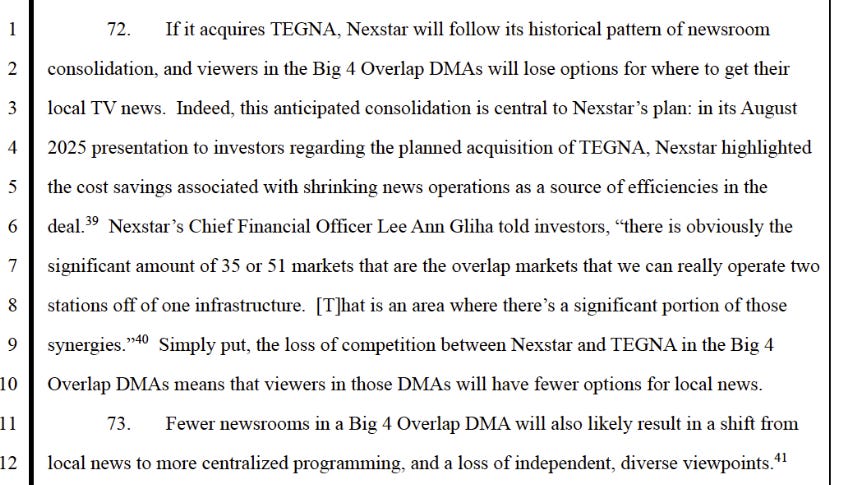
The second way these guys exploit their power is by killing the local news to reduce their costs. When they own a few stations in a market, like Nexstar in Indianapolis, they consolidate the news programming under one roof, laying off entire news divisions. It has already done so in 14 different markets, and their execs are bragging to investors that this deal will enable them to do it in 31 additional markets. There aren’t that many local news outlets anymore, so it’s a meaningful problem. And most areas have just a few local news broadcasts, which means losing local news capacity actually harms competition in the form of lost viewpoint diversity.
The final mechanism to exploit their market power is about politics. I already noted that last year, these companies allegedly sought to have ABC comedian Jimmy Kimmel kicked off the air to gain political favor with the administration. While it seems like a partisan strategy, it’s not. Many conservatives don’t like this merger, since there are right-wing companies like Newsmax that have to negotiate with local affiliates for distribution.
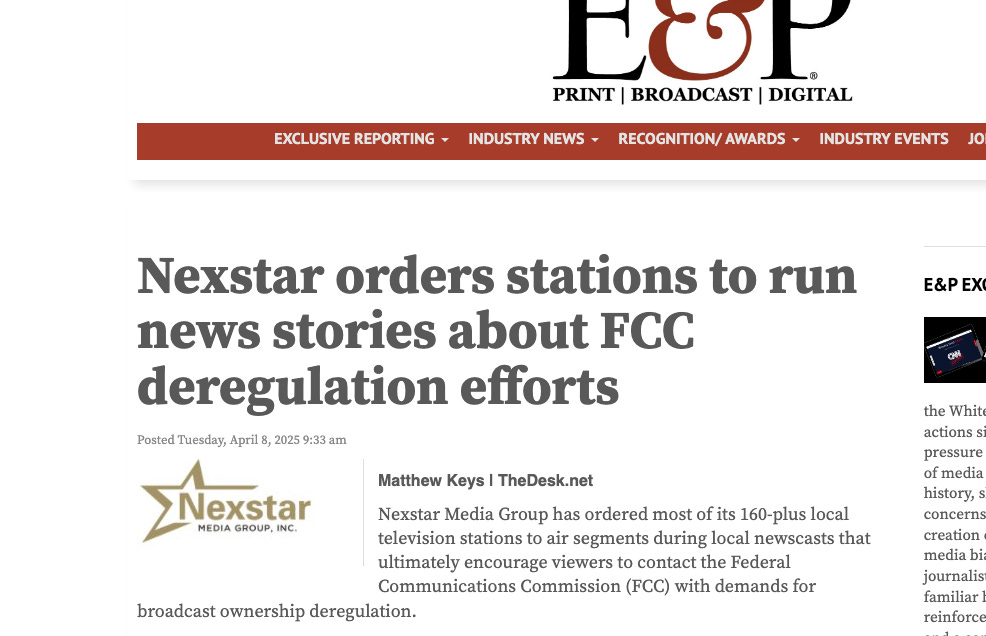
Indeed, the Kimmel choice is consistent, not with partisan favoritism, but promoting political views that foster more market power for these holding companies. For instance, in April of last year, Nexstar ordered local news across its 160 stations to air stories promoting local cable deregulation.
And Nexstar’s political agenda has been successful in terms of bringing along the Trump administration. In February, Trump said he supported the merger.
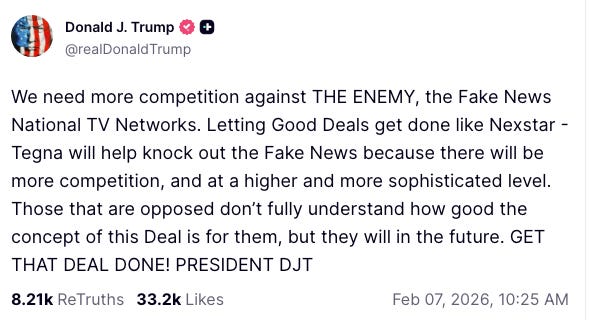
His Federal Communications Commission Chair, Brendan Carr, then greenlit the deal, and there’s little chance the Federal Antitrust Division does anything. Carr also has to change media ownership rules to allow a broadcast media company to reach more than 39% of the American public, which he is in the process of doing.
Having state officials openly fight the Federal government over something like broadcast TV is highly unusual, to say the least. It’s not surprising that of the eight states - California, Colorado, Connecticut, Illinois, New York, North Carolina, Oregon, and Virginia - are helmed by Democratic attorneys general. It’s a good case, but not an ironclad one.
Nexstar and TEGNA will make a number of arguments. They will say that the market is not local broadcast retransmission fees, but a more expansive media universe, including websites, on-demand streaming services, and apps. They will point to the increasing prevalence of sports programming going onto streamers directly, ESPN Plus, Amazon Prime, and so forth. They will also point out that government experts at the FCC and Antitrust Division cleared the deal, so why would the states know any better?
The break-up fee if the deal doesn’t go through is just $125 million, so Nexstar and TEGNA were confident when they signed the deal. My guess is that figure would be higher if TEGNA execs had realized that state officials were serious about challenging the administration.
What Now?
What’s happening more broadly is that the states have stepped up in a big way as the Trump administration stepped back. Today, for instance, the CEO of Live Nation, Michael Rapino, is on the stand in an antitrust trial in New York. That case is also led by the states, after the Federal government dropped out. Bonta, among other enforcers are, also investigating the Paramount-Warner merger deal.
This trend goes beyond merger law. Arizona state attorney general Kris Mayes just filed criminal charges against prediction market firm Kalshi for operating illegal casinos. These law enforcers can’t fill the entire gap left by the Trump administration, but they can fill some of it. And it feels different than the first term of Trump, where corporate power wasn’t really a fault line in political conflict.
As these enforcers gain the muscle memory to challenge corporate power, they aren’t going to forget it. Now the question is how far the public and political leaders will go in terms of understanding our power to take apart the rest of the censorship machine.
Thanks for reading! Your tips make this newsletter what it is, so please send me tips on weird monopolies, stories I’ve missed, or other thoughts. And if you liked this issue of BIG, you can sign up here for more issues, a newsletter on how to restore fair commerce, innovation, and democracy. Consider becoming a paying subscriber to support this work, or if you are a paying subscriber, giving a gift subscription to a friend, colleague, or family member. If you really liked it, read my book, Goliath: The 100-Year War Between Monopoly Power and Democracy.
cheers,
Matt Stoller